


Overview
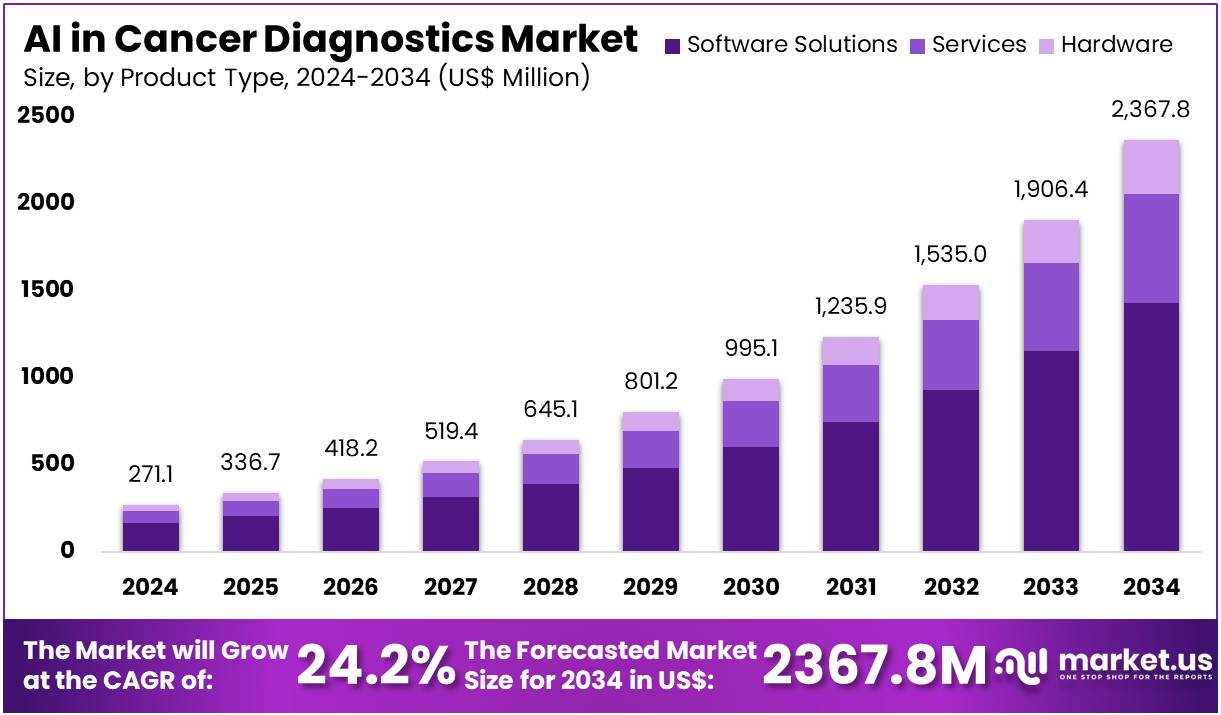
New York, NY – July 10, 2026 – The AI in Cancer Diagnostics Market size is expected to be worth around US$ 2,367.8 million by 2034 from US$ 271.1 million in 2024, growing at a CAGR of 24.2% during the forecast period 2025 to 2034.
Artificial intelligence (AI) is becoming an important tool in cancer diagnostics by helping healthcare professionals detect cancer earlier and more accurately. AI systems can analyze large amounts of medical data, including imaging scans, pathology slides, and patient records, to identify patterns that may indicate the presence of cancer.
In medical imaging, AI algorithms can assist radiologists by highlighting suspicious areas in X-rays, CT scans, MRI scans, and mammograms. This support can improve the speed and consistency of cancer detection, especially in cases where subtle abnormalities may be difficult to identify with the human eye alone.
AI is also being used in pathology, where it can analyze digital biopsy images to help pathologists identify cancer cells and classify tumor types. These capabilities can contribute to more precise diagnoses and support treatment planning tailored to individual patients.
While AI is not intended to replace medical professionals, it serves as a valuable decision-support tool. By reducing the risk of diagnostic errors and improving workflow efficiency, AI has the potential to enhance patient care and outcomes.
As research and technology continue to advance, AI is expected to play an increasingly significant role in cancer diagnostics, supporting earlier intervention and more personalized healthcare solutions worldwide.
Key Takeaways
- In 2024, the AI in cancer diagnostics market generated revenue of US$ 271.1 million and is projected to reach US$ 2,367.8 million by 2034, growing at a CAGR of 24.2%.
- By product type, the market is segmented into software solutions, services, and hardware. Software solutions led the market in 2023, accounting for 60.4% of the total share.
- Based on application, the market is categorized into breast cancer, brain tumor, colorectal cancer, lung cancer, and other applications. Among these, breast cancer held the largest share at 35.0%.
- By end user, the market is divided into hospitals, surgical centers & medical institutes, and others. Hospitals represented the leading segment, contributing 52.8% of the total market revenue.
- Regionally, North America dominated the market in 2023, capturing a 48.3% market share.
Regional Analysis
North America held the largest share of the AI in cancer diagnostics market in 2023, accounting for 48.3% of total revenue. The region’s leadership is driven by strong investment in precision medicine, widespread adoption of digital imaging technologies, and the growing need for early and accurate cancer detection. AI-based tools are improving the analysis of mammograms, CT scans, and pathology slides, thereby supporting radiologists and pathologists in making faster and more reliable diagnoses.
A supportive regulatory environment has also contributed to market growth. The U.S. Food and Drug Administration has authorized a rising number of AI/ML-enabled devices for oncology applications, including solutions for breast cancer screening and prostate cancer detection. In addition, major medical technology companies such as Siemens Healthineers are expanding their AI-integrated diagnostic offerings across the region.
The Asia Pacific region is expected to register the fastest CAGR during the forecast period. Growth is supported by the increasing cancer burden, government investments in digital healthcare infrastructure, and a stronger focus on early diagnosis. Countries such as China and Japan are investing in advanced medical technologies and AI integration. Companies such as Philips are also expanding their presence in Asia Pacific, supporting the adoption of AI-enabled diagnostic solutions for improved cancer detection.
Emerging Trends
- Advancement of Biomarker-Driven Detection: Programs such as the NCI’s Early Detection Research Network are accelerating AI-driven molecular biomarker analysis. By processing large biomarker datasets, AI identifies subtle changes linked to early cancer development, enabling non-invasive tests that may detect disease progression before symptoms emerge.
- Growth of AI-Enabled Medical Devices: The FDA’s expanding AI-Enabled Medical Device List demonstrates growing authorization of AI tools for oncology applications. Approved technologies now include digital pathology systems, radiomics platforms, and diagnostic support tools, reflecting increasing regulatory confidence in AI’s clinical safety and effectiveness.
- Establishment of Robust Regulatory Frameworks: In March 2024, the FDA introduced coordinated guidance for evaluating AI and machine learning medical products. The framework emphasizes transparency, ongoing performance monitoring, and predetermined change control, providing developers with clearer regulatory expectations while maintaining strong patient safety standards.
- Integration of Multimodal Data Streams: AI models are increasingly trained using combined imaging, genomic, and electronic health record data. By integrating radiomic features with molecular profiles, these systems improve cancer subtype identification and progression risk prediction, supporting more comprehensive and personalized diagnostic assessments.
- Emphasis on Explainability and Trust: As AI adoption in clinical oncology grows, explainable AI methods are receiving greater attention. These approaches help clinicians understand model decisions by linking outputs to biological or imaging features, thereby improving trust and supporting informed medical decision-making.
Use Cases
- Breast Cancer Screening (Digital Mammography): AI-powered tools such as ProFound AI® V4.0 assist radiologists in detecting soft-tissue densities and microcalcifications during digital breast tomosynthesis exams. Operating alongside physicians in real time, these systems improve lesion detection rates while minimizing additional workflow burden.
- Prostate Cancer Diagnosis (Histopathology): AI-augmented histopathology workflows are being evaluated to reduce dependence on additional staining techniques. Clinical studies are comparing AI-assisted H&E slide analysis with traditional immunohistochemistry, aiming to streamline prostate cancer diagnosis in routine core needle biopsy cases.
- Skin Cancer Detection (Teledermatoscopy): Teledermatology platforms are incorporating AI algorithms to pre-screen dermatoscopic images for melanoma and non-melanoma skin cancers. Clinical trials are assessing AI’s effect on diagnostic accuracy and workflow efficiency, particularly in remote settings with limited dermatology expertise.
- Multi-Cancer CT Screening: AI models are being investigated for detecting lesions across multiple organs, including lung, liver, and gastric tissues, from a single non-contrast CT scan. Automated lesion detection can flag suspicious regions for radiologist review and accelerate follow-up care.
- Colorectal Polyp Detection (Endoscopy): FDA-cleared software such as SKOUT® supports real-time colorectal polyp detection during white-light colonoscopy. By highlighting potential polyps in endoscopic video feeds, these AI tools assist clinicians in identifying subtle mucosal changes and improving adenoma detection rates.
Frequently Asked Questions on AI in Cancer Diagnostics
- How does AI improve cancer diagnosis?
AI improves cancer diagnosis by processing large datasets quickly, recognizing subtle abnormalities, reducing diagnostic variability, and supporting clinicians with evidence-based insights. This capability can improve detection accuracy, accelerate workflows, and assist in identifying cancer at earlier stages. - What AI technologies are commonly used in cancer diagnostics?
Common AI technologies in cancer diagnostics include machine learning, deep learning, computer vision, natural language processing, and predictive analytics. These technologies analyze imaging data, pathology reports, and clinical information to support accurate cancer identification. - Which types of cancer can AI help detect?
AI can assist in detecting several cancer types, including breast, lung, prostate, colorectal, skin, and brain cancers. Its effectiveness depends on the quality of training data, imaging techniques, and integration with clinical diagnostic workflows. - What are the benefits of using AI in cancer diagnostics?
The benefits of AI in cancer diagnostics include improved diagnostic accuracy, faster interpretation of medical data, reduced workload for healthcare professionals, and enhanced early detection capabilities. These advantages can contribute to better treatment planning and patient outcomes. - What is the AI in cancer diagnostics market?
The AI in cancer diagnostics market refers to the commercial ecosystem involving AI-based software, tools, platforms, and services used to support cancer detection, diagnosis, prognosis, and treatment decision-making across healthcare settings. - What factors are driving market growth?
Key factors driving market growth include increasing cancer prevalence, rising demand for early diagnosis, advancements in artificial intelligence technologies, growing adoption of digital pathology, and supportive investments from healthcare providers and technology companies. - Which regions are leading the market?
North America is currently a leading region in the AI in cancer diagnostics market due to advanced healthcare infrastructure, significant research investments, and early adoption of AI technologies. Europe and Asia-Pacific are also experiencing notable growth.
Conclusion
AI is transforming cancer diagnostics by improving the accuracy, speed, and consistency of disease detection across imaging, pathology, and patient data analysis. The market’s projected growth from US$ 271.1 million in 2024 to US$ 2,367.8 million by 2034 highlights rising adoption of AI-driven solutions.
Advancements in biomarker analysis, multimodal data integration, explainable AI, and supportive regulatory frameworks are strengthening clinical confidence in these technologies. AI applications in breast, prostate, skin, colorectal, and multi-cancer detection demonstrate its practical value in enhancing early diagnosis and treatment planning. Overall, AI is expected to play a critical role in enabling more personalized, efficient, and effective cancer care worldwide.
Discuss your needs with our analyst
Please share your requirements with more details so our analyst can check if they can solve your problem(s)




