


Overview
New York, NY – August 20 2026 – The Global India Thyroid Function Test Market Size is expected to be worth around US$ 94.4 million by 2034 from US$ 53.2 million in 2024, growing at a CAGR of 5.9% during the forecast period 2025 to 2034.
The India Thyroid Function Test market is expanding due to the increasing prevalence of thyroid disorders, rising health awareness, and growing adoption of preventive diagnostic screening. Thyroid function tests, including Thyroid Stimulating Hormone (TSH), Free T3, and Free T4 tests, are essential for diagnosing and monitoring hypothyroidism, hyperthyroidism, thyroid nodules, and autoimmune thyroid conditions. India has one of the highest burdens of thyroid disorders globally.
According to clinical studies published by healthcare institutions, approximately 42 million Indians are affected by thyroid diseases, with hypothyroidism accounting for a major share of cases.
The prevalence of hypothyroidism in Indian adults is estimated at around 10.95%, indicating that nearly 1 in every 10 individuals may require thyroid assessment or monitoring. Women represent a significant patient population, with studies showing thyroid disorders are more common among females, especially during pregnancy and middle age.
Research indicates that nearly 1 in 5 pregnant women in India may experience thyroid-related abnormalities, increasing the demand for regular thyroid screening. The growing healthcare infrastructure is supporting market expansion, with India having more than 100,000 diagnostic laboratories and thousands of hospitals and healthcare centers offering pathology testing services.
Increasing use of automated immunoassay platforms, digital reporting systems, and affordable thyroid screening packages is improving accessibility. Government health programs and rising preventive healthcare adoption are encouraging early detection.
With millions of undiagnosed cases, increasing chronic disease monitoring needs, and improved diagnostic availability, the India Thyroid Function Test market is expected to play a crucial role in strengthening endocrine healthcare management.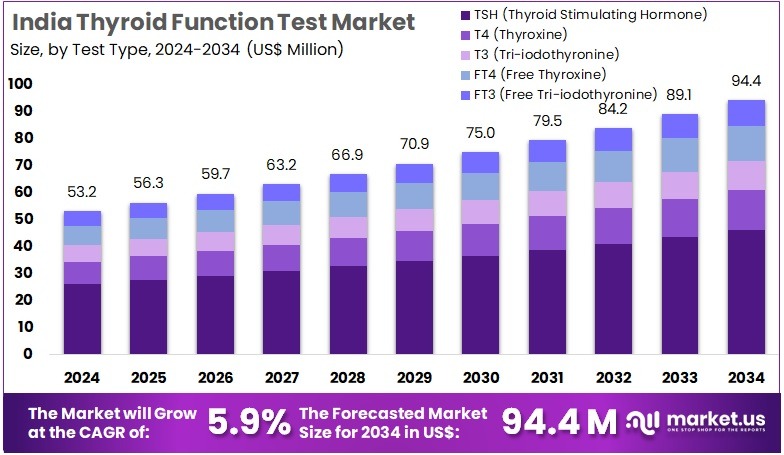
Key Takeaways
- In 2024, the market recorded a revenue of US$ 53.2 million and is projected to grow at a CAGR of 5.9%, reaching approximately US$ 94.4 million by 2034.
- Based on test type, the market is segmented into TSH (Thyroid Stimulating Hormone), T4 (Thyroxine), T3 (Tri-iodothyronine), FT4 (Free Thyroxine), and FT3 (Free Tri-iodothyronine). Among these, TSH testing dominated the market in 2023, accounting for 48.9% of the total market share.
- By end-user, the market is categorized into diagnostic laboratories, clinics, research organizations, and hospitals. Diagnostic laboratories emerged as the leading segment in 2023, capturing a significant market share of 52.3% due to increased thyroid screening and diagnostic testing demand.
Statistical Information
- Growing Global Burden of Thyroid Disorders Driving Testing Demand: Thyroid disorders are increasing the need for regular thyroid function testing, including TSH, T4, and T3 assessments. The American Thyroid Association estimates that around 20 million people in the United States have some form of thyroid disease, while up to 60% of affected individuals remain unaware of their condition, highlighting the importance of diagnostic screening.
- Total Indians affected by thyroid disorders: Epidemiological projections estimate that about 42 million people in India suffer from thyroid disorders. This corresponds to roughly 3% of India’s 2024–2025 population (~1.42 billion), forming the core clinical demand base for thyroid function testing (TSH, T3, T4, FT3, FT4).
- Hypothyroidism prevalence in Indian adults: One large Indian study found an overall hypothyroidism prevalence of 10.95% in adults, 3.47% previously undiagnosed and 7.48% self‑reported. Another study and commentary report 11% hypothyroidism prevalence, with 13.1% in age 46–54 years and 7.5% in age 18–35 years. This “one in ten adults” figure directly translates into high, recurring thyroid test volumes.
- Repeat testing frequencies in Indian clinical practice: Clinical guidance suggests patients on thyroid hormone therapy are tested every 3 months until TSH is normalized, then every 6–12 months. Subclinical hypothyroidism cases are often monitored at 6‑month intervals. If you assume 10–11% adult prevalence and 2–4 thyroid tests per patient per year, you can estimate total annual thyroid test volumes.
- Age and sex distribution of hypothyroidism: Commentary based on Indian workshop data notes 11% hypothyroidism prevalence overall, with 13.1% prevalence in ages 46–54 and 7.5% in ages 18–35. Women are disproportionately affected, and many remain undiagnosed. This age‑and‑gender concentration shapes where thyroid function test demand is highest: middle‑aged urban women.
- NFHS-based growth signal for thyroid test demand: NFHS‑V’s increase in self‑reported thyroid disorders from 2.2% to 2.9% over roughly 5 years suggests an approximate relative increase of ~32% in reported thyroid disease prevalence. Even allowing for reporting bias, this provides a directional indicator of rising diagnostic activity and, by implication, thyroid function test demand in India.
- NFHS change in self‑reported thyroid disorders: Government NFHS data show self‑reported goitre/thyroid disorder in women 15–49 years increased from 2.2% in NFHS‑4 (2015–2016) to 2.7% in NFHS‑5 (2019–2021). In men, it remained 0.5% in both rounds. This is a 23% relative increase among women, signaling rising diagnosis and, by extension, thyroid test utilization.
- State-level variation in thyroid disorder prevalence: The same NFHS‑based annex shows state variations: for women 15–49, self‑reported goitre/thyroid disorder ranges from 0.7% in Arunachal Pradesh to 3.4% in Punjab (NFHS‑4) and 4.1% in Punjab (NFHS‑5). This implies higher thyroid test demand in northern states such as Punjab, Haryana, and Uttarakhand, compared with several northeastern and central states below 2%.
- Overall adult thyroid dysfunction breakdown: A recent synthesis referencing ICMR and National Health Portal data indicates approximate adult Indian prevalence of hypothyroidism ~10.9%, subclinical hypothyroidism ~8–10%, hyperthyroidism 1.3–1.6%, and autoimmune thyroiditis 10–12% among women of reproductive age. These proportions define distinct diagnostic segments for TSH‑focused vs antibody (Anti‑TPO) testing.
Emerging Trends
- Increasing Adoption of Automated Thyroid Testing Platforms: Diagnostic laboratories are increasingly adopting automated immunoassay systems to improve thyroid testing accuracy and speed. The CDC supports thyroid hormone standardization programs to improve measurement accuracy for TSH and free T4 tests, helping laboratories deliver more reliable results for millions of patients requiring thyroid monitoring.
- Growth of Point-of-Care Thyroid Testing Solutions: Point-of-care thyroid diagnostics are becoming more important for faster testing in clinics and healthcare facilities. The first FDA-approved point-of-care TSH test was introduced in 1999, and newer platforms support rapid thyroid assessment using TSH, T3, and T4 measurements.
- Rising Focus on Early Detection and Preventive Screening: Healthcare providers are emphasizing early thyroid diagnosis because untreated thyroid disorders can lead to cardiovascular and metabolic complications. Evidence reviews estimate that around 5% of women and 3% of men in the U.S. have subclinical thyroid dysfunction, increasing the need for effective screening strategies.
- Improvement in Thyroid Test Accuracy Through Standardization: Standardized laboratory testing is emerging as a major trend to reduce variations between diagnostic facilities. The CDC is working with laboratories and manufacturers by providing reference materials for thyroid hormone testing, especially for free thyroxine (fT4) and thyroid-stimulating hormone (TSH) measurement accuracy.
- Increasing Demand for Personalized Thyroid Disease Monitoring: Personalized thyroid care is gaining importance as physicians use repeated TSH, T4, and T3 measurements to adjust treatment plans. Clinical reviews by the American Thyroid Association highlight that thyroid hormone assays remain among the most commonly performed endocrine laboratory investigations worldwide.
Use Cases
- Routine Diagnosis of Hypothyroidism and Hyperthyroidism: Thyroid function tests are widely used to identify abnormal hormone levels associated with underactive or overactive thyroid conditions. Healthcare guidelines recommend serum TSH testing as the primary evaluation method, followed by free T4 or T3 testing when required.
- Pregnancy and Women’s Health Monitoring: Thyroid testing plays an important role in women’s healthcare, particularly during pregnancy, where thyroid hormone imbalance can affect maternal and fetal health. Clinical evidence identifies pregnant women as a high-risk group requiring closer thyroid evaluation and monitoring.
- Chronic Disease Management and Follow-Up Testing: Patients receiving thyroid hormone therapy require regular laboratory monitoring to maintain appropriate hormone levels. TSH and free T4 tests are commonly used by healthcare providers to evaluate treatment response and support long-term disease management.
- Hospital and Diagnostic Laboratory Screening Programs: Hospitals and diagnostic laboratories use thyroid panels for routine health evaluations, endocrine assessments, and symptom-based diagnosis. Large-scale laboratory testing programs benefit from standardized assays that improve consistency across different healthcare facilities.
- Newborn and Early-Life Thyroid Screening: Thyroid testing is also used in newborn screening programs to identify congenital thyroid disorders at an early stage. The American Thyroid Association notes that quantitative TSH testing methods are clinically valuable for newborn thyroid screening due to their accuracy and accessibility.
Frequently Asked Questions on India Thyroid Function Test
- What factors are driving growth of the Thyroid Function Test Market?
The Thyroid Function Test Market is growing due to increasing thyroid disorder prevalence, rising awareness about preventive healthcare, improved diagnostic infrastructure, and adoption of automated laboratory technologies. Growing demand for early diagnosis and regular disease monitoring is also supporting market expansion. - Which segment dominates the Thyroid Function Test Market?
The TSH test segment holds a leading position in the Thyroid Function Test Market because TSH measurement is widely recommended for initial thyroid evaluation. Diagnostic laboratories also represent a major end-user segment due to increasing testing volumes and healthcare screening programs. - How are technological advancements impacting the Thyroid Function Test Market?
Technological advancements are improving thyroid diagnostics through automated immunoassay systems, high-sensitivity testing platforms, and digital laboratory solutions. These innovations provide faster results, improved accuracy, and better patient monitoring, helping healthcare providers manage thyroid-related conditions more effectively. - What are the major applications of Thyroid Function Tests?
Thyroid Function Tests are used for diagnosing hypothyroidism, hyperthyroidism, thyroid inflammation, and autoimmune thyroid diseases. They are also applied in routine health screening, pregnancy monitoring, medication adjustment, and long-term follow-up of patients receiving thyroid hormone therapy. - What is the future outlook of the Thyroid Function Test Market?
The Thyroid Function Test Market is expected to grow with increasing healthcare awareness, rising demand for preventive screening, and improvements in diagnostic technologies. Expansion of laboratory services and adoption of personalized healthcare approaches will further support future market development. - What symptoms may require a Thyroid Function Test?
Symptoms such as unexplained weight changes, fatigue, irregular heartbeat, mood changes, hair loss, and temperature sensitivity may indicate thyroid abnormalities. Healthcare providers recommend thyroid function testing to evaluate hormone levels and determine whether symptoms are linked to thyroid dysfunction. - How often should thyroid function tests be performed?
The frequency of thyroid function testing depends on individual health conditions, age, treatment status, and risk factors. Patients with diagnosed thyroid disorders may require regular monitoring, while others may undergo testing when symptoms or clinical concerns appear. - How is the Thyroid Function Test Market benefiting from healthcare awareness programs?
Healthcare awareness programs are increasing knowledge about thyroid disorders and encouraging early diagnosis. Greater public understanding of symptoms, regular health check-ups, and preventive screening practices are increasing demand for thyroid testing services across hospitals and diagnostic centers.
Conclusion
The India Thyroid Function Test market is witnessing steady growth due to the increasing prevalence of thyroid disorders, rising healthcare awareness, and expanding diagnostic infrastructure. Growing adoption of TSH, T3, and T4 testing, along with advanced automated immunoassay technologies, is improving early diagnosis and patient monitoring.
Diagnostic laboratories and hospitals continue to play a significant role in increasing testing accessibility. The growing focus on preventive healthcare, personalized treatment approaches, and regular thyroid screening is expected to create new opportunities for market development. With millions of individuals requiring thyroid evaluation, thyroid function testing will remain an essential component of endocrine healthcare management.
Discuss your needs with our analyst
Please share your requirements with more details so our analyst can check if they can solve your problem(s)




