


Overview
New York, NY – August 20, 2026 –The Global Suture Needles Market size is expected to be worth around US$ 1,115.0 Million by 2034 from US$ 634.5 Million in 2024, growing at a CAGR of 5.8% during the forecast period from 2025 to 2034. In 2024, North America led the market, achieving over 36.3% share with a revenue of US$ 230.3 Million.
The global suture needles is growing steadily due to the rising volume of surgical procedures, increasing incidence of chronic diseases, and continuous advancements in surgical wound closure technologies. Suture needles are critical medical devices used for tissue approximation and wound repair across general surgery, cardiovascular surgery, orthopedic procedures, ophthalmic surgery, and cosmetic applications.
Globally, approximately 310 million major surgical procedures are performed each year, creating strong demand for reliable and sterile suturing products. The increasing disease burden is a major factor supporting market growth.
Cardiovascular diseases remain the leading cause of mortality, responsible for nearly 17.9 million deaths annually, accounting for about 31% of global deaths. Cancer causes approximately 9.7–10 million deaths each year, resulting in millions of surgical interventions.
According to demographic estimates, the worldwide population aged 65 years and older exceeded 760 million in 2021 and is expected to reach nearly 1.6 billion by 2050, increasing the requirement for surgical treatments.
Technological innovation is transforming suture needle manufacturing, with advanced products featuring laser-cut edges, enhanced coatings, improved tensile strength, and precision-engineered designs. Surgical needle manufacturers are developing specialized products for microsurgery, robotic-assisted surgery, and minimally invasive procedures, where high accuracy and reduced tissue damage are essential. Hospitals account for a major share of suture needle utilization due to the high number of inpatient and outpatient surgeries performed annually.
Healthcare facilities worldwide conduct more than 100 million additional procedures each year requiring wound closure solutions, supporting product adoption. Increasing healthcare expenditure, rising surgical awareness, and demand for infection-control-focused disposable medical devices are expected to drive continued expansion of the suture needles market.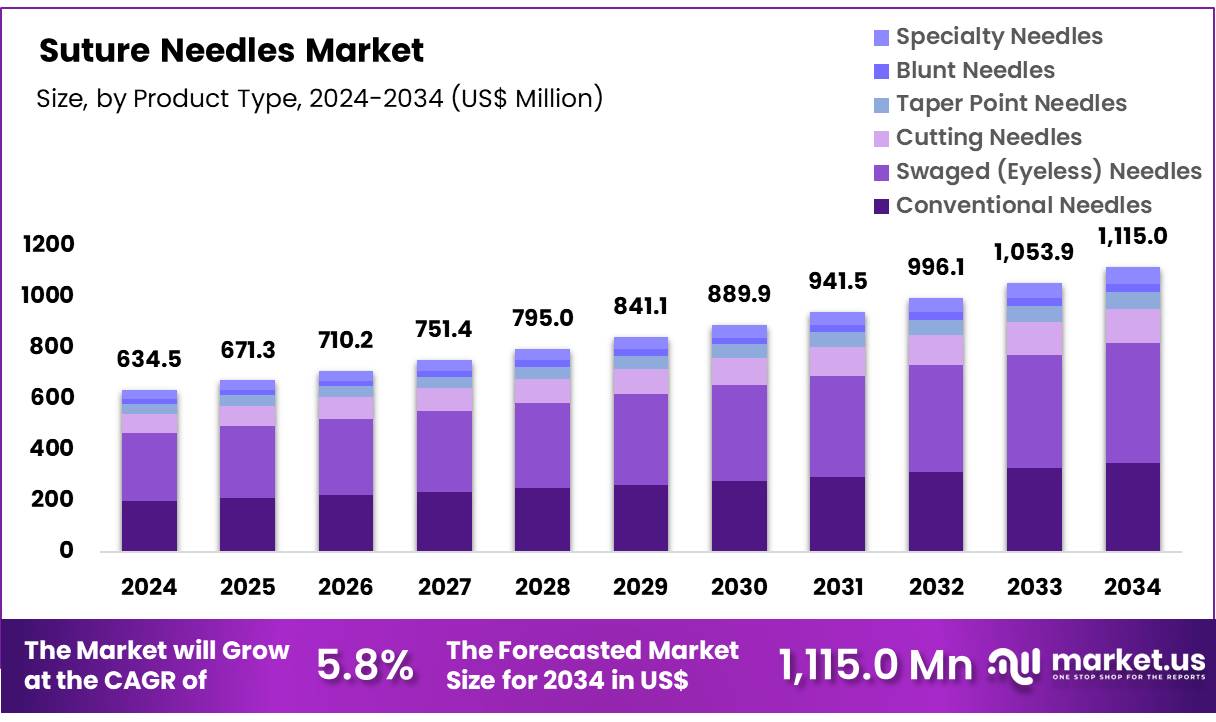
Key Takeaways
- Market Size: The global Suture Needles Market is projected to reach approximately US$ 1,115.0 million by 2034, increasing from US$ 634.5 million in 2024.
- Market Growth: The market is expected to expand at a CAGR of 5.8% during the forecast period from 2025 to 2034, driven by rising surgical procedures and demand for advanced wound closure products.
- Product Type Analysis: Waged (eyeless) needles dominated the market in 2024, accounting for approximately 42.1% of the global market share due to their widespread adoption in surgical applications.
- Material Analysis: Stainless steel suture needles held the leading position in 2024, representing approximately 82.3% of the total market share due to their strength, durability, and corrosion resistance.
- Application Analysis: General surgery emerged as the largest application segment in 2024, capturing approximately 39.6% of the total market share due to the high volume of surgical procedures performed globally.
- Regional Analysis: North America dominated the global suture needles market in 2024, accounting for more than 36.3% share with a market revenue of approximately US$ 230.3 million, supported by advanced healthcare infrastructure and high surgical volumes.
Statistical Information
- Estimated surgical volume per population in India: A surgical care analysis indicates that approximately 3,646 surgeries are performed annually per 100,000 individuals in India, compared with about 5,000 surgeries per 100,000 in some high‑income countries. With India’s population around 1.42 billion, this implies roughly 51–52 million surgical procedures per year, each potentially requiring at least one suture needle.
- Surgical sutures market size as proxy for needle demand: A recent Indian manufacturing and demand article estimates the Indian surgical sutures market at USD 184.73 million in 2024, projected to reach USD 230.01 million by 2029 at a CAGR of 4.55%. Since almost all sutures used in open and minimally invasive surgery are supplied with suture needles or used with needles, this value provides a proxy scale for associated suture needle demand.
- Types of suture needles used in Indian practice: Clinical descriptions note that in India, as elsewhere, surgeons use a range of curved, straight, taper‑point, cutting, reverse‑cutting, and micro‑point needles, tailored to tissue type. Common sizes include 3‑0 (0.2 mm diameter) for medium‑depth suturing and 5‑0 (0.1 mm) for finer skin and vascular work. This mix influences per‑procedure needle counts and segment demand.
- USP sizing and diameters for sutures: USP standards show that suture sizes from 2 (0.5 mm diameter) to 11‑0 (0.01–0.02 mm) correspond to different needle gauges and applications. For example, 4‑0 synthetic absorbable suture has a diameter of 0.15 mm, often paired with cutting or reverse‑cutting needles for skin closure 6‑0 is used for delicate vascular or ophthalmic work. This granularity supports segmenting needle demand by specialty.
- Needle‑stick injury prevalence among Indian healthcare workers: A tertiary care teaching hospital study in South India found 73.7% of healthcare providers had experienced at least one needle‑stick injury (NSI) during their career 48.9% of NSIs occurred in nurses, and 28.7% in doctors. While this includes hypodermic and other needles, it underscores high overall needle usage and drives demand for safer suture needle designs and safety protocols.
- Actual surgical volume vs global benchmark: An LSE/UHC‑based analysis reports that in 2019, India recorded 1,385 surgeries per 100,000 population, far below the global target of 5,000 surgeries per 100,000. Only a few Union Territories met this benchmark. This indicates both current suture needle demand and significant upside as surgical access expands.
- Rural surgical access and unmet need: An analysis of rural surgical volumes found that nationally only 6.81% of the need for major surgical operations was met in rural regions. Rural rates of major operations were 341 per 100,000, while total operations were 1,274 per 100,000. As rural capacity expands, suture needle demand in district and sub‑district hospitals is likely to grow faster than in metros.
- National surgical procedures data from Lancet Commission: Lancet Commission data compiled for India report number of surgical procedures per 100,000 population around 1,385 in 2019, far below the recommended 5,000/100,000 target. For a population of 1.42 billion, 1,385 procedures/100,000 equates to roughly 19.7 million surgeries actually performed, vs 71 million needed a gap that signals future growth in suture needle demand as access proves.
Regional Analysis
North America led the market, achieving over 36.3% share
North America maintained a leading position in the global suture needles market in 2024, supported by advanced healthcare infrastructure, high surgical procedure volumes, and strong adoption of advanced surgical technologies.
The region’s well-established hospital networks, ambulatory surgical centers, and focus on minimally invasive procedures continue to support demand for precision-based wound closure products. The U.S. healthcare system performs millions of surgical procedures annually, contributing to consistent utilization of surgical needles.
Europe represents a significant market, driven by developed healthcare systems, strict surgical safety standards, and increasing focus on infection prevention and quality surgical outcomes. Asia Pacific is expected to witness strong growth due to expanding healthcare investments, rising surgical access, and increasing demand for advanced medical devices.
WHO highlights that improving access to safe and affordable surgery remains a major healthcare priority, particularly in developing regions where millions of additional procedures are needed annually.
Latin America and the Middle East & Africa are gradually expanding due to healthcare infrastructure improvements, increasing medical capacity, and growing access to surgical services. Overall, rising surgical demand, technological innovation, and improved healthcare accessibility are expected to drive global suture needle adoption.
Emerging Trends
- Increasing Adoption of Precision-Engineered Surgical Needles: Suture needle manufacturers are focusing on advanced designs that improve sharpness, tissue penetration, and surgical accuracy. Modern procedures require needles with optimized geometry, coatings, and strength. With global surgical volumes estimated at more than 300 million operations annually, demand for reliable precision closure devices continues to increase across hospitals.
- Growing Use of Suture Needles in Minimally Invasive and Robotic Surgery: Robotic and minimally invasive surgeries are increasing the need for highly precise suturing tools. Robotic platforms require accurate needle handling, controlled movement, and improved visibility during complex procedures. Research in robotic suturing highlights automated needle tracking and handling as important developments for next-generation surgical systems.
- Rising Focus on Surgical Safety and Regulatory Compliance: Healthcare systems are emphasizing safer surgical devices through strict performance standards. The U.S. FDA has established performance criteria for surgical sutures, including requirements related to strength, attachment quality, and safety evaluation. These standards encourage manufacturers to develop higher-quality needles with improved reliability.
- Increasing Demand for Specialty Needles in Complex Procedures: Specialized surgical applications such as cardiovascular, ophthalmic, plastic, and microsurgery procedures are increasing demand for customized needle designs. Fine needles and advanced shapes help surgeons perform delicate tissue repair with minimal damage. With cardiovascular diseases causing approximately 17.9 million deaths annually worldwide, surgical closure requirements continue to expand.
- Shift Toward Improved Needle Materials and Coating Technologies: Surgical needle development is moving toward stronger materials, improved surface finishing, and enhanced coatings to reduce tissue resistance. Stainless steel remains widely used due to durability and corrosion resistance. The FDA classifies sterile stainless steel surgical sutures as Class II medical devices under regulation 878.4495, requiring safety and performance compliance.
Use Cases
- General Surgery and Abdominal Procedures: General surgery remains one of the largest application areas for suture needles, including procedures such as gastrointestinal surgery, hernia repair, and soft tissue closure. Increasing global surgical activity, with hundreds of millions of operations performed annually, continues to support demand for dependable wound closure solutions.
- Cardiovascular and Vascular Surgery Applications: Suture needles play an essential role in cardiovascular procedures where precise tissue handling is required. Heart surgeries, vascular repairs, and bypass procedures depend on specialized needles capable of maintaining closure strength. Cardiovascular diseases account for nearly 17.9 million deaths annually, increasing the need for surgical interventions.
- Ophthalmic and Microsurgery Applications: Fine surgical needles are widely used in ophthalmic and microsurgical procedures requiring high accuracy. Ultra-fine needles allow surgeons to repair delicate tissues with minimal trauma. Increasing demand for cataract procedures and vision-restoring surgeries supports the use of specialized small-diameter needles.
- Plastic, Cosmetic, and Reconstructive Surgery: Plastic and reconstructive surgeries require precision-based suturing for improved aesthetic outcomes and reduced scarring. Advanced cutting and reverse-cutting needles are commonly used for skin closure and soft tissue repair. Increasing reconstructive procedures after trauma, burns, and cancer treatment continues to support usage.
- Training, Simulation, and Surgical Skill Development: Medical education programs increasingly use surgical simulation systems to train surgeons in needle handling and suturing techniques. Simulation-based training helps improve accuracy, reduce errors, and develop skills before performing procedures on patients. Growing emphasis on surgical quality improvement is increasing adoption of structured training methods.
Frequently Asked Questions on Suture Needles
- What factors are driving the growth of the suture needles market?
The suture needles market is growing due to increasing surgical procedures, rising chronic disease cases, aging populations, and demand for advanced wound closure solutions. Growth in minimally invasive surgeries and improvements in healthcare infrastructure are also increasing adoption across hospitals and surgical centers. - Which type of suture needles is commonly used in surgeries?
Commonly used suture needles include curved, straight, taper-point, cutting, reverse-cutting, and micro-point needles. Curved needles are widely preferred for internal tissue closure, while cutting and reverse-cutting needles are mainly used for skin and tougher tissue repair procedures. - Why is stainless steel widely used for manufacturing suture needles?
Stainless steel is preferred for suture needle manufacturing because it provides high strength, corrosion resistance, durability, and compatibility with sterilization processes. These properties allow surgeons to perform precise tissue closure while maintaining needle performance during different surgical procedures. - How does minimally invasive surgery impact the demand for suture needles?
The increasing adoption of minimally invasive and robotic-assisted surgeries is creating demand for advanced suture needles with improved precision and flexibility. These procedures require specialized needles that enable accurate tissue handling, smaller incisions, reduced trauma, and faster patient recovery. - How are technological advancements improving suture needles?
Technological advancements are improving suture needles through sharper designs, enhanced coatings, laser manufacturing, and improved materials. These innovations help reduce tissue resistance, improve penetration accuracy, minimize surgical trauma, and provide better control during delicate procedures such as microsurgery. - What role do hospitals play in the suture needles market?
Hospitals are the largest users of suture needles due to the high volume of surgical procedures performed daily. Government hospitals, private healthcare facilities, and ambulatory surgical centers require continuous supplies of sterile needles for emergency, routine, and specialized surgical applications. - What are the future growth opportunities in the suture needles market?
Future opportunities include increasing surgical access in developing regions, growth of robotic surgery, expansion of outpatient procedures, and demand for customized surgical needles. Improvements in healthcare infrastructure and rising investments in advanced medical devices will further support market development.
Conclusion
The global suture needles market is expected to witness steady growth due to increasing surgical procedures, rising chronic disease prevalence, aging populations, and continuous advancements in surgical technologies. Demand is supported by growing adoption of precision-engineered needles, minimally invasive procedures, robotic surgeries, and advanced wound closure solutions.
Hospitals, ambulatory surgical centers, and specialty clinics remain key end users, driving consistent product utilization. Innovations in needle design, coatings, and materials are improving surgical accuracy, safety, and patient outcomes. With expanding healthcare infrastructure and increasing access to surgical care worldwide, the suture needles market is positioned for sustainable long-term development.
Discuss your needs with our analyst
Please share your requirements with more details so our analyst can check if they can solve your problem(s)




