


Overview
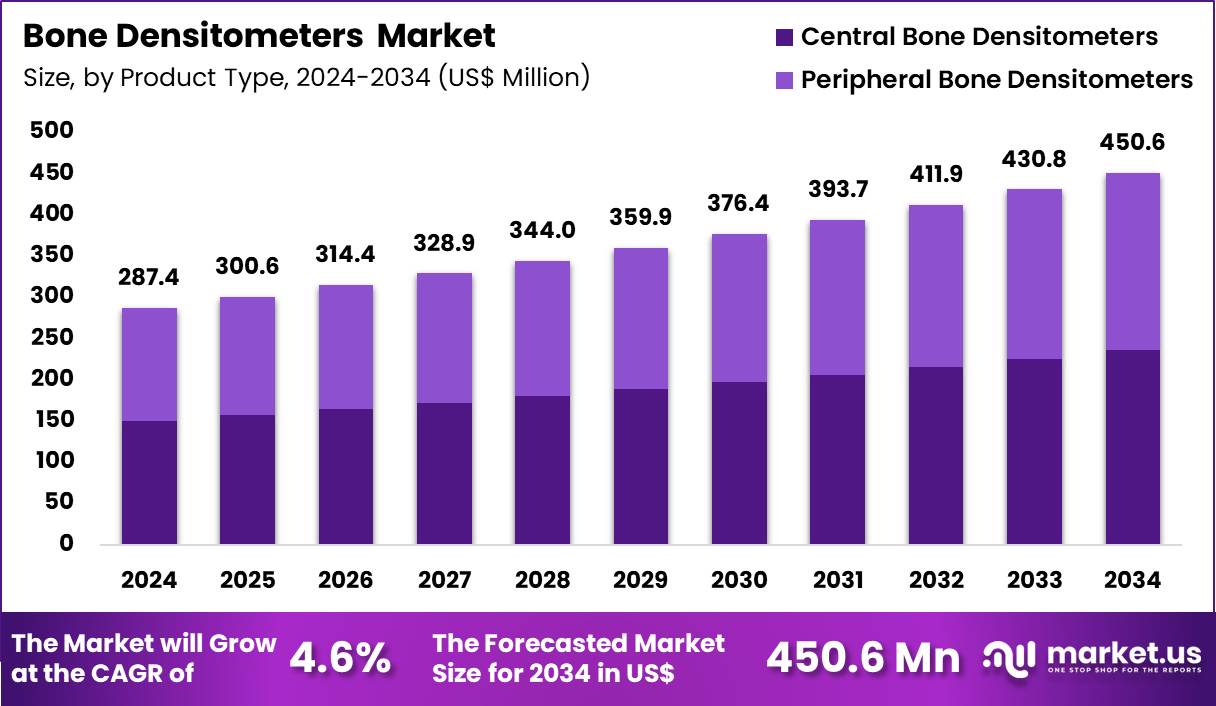
New York, NY – Oct 06, 2026 – The Global Bone Densitometers Market size is expected to be worth around US$ 450.6 Million by 2034 from US$ 287.4 Million in 2024, growing at a CAGR of 4.6% during the forecast period 2025 to 2034. In 2024, North America led the market, achieving over 41.6% share with a revenue of US$ 119.6 Million.
The global bone densitometers market is gaining steady momentum, supported by the rising prevalence of osteoporosis and other bone-related disorders, particularly among aging populations. Bone densitometers are medical imaging devices used to measure bone mineral density (BMD) and assess the risk of fractures and osteoporosis. The growing emphasis on early diagnosis and preventive healthcare is increasing the adoption of these systems across hospitals, diagnostic centers, and specialized clinics.
Technological advancements have contributed to the development of more accurate, faster, and patient-friendly bone densitometry systems. Dual-energy X-ray absorptiometry (DXA) remains one of the most widely used technologies due to its reliability in evaluating bone density. Increasing healthcare expenditure, improvements in diagnostic infrastructure, and greater awareness of osteoporosis screening are expected to support market expansion.
North America represents a significant market owing to advanced healthcare infrastructure, high awareness of bone health, and the presence of established medical device manufacturers. Meanwhile, growth opportunities in Asia-Pacific are being supported by an aging population, increasing healthcare investments, and expanding access to diagnostic services.
Key market participants are focusing on product innovation, technological upgrades, strategic partnerships, and geographic expansion to strengthen their market positions. Overall, increasing demand for early osteoporosis detection and improved bone health management is expected to create favorable opportunities for the bone densitometers market in the coming years.
Key Takeaways
- In 2024, the global bone densitometers market generated revenue of US$ 287.4 million and is projected to reach US$ 450.6 million by 2034, expanding at a CAGR of 4.6% during the forecast period.
- By product type, the market is segmented into central bone densitometers and peripheral bone densitometers. Central bone densitometers dominated the market in 2024, accounting for a 52.3% market share.
- Based on technology, the market includes dual-energy X-ray absorptiometry (DXA/DEXA), quantitative computed tomography (QCT), quantitative ultrasound (QUS), radiographic absorptiometry (RA), single-energy X-ray absorptiometry (SEXA), and others. Among these, DXA/DEXA held the largest share at 41.8% in 2024.
- By application, the market is categorized into osteoporosis and osteopenia diagnosis, cystic fibrosis diagnosis, chronic kidney disease diagnosis, rheumatoid arthritis diagnosis, and body composition measurement. The osteoporosis and osteopenia diagnosis segment led the market with a 34.4% revenue share.
- By end user, the market is segmented into hospitals, diagnostic imaging centers, specialty clinics, and others. Hospitals accounted for the largest revenue share of 56.7% in 2024.
- Regionally, North America dominated the global bone densitometers market in 2024, accounting for a 41.6% market share.
Key Market Segments
- Product Type Analysis: Central bone densitometers held a 52.3% market share, supported by their ability to assess bone mineral density at clinically important sites such as the hip and spine. Their diagnostic accuracy, standardized reporting, clinical acceptance, and integration with hospital infrastructure continue to drive demand.
- Technology Analysis: Dual-energy X-ray absorptiometry (DXA) accounted for 41.8% of the market, supported by high precision, low radiation exposure, and widespread clinical acceptance. Its use in osteoporosis diagnosis and monitoring, improved software capabilities, cost effectiveness, and guideline endorsement continue to strengthen adoption.
- Application Analysis: Osteoporosis and osteopenia diagnosis represented 34.4% of the market, driven by aging populations and increasing awareness of bone health. Growing emphasis on early detection, fracture prevention, routine screening, and improved healthcare access is supporting diagnostic demand across healthcare settings.
- End-User Analysis: Hospitals accounted for 56.7% of the market, supported by extensive diagnostic infrastructure, high patient volumes, and integrated care pathways. Their capacity to acquire advanced systems, manage chronic conditions, and provide multidisciplinary care strengthens utilization and maintains hospitals as leading end users.
Regional Analysis
North America
North America accounted for 41.6% of the global bone densitometers market in 2024, supported by rising osteoporosis awareness, preventive screening programs, and established healthcare infrastructure. The adoption of dual-energy X-ray absorptiometry (DXA) systems has increased across hospitals, primary care facilities, and specialized clinics, particularly for postmenopausal women and older adults.
Technological advancements in portable and peripheral densitometry devices have improved access to screening in ambulatory and rural settings. An aging population and increasing prevalence of metabolic disorders are further supporting demand for accurate bone density assessment.
Favorable insurance coverage, updated clinical guidelines, and investments in advanced diagnostic equipment are also strengthening market penetration. In addition, software improvements for fracture-risk assessment are enhancing clinical decision-making and supporting the continued dominance of the region.
Asia Pacific
Asia Pacific is expected to register the highest CAGR during the forecast period, driven by rapid population aging, increasing osteoporosis awareness, and improving healthcare infrastructure. Government initiatives, screening programs, equipment upgrades, and growing adoption of portable and central DXA systems are expanding access to bone density testing. Rising healthcare investments and demand for early diagnosis are expected to further support regional market growth.
Emerging Trends
- Growing use of DXA systems: Dual-energy X-ray absorptiometry (DXA) continues to be the leading approach for bone density measurement. It is commonly used for the hip and spine and is considered a reliable method for diagnosing osteoporosis and estimating fracture risk.
- Increasing demand from aging populations: Demand for bone densitometers is expected to increase as the number of older adults rises. Osteoporosis becomes more common with age, increasing the need for screening, diagnosis, and follow-up testing.
- Greater focus on early diagnosis: Healthcare systems are placing greater emphasis on identifying low bone density before serious fractures occur. Bone density testing can detect low bone mass, support osteoporosis diagnosis, and help estimate future fracture risk.
- Development of compact and peripheral systems: Portable and peripheral bone density devices are gaining attention because they can support screening in locations where full-size DXA systems may not be practical. However, peripheral measurements may have limitations for diagnosis and treatment monitoring.
- Improved device software and clinical reporting: Modern densitometers increasingly combine measurement systems with software that supports BMD calculation, T-scores, Z-scores, comparison with reference populations, and monitoring of changes over time. FDA records also show continued development and clearance of DXA systems.
Use Cases
- Osteoporosis diagnosis: Bone densitometers are primarily used to identify osteoporosis by measuring bone mineral density, particularly at the hip and spine. DXA results help healthcare professionals determine whether bone density has reached a level associated with osteoporosis.
- Osteoporosis screening: Densitometers are used to screen people who have a higher risk of osteoporosis. CDC guidance identifies women aged 65 and older as an important screening group, while younger women may also require testing when additional risk factors are present.
- Fracture-risk assessment: Bone density measurements are used to support assessment of future fracture risk. Lower bone density is associated with greater fracture risk, making densitometry useful for identifying patients who may require further clinical evaluation or preventive treatment.
- Monitoring osteoporosis treatment: Repeat bone density measurements can be used to monitor changes in bone density and evaluate the effectiveness of ongoing osteoporosis management. This supports longer-term clinical decision-making and treatment follow-up.
- Assessment of high-risk patients: Bone densitometry can be used for patients with risk factors such as previous fractures, family history, low body weight, physical inactivity, or prolonged use of certain medicines. These applications expand demand beyond routine age-based screening.
Frequently Asked Questions About Bone Densitometers
- What is a DXA bone density test?
A DXA test measures bone mineral density using two low-energy X-ray beams. The test is generally quick, painless, and noninvasive. It is commonly performed on the hip and spine because these areas are important for assessing osteoporosis and fracture risk. - Why are bone densitometers used?
Bone densitometers are used to diagnose osteoporosis, identify low bone density, estimate fracture risk, and monitor osteoporosis treatment. These applications make densitometry an important diagnostic tool for patients who have age-related or other risk factors for bone loss. - What does a bone density test measure?
A bone density test measures bone mineral density, which indicates the amount of mineral contained within a specific area of bone. DXA commonly evaluates the hip and spine and provides measurements that can be compared with established reference populations. - How long does a bone density test take?
A DXA examination is generally a quick procedure and does not require invasive preparation. The patient lies on a cushioned table while the scanner measures selected areas of the skeleton. The exact examination time depends on the system and scanning sites. - Which body areas are normally scanned?
Hip and spine are the most common scanning locations for DXA because they are important sites for osteoporosis assessment and fracture risk. Some systems can also measure the forearm or other areas, depending on clinical requirements and device capabilities. - What factors can create demand for bone densitometers?
Demand can be influenced by the growing older population, increasing osteoporosis awareness, higher focus on preventive healthcare, clinical guidelines, and the need for treatment monitoring. Additional risk factors include previous fractures, low body weight, inactivity, and certain long-term medicines. - How is technology development affecting the market?
Technology development is improving measurement, reporting, software functionality, and system flexibility. FDA records show continued regulatory activity for DXA bone densitometer systems, indicating ongoing product development and refinement within the medical imaging equipment segment.
Conclusion
The global bone densitometers market is expected to witness steady growth, supported by the rising prevalence of osteoporosis, population aging, and increasing focus on early diagnosis and preventive healthcare. Central bone densitometers and DXA technology are expected to maintain their leading positions due to their clinical accuracy, reliability, and widespread adoption.
Hospitals will remain key end users, while diagnostic centers and specialty clinics are expected to contribute to market expansion. North America currently leads the market, whereas Asia Pacific offers strong growth potential due to improving healthcare infrastructure and rising awareness. Technological advancements, portable systems, and enhanced software capabilities are expected to further support market development.
Discuss your needs with our analyst
Please share your requirements with more details so our analyst can check if they can solve your problem(s)




