


Overview
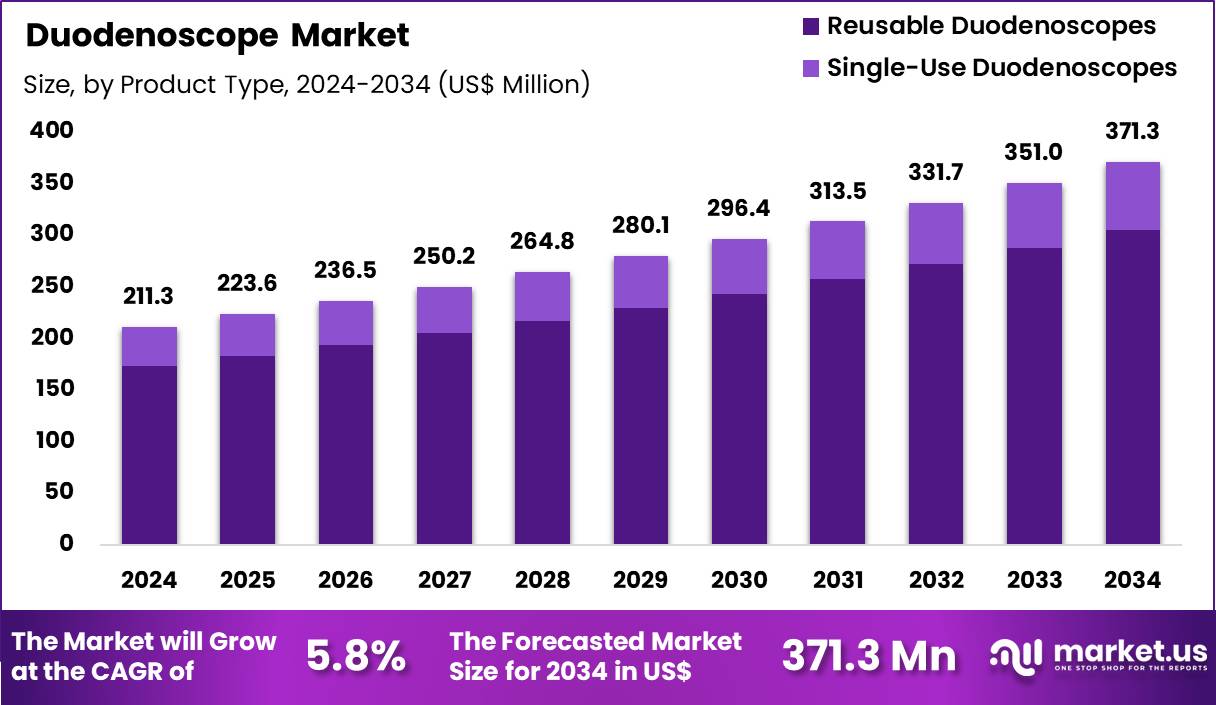
New York, NY – Sep 22, 2026 – The Global Duodenoscope Market size is expected to be worth around US$ 371.3 Million by 2034 from US$ 211.3 Million in 2024, growing at a CAGR of 5.8% during the forecast period 2025 to 2034. In 2024, North America led the market, achieving over 43.6% share with a revenue of US$ 92.1 Million.
The Duodenoscope is a specialized flexible endoscopic device used primarily for examining and treating the duodenum and bile and pancreatic ducts during procedures such as endoscopic retrograde cholangiopancreatography (ERCP). Unlike conventional endoscopes, duodenoscopes feature a side-viewing optical system and an elevator mechanism that enables physicians to guide accessories into the bile and pancreatic ducts.
Duodenoscopes are increasingly important in advanced gastrointestinal care because ERCP can diagnose and manage conditions, including bile duct stones, strictures, tumors, and biliary obstruction. According to the U.S. National Institute of Diabetes and Digestive and Kidney Diseases, ERCP combines endoscopy and X-ray imaging and is mainly used for treatment rather than routine diagnosis.
Technological development is focusing on improved visualization, ergonomic designs, disposable components, and infection-control features. The U.S. Food and Drug Administration has highlighted duodenoscope reprocessing as an important patient-safety issue because the complex design can make complete cleaning and disinfection challenging. In 2019, the FDA recommended that healthcare facilities transition toward duodenoscopes with innovative designs that facilitate effective reprocessing, including models with disposable components.
The global clinical demand for duodenoscopes is supported by the growing use of minimally invasive gastrointestinal procedures and the increasing prevalence of biliary and pancreatic disorders. Modern systems increasingly incorporate high-definition imaging, enhanced visualization, and improved accessory control. The market is also benefiting from healthcare providers’ focus on infection prevention, procedure efficiency, and safer endoscopic workflows.
Key Takeaways
- In 2024, the Duodenoscope Market generated revenue of US$ 211.3 million and is projected to grow at a CAGR of 5.8%, reaching approximately US$ 371.3 million by 2034.
- By product type, the market is segmented into reusable duodenoscopes and single-use duodenoscopes. Reusable duodenoscopes dominated in 2024, accounting for 82.1% of the market share.
- Based on application, the market is categorized into diagnostics and therapeutics. The diagnostics segment held the leading position in 2024, representing 54.2% of the total market share.
- By end user, the market is divided into hospitals and outpatient facilities. The hospitals segment dominated the market in 2024, capturing the largest revenue share of 57.6%.
- Regionally, North America dominated the global Duodenoscope Market in 2024, accounting for 43.6% of the overall market share.
Market Segmentation
- Product Type Analysis – Reusable duodenoscopes, accounting for 82.1%, are expected to maintain dominance due to their cost efficiency and suitability for high-volume hospital procedures. Established reprocessing systems, trained personnel, procurement contracts, and improved device designs support continued adoption. Clinical familiarity and long-term utilization further strengthen their market position.
- Application Analysis – Diagnostics, holding 54.2%, are projected to remain the leading application due to the growing need to identify biliary and pancreatic disorders through ERCP procedures. Rising cases of gallstones, biliary strictures, and pancreatic diseases support diagnostic demand. Improved imaging, maneuverability, and early detection further encourage utilization.
- End-User Analysis – Hospitals, representing 57.6%, are expected to dominate because they handle complex gastrointestinal procedures requiring specialized ERCP capabilities. Dedicated endoscopy units, infection-control infrastructure, trained specialists, and multidisciplinary support encourage hospital-based utilization. Higher patient volumes and investment capacity for advanced equipment further reinforce hospitals’ leading position.
Statistical Information
- In a 2026 randomized trial of 319 ERCP patients, procedure-related complications occurred in 9 patients in each of the disposable-end-cap and conventional reusable duodenoscope groups, with no statistically significant difference.
- The same 2026 trial recorded successful procedures in 154 of 159 patients using disposable-end-cap duodenoscopes and 155 of 160 patients using conventional reusable devices, showing comparable procedural success
- In the 2026 randomized trial, 0 cases of cap detachment occurred among the 159 patients assigned to disposable distal-end-cap duodenoscopes, providing a numerical safety measure for the redesigned device.
- Among 319 patients in the 2026 randomized study, 0 patients in either treatment group developed bacteremia within 3 months after the ERCP procedure.
- A 2025 randomized study involving 162 duodenoscopes found bacterial contamination after manual cleaning of 8.6% in both disposable-distal-cap and detachable-elevator groups.
- Following high-level disinfection in the 2025 randomized study, 0 bacterial contamination was detected in either of the two groups, with 81 duodenoscopes per group evaluated.
- After manual cleaning in the 2025 study, mean ATP residue levels were 164.6 ± 257.5 RLUs for disposable-cap duodenoscopes versus 158.1 ± 286.1 RLUs for detachable-elevator devices.
Regional Analysis
North America remains a key region for the duodenoscope market, supported by extensive ERCP utilization and strong regulatory attention to device safety. The U.S. FDA reports that duodenoscopes are used in more than 500,000 ERCP procedures annually and continues to encourage designs that facilitate or eliminate reprocessing.
Asia Pacific is witnessing increasing adoption of advanced pancreaticobiliary endoscopy as healthcare facilities expand interventional capabilities. Japan and other developed Asian markets are supported by experienced gastroenterology centers and growing use of advanced imaging and therapeutic ERCP techniques. Recent research also highlights increasing digitalization, with a 2026 ERCP dataset containing 19,018 raw images, 19,317 processed images, and data from 1,602 patients, supporting AI-based diagnostic development.
Overall, regional development is being shaped by infection-control requirements, technological innovation, increasing ERCP capacity, and demand for more efficient and safer duodenoscope platforms.
Business opportunities
The Duodenoscope Market offers significant business opportunities through the development of single-use, reusable, and hybrid devices designed to improve ERCP safety and procedural efficiency. Manufacturers can invest in advanced imaging, improved maneuverability, disposable distal components, and infection-control technologies to address reprocessing challenges.
AI-enabled endoscopy also creates opportunities for computer-assisted diagnosis and procedural guidance, supported by growing availability of ERCP image datasets. Companies can further expand through partnerships with hospitals, gastroenterology centers, and academic institutions for clinical validation and technology development.
Reprocessing equipment, automated cleaning systems, and traceability solutions represent additional opportunities within the reusable-device ecosystem. Emerging healthcare systems in Asia Pacific and other developing regions provide opportunities for localized distribution, physician training, technical support, and affordable device platforms.
Overall, innovation focused on infection prevention, visualization, workflow efficiency, and clinical reliability can create new revenue opportunities for duodenoscope manufacturers and technology providers.
Emerging Trends
- Single-use adoption is expanding: Infection-control concerns are encouraging hospitals to evaluate disposable duodenoscopes. A 2025 clinical study reported 88.7% successful ERCP completion with single-use devices, compared with 95% for reusable systems, supporting continued development of disposable platforms.
- Disposable components are gaining attention: Manufacturers are developing duodenoscopes with disposable caps and elevator components to reduce contamination risks while retaining reusable systems. Recent evidence showed disposable-cap designs achieved 0% culture positivity compared with 0.80% for traditional devices.
- AI-ready imaging is emerging: Duodenoscope-based ERCP is increasingly connected with digital image analysis and artificial intelligence. A 2026 ERCP dataset contains 19,018 raw images, 19,317 processed images, and data from 1,602 patients, supporting future automated image-analysis applications.
- Reprocessing remains a technology focus: The U.S. FDA continues encouraging designs that facilitate or eliminate complex reprocessing. In the United States, duodenoscopes are used in more than 500,000 ERCP procedures annually, creating strong operational importance for safer cleaning and device designs.
- Hybrid designs balance safety and performance: Duodenoscope development is increasingly combining reusable systems with disposable components. Evidence from 518 ERCP patients found disposable-cap devices reduced persistent microbial contamination with a relative risk of 0.34, while technical success remained comparable.
Use Cases
- Emergency ERCP: Single-use duodenoscopes are useful for urgent biliary interventions where immediate access is important and reprocessing time can create workflow challenges. In one clinical series, 20 of 21 procedures (95%) achieved technical and clinical success using a single-use device.
- Complex therapeutic procedures: Duodenoscopes support advanced ERCP procedures involving biliary and pancreatic interventions. In a multicenter evaluation, 196 of 551 procedures (35.6%) were classified as high-complexity ASGE grades 3–4, demonstrating use beyond routine examinations.
- Infection-risk management: Disposable duodenoscopes can be considered for patients carrying multidrug-resistant organisms because they avoid patient-to-patient reuse. FDA guidance identifies duodenoscope reprocessing as an important safety issue, while more than 500,000 ERCP procedures annually require these devices in the U.S.
- Hospital ERCP workflow: Single-use systems can support procedures without requiring the same post-procedure scope reprocessing pathway. In a multicenter study involving 551 patients, 503 procedures (91.3%) were completed using only the single-use duodenoscope, indicating substantial standalone clinical usability.
- Pediatric ERCP: Single-use technology is also being evaluated in pediatric gastroenterology. A 2026 pediatric-center study reviewed 28 patients treated with a single-use duodenoscope, extending evaluation of disposable technology to specialized procedures involving younger patients.
Recent Development
- In September 2025, FUJIFILM Medical launched the ED-840T in Japan with a 4.5 mm instrument channel, redesigned distal-end shape, and improved insertion characteristics. The company highlighted improved imaging of the papilla and enhanced elevator angulation for pancreaticobiliary procedures.
- In September 2025, PENTAX Medical and Advanced Sterilization Products launched the Sterilizable DEC Duodenoscope in the U.S. The reusable device can undergo complete sterilization in 68 minutes using the ASP STERRAD system, targeting faster infection-control workflows for ERCP facilities.
- In February 2026, PENTAX Medical highlighted its I-DEC Video Duodenoscope as an approach to improving ERCP safety, precision, and infection prevention. The development reflects the company’s continued focus on incorporating infection-control considerations directly into duodenoscope design.
Frequently Asked Questions About Duodenoscope
- How does a duodenoscope work?
A duodenoscope passes through the mouth, stomach, and into the duodenum. Its side-viewing design helps physicians locate the major papilla, while instruments pass through its working channel to perform diagnostic and therapeutic procedures. - How long does an ERCP procedure take?
According to the American Society for Gastrointestinal Endoscopy, an ERCP examination generally takes around 60 minutes. Duration can vary depending on the patient’s condition, the complexity of treatment, and procedures such as stone removal or stent placement. - What conditions can be treated using a duodenoscope?
Duodenoscope-assisted ERCP can manage bile duct stones, pancreaticobiliary strictures, blockages, cholangitis, and certain cancers. Procedures may include sphincterotomy, stone extraction, duct dilation, stent placement, and biopsy for selected pancreaticobiliary conditions. - How many ERCP procedures use duodenoscopes annually in the United States?
The U.S. FDA states that duodenoscopes are used in more than 500,000 ERCP procedures annually in the United States. This substantial procedural volume supports continued demand for reliable, safe, and efficient duodenoscope technologies. - What are the major types of duodenoscopes?
The market includes reusable and single-use duodenoscopes, with newer designs incorporating disposable distal components. These technologies aim to balance procedural performance with infection-control requirements, particularly because reusable devices require thorough cleaning and disinfection between patients. - Why is infection control important in the duodenoscope market?
Infection control is important because duodenoscopes contain complex working parts that can retain biological material if inadequately reprocessed. The FDA notes that contamination can rarely result in patient-to-patient transmission, encouraging safer designs and improved reprocessing practices. - What factors are driving the duodenoscope market?
Market development is supported by demand for advanced ERCP procedures, increasing focus on infection prevention, improvements in visualization, and the development of single-use technologies. More than 500,000 annual U.S. ERCP procedures demonstrate substantial clinical utilization.
Conclusion
The Duodenoscope Market is evolving as healthcare providers increasingly prioritize infection control, procedural precision, and efficient ERCP workflows. Reusable duodenoscopes remain widely used, while single-use and hybrid designs are gaining attention because they can reduce reprocessing challenges.
Technological advances in high-definition imaging, improved elevator mechanisms, ergonomic designs, and disposable components are supporting clinical performance. Hospitals remain important end users because of their specialized endoscopy infrastructure and complex case volumes.
North America continues to represent a leading regional market, while Asia Pacific offers opportunities through expanding healthcare infrastructure and advanced endoscopic capabilities. Overall, continued innovation, regulatory support, and demand for safer pancreaticobiliary procedures are expected to shape competitive development in the duodenoscope industry.
Discuss your needs with our analyst
Please share your requirements with more details so our analyst can check if they can solve your problem(s)




