


Overview
New York, NY – Sep 22, 2026 – The Global COVID-19 Saliva Sampling Test Potential Market size is expected to be worth around US$ 5.6 Billion by 2034 from US$ 3.8 Billion in 2024, growing at a CAGR of 3.9% during the forecast period 2025 to 2034. In 2024, North America led the market, achieving over 37.5% share with a revenue of US$ 1.4 Billion.
COVID-19 Saliva Sampling Test has strong potential due to the growing demand for non-invasive, convenient, and repeatable SARS-CoV-2 screening. Saliva collection eliminates many difficulties associated with nasopharyngeal swabs and can support testing across schools, workplaces, hospitals, airports, and community settings. The U.S. FDA authorized Yale’s Saliva Direct test, supporting the feasibility of saliva-based molecular diagnostics.
Clinical evidence demonstrates substantial diagnostic potential. A systematic review covering 44 studies and 14,043 participants across 21 countries reported 89.2% sensitivity, 96.4% specificity, and 94.3% overall accuracy for saliva-based SARS-CoV-2 detection. These figures demonstrate that saliva can provide reliable results while offering a less invasive sampling method.
Testing frequency can further improve surveillance effectiveness. An NIH-funded study reported that screening every 3 days achieved more than 98% sensitivity, while weekly testing reached approximately 98% sensitivity in the evaluated model. Such performance supports the use of saliva testing for recurring institutional and community surveillance programs.
The market also benefits from simplified sample collection, reduced dependence on trained healthcare workers, and suitability for self-collection. Potential applications include PCR, RT-PCR, antigen testing, and molecular screening, with demand influenced by outbreak monitoring and respiratory-virus surveillance.
However, diagnostic performance can vary according to viral load, symptom status, sample quality, collection method, assay sensitivity, and circulating variants. Continued development of automated collection systems and highly sensitive molecular assays could strengthen the future adoption of COVID-19 saliva testing.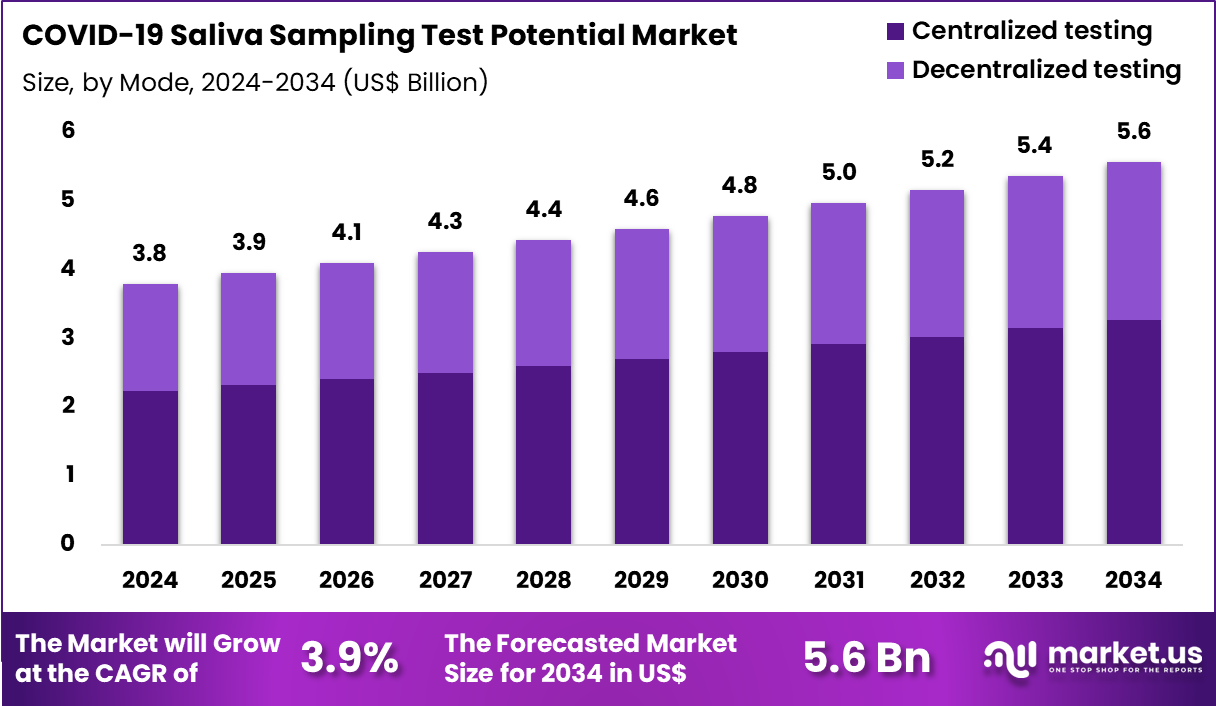
Key Takeaways
- In 2024, the market generated revenue of US$ 3.8 Billion, registering a CAGR of 3.9%, and is projected to reach US$ 5.6 Billion by 2034.
- By mode, the market is segmented into centralized testing and decentralized testing. Centralized testing dominated in 2024, accounting for a market share of 58.7%.
- Based on technology, the market is categorized into fluorescence-labeled antigen/antibodies testing, RT-PCR, and CRISPR-CAS9. Fluorescence-labeled antigen/antibodies testing held the leading position with a share of 46.9% in 2024.
- By location, the market is segmented into corporate campus environments, travel stations, sports arenas, entertainment venues, and universities & colleges. Corporate campus environments dominated the segment, capturing the largest revenue share of 39.4%.
- North America led the global market in 2024, accounting for a significant market share of 37.5%.
Market Segmentation Overview
- Mode Analysis: Centralized testing accounted for 58.7% of the market and is expected to maintain its leading position due to high testing capacity, standardized workflows, and advanced laboratory automation. Its ability to process large sample volumes efficiently supports mass screening and surveillance programs. Increasing investments in laboratory infrastructure, quality control systems, and government-supported testing initiatives further strengthen centralized testing adoption.
- Technology Analysis: Fluorescence-labeled antigen/antibodies testing held a 46.9% market share and is expected to remain dominant because of rapid results, simplified procedures, and suitability for saliva-based screening. These assays can support timely identification and intervention while offering convenient testing. Improvements in assay sensitivity, affordability, portability, and testing efficiency are expected to encourage broader adoption across healthcare and workplace settings.
- Location Analysis: Corporate campus environments represented the largest location segment, with a 39.4% market share. The segment is expected to maintain its dominance as organizations prioritize employee health, workplace safety, and early infection detection. Non-invasive saliva collection can improve testing participation and simplify repeated screening. Growing hybrid work models, on-site testing programs, and corporate-diagnostic partnerships are further supporting adoption.
Statistical Information
- Self-Collected Saliva Had Sixty Eight Percent Sensitivity: In a CDC investigation of 1,076 participants, self-collected saliva samples had 68% sensitivity versus healthcare-worker-collected nasopharyngeal swabs. Specificity was 99%, positive predictive value was 90%, and negative predictive value was 97%. Among participants tested 3–7 days after symptom onset, saliva sensitivity increased to 85%.
- Saliva Test Agreement Reached Ninety Four Percent In The First Five Days: A 2025 study found that saliva testing had 94.0% positive-per cent agreement with nasal RT-PCR among people tested within the first 5 days of symptoms. The 95% confidence interval was 88.9%–99.1%. This suggests saliva can perform strongly early in symptomatic infection, while test performance can change across the course of illness as viral dynamics differ by specimen type.
- Pooled Saliva Testing Can Improve Screening Throughput: In a pooled-saliva study, 1,475 individual samples were tested through 374 pools of 4 samples. The strategy produced no false-negative pools and a 0.8% false-positive-pool rate. Pooling can increase testing throughput and reduce per-person reagent consumption in low-prevalence surveillance settings, although any positive pool requires individual follow-up testing
- Saliva Point-of-Care PCR Delivered Ninety Point Two Per cent Sensitivity: In an Italian comparison study, saliva-based point-of-care PCR achieved 90.2% sensitivity, detecting 37 of 41 reference-positive samples. Specificity was 100%, based on 59 of 59 reference-negative samples. This supports saliva’s potential for decentralised molecular testing when a near-patient PCR workflow is available
- Adult Saliva Test Sensitivity Was Seventy-Eight Per cent: In the same clinical study, saliva molecular-test sensitivity in adults was 77.8%, with a 95% confidence interval of 67.2%–86.3%. Adult SARS-CoV-2 prevalence in the evaluated cohort was 24.8%, with 81 positive cases among 326 adults. This provides clinical performance data in a relatively high-prevalence setting rather than in mass asymptomatic surveillance.
Regional Analysis
North America dominated the COVID-19 Saliva Sampling Test Potential Market, accounting for 37.5% of the market in 2024. Strong diagnostic infrastructure, advanced molecular testing capabilities, and continued SARS-CoV-2 surveillance supported regional demand.
The United States recorded more than 104 million reported COVID-19 cases and over 1.1 million hospitalizations by 2023, highlighting the importance of accessible testing and monitoring. Saliva-based collection offers non-invasive sampling and can reduce dependence on trained swab collectors, supporting repeated screening in workplaces, universities, healthcare facilities, and communities.
Asia Pacific is projected to register the highest CAGR during the forecast period. Rising investments in infectious-disease surveillance, expanding laboratory capacity, and increasing awareness of asymptomatic transmission are supporting regional adoption.
Countries across the region are strengthening community-level testing and genomic surveillance capabilities. The availability of self-collection methods and saliva-compatible molecular assays can further improve testing accessibility, particularly across densely populated urban and semi-urban areas.
Emerging Trends
- Self-Collection Testing: Saliva-based testing is increasingly moving toward self-collection because it is more comfortable than nasal swabbing. The FDA authorized SalivaDirect in 2020, supporting the use of saliva as a practical specimen for SARS-CoV-2 molecular testing and scalable screening programs.
- Frequent Surveillance Testing: Continued SARS-CoV-2 circulation is increasing the importance of regular surveillance. WHO reported that approximately 69,900 specimens were tested weekly across 103 countries during January–February 2025, supporting demand for convenient sampling methods that can simplify repeated testing.
- Rapid Testing Technologies: Faster diagnostic technologies are becoming increasingly important for COVID-19 screening. CDC states that COVID-19 antigen tests can generally provide results within 15–30 minutes, encouraging development of convenient testing approaches for homes, workplaces, schools, healthcare facilities, and community settings.
- Variant Monitoring: Ongoing SARS-CoV-2 evolution is creating demand for adaptable diagnostic technologies. WHO reported global COVID-19 test positivity of approximately 11% in May 2025, highlighting the continuing need for surveillance systems capable of identifying changing infection patterns and emerging variants.
- Multiplex Respiratory Testing: Diagnostic development is increasingly focused on detecting multiple respiratory pathogens through integrated testing. CDC surveillance programs monitor COVID-19, influenza, and RSV, creating opportunities for saliva-compatible multiplex assays that can provide broader respiratory-disease information from a single patient sample.
Use Cases
- Workplace Screening: Saliva testing can support regular screening in corporate workplaces where employees interact frequently. Non-invasive collection can improve participation and reduce dependence on trained swab collectors. The 39.4% share of corporate campus environments highlights the importance of workplace-based screening applications.
- University and School Screening: Educational institutions can use saliva sampling for periodic surveillance among students and staff. Simple collection methods are useful for large groups, while frequent testing can help identify infections earlier and reduce transmission within crowded classrooms, campuses, and residential facilities.
- Healthcare Facility Surveillance: Hospitals and healthcare facilities can use saliva-based testing for screening patients, staff, and visitors. The approach may reduce discomfort and simplify sample collection. It can complement laboratory molecular testing, particularly when facilities need repeated surveillance among high-risk or frequently exposed populations.
- Travel and Public Events: Airports, travel stations, sports arenas, and entertainment venues can use convenient saliva sampling to support screening during periods of increased transmission. Easy collection is particularly useful where large numbers of people require testing within limited timeframes.
- Community and Home Testing: Saliva collection can support community surveillance and home-based testing because samples can be collected with minimal equipment. FDA authorization of SalivaDirect demonstrated the feasibility of saliva-based molecular testing, creating opportunities for accessible screening and public-health monitoring.
Recent Development
- In 2026, Thermo Fisher Scientific, Inc. continues to support SARS-CoV-2 molecular testing through PCR and digital PCR technologies, providing laboratories with scalable platforms for nucleic-acid detection and respiratory-virus research. Its molecular diagnostic capabilities support ongoing assay development and infectious-disease surveillance workflows.
- In 2026, QIAGEN N.V. continues strengthening molecular diagnostic workflows through nucleic-acid extraction, purification, and amplification technologies. Its integrated solutions support laboratories performing infectious-disease testing and respiratory-pathogen surveillance, creating opportunities for more efficient SARS-CoV-2 detection and sample-processing workflows.
- In 2026, Roche Diagnostics continues expanding respiratory diagnostic capabilities through its cobas portfolio. Its respiratory testing solutions can deliver results in approximately 20 minutes on the cobas liat platform, while multiplex assays simultaneously detect SARS-CoV-2, influenza A/B, and RSV, supporting rapid clinical decision-making.
- In 2026, Abbott Laboratories continues advancing decentralized molecular diagnostics through its rapid testing platforms. Abbott’s ID NOW COVID-19 technology was designed to provide positive results in as little as 5 minutes and negative results in 13 minutes, demonstrating the company’s focus on rapid point-of-care respiratory testing.
- In 2026, Hologic, Inc. continues developing automated respiratory testing through its Panther Fusion and Aptima platforms. Its multiplex respiratory portfolio can differentiate 4 major respiratory viruses, including SARS-CoV-2, influenza A, influenza B, and RSV, from a single patient specimen, supporting efficient laboratory workflows.
- In 2026, Bio-Rad Laboratories, Inc. continues supporting infectious-disease diagnostics through PCR and digital PCR technologies. Its high-sensitivity molecular platforms provide laboratories with tools for nucleic-acid quantification and assay development, supporting continued research into SARS-CoV-2 detection and broader respiratory-virus surveillance.
Frequently Asked Questions on COVID-19 Saliva Sampling Test Potential
- Which region is expected to grow fastest?
Asia Pacific is expected to register the highest CAGR during the forecast period. Expanding healthcare infrastructure, infectious-disease surveillance, large population centers, increasing diagnostic awareness, and demand for convenient sample collection are expected to support regional growth. - What is driving market growth?
Market growth is supported by demand for non-invasive testing, convenient sample collection, repeated surveillance, workplace screening, and improved molecular technologies. Increasing respiratory-virus monitoring and the need for scalable diagnostic solutions are also creating new opportunities. - What are the major applications?
Major applications include workplace screening, universities, healthcare facilities, community surveillance, travel locations, sports venues, entertainment facilities, and home testing. These settings benefit from simple saliva collection, reduced discomfort, and the ability to support repeated testing programs. - What challenges affect market adoption?
Challenges include variations in viral load, saliva quality, collection technique, disease stage, assay sensitivity, and testing protocols. Maintaining consistent sample quality and achieving comparable sensitivity across different populations remain important considerations for wider adoption. - What role does PCR play in saliva testing?
RT-PCR provides highly sensitive molecular detection of SARS-CoV-2 and can be adapted for saliva specimens. Its strong analytical performance makes it useful for laboratory testing, surveillance, research applications, and situations requiring reliable identification of viral genetic material. - What is the future outlook for the market?
The market is expected to continue developing through improved saliva collection systems, rapid diagnostics, multiplex respiratory testing, automation, and decentralized screening. Growing surveillance needs and technological improvements could support continued adoption across healthcare and community settings.
Conclusion
The COVID-19 Saliva Sampling Test Potential Market is expected to experience steady development, supported by growing demand for non-invasive, convenient, and repeatable diagnostic solutions. Saliva-based collection offers practical advantages over traditional sampling methods, particularly for large-scale screening across workplaces, educational institutions, healthcare facilities, travel locations, and community settings.
Advances in molecular diagnostics, self-collection, rapid testing, automation, and multiplex respiratory testing are expected to create further opportunities. At the same time, variations in viral load, sample quality, collection procedures, disease stage, and assay performance remain important considerations. Continued technological improvements are expected to strengthen the role of saliva testing in future infectious-disease surveillance.
Discuss your needs with our analyst
Please share your requirements with more details so our analyst can check if they can solve your problem(s)




