


Overview
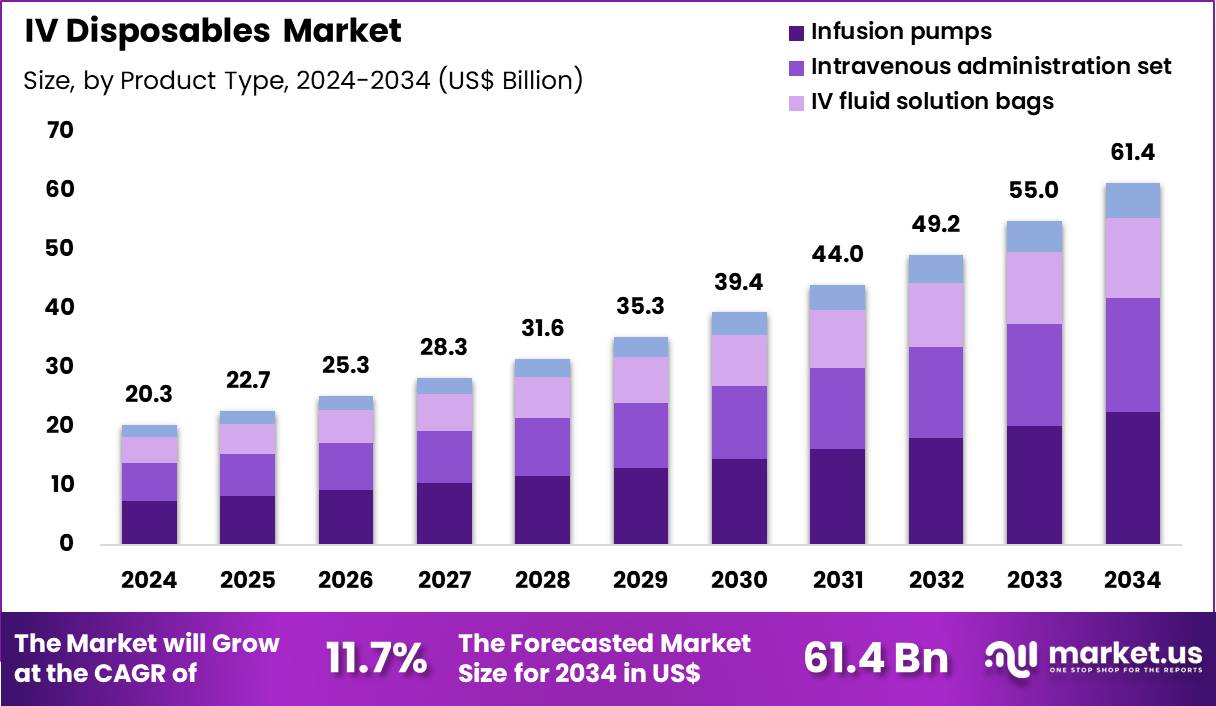
New York, NY – Sep 22, 2026 – The Global IV Disposables Market size is expected to be worth around US$ 61.4 Billion by 2034 from US$ 20.3 Billion in 2024, growing at a CAGR of 11.7% during the forecast period 2025 to 2034. In 2024, North America led the market, achieving over 39.6% share with a revenue of US$ 0.8 Billion.
The Global IV Disposables Market covers single-use medical products used for intravenous fluid and medication administration, including IV sets, extension sets, catheters, connectors, needleless valves, and related accessories. These products are essential across hospitals, clinics, ambulatory surgical centers, emergency departments, and home healthcare settings because they support safe and controlled delivery of fluids, nutrients, blood products, and medicines.
The market is being driven by the increasing volume of hospital-based treatments, rising demand for infection-control solutions, growth in chronic disease management, and the expanding use of disposable products to reduce cross-contamination risks. Technological improvements in needleless connectors, safety IV catheters, antimicrobial components, and closed-system devices are also supporting product adoption.
North America remains an important market due to advanced healthcare infrastructure, high procedure volumes, strong infection-prevention practices, and established medical-device manufacturers. Meanwhile, the Asia-Pacific is expected to experience significant growth as healthcare expenditure, hospital capacity, and access to modern intravenous therapy continue expanding.
Key Takeaways
- In 2024, the IV Disposables Market generated revenue of US$20.3 billion and is projected to reach US$61.4 billion by 2034, expanding at a CAGR of 11.7% during the forecast period.
- By product type, the market is segmented into infusion pumps, intravenous administration sets, IV fluid solution bags, and others. Among these, infusion pumps dominated the market in 2023, accounting for a 36.8% market share
- Based on end-user, the market is segmented into hospitals, specialty clinics, ambulatory surgical centers, and home care settings. Hospitals held the largest share, accounting for 58.6% of the market.
- North America dominated the global IV Disposables Market in 2024, securing a 39.6% market share, supported by advanced healthcare infrastructure and high adoption of intravenous therapy products.
Market segmentation
- Product Type Analysis – Infusion pumps, holding 36.8%, are expected to dominate the IV Disposables Market due to increasing demand for precise and controlled drug delivery. Growing use in chemotherapy, antibiotics, critical care, and surgical procedures supports adoption. Smart pump technologies, dose-error reduction, and expanding outpatient infusion services further strengthen segment growth.
- End-User Analysis – Hospitals, holding 58.6%, are projected to dominate the IV Disposables Market because they conduct high volumes of intravenous therapies across emergency, surgical, oncology, and critical care departments. Rising chronic disease admissions, infection-control requirements, standardized IV systems, and adoption of advanced infusion technologies continue to drive strong product consumption.
Statistical Information
- The 2025 infusion-pump study tested continuous delivery at a set flow rate of 4 mL/h, using 0.9% normal saline and measuring output at 10-minute intervals to calculate hourly flow performance.
- The COOPDECH Amy PCA electronic pump maintained consistent flow performance across the tested conditions, while the CADD-Solis showed a 5.0% decrease with epidural-catheter placement.
- During motion testing, the CADD-Solis pump produced a 4.2% increase in flow rate, reaching 102.4% of its programmed 4 mL/h rate compared with 98.1% under control conditions.
- Warming the COOPDECH Balloonjector from 25°C to 32°C increased its measured flow rate by 24.3%, reaching 117.5% of the programmed rate compared with 98.2% under control conditions.
- Increasing temperature from 25°C to 32°C increased the Rakurakufuser’s measured flow rate by 20.3%, demonstrating the sensitivity of elastomeric disposable infusion pumps to operating temperature.
- In the 2025 pump study, the Rakurakufuser operated within the defined 100% ±15% accuracy range for 89.1% of dosing time under warming conditions, compared with 31.0% under control conditions.
- The CADD-Solis delivered a measured bolus of 2.7 mL against a programmed 3.0 mL dose when connected to an epidural catheter, representing a mean difference of 0.3 mL.
- The 2025 study evaluated 3 mL bolus doses across four operating conditions and found no significant bolus-volume changes for three of the four tested portable pump systems.
- The electronic pumps tested in 2025 maintained flow within the study’s 100% ±15% target range across challenging conditions including warming and catheter resistance, indicating comparatively stable disposable infusion delivery.
Regional Analysis
North America remains a leading region for the IV Disposables Market, supported by strong infection-prevention practices, advanced hospital infrastructure, and widespread use of single-use intravenous systems. CDC guidance specifically recommends using infusion bags, tubing, and connectors for one patient only, reinforcing demand for disposable IV products and safe administration practices.
Asia Pacific is expected to experience strong growth as healthcare systems expand medical-device access, strengthen infection-prevention programs, and improve procurement and supply-chain capabilities. WHO’s 2025 Western Pacific guidance emphasizes improved healthcare infrastructure, resilient systems, and appropriate medical technologies across Asia-Pacific facilities.
WHO also reviewed IPC systems across 6 priority Western Pacific countries, highlighting opportunities to strengthen infection-control implementation and monitoring. This regional development is likely to support greater adoption of IV administration sets, connectors, catheters, and other single-use products across hospitals and primary-care facilities.
Business opportunities
The IV Disposables Market offers significant business opportunities through the development of safety-engineered IV catheters, needleless connectors, infusion sets, and closed-system devices that support infection prevention and safer intravenous therapy.
Growing adoption of outpatient and home-based care also creates demand for lightweight, user-friendly disposable products. Manufacturers can further expand through smart infusion systems, antimicrobial components, sustainable materials, recyclable packaging, and advanced sterile designs.
Emerging healthcare infrastructure across Asia Pacific provides opportunities for localized manufacturing, distribution partnerships, and cost-effective IV products. In addition, hospitals increasingly require dependable procurement and inventory-management solutions to prevent shortages of essential disposable supplies.
Companies investing in product innovation, infection-control technologies, sustainability, and integrated infusion solutions can strengthen their competitive position while addressing evolving clinical and operational requirements across hospitals, specialty clinics, ambulatory centers, and home-care environments.
Emerging Trends
- Needleless Connector Safety: In 2025, a clinical study tested 360 needleless connectors from 111 cancer patients, identifying contamination in 80.6% before cleaning. This supports stronger disinfection practices and increased demand for safer needleless IV connection technologies.
- Longer Disinfection Practices: A 2025 study compared 5-, 10-, and 15-second connector-scrubbing methods. The 15-second approach delivered significantly better decontamination results, with P=0.024, encouraging healthcare facilities to strengthen standardized IV infection-prevention procedures.
- Temperature-Stable Infusion: A 2025 study found that warming two elastomeric pumps from 25°C to 32°C increased flow rates by 24.3% and 20.3%, respectively. This highlights opportunities for disposable infusion systems with improved temperature stability and predictable medication delivery.
- Electronic Infusion Control: Research published in 2025 evaluated 4 portable infusion pumps under different operating conditions. Electronic systems demonstrated comparatively consistent delivery, supporting greater interest in controlled infusion technologies that can improve dosing reliability across clinical environments.
- Performance Monitoring: FDA documentation in 2025 highlighted infusion-set performance concerns involving flow rate, bolus accuracy, occlusion alarms, and post-occlusion volume. These requirements are increasing attention toward measurable performance testing and quality control for disposable administration systems.
Use Cases
- Oncology Infusion: Needleless connectors are widely relevant to cancer treatment, with a 2025 clinical study involving 111 adult cancer patients receiving central venous access. This demonstrates the importance of disposable connectors for repeated medication administration and infection prevention during oncology care.
- Portable Infusion Therapy: A 2025 study evaluated 4 portable pumps programmed at 4 mL/h, demonstrating their application for controlled fluid and medication administration. Such systems support therapies requiring continuous or intermittent intravenous delivery outside conventional inpatient settings.
- Home Healthcare: FDA guidance highlights infusion-pump use in home settings, including monitoring pump settings, responding to alarms, and maintaining backup power. These requirements support demand for convenient disposable administration sets suitable for patients receiving intravenous therapy at home.
- Pediatric and Neonatal Care: FDA guidance issued during a 2025 infusion-set performance issue specifically addressed critical-care, neonatal, infant, and pediatric patients. This demonstrates the importance of appropriately sized and clinically compatible disposable IV sets for vulnerable patient groups.
- Single-Patient IV Administration: CDC guidance recommends that IV bags, tubing, and connectors be used for 1 patient only. This infection-prevention requirement supports continuous use of disposable IV components across hospitals, clinics, and other healthcare environments, providing intravenous treatment.
Recent Development
- In October 2025, B. Braun launched Midazolam in 0.8% Sodium Chloride Injection in the U.S. The product is supplied in 50 mg/50 mL and 100 mg/100 mL IV bags and uses packaging that is not made with DEHP, PVC, or natural rubber latex.
- In November 2025, Terumo presented its infusion-management strategy around systems designed for precise dosing control and broader digital integration. Its Terufusion™ platform combines infusion technology with capabilities such as remote monitoring, customizable dose modes, and an integrated drug library.
- In 2025, Fresenius Kabi continued expanding its IV-therapy portfolio, which includes infusion systems, IV solutions, accessories, and related technologies. Its official portfolio confirms continued investment in products supporting anesthesia, oncology, anti-infective, and critical-care applications.
Frequently Asked Questions About IV Disposables
- What products are included in IV disposables?
IV disposables include administration sets, fluid-delivery tubing, extension sets, needleless connectors, stopcocks, manifolds, in-line filters, flow regulators, vial adapters, transfer sets, and blood administration sets used during intravenous treatment. - Why are IV disposables important in healthcare?
IV disposables help provide controlled intravenous treatment while supporting infection prevention. CDC recommends using IV bags, tubing, and connectors for one patient only, followed by appropriate disposal to reduce contamination and infection risks. - How long can IV administration sets be used?
For patients not receiving blood, blood products, or fat emulsions, continuously used administration sets should generally be replaced no more frequently than every 96 hours and at least every 7 days, according to CDC recommendations. - Which healthcare settings use IV disposables?
IV disposables are used across hospitals, emergency departments, intensive-care units, oncology centers, surgical facilities, specialty clinics, and home-care environments where intravenous fluids, medications, nutrition, or blood products require controlled administration. - What factors influence IV disposable product selection?
Product selection depends on the intended therapy, fluid type, required flow control, pressure conditions, patient population, compatibility, sterility, and connection requirements. FDA guidance identifies components including filters, valves, connectors, tubing, and injection sites. - How does infection prevention affect the IV Disposables Market?
Infection prevention strongly influences IV disposable usage because contaminated equipment can introduce microorganisms into vascular systems. CDC recommends aseptic technique and single-patient use of IV bags, tubing, and connectors, supporting demand for sterile disposable products. - What are the major opportunities in the IV Disposables Market?
Major opportunities include advanced needleless connectors, safety-engineered components, pump-compatible administration sets, improved filters, antimicrobial technologies, and sustainable materials. FDA’s current classification framework also recognizes updated standards for single-use infusion and transfusion equipment.
Conclusion
The IV Disposables Market is positioned for strong growth as healthcare providers increasingly prioritize safe intravenous administration, infection prevention, and reliable fluid and medication delivery. Infusion pumps remain a key product category, supported by demand for precise dosing and advanced infusion technologies.
Hospitals continue to represent the leading end-user segment because of extensive use across emergency care, surgery, oncology, and critical care. North America maintains a strong position, while Asia Pacific offers substantial opportunities through healthcare infrastructure expansion.
Growing home-based infusion therapy, smart infusion systems, needleless connectors, and user-friendly disposable products are creating new avenues for innovation. Overall, manufacturers focusing on safety, connectivity, product efficiency, and supply-chain resilience are well positioned to benefit from evolving healthcare requirements.
Discuss your needs with our analyst
Please share your requirements with more details so our analyst can check if they can solve your problem(s)




