


Overview
New York, NY – Sep 21, 2026 – The Global Cross-species Organ Transplantation Market size is expected to be worth around US$ 30.9 Billion by 2034 from US$ 15.4 Billion in 2024, growing at a CAGR of 7.2% during the forecast period 2025 to 2034. In 2024, North America led the market, achieving over 39b.7% share with a revenue of US$ 6.1 Billion.
Cross-species Organ Transplantation, also known as the xenotransplantation market, is gaining momentum as a potential solution to the persistent shortage of human donor organs. In the United States, 167,230 unique patients were on the solid-organ transplant waiting list in 2024, while 70,600 new patients were added during the year. The U.S. Health Resources and Services Administration (HRSA) also reports that more than 100,000 people currently need an organ transplant.
Genetically modified pigs represent the leading donor source because their organs can be engineered to improve biological compatibility with humans. The U.S. FDA identifies pig kidneys, skin, pancreatic islets, and other tissues among potential xenotransplantation products and notes that approximately 10 patients die every day in the United States while waiting for lifesaving organ transplants. Clinical research is producing measurable advances. In 2025, a first-in-human porcine kidney xenograft demonstrated essential kidney functions during a 51-day postoperative follow-up.
Another reported recipient lived with a gene-edited pig kidney for a record 8 months before the organ was removed. Between February 2024 and April 2025, the FDA granted 3 Investigational New Drug applications for xenotransplantation clinical trials.
These developments are strengthening investment in gene editing, immunosuppression, pathogen control, and organ preservation. However, immune rejection, infection risks, ethical concerns, and long-term safety remain critical challenges for commercialization.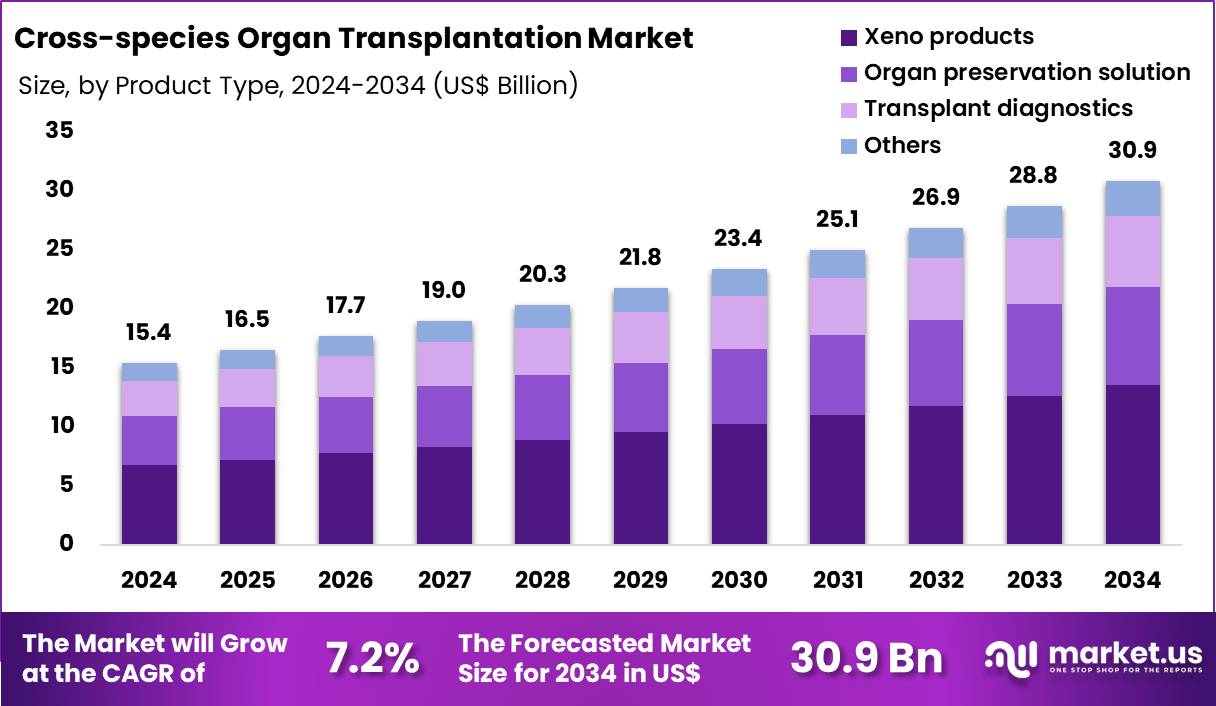
Key Takeaways
- In 2024, the Cross-species Organ Transplantation Market generated revenue of US$ 15.4 billion and is projected to grow at a CAGR of 7.2%, reaching approximately US$ 30.9 billion by 2034.
- By product type, the market is segmented into xeno products, organ preservation solutions, transplant diagnostics, and others. Xeno products dominated the segment in 2024, accounting for a 43.8% market share.
- Based on application, the market is categorized into kidney, heart, lung, liver, and others. The kidney segment held the leading position in 2024, representing a significant 48.3% share of the market.
- By end user, the market is segmented into transplant centers, hospitals, and others. Transplant centers dominated the market in 2024, capturing the largest revenue share of 54.2%.
- Regionally, North America dominated the global Cross-species Organ Transplantation Market in 2024, accounting for approximately 39.7% of the total market share, supported by advanced transplantation research and healthcare infrastructure.
Market Segmentation Overview
- Product Type Analysis: Xeno products, with a 43.8% market share in 2024, are expected to remain dominant as genetically modified animal-derived organs address critical donor shortages. Advances in gene editing, immune modulation, and pathogen control are improving compatibility and graft safety. Porcine organs are receiving significant research attention because of their physiological similarities to humans, supporting continued development of xenotransplantation solutions.
- Application Analysis: Kidney applications, accounting for 48.3% in 2024, are projected to lead the market because kidney failure represents a major cause of transplant demand. Xenogeneic kidneys are receiving substantial research attention due to their clinical need and comparatively established experimental evidence. Improvements in graft survival, immunosuppression, and transplantation protocols are further supporting kidney-focused xenotransplantation development.
- End-User Analysis: Transplant centers, holding 54.2% of the market in 2024, are expected to remain the leading end-user segment because xenotransplantation requires specialized surgical teams, advanced monitoring, and controlled clinical environments. These centers increasingly participate in experimental transplantation programs, clinical research, and post-transplant monitoring. Growing collaborations with biotechnology companies and research institutions are further strengthening their role.
Statistical Information
- United States Organ Shortage Exceeds One Hundred Thousand Patients: More than 100,000 people remain on the U.S. organ-transplant waiting list. In 2025, the U.S. transplant system completed 49,064 organ transplants, indicating that demand still substantially exceeds available donor-organ supply. This deficit is the core commercial and clinical rationale for cross-species transplantation, gene-edited porcine organs, biosecure donor herds, immunosuppression, transplant monitoring, and xenograft-manufacturing infrastructure.
- FDA Cleared First Registration Oriented Xenokidney Clinical Study: FDA cleared United Therapeutics’ investigational new-drug application for the UKidney clinical study in 2025. The first study cohort includes 6 end-stage renal-disease patients at 2 transplant centres. If results are supportive, enrolment can expand to up to 50 participants. The investigational kidney is derived from a pig with 10 gene edits and is intended to support a future FDA Biologics License Application.
- Gene Editing Increased Preclinical Kidney Xenograft Survival To Two Years: In nonhuman-primate studies, kidneys from pigs with 69 genetic edits achieved survival up to 2 years. In the first living-human pig-kidney transplant described in 2024, the recipient produced 3 litres of urine within the first 24 hours, was discharged without dialysis after 20 days, and survived 52 days before a sudden cardiac event while the kidney remained functional.
- Gene-Edited Pig Kidneys Produced Urine Within Four Minutes: In a seven-day study involving a brain-dead human recipient, genetically modified pig kidneys began producing urine within 4 minutes of reperfusion. The kidneys produced more than 37 litres of urine during the first 24 hours. At the end of the 7-day study, serum creatinine was 0.9 mg/dL and creatinine clearance was 200 mL/min, indicating sustained filtration function.
- Seventeen Americans Die Daily While Awaiting Transplant Organs: According to Harvard Medical School reporting based on UNOS data, more than 100,000 people in the United States await an organ transplant and approximately 17 people die each day while waiting. At Massachusetts General Hospital alone, more than 1,400 patients were waiting for a kidney transplant. These figures demonstrate the unmet demand that gene-edited porcine-organ programmes seek to address.
- United Kingdom Active Transplant Waitlist Reached Record Eight Thousand: NHS Blood and Transplant reported 8,096 active transplant-waiting-list patients in the United Kingdom as of 31 March 2025, including 276 children. A further 3,883 patients were temporarily suspended from the list, producing a total population of approximately 11,979 people awaiting or temporarily unavailable for transplant. The record waitlist highlights the potential need for alternative organ-supply technologies.
Regional Analysis
North America led the market by securing a market share of 39.7% in 2024.
North America dominated the Cross-species Organ Transplantation Market with a 39.7% share in 2024, supported by advanced biotechnology, strong clinical research infrastructure, and increasing investments in xenotransplantation. The U.S. FDA recognizes pigs as promising donor sources for kidneys, skin, and pancreatic islets.
The region also faces significant transplant demand, with approximately 10 patients dying every day in the U.S. while awaiting lifesaving organ transplants. Asia Pacific is projected to record the highest CAGR during the forecast period, driven by expanding research programs, government support, and technological advances in gene editing.
China reported Asia’s first gene-edited pig-kidney transplant into a human recipient in 2025, with the transplanted kidney functioning for more than 200 days. China also conducted a gene-edited pig-liver transplantation study with a 10-day observation period. These developments demonstrate the region’s increasing capabilities and potential for accelerating xenotransplantation research.
Business Opportunities
The Cross-species Organ Transplantation Market presents significant business opportunities as organ shortages encourage investment in alternative transplantation technologies. Gene-edited pig organ development represents a major opportunity, with companies focusing on improving immune compatibility, reducing rejection, and enhancing graft survival. Clinical trial services can expand as biotechnology companies and transplant centers evaluate xenogeneic kidneys, hearts, livers, and lungs.
The development of advanced immunosuppressive therapies offers another opportunity to improve long-term transplant outcomes while reducing complications. Growing xenotransplantation programs also create demand for organ preservation and perfusion technologies capable of maintaining organ quality during transportation. Specialized pathogen screening and diagnostic systems can support biosafety requirements before and after transplantation.
In addition, regulatory consulting, clinical monitoring, and ethical assessment services may experience increasing demand as clinical programs expand. Asia Pacific offers further opportunities through growing research capabilities, government funding, biotechnology partnerships, and specialized transplantation infrastructure, particularly in emerging xenotransplantation programs across China and Japan.
Emerging Trends
- Gene-edited pig organs: Multi-gene editing is improving pig-organ compatibility with humans and reducing immune rejection, making genetically modified kidneys, hearts, and livers increasingly important for future transplantation.
- Kidney xenotransplantation trials: Kidney applications are moving toward human clinical studies because of high transplant demand. Recent research has demonstrated prolonged kidney function in experimental recipients, strengthening confidence in xenotransplantation.
- Advanced immune management: Researchers are combining genetic modifications with improved immunosuppressive therapies to control rejection, support graft survival, and improve the safety of cross-species transplantation procedures.
- Stronger infection monitoring: Xenotransplantation programs increasingly use intensive pathogen screening before transplantation and continuous monitoring afterward to reduce risks associated with animal-derived infectious agents.
- Improved organ preservation: Advanced perfusion and preservation technologies are being developed to maintain organ quality, assess organ function, and potentially extend the time available for transportation before transplantation.
Use Cases
- Kidney transplantation: Genetically modified pig kidneys are being studied as an alternative for patients with end-stage kidney disease. In one human case, a pig kidney maintained essential functions for 51 days, including waste removal and electrolyte regulation.
- Heart replacement: Pig hearts are being evaluated for patients with severe heart failure who have limited human-donor options. Clinical experience since 2022 has demonstrated technical feasibility while highlighting the need for better immune control and infection monitoring.
- Liver support: Genetically modified pig livers can potentially provide temporary support for patients with severe liver failure while they recover or wait for a human donor. A 2025 study reported liver function for 10 days in a brain-dead recipient.
- Diabetes treatment: Pig pancreatic islets are being investigated as a potential cell-based treatment for diabetes. The FDA specifically identifies pancreatic islets among pig-derived products being studied for human xenotransplantation.
- Skin replacement: Pig skin can be used as a potential temporary biological covering for severe wounds and burns. The FDA lists pig skin among xenotransplantation products, creating opportunities for wound-care applications where suitable human tissue is limited.
Recent Development
- On May 15, 2026, United Therapeutics Corporation announced that the U.S. FDA cleared its IND application to begin the first human clinical trial of its UHeart™ xenotransplantation program. The investigational heart is derived from a pig with 10 gene edits, and the EXPRESS study will initially enroll up to 2 participants.
- On June 22, 2026, eGenesis Inc. announced the appointment of Glenn S. Vraniak as Chief Financial Officer and Jennifer Bergheiser as Chief Commercial Officer, strengthening its leadership as the company advances gene-edited porcine organs toward clinical development. eGenesis currently has 3 major organ programs covering kidney, liver, and heart.
- In February 2026, eGenesis-supported research published in Nature Medicine evaluated extracorporeal liver cross-circulation using genetically modified pig livers in brain-dead human recipients. The research explored whether pig livers could provide temporary liver support while researchers assess safety and functional performance.
- In April 2026, United Therapeutics presented new xenotransplantation data at the 46th ISHLT Annual Meeting in Toronto. The company reported research covering its xenotransplantation and ex-vivo lung perfusion programs, demonstrating continued development across multiple transplant applications.
- In 2026, eGenesis continued advancing its pipeline of gene-edited porcine organs, with programs covering EGEN-2784 kidney, EGEN-5784 liver, and EGEN-4467 heart. The company’s pipeline includes research, preclinical, IND-enabling, and clinical-stage activities, indicating broader development beyond kidney transplantation.
Frequently Asked Questions About Cross-species Organ Transplantation
- Why is cross-species organ transplantation important?
Xenotransplantation could help address the shortage of human donor organs. In the United States, more than 100,000 people need organ transplants, creating strong demand for alternative organ sources such as genetically modified pig kidneys, hearts, and livers. - Which region leads the market?
North America dominated the Cross-species Organ Transplantation Market with a 39.7% share in 2024. Strong biotechnology capabilities, advanced transplantation infrastructure, clinical research, and regulatory developments in the United States support regional market leadership. - Which region is expected to grow fastest?
Asia Pacific is expected to record the highest CAGR during the forecast period. Increasing biotechnology investments, government-supported research, and advances in gene editing are supporting xenotransplantation development across countries including China and Japan. - What animals are mainly used for xenotransplantation?
Pigs are the primary animals investigated for xenotransplantation because their organs have anatomical and physiological similarities to human organs. Genetic modification can further improve compatibility, reduce immune rejection, and address specific biological barriers. - What role does gene editing play?
Gene editing technologies such as CRISPR help researchers modify donor pigs by removing genes associated with immune rejection and adding human genes that improve compatibility. Some advanced donor pigs contain 10 genetic modifications for transplantation research. - What are the major business opportunities?
Major opportunities include gene-edited organ development, immunosuppressive therapies, organ preservation, pathogen testing, clinical trials, and specialized transplantation services. Growing research programs are also creating opportunities for biotechnology partnerships and advanced transplantation infrastructure.
Conclusion
The Cross-species Organ Transplantation Market is entering an important phase of development as advances in gene editing, immunosuppressive therapies, and organ preservation address critical donor shortages. Valued at US$15.4 billion in 2024, the market is projected to reach US$30.9 billion by 2034, expanding at a 7.2% CAGR.
Xeno products led with 43.8%, while kidney applications accounted for 48.3% and transplant centers represented 54.2%. North America dominated with a 39.7% share in 2024, while Asia Pacific is expected to experience the fastest growth. Continued clinical research, regulatory progress, and biotechnology innovation will remain essential for overcoming rejection, infection, ethical, and safety challenges.
Discuss your needs with our analyst
Please share your requirements with more details so our analyst can check if they can solve your problem(s)




