


Overview
New York, NY – Sep 18, 2026 – The Global Bleeding Control Kit Market size is expected to be worth around US$ 5.7 Billion by 2034 from US$ 4.3 Billion in 2024, growing at a CAGR of 2.9% during the forecast period 2025 to 2034. In 2024, North America led the market, achieving over 40.2% share with a revenue of US$ 1.7 Billion.
Bleeding Control Kit is witnessing steady growth due to increasing emphasis on emergency preparedness, trauma care, and public safety initiatives. Bleeding control kits are designed to provide immediate treatment for life-threatening hemorrhage and generally include tourniquets, hemostatic gauze, compression bandages, trauma dressings, gloves, and shears.
According to global trauma statistics, injuries account for approximately 4.4 million deaths annually, representing nearly 8% of all deaths worldwide, while uncontrolled bleeding remains one of the leading causes of preventable trauma fatalities.
Studies indicate that timely bleeding control can improve survival rates by up to 20–30% in severe trauma cases when intervention is provided before emergency medical services arrive. These factors are encouraging governments, hospitals, educational institutions, and workplaces to expand the availability of bleeding control kits.
Growing investments in emergency medical infrastructure and public access trauma programs are further supporting market expansion. Hospitals contribute nearly 48% of total end-user demand, while emergency medical services and military organizations account for approximately 27% of market consumption.
Public facilities, including airports, schools, sports venues, and commercial buildings, represent around 18% of installations as bleeding control stations become more common. North America holds nearly 40% of the global market, followed by Europe with approximately 29%, supported by advanced trauma systems and widespread emergency response training.
A standard bleeding control kit typically contains 6–12 essential medical components and is designed to provide immediate care during the critical 5–10 minutes following a traumatic injury. Increasing workplace safety regulations, rising road traffic accidents exceeding 20 million serious injuries annually worldwide, and growing awareness of hemorrhage control training are expected to sustain strong demand for bleeding control kits throughout the forecast period.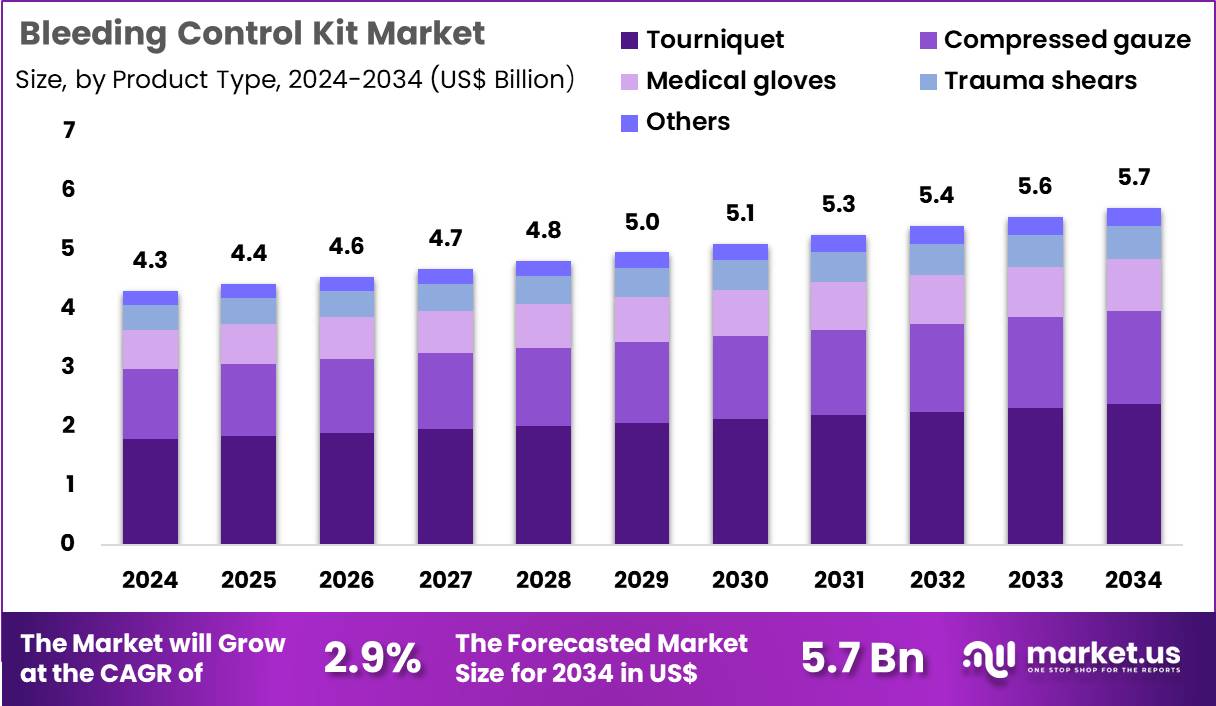
Key Takeaways
- The global Bleeding Control Kit market was valued at US$ 4.3 billion in 2024 and is projected to reach US$ 5.7 billion by 2034, expanding at a CAGR of 2.9% during the forecast period.
- By product type, the market is segmented into tourniquet, medical gloves, trauma shears, compressed gauze, and others, with the tourniquet segment dominating the market with a 41.8% share in 2024.
- Based on end user, the market is categorized into hospitals & clinics, industries & corporate offices, sports academies, aviation, and others, with hospitals & clinics accounting for the largest 52.9% market share in 2024.
- North America emerged as the leading regional market, capturing 40.2% of the global market share in 2024.
Market Segmentation Overview
- Product Type Analysis: Tourniquet accounted for 41.8% of the Bleeding Control Kit market in 2024, making it the leading product category due to its ability to rapidly stop severe blood loss before advanced medical care arrives. Increasing emergency preparedness programs, expanding first-responder training, and greater placement of bleeding control kits in schools, airports, and workplaces continue to drive adoption. Demand is also supported by the growing incidence of trauma and accident-related injuries worldwide.
- End-User Analysis: Hospitals & clinics captured 52.9% of the global market in 2024, supported by rising emergency room visits, surgical procedures, and trauma-related admissions. These facilities maintain bleeding control kits as part of standard emergency care, ensuring immediate access during critical situations. Continuous investments in healthcare infrastructure, staff training, and trauma management protocols are expected to sustain the segment’s leadership throughout the forecast period.
Statistical Information
- Tourniquet Skills Declined Thirty-One Percentage Points After Training: Evidence cited in the trauma review showed correct tourniquet application decreased from 100% immediately after training to 69% after 6 months, a decline of 31 percentage points. In a separate randomised trial, only 54.5% of 303 laypersons correctly applied a tourniquet 3–9 months after training. These findings support recurring refresher training and practice-tourniquet purchases alongside kit deployment.
- Layperson Training Studies Included More Than Fifteen Thousand Participants: A systematic review assessed 36 studies of Stop the Bleed training, covering a total population of 15,406 participants. Individual study sizes ranged from 10 laypersons to 4,324 law-enforcement responders. Across 43 training sessions involving 345 laypersons, 73% reported increased confidence in controlling severe bleeding. This evidence supports continuing kit purchases paired with recurring public training programmes
- Community Training Network Includes More Than One Hundred Thousand Instructors: Since its 2015 launch, Stop the Bleed has developed a network of more than 117,000 certified instructors. Training classes commonly last around 90 minutes and teach direct pressure, wound packing, and tourniquet application. The instructor network supports sustained kit demand because training programmes frequently include hands-on equipment use, public distribution of kits, replacement of training supplies, and periodic community refresher courses.
- Major Trauma Patients Waited Nearly One Hour For Definitive Care: A North American study of 680 patients predicted to require massive transfusion found median time to definitive emergency-department care was 57 minutes. Median emergency-responder arrival was 6 minutes, followed by 27 minutes from scene departure to hospital arrival. Total definitive-care delays ranged from 12 to 232 minutes, demonstrating why public-access bleeding kits can bridge the initial prehospital treatment gap.
- Hemorrhage Caused Eighty One Percent Of Early Trauma Deaths: Among 680 critically injured patients, 100 died within 24 hours, representing 14.7% mortality. Of these early deaths, 81 patients, or 81%, died from exsanguination or haemorrhage. The study estimates that nearly one-quarter of deaths from uncontrolled haemorrhage may be preventable. This supports kit deployment, bystander education, and rapid use of tourniquets, pressure dressings, and wound-packing gauze.
- Limb Injuries Create Direct Tourniquet and Gauze Kit Demand: In the trauma study, 18.2% of bleeding sources were located in limbs or extremities, while 11.4% involved the pelvis, 20.4% the chest, and 44.3% the abdomen. Tourniquets were used prehospital in 43 cases, or 18.4% of patients receiving a prehospital intervention. Extremity injuries are particularly relevant because trained bystanders can apply tourniquets before hospital arrival.
Regional Analysis
North America led the market by securing a market share of 40.2% in 2024.
North America led the global Bleeding Control Kit market with a 40.2% share in 2024, supported by advanced trauma care infrastructure, widespread adoption of emergency preparedness programs, and strong government initiatives. The Stop the Bleed® campaign continues to increase public access to bleeding control kits in schools, airports, workplaces, and public venues.
According to the Centers for Disease Control and Prevention (CDC), 227,039 unintentional injury deaths were recorded in the United States in 2022, reinforcing the need for rapid hemorrhage management.
Asia Pacific is projected to witness the fastest growth during the forecast period due to expanding healthcare infrastructure, rising road traffic and industrial accidents, and increasing investments in emergency medical services. The World Health Organization (WHO) reports that injuries and violence cause nearly 1 million deaths annually in the Western Pacific Region. Growing first-aid awareness, government healthcare investments, and improved availability of trauma care products are expected to accelerate regional market expansion.
Business Opportunities
The Bleeding Control Kit market presents significant business opportunities as governments, healthcare providers, educational institutions, and private organizations increase investments in emergency preparedness. Expanding workplace safety regulations and public access trauma programs are creating demand for bleeding control kits in schools, airports, shopping malls, sports venues, and industrial facilities.
Manufacturers have opportunities to develop lightweight, compact, and easy-to-use kits equipped with advanced tourniquets, hemostatic dressings, and smart labeling systems. The growing adoption of first-aid and hemorrhage control training is also encouraging bulk procurement by corporations and public safety agencies. Emerging economies offer strong growth potential due to improving healthcare infrastructure and rising awareness of trauma management.
Partnerships with hospitals, emergency medical service providers, military organizations, and government agencies can strengthen market presence. Additionally, innovations such as eco-friendly packaging, RFID-enabled inventory tracking, and customized kits for different industries are expected to create new revenue streams while expanding the global customer base and supporting long-term market growth.
Emerging Trends
- Expansion of Public Bleeding Control Programs: Governments and healthcare organizations are increasing the installation of bleeding control kits in schools, airports, workplaces, and public buildings. The STOP THE BLEED® program has trained over 5 million people worldwide, improving emergency preparedness.
- Growing Adoption of Advanced Tourniquets: Modern tourniquets with faster application mechanisms and improved durability are becoming standard in trauma kits. According to NCBI, timely tourniquet use can achieve survival rates of about 92% in patients with severe extremity bleeding.
- Rising Demand for Compact Trauma Kits: Lightweight and portable bleeding control kits containing 5–10 essential components are gaining popularity among emergency responders, law enforcement agencies, and industrial workplaces for rapid hemorrhage management.
- Increase in Community First-Aid Training: Healthcare authorities are expanding bleeding control education for teachers, employees, and the general public. Many STOP THE BLEED® training sessions can be completed in approximately 90 minutes, enabling faster bystander response.
- Integration with Workplace and Disaster Preparedness: Organizations are including bleeding control kits in occupational safety and emergency response plans. The CDC reported 227,039 unintentional injury deaths in the U.S. in 2022, highlighting the growing need for immediate hemorrhage control resources.
Use Cases
- Emergency Medical Services (EMS): Ambulances and first responders carry bleeding control kits to manage severe hemorrhage before patients reach hospitals. Rapid intervention during the first 5–10 minutes can significantly improve survival in trauma emergencies.
- Hospitals and Trauma Centers: Hospitals use bleeding control kits in emergency rooms, operating theaters, and trauma units. With 52.9% of market demand coming from hospitals and clinics, these kits support immediate stabilization of critically injured patients.
- Schools and Educational Institutions: Schools and universities are installing bleeding control kits alongside AEDs as part of emergency preparedness programs. The STOP THE BLEED® initiative has trained over 5 million people globally, increasing readiness for medical emergencies.
- Industrial and Construction Workplaces: Manufacturing plants, warehouses, and construction sites use bleeding control kits to respond quickly to machinery and equipment-related injuries, helping reduce complications from severe workplace bleeding.
- Public Venues and Transportation Hubs: Airports, stadiums, shopping malls, railway stations, and other crowded locations are deploying bleeding control kits to improve emergency response capabilities and provide immediate care before emergency medical personnel arrive.
Recent Development
- In 2026, North American Rescue, LLC expanded its bleeding control product portfolio with updated public-access bleeding control kits designed for schools, workplaces, and community locations. The kits include essential components such as C-A-T® tourniquets, hemostatic dressings, trauma shears, gloves, and emergency instructions to support rapid hemorrhage control.
- In 2026, SAM Medical continued strengthening its trauma care solutions by focusing on advanced tourniquet technologies and emergency medical equipment for military, EMS, and civilian applications. The company’s products remain aligned with modern tactical trauma requirements, emphasizing faster application and improved usability in critical bleeding situations.
- In 2026, Combat Medical Systems increased focus on battlefield and pre-hospital trauma preparedness by supporting medical teams with portable hemorrhage management solutions. Growing demand from defense organizations and emergency responders is encouraging companies to develop lightweight and durable bleeding control equipment.
- In 2026, Z-Medica (QuikClot) continued advancing hemostatic bleeding control technologies as demand increased for products capable of rapid clot formation during emergencies. Hemostatic dressings remain widely used in trauma kits due to their ability to support faster bleeding control in pre-hospital environments.
- In 2026, H&H Medical Corporation and TacMed Solutions benefited from rising adoption of compact trauma kits among military personnel, first responders, and public safety organizations. Increasing emphasis on immediate hemorrhage control is driving innovation in portable, easy-to-use emergency medical products.
- In 2026, Aero Healthcare and Chinook Medical Gear focused on expanding emergency preparedness solutions for industrial, outdoor, and institutional users. Growing demand for workplace safety kits and public-access bleeding control stations is encouraging manufacturers to introduce customized trauma care packages.
Frequently Asked Questions on Bleeding Control Kit
- Why is the Bleeding Control Kit Market growing?
The Bleeding Control Kit Market is expanding due to rising trauma cases, increasing workplace safety requirements, and growing awareness of emergency preparedness. Government initiatives, public access programs, and first-aid training campaigns are encouraging wider adoption across multiple sectors. - What are the major products included in Bleeding Control Kits?
Bleeding Control Kits commonly include tourniquets, compressed gauze, pressure bandages, medical gloves, trauma shears, and emergency instructions. Advanced kits may also contain hemostatic agents and specialized wound management products for faster hemorrhage control during critical situations. - What factors are driving demand for Bleeding Control Kits?
Increasing road accidents, workplace injuries, disaster preparedness programs, and public safety initiatives are major factors driving market demand. Growing awareness about immediate bleeding management and the importance of first responders are further supporting adoption worldwide. - How does government support influence the Bleeding Control Kit Market?
Government initiatives such as public bleeding control programs and emergency preparedness campaigns are increasing awareness and accessibility. Programs like STOP THE BLEED® encourage organizations to install kits and train communities for faster response during severe bleeding emergencies. - Which region dominates the Bleeding Control Kit Market?
North America dominates the Bleeding Control Kit Market with a 40.2% share in 2024. The region benefits from advanced healthcare infrastructure, strong trauma preparedness programs, widespread training initiatives, and increasing installation of bleeding control stations. - How are technological advancements influencing Bleeding Control Kits?
Technological advancements are improving kit efficiency through lightweight designs, advanced hemostatic materials, improved tourniquet systems, and compact packaging. These innovations help emergency responders and non-medical users manage severe bleeding more effectively during critical situations. - What is the future outlook for the Bleeding Control Kit Market?
The future outlook remains positive due to increasing investments in emergency preparedness, expanding public safety programs, and rising demand for trauma management solutions. Product innovation and wider community training are expected to create new growth opportunities.
Conclusion
The Bleeding Control Kit market is experiencing steady growth due to increasing awareness of emergency trauma management, rising injury cases, and expanding public safety initiatives. Tourniquets, hemostatic dressings, and advanced trauma supplies are becoming essential components across hospitals, workplaces, military operations, and public facilities.
North America continues to lead the market with strong healthcare infrastructure and bleeding control programs, while Asia Pacific presents significant growth opportunities through improving emergency care systems.
Government initiatives, first-aid training programs, and technological advancements in compact trauma solutions are expected to further support market expansion. Increasing adoption of accessible bleeding control kits will remain crucial for reducing preventable deaths caused by severe blood loss.
Discuss your needs with our analyst
Please share your requirements with more details so our analyst can check if they can solve your problem(s)




