


Overview
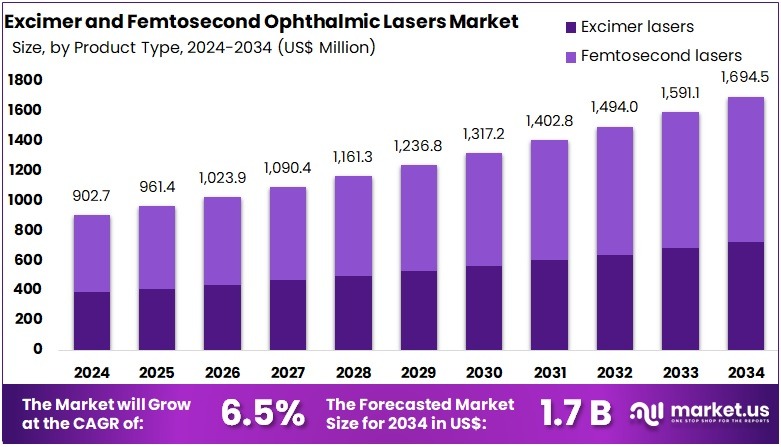
New York, NY – Sep 01, 2026 – The Global Excimer and Femtosecond Ophthalmic Lasers Market size is expected to be worth around US$ 1694.5 Million by 2034, from US$ 902.7 Million in 2024, growing at a CAGR of 6.5% during the forecast period from 2025 to 2034. North America held a dominant market position, capturing more than a 33.4% share and holding US$ 301.5 Million market value for the year.
The global Excimer and Femtosecond Ophthalmic Lasers Market is witnessing strong growth as demand for advanced vision correction procedures and precision eye surgeries continues to rise worldwide. Excimer lasers are widely used in refractive surgeries such as LASIK and PRK to reshape the cornea, while femtosecond lasers enable highly accurate corneal flap creation, cataract surgery, and corneal transplantation with minimal tissue damage. These technologies have significantly improved surgical accuracy, patient safety, and recovery time.
More than 30 million LASIK procedures have been performed globally since the procedure was introduced, reflecting sustained demand for laser-based vision correction. In addition, cataracts remain the leading cause of blindness worldwide, affecting an estimated 65 million people, creating significant demand for advanced ophthalmic laser systems.
Growing adoption of bladeless LASIK, increasing prevalence of refractive errors, rising healthcare expenditure, and continuous technological innovations are supporting market expansion. Integration of image-guided systems, artificial intelligence-assisted planning, and enhanced laser precision is further improving clinical outcomes.
Expanding ophthalmology centers, favorable reimbursement in developed markets, and increasing awareness of minimally invasive eye procedures are expected to create new opportunities for manufacturers throughout the forecast period.
Key Takeaways
- The global Excimer and Femtosecond Ophthalmic Lasers Market is expected to grow from US$ 902.7 million in 2024 to approximately US$ 1,694.5 million by 2034, registering a CAGR of 6.5% during the forecast period.
- Femtosecond lasers led the product segment in 2024, capturing over 57.3% of the global market revenue, supported by their high precision, improved safety profile, and extensive use in ophthalmic surgical procedures.
- Refractive surgery accounted for the largest application share in 2024, holding more than 71.1% of the market as the demand for laser-based vision correction procedures continued to increase worldwide.
- Hospitals remained the dominant end-user segment in 2024, contributing over 46.6% of total market revenue due to their advanced surgical capabilities, specialized ophthalmic departments, and high patient volumes.
- North America held the leading regional position in 2024, accounting for more than 33.4% of the global market and generating approximately US$ 301.5 million in revenue, driven by advanced healthcare infrastructure and strong adoption of laser-assisted eye surgeries.
Market segmentation
- Product Type Analysis: In 2024, femtosecond lasers dominated the product segment with over 57.3% market share, driven by superior precision, reduced tissue damage, and strong adoption in LASIK and cataract surgeries. Excimer lasers maintained steady demand for reliable corneal reshaping, supporting continued growth in refractive ophthalmic procedures.
- Application Analysis: In 2024, refractive surgery accounted for more than 71.1% of the market, fueled by increasing demand for LASIK, PRK, and SMILE procedures. Cataract surgery and other therapeutic applications also expanded steadily, supported by technological advancements, improved clinical outcomes, and growing patient preference.
- End-User Analysis: In 2024, hospitals led the end-user segment with over 46.6% market share, supported by advanced infrastructure and experienced ophthalmologists. Ophthalmology clinics and ambulatory surgical centers expanded steadily, driven by outpatient procedures, cost efficiency, shorter recovery times, and increasing adoption of laser-assisted eye surgeries.
Statistical Information
- A 2025 Scientific Reports study evaluated 81 eyes treated with a 1050 Hz excimer laser during FS-LASIK. Eyes with intraoperative delays of less than 5 seconds achieved significantly better refractive accuracy than procedures delayed 10–60 seconds, highlighting the importance of workflow efficiency.
- The same 2025 study classified procedures into 3 operational delay groups: <5 s, 5–<10 s, and 10–60 s, providing measurable workflow thresholds that directly influenced postoperative refractive precision.
- A 2025 Scientific Reports comparison included 200 eyes from 100 patients, with 100 eyes treated using the VisuMax 800 femtosecond laser and 100 eyes using the VisuMax 500, enabling direct performance comparison between the two laser platforms.
- The 2025 VisuMax comparison reported that 100% of eyes in both laser groups achieved uncorrected distance visual acuity (UDVA) of 20/25 or better at postoperative follow-up, demonstrating excellent refractive performance.
- The same study found that 100% of eyes in both groups achieved corrected distance visual acuity (CDVA) of 20/20 or better, indicating consistently high visual outcomes across both femtosecond laser systems.
- A 2025 JAMA Ophthalmology randomized clinical trial enrolled 196 patients (196 eyes) to compare femtosecond laser arcuate keratotomy with toric intraocular lens implantation for cataract surgery, providing robust operational evidence for laser-assisted ophthalmic procedures.
- A 2025 Diagnostics clinical study compared 500 kHz and 2 MHz femtosecond laser platforms for small lenticule extraction, demonstrating the industry’s transition toward significantly higher pulse repetition frequencies for faster procedures.
Regional Analysis
North America dominated the Excimer and Femtosecond Ophthalmic Lasers Market in 2024, accounting for over 33.4% of global revenue and reaching US$ 301.5 million. The region benefits from advanced ophthalmic infrastructure, widespread availability of FDA-approved laser platforms, and high adoption of laser-assisted refractive and cataract procedures.
Continuous product innovation, strong clinical research, and favorable reimbursement for medically necessary ophthalmic care continue to support market expansion. Recent regulatory approvals, including new excimer laser systems in the U.S., have further strengthened the region’s technology landscape.
Europe remains a significant market, supported by increasing adoption of femtosecond laser-assisted cataract surgery, an aging population, and well-established eye-care services. Asia-Pacific is expected to witness the fastest growth, driven by rising rates of myopia, expanding healthcare infrastructure, growing investments in ophthalmology, and increasing medical tourism across countries such as China, India, South Korea, and Thailand.
Latin America is experiencing gradual adoption, particularly in urban specialty eye hospitals, while the Middle East and Africa continue to expand through investments in advanced ophthalmic centers, especially in Gulf countries. Overall, North America is expected to retain its leadership due to continuous technological innovation, skilled ophthalmic surgeons, and strong integration of advanced laser platforms into routine clinical practice.
Business opportunities
The Excimer and Femtosecond Ophthalmic Lasers Market offers significant business opportunities as the demand for laser-assisted vision correction and precision cataract surgery continues to increase worldwide. Rising prevalence of myopia, hyperopia, astigmatism, and age-related cataracts is encouraging hospitals and eye-care centers to invest in advanced ophthalmic laser platforms. Manufacturers can capitalize on this demand by introducing faster, more compact, and AI-enabled laser systems that improve surgical precision and workflow efficiency.
Emerging economies such as India, China, Brazil, and Southeast Asian countries present strong expansion opportunities due to improving healthcare infrastructure, growing disposable incomes, and increasing awareness of refractive surgery. Partnerships with specialty eye hospitals, ambulatory surgical centers, and ophthalmology clinics can accelerate product adoption. In addition, the expansion of medical tourism for affordable LASIK and cataract procedures is creating demand for high-performance laser technologies.
Another key opportunity lies in developing integrated ophthalmic solutions that combine imaging, diagnostics, treatment planning, and laser systems on a single platform. Service-based business models, including equipment leasing, maintenance contracts, software upgrades, and surgeon training programs, can generate recurring revenue.
Furthermore, continued investment in femtosecond laser innovations for corneal transplantation, glaucoma treatment, and premium cataract procedures will help manufacturers diversify their product portfolios and strengthen their competitive position in the global ophthalmic laser market.
Emerging Trends
- Higher-speed femtosecond laser platforms are improving surgical efficiency: New systems operating at 2 MHz are being evaluated against 500 kHz platforms, enabling faster lenticule creation while maintaining comparable visual outcomes in refractive surgery.
- Regulatory approvals are expanding advanced excimer laser access: In March 2025, the FDA approved the WaveLight EX500 for LASIK, while approved systems treat myopia up to −10.00 D, hyperopia up to +4.00 D, and astigmatism up to 4.00 D in eligible adults.
- Workflow optimization is becoming a clinical priority: A 2025 study using a 1050 Hz excimer laser found that maintaining intraoperative delays below 5 seconds produced better refractive accuracy than delays of 10–60 seconds, highlighting the importance of surgical efficiency.
- AI integration is emerging in ophthalmic laser planning: Recent peer-reviewed research highlights AI-assisted optical coherence tomography and personalized treatment planning, supporting more precise laser delivery while reducing variability in refractive and cataract procedures.
- Precision engineering continues to improve laser performance: FDA technical documentation describes ophthalmic femtosecond lasers using sub-picosecond pulses, 15 kHz repetition rates, and focal spot diameters below 6 microns, enabling micron-level tissue cutting with minimal collateral damage.
Use Cases
- Laser-assisted LASIK remains the leading clinical application: FDA-approved excimer systems correct myopia up to −10.00 D, hyperopia up to +4.00 D, and mixed astigmatism up to 4.00 D, providing personalized refractive correction for adult patients.
- Femtosecond lasers are increasingly used in cataract surgery: A 2025 meta-analysis confirmed their use for arcuate keratotomy to improve astigmatism correction, supporting greater precision during premium cataract procedures.
- Complex diabetic cataract cases are benefiting from laser-assisted surgery: A 2025 prospective clinical study evaluated femtosecond laser-assisted cataract surgery in 120 eyes, demonstrating growing adoption in patients requiring precise surgical management.
- Corneal transplantation and glaucoma procedures are expanding laser applications: A 2025 ophthalmology review identified femtosecond lasers as key tools for corneal graft preparation, glaucoma management, presbyopia correction, and pterygium surgery because of their high surgical precision.
- High-volume refractive centers are adopting advanced laser workflows: A 2025 comparative study involving 200 eyes reported that both modern femtosecond laser platforms achieved 100% postoperative uncorrected visual acuity of 20/25 or better, supporting routine use in vision correction clinics.
Recent development
- In January 2025, Carl Zeiss Meditec AG received U.S. FDA approval for the ZEISS MEL 90 Excimer Laser, completing its corneal refractive workflow in the U.S. by integrating the MEL 90 with the VISUMAX 800 femtosecond laser for LASIK and SMILE procedures.
- In July 2025, Ziemer Ophthalmic Systems AG launched a new patient education website to improve awareness of laser-based refractive and cataract procedures and support the adoption of its FEMTO LDV and Z8 laser platforms.
- In August 2025, Ziemer Ophthalmic Systems AG highlighted new clinical applications of its Z8 platform for pediatric cataract surgery, demonstrating broader use of femtosecond laser technology in ophthalmic surgery.
- In September 2025, Alcon Inc. showcased its expanded WaveLight Plus, WaveLight Femtosecond, WaveLight Excimer, and LenSx laser portfolio at the ESCRS 2025 Congress, highlighting new clinical data and reinforcing its refractive and cataract surgery platform.
Frequently Asked Questions On Excimer and Femtosecond Ophthalmic Lasers
- What is driving the growth of the Excimer and Femtosecond Ophthalmic Lasers Market?
The market is expanding due to rising cases of myopia, hyperopia, astigmatism, and cataracts. Increasing demand for minimally invasive eye surgeries, technological advancements, growing healthcare investments, and greater patient awareness are also supporting market growth globally. - What are the major applications of Excimer and Femtosecond Ophthalmic Lasers?
These laser systems are widely used for LASIK, PRK, SMILE, femtosecond laser-assisted cataract surgery, corneal transplantation, and other precision ophthalmic procedures. Their versatility enables surgeons to perform highly accurate treatments with improved visual outcomes and faster recovery. - Which end-users are the primary adopters of these laser systems?
Hospitals, ophthalmology clinics, and ambulatory surgical centers are the primary users of excimer and femtosecond ophthalmic lasers. Hospitals lead adoption because of advanced surgical infrastructure, while specialty clinics increasingly utilize these systems for outpatient refractive procedures. - Which region currently leads the Excimer and Femtosecond Ophthalmic Lasers Market?
North America remains the leading regional market due to its advanced healthcare infrastructure, strong adoption of laser-assisted eye surgeries, skilled ophthalmologists, favorable regulatory environment, and continuous investments in ophthalmic technology and clinical research. - What technological trends are shaping the Excimer and Femtosecond Ophthalmic Lasers Market?
Key trends include AI-assisted surgical planning, high-speed femtosecond laser platforms, image-guided treatment systems, integrated diagnostic technologies, improved laser precision, and digital workflow solutions that enhance efficiency and patient outcomes in ophthalmic surgery. - What is the future outlook for the Excimer and Femtosecond Ophthalmic Lasers Market?
The market is expected to benefit from increasing demand for refractive and cataract surgeries, expanding healthcare infrastructure, continuous laser technology innovation, growing medical tourism, and broader adoption of minimally invasive ophthalmic procedures across emerging and developed economies.
Conclusion
The Excimer and Femtosecond Ophthalmic Lasers Market is experiencing steady growth, driven by the increasing demand for precise, minimally invasive vision correction and cataract procedures. Technological advancements in femtosecond and excimer laser platforms are improving surgical accuracy, patient safety, and recovery times, encouraging wider adoption across hospitals and specialty eye clinics.
The growing prevalence of refractive errors, aging populations, and rising awareness of laser-assisted ophthalmic treatments continue to support market expansion. Femtosecond lasers remain the preferred product segment due to their precision, while refractive surgery continues to account for the largest application share.
North America leads the market with strong healthcare infrastructure and rapid technology adoption, while Asia-Pacific is emerging as a high-growth region due to expanding healthcare access and increasing procedure volumes. Continuous innovation, integration of digital imaging and AI-assisted planning, and investments in advanced ophthalmic care are expected to create long-term opportunities for manufacturers and healthcare providers worldwide.
Discuss your needs with our analyst
Please share your requirements with more details so our analyst can check if they can solve your problem(s)




