


Overview
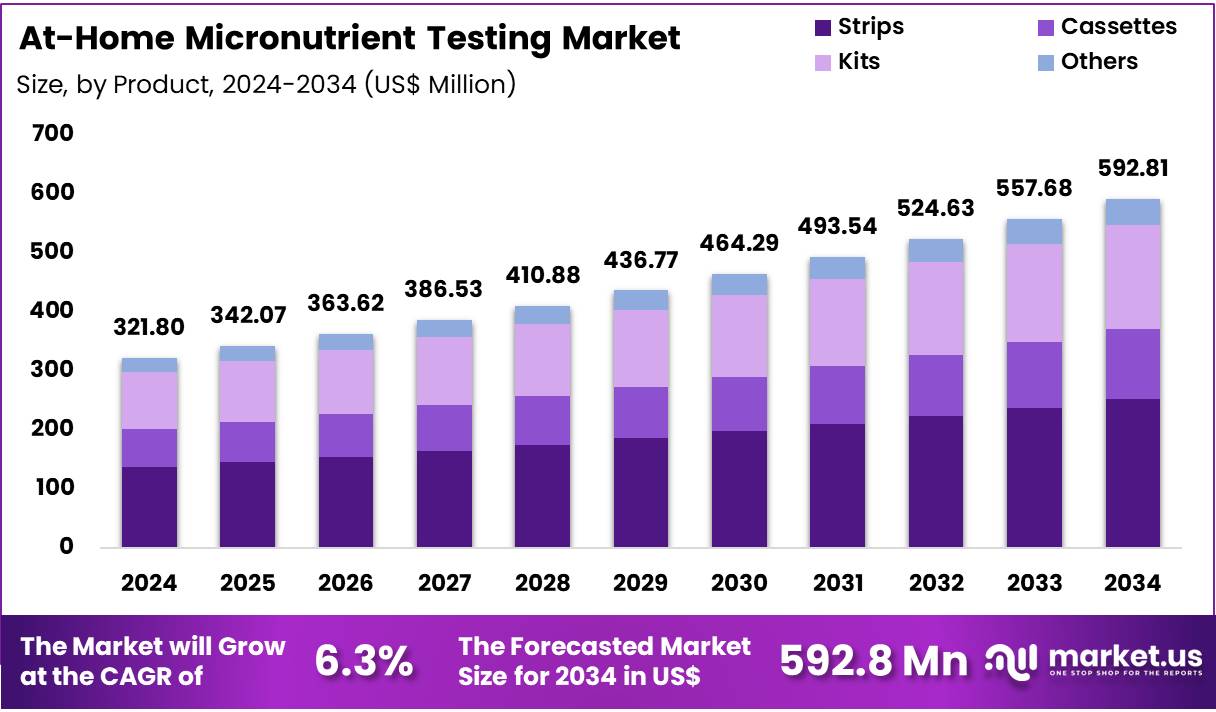
New York, NY – Sep 01, 2026 – Global At-Home Micronutrient Testing Market size is expected to be worth around US$ 592.8 Million by 2034 from US$ 321.8 Million in 2024, growing at a CAGR of 6.3% during the forecast period 2025 to 2034. In 2024, North America led the market, achieving over 39.7% share with a revenue of US$ 127.8 Million.
The global At-Home Micronutrient Testing market is gaining momentum as consumers increasingly seek convenient, preventive, and personalized health monitoring solutions. These test kits allow individuals to measure essential vitamins and mineral levels, including vitamin D, vitamin B12, iron, magnesium, and folate, using finger-prick blood samples collected at home and analyzed by certified laboratories. The growing adoption of telehealth, digital health platforms, and personalized nutrition services is further supporting market expansion.
According to the World Health Organization (WHO), micronutrient deficiencies affect more than 2 billion people worldwide, making early nutritional assessment an important public health priority. Iron deficiency remains the most common nutritional deficiency globally, while vitamin D insufficiency affects a significant share of the population across many countries.
In the United States, the Centers for Disease Control and Prevention (CDC) reports that nearly 10% of women aged 12–49 years have iron deficiency, highlighting the need for accessible screening solutions. At-home testing offers faster sample collection, digital result delivery, and personalized recommendations without requiring a clinic visit.
The market is also benefiting from advancements in dried blood spot (DBS) technology, laboratory automation, and smartphone-enabled health platforms that improve testing accuracy and user experience.
Rising consumer awareness of preventive healthcare, increasing healthcare expenditure, and expanding availability of direct-to-consumer diagnostic services are expected to create strong growth opportunities. As personalized wellness and remote healthcare continue to evolve, at-home micronutrient testing is expected to become an increasingly important component of routine health management.
Key Takeaways
- In 2024, the At-Home Micronutrient Testing market was valued at US$ 321.8 million and is projected to reach US$ 592.8 million by 2034, expanding at a CAGR of 6.3% during the forecast period.
- By Product, the market is segmented into Strips, Cassettes, Kits, and Others. Among these, Strips dominated the market in 2024, accounting for 42.5% of the total market share.
- By Micronutrient Type, the market is categorized into Vitamins, Minerals, and Comprehensive Panels. The Vitamins segment held the largest share, contributing 51.7% of the market in 2024.
- By Distribution Channel, the market comprises Hospital Pharmacies, Online Pharmacies, Retail Pharmacies, Hypermarkets, and Others. Online Pharmacies emerged as the leading distribution channel, capturing 43.5% of the market share in 2024.
- North America dominated the global At-Home Micronutrient Testing market in 2024, securing the largest regional market share of 39.7%.
Market segmentation
- Product Analysis: Strips led the at-home micronutrient testing market with a 42.5% share in 2024 due to their affordability, ease of use, and rapid results. They enable convenient self-testing for vitamins and minerals, making them highly popular among health-conscious consumers seeking routine nutritional monitoring.
- Micronutrient Type Analysis: Vitamins accounted for the largest market share of 51.7% in 2024 because vitamin D, B12, and folate deficiencies are common worldwide. Rising preventive healthcare awareness, personalized nutrition trends, and easy-to-use home testing kits continue to drive strong consumer demand for vitamin testing.
- Distribution Channel Analysis: Online pharmacies captured 43.5% of the market in 2024, supported by convenient ordering, broad product availability, and home delivery. Digital platforms also offer telehealth support, personalized recommendations, subscription services, and competitive pricing, encouraging greater adoption of at-home micronutrient testing kits.
Statistical Information
- A 2025 peer-reviewed validation study found a Pearson correlation coefficient of 0.976 between dried blood spot (DBS) and plasma measurements for 25-hydroxyvitamin D₃, indicating excellent analytical agreement for at-home sample collection.
- The same 2025 study reported that DBS vitamin D measurements were, on average, 6% lower than plasma measurements (95% CI: 2%–13%), demonstrating predictable analytical bias suitable for correction.
- The LC-MS/MS assay used for at-home DBS vitamin D testing achieved a calibration linearity (R²) of 0.9988 across a measurement range of 5–125 ng/mL in plasma validation.
- For dried blood spot samples, the analytical method achieved an R² of 0.9967 across the same 5–125 ng/mL concentration range, confirming high analytical performance for home-collected specimens.
- The validated assay demonstrated an analytical accuracy ranging from 95.02% to 101.3% during plasma quality-control testing.
- The intra-assay precision of the LC-MS/MS vitamin D method ranged between 5.0% and 6.4%, indicating consistent repeatability for micronutrient measurements.
- The assay achieved a limit of detection (LOD) of 1 ng/mL and a limit of quantification (LOQ) of 5 ng/mL for vitamin D measurement from dried blood spots.
- Quality assessment samples showed analytical bias ranging from −3.32% to +3.26%, demonstrating stable laboratory performance for vitamin D testing.
Regional Analysis
North America Dominates the At-Home Micronutrient Testing Market
North America accounted for the largest share of the at-home micronutrient testing market in 2024, supported by advanced healthcare infrastructure, widespread adoption of digital health technologies, and strong consumer awareness of preventive healthcare. The region has a high prevalence of vitamin D, vitamin B12, and iron deficiencies, encouraging consumers to use convenient home-based testing kits for routine nutritional monitoring.
According to the Centers for Disease Control and Prevention (CDC), iron deficiency affects nearly 10% of U.S. women aged 12–49 years, while the National Institutes of Health (NIH) reports that vitamin D inadequacy remains common across several population groups. The widespread availability of CLIA-certified laboratories, telehealth services, and direct-to-consumer diagnostic platforms further supports market growth.
Additionally, strong e-commerce penetration and insurance coverage for certain diagnostic services have improved access to home testing solutions. Continuous product innovation and growing consumer demand for personalized nutrition reinforce North America’s leadership in the global at-home micronutrient testing market.
Asia Pacific is Expected to Register the Fastest Growth
Asia Pacific is projected to witness the highest growth during the forecast period due to increasing health awareness, expanding digital healthcare ecosystems, and rising demand for preventive wellness solutions. Countries such as China, India, Japan, and South Korea are experiencing rapid adoption of at-home diagnostic services, supported by growing internet penetration and flourishing e-commerce platforms.
According to the World Health Organization (WHO), micronutrient deficiencies remain a major public health concern across many Asian countries, increasing demand for accessible nutritional screening. Urban lifestyles, changing dietary habits, and limited sunlight exposure have also contributed to higher rates of vitamin D deficiency in several parts of the region.
Government initiatives promoting digital health, combined with expanding telemedicine services and online pharmacy networks, are improving access to home-based micronutrient testing. The entry of regional diagnostic companies and personalized nutrition providers is expected to further accelerate market growth across Asia Pacific.
Business opportunities
The At-Home Micronutrient Testing Market presents significant business opportunities as consumers increasingly prioritize preventive healthcare, personalized nutrition, and convenient home-based diagnostics.
Companies can expand their offerings by integrating at-home testing kits with telehealth consultations, AI-powered nutrition recommendations, and customized supplement subscription services, creating recurring revenue streams and stronger customer engagement.
Growing adoption of e-commerce and retail pharmacy partnerships is improving product accessibility, while expansion into emerging markets offers substantial growth potential due to rising health awareness and digital healthcare adoption.
Additionally, employers are incorporating home testing into corporate wellness programs to promote employee health and reduce healthcare costs. Manufacturers can further differentiate themselves by developing comprehensive multi-nutrient testing panels and mobile health platforms that provide continuous monitoring, personalized insights, and long-term wellness management, strengthening their competitive position in the evolving digital health ecosystem.
Emerging Trends
- Growing Demand for Preventive Health Monitoring: Consumers are increasingly using at-home micronutrient tests to identify vitamin and mineral deficiencies before symptoms appear. The CDC’s 2026 National Nutrition Report measures 131 biochemical indicators, highlighting the growing importance of biomarker-based nutrition monitoring and supporting demand for home testing solutions.
- Expansion of Personalized Nutrition Services: Home testing companies are pairing blood biomarker results with personalized diet plans and supplement recommendations. Recent U.S. data show vitamin D inadequacy among supplement users declined from 12.8% to 5.8%, encouraging personalized nutrition programs based on individual micronutrient status rather than general supplementation.
- Integration with Digital Health Platforms: At-home micronutrient testing is increasingly connected with mobile apps, cloud-based reports, and telehealth consultations. The FDA recognizes home-use tests as valuable tools for early detection and health monitoring, supporting wider digital healthcare adoption while emphasizing professional follow-up when needed.
- Broader Multi-Nutrient Testing Panels: Testing providers are expanding beyond single-vitamin analysis to comprehensive nutrient panels covering vitamins, minerals, trace elements, and fatty acids. The CDC’s latest nutrition surveillance includes 69 fat-soluble, 22 water-soluble nutrient biomarkers, plus 7 iron indicators, reflecting growing interest in comprehensive nutritional assessment.
- Greater Focus on Accurate Supplement Management: Consumers increasingly use home micronutrient tests to avoid both deficiencies and excessive supplement intake. Recent NHANES analysis found the proportion of people with vitamin D levels considered high increased from 2.2% to 7.6%, emphasizing the need for evidence-based supplementation guided by testing.
Use Cases
- Monitoring Vitamin and Mineral Deficiencies: Individuals use at-home kits to measure nutrients such as vitamin D, vitamin B12, folate, and iron through finger-prick blood samples. The CDC identifies micronutrients as essential for healthy development, immunity, and disease prevention, supporting routine nutritional assessment.
- Personalized Supplement Planning: Healthcare professionals use home test reports to recommend customized supplement dosages instead of standard multivitamins. Research found that vitamin D inadequacy among users of multiple vitamin D supplements fell to 5.8%, demonstrating the value of individualized supplementation strategies.
- Remote Clinical Nutrition Management: Telehealth providers use home-collected micronutrient data to review patient nutrition remotely and recommend dietary changes without requiring frequent clinic visits. FDA guidance supports home-use tests as an effective monitoring tool when combined with healthcare provider oversight.
- Maternal and Child Nutrition Assessment: Pregnant women and parents use micronutrient testing to monitor nutrients such as iron, folate, and vitamin D that are essential during pregnancy and early childhood. The CDC recommends 400 IU/day of vitamin D for infants younger than 12 months.
- Corporate Wellness and Preventive Healthcare Programs: Employers and wellness providers increasingly include nutrition screening within preventive health initiatives. The CDC’s latest nutrition report evaluates 131 biochemical markers, providing scientific support for broader workplace nutrition monitoring and targeted wellness interventions.
Recent development
- May 2025: Thorne launched its On-the-Go Sports Performance product line through a campaign featuring tennis player Ben Shelton, expanding its personalized nutrition and wellness ecosystem that complements micronutrient testing services.
- June 2025: Labcorp launched Labcorp Whole Health Solutions, introducing specialized laboratory panels with more than 1,000 biomarkers covering micronutrients, hormones, cardiometabolic health, longevity, and wellness, strengthening its functional and preventive testing portfolio.
- July 2026: Labcorp launched the Marker by Labcorp™ Genetic Health Panel, expanding direct-to-consumer health testing with hereditary risk assessment and strengthening its consumer diagnostics portfolio.
- September 2025: Thorne formed a Scientific Advisory Board to accelerate scientific wellness research and innovation, supporting the development of evidence-based personalized health and nutrition solutions.
Frequently Asked Questions on the At-Home Micronutrient Testing
- What factors are driving the growth of the At-Home Micronutrient Testing Market?
The market is growing because of increasing consumer awareness of preventive healthcare, rising demand for personalized nutrition, expanding telehealth services, greater adoption of home diagnostics, and continuous improvements in laboratory testing technologies that provide accurate and convenient health assessments. - Which micronutrients are commonly measured in at-home testing kits?
Most at-home micronutrient tests evaluate nutrients such as vitamin D, vitamin B12, folate, iron, magnesium, zinc, and other essential vitamins and minerals. Some advanced panels also assess antioxidants, fatty acids, and additional nutritional biomarkers. - Who can benefit from At-Home Micronutrient Testing?
At-home micronutrient testing benefits health-conscious individuals, athletes, older adults, people with dietary restrictions, pregnant women under medical guidance, and anyone experiencing symptoms that may be associated with vitamin or mineral deficiencies requiring nutritional evaluation. - How accurate are At-Home Micronutrient Testing kits?
The accuracy of at-home micronutrient testing depends on proper sample collection and analysis by accredited laboratories. Many reputable providers follow standardized laboratory procedures, making results reliable when users carefully follow the kit instructions provided. - What are the major trends shaping the At-Home Micronutrient Testing Market?
Key trends include AI-powered health reports, personalized supplement recommendations, integration with mobile health applications, subscription-based wellness services, expanded multi-nutrient testing panels, and increasing collaboration between diagnostic laboratories and telehealth providers to improve preventive healthcare delivery. - What is the future outlook for the At-Home Micronutrient Testing Market?
The market is expected to expand steadily as preventive healthcare becomes more important worldwide. Increasing digital health adoption, personalized nutrition services, improved home diagnostic technologies, and broader access to telemedicine are likely to support long-term market growth.
Conclusion
The global At-Home Micronutrient Testing Market is experiencing steady growth, driven by rising consumer awareness of preventive healthcare, personalized nutrition, and the convenience of home-based diagnostics.Increasing adoption of digital health platforms, telehealth integration, and direct-to-consumer testing services continues to support market expansion.
North America remains the leading regional market, while Asia-Pacific is expected to witness the fastest growth due to improving healthcare access and expanding e-commerce. Continuous innovation in testing technologies and comprehensive nutrient panels is expected to create new opportunities for market participants throughout the forecast period.
Discuss your needs with our analyst
Please share your requirements with more details so our analyst can check if they can solve your problem(s)




