


Overview
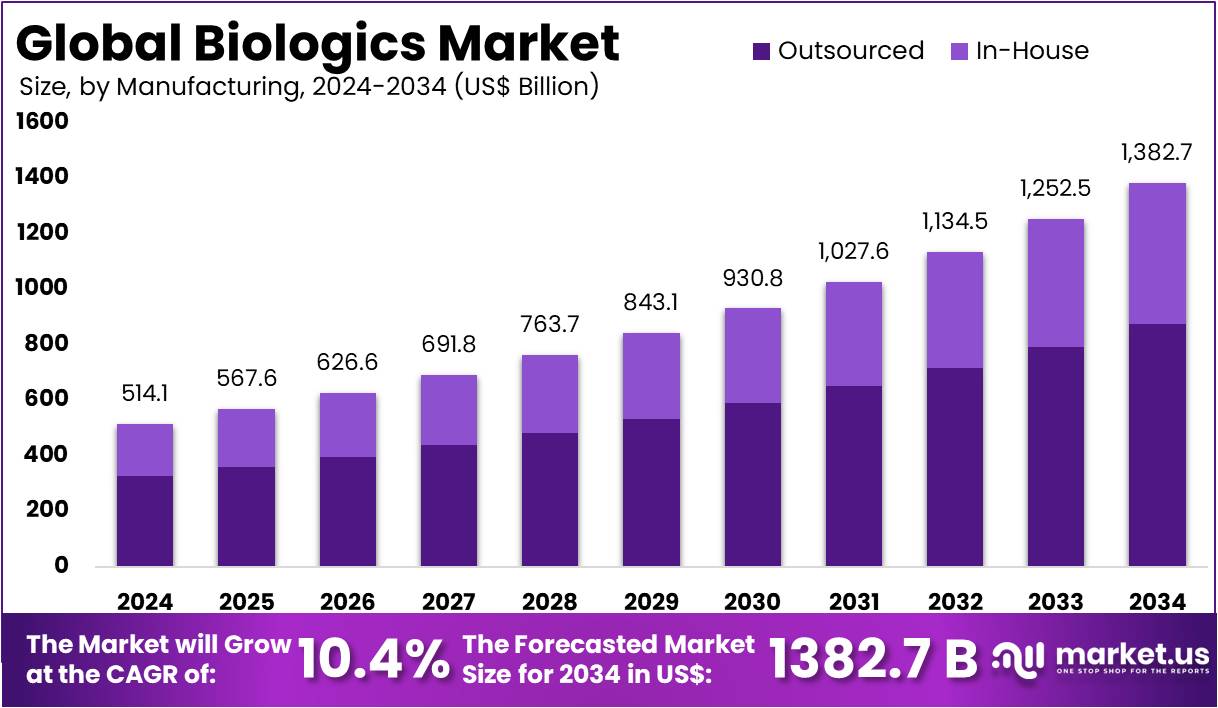
New York, NY – July 24, 2026 – The Global Biologics Market Size is expected to be worth around US$ 1382.7 billion by 2034 from US$ 514.1 billion in 2024, growing at a CAGR of 10.4% during the forecast period 2025 to 2034. North America held a dominant market position, capturing more than a 43.8% share and holding a US$ 225.2 billion market value for the year.
The global biologics market is experiencing strong and sustained growth, driven by rising prevalence of chronic diseases, expanding therapeutic innovation, and increasing adoption of targeted treatment approaches. Biologics, including monoclonal antibodies, vaccines, and cell and gene therapies, are gaining prominence due to their higher specificity and improved clinical outcomes compared to conventional small-molecule drugs.
The growing burden of chronic illnesses continues to be a key demand driver. According to the American Cancer Society, over 2.0 million new cancer cases are expected in the United States in 2025, while autoimmune diseases affect an estimated 5–8% of the global population. In addition, the Alzheimer’s Association reports that approximately 7.2 million Americans aged 65 and above are projected to live with Alzheimer’s disease in 2025, highlighting the urgent need for advanced biologic therapies.
Technological advancements are further accelerating market expansion. The success of mRNA-based vaccines, such as Pfizer-BioNTech’s Comirnaty, which generated revenues exceeding USD 37 billion at peak demand, has demonstrated the scalability and versatility of biologics platforms. Regulatory support is also strengthening the market landscape, with the U.S. FDA approving over 15–20 novel biologics annually in recent years.
Driven by innovation and unmet clinical needs, the global biologics market is projected to surpass USD 600 billion by 2030, growing at a CAGR of approximately 8–10% during the forecast period.
Key Takeaways
- In 2024, the biologics market generated revenue of US$ 514.1 billion and is projected to grow at a CAGR of 10.4%, reaching US$ 1,382.7 billion by 2034.
- Based on product type, the biologics market is segmented into monoclonal antibodies, vaccines, recombinant proteins, antisense & RNAi therapeutics, and others. The monoclonal antibodies segment dominated in 2023, accounting for 47.6% market share.
- By manufacturing type, the biologics market is categorized into outsourced and in-house manufacturing. The outsourced manufacturing segment held the leading position with a 63.2% market share.
- Based on application, the biologics market is segmented into oncology, immunology, infectious disease, cardiovascular disorders, and others. The oncology segment dominated the market with the largest revenue share of 45.5%.
- By source type, the market is divided into microbial, mammalian, and others. The microbial segment led the market, capturing a revenue share of 38.4%.
- Regionally, North America dominated the biologics market in 2023, accounting for 43.8% of the overall market share.
Statistical Information
- Rising FDA Approvals of Biologics: In 2025, the U.S. Food and Drug Administration (FDA) approved 44 new drugs, of which 12 were biologics, including 9 monoclonal antibodies, 2 antibody–drug conjugates, and 1 fusion protein, with cancer remaining the main therapeutic target.
- FDA’s Expedited Pathways Supporting Biologics: An analysis in Scientific Reports documents that from 1980–2022, the FDA approved 1,355 new pharmaceutical products, with the largest increases in antineoplastic and immunomodulating drugs, biologics, and orphan drugs, many of which used expedited pathways.
- R&D Investment Required for Innovative Biologics: A 2025 NIH‑linked study estimated a median uncapitalized R&D investment of b per biologic with priority review, rising to USD 873.7 million after accounting for the cost of capital.
- NIH Contribution to New Drug Approvals: An analysis of NIH funding and FDA approvals found that NIH‑supported research contributed to every one of the 210 new drugs approved between 2010 and 2016, with more than USD 100 billion in NIH grants tied to that corpus of work.
- Disease Focus of 2025 FDA Approvals: In 2025, CDER approved 46 new therapeutic agents, with 16 (35%) for cancer, 5 (11%) for cardiology, and 4 (9%) for allergy and inflammatory diseases, confirming oncology and immune‑mediated conditions as leading focus areas.
- NIH Budget and Cancer‑Focused Initiatives: The budget includes USD 2.9 billion in mandatory funding to reauthorize and extend the Cancer Moonshot program in FY 2025 and 2026, underscoring federal commitment to oncology and related biologic research.
- NIH Extramural Grant Investment, FY 2025: In FY 2025, NIH awarded USD 35.3 billion in competing and non‑competing extramural grants, within a total appropriation of USD 48.5 billion.
- Scale of Ongoing and Completed Studies: ClinicalTrials.gov reports 587,109 registered studies globally across 226 countries and territories, covering interventional and observational designs.
- Economic Impact of NIH Grants: In 2025, NIH research grants totalling USD 36.58 billion generated USD 94.15 billion in economic activity and supported 390,863 jobs in the United States, a 250% return.
Regional Analysis
North America dominated the biologics market in 2023, accounting for 43.8% of the overall market share.
North America continues to be a leading region in the biologics market due to strong healthcare infrastructure, advanced biotechnology research, high healthcare spending, and a supportive regulatory framework. The region has significant demand for biologic therapies, driven by the increasing prevalence of cancer, autoimmune diseases, and other complex conditions requiring targeted treatments.
In the United States, the American Cancer Society estimated approximately 1.95 million new cancer cases in 2023, highlighting the growing need for innovative oncology biologics. The U.S. Food and Drug Administration (FDA) plays a major role in accelerating biologics innovation through approvals of novel biologic products and biosimilars. In 2024, FDA reached a milestone by approving its 60th biosimilar, improving access and competition in the biologics sector.
Additionally, FDA data shows that biologics represented around 32% of drug approvals in 2024, reflecting the increasing importance of biological therapies in modern healthcare. Strong research capabilities, biotechnology investments, and expanding adoption of advanced therapies continue to strengthen North America’s position in the global biologics market.
Emerging Trends
- Increasing Adoption of Cell and Gene Therapies: Cell and gene therapies are becoming a major trend in the biologics sector due to their ability to address rare and genetic diseases. The U.S. FDA’s Center for Biologics Evaluation and Research (CBER) has approved more than 50 cell and gene therapy products since 2017, reflecting rapid advancement in advanced biologic treatments.
- Expansion of Biosimilars for Affordable Treatment Access: Biosimilars are gaining importance as healthcare systems focus on reducing treatment costs while maintaining therapeutic effectiveness. The U.S. FDA has approved more than 60 biosimilar products by 2024, increasing competition and improving access to biologic medicines for patients.
- Growth of Personalized and Precision Biologics: Personalized medicine is driving biologics innovation by enabling treatments based on individual genetic and molecular profiles. Targeted biologics, including monoclonal antibodies, are increasingly used in oncology and immune disorders to improve treatment accuracy and patient outcomes.
- Artificial Intelligence in Biologic Drug Development: AI is increasingly being integrated into biologic discovery to improve antibody design, identify drug targets, and shorten development timelines. Pharmaceutical companies are using AI-based platforms to analyze biological data and improve success rates in complex biologic research.
- Increasing Innovation in Monoclonal Antibody Therapies: Monoclonal antibodies remain a leading biologic technology due to their application in cancer, autoimmune diseases, and infectious disorders. The FDA has approved over 100 therapeutic monoclonal antibody products, demonstrating their growing importance in modern healthcare.
Use Cases
- Cancer Immunotherapy and Targeted Oncology Treatments: Biologics are widely used in cancer care through monoclonal antibodies, immune checkpoint inhibitors, and antibody-drug conjugates. These therapies provide targeted treatment approaches and have expanded options for patients with advanced cancers. The American Cancer Society estimated nearly 2 million new cancer cases in the U.S. in 2023, increasing demand for innovative therapies.
- Gene Therapy for Rare Genetic Disorders: Gene therapies are creating new treatment opportunities for rare diseases by targeting underlying genetic causes. FDA-approved gene therapies are being used for conditions such as inherited blood disorders and certain neurological diseases, representing a major shift toward disease-modifying treatments.
- Autoimmune Disease Management with Biologic Drugs: Biologics are increasingly used for autoimmune diseases including rheumatoid arthritis, psoriasis, and inflammatory bowel disease. These therapies target specific immune pathways, helping patients who do not respond effectively to traditional treatments.
- Advanced Vaccine Development Using Biological Platforms: Modern biologic platforms, including mRNA and recombinant technologies, are expanding vaccine development beyond traditional infectious disease prevention. The success of COVID-19 mRNA vaccines has accelerated research into vaccines for influenza, respiratory syncytial virus (RSV), and other diseases.
- Regenerative Medicine and Personalized Cell Therapies: Regenerative medicine is emerging as an important biologics application, using living cells and genetic technologies to repair damaged tissues and treat complex diseases. FDA programs support development of advanced therapies, with thousands of clinical trials globally evaluating cell-based treatments.
Frequently Asked Questions on Biologics Market
- What factors are driving the growth of the biologics market?
The biologics market is growing due to increasing chronic disease cases, rising demand for targeted therapies, biotechnology advancements, and adoption of personalized medicine. Strong research investments, expanding clinical pipelines, and regulatory support are further accelerating innovation in biologic treatments. - Which product type dominates the biologics market?
Monoclonal antibodies are a leading product segment in the biologics market because of their extensive use in oncology, autoimmune diseases, and inflammatory disorders. Their ability to provide precise disease targeting has increased adoption among healthcare professionals and pharmaceutical companies. - Why are monoclonal antibodies important in biologics development?
Monoclonal antibodies are important because they offer highly specific treatment approaches by targeting disease-related proteins. They are widely used in cancer immunotherapy, autoimmune disease management, and infectious disease treatment, providing improved therapeutic outcomes compared with many conventional medicines. - How are biosimilars impacting the biologics market?
Biosimilars are improving patient access to biologic medicines by offering more affordable alternatives to reference biologic products. Their increasing regulatory approvals are encouraging competition, supporting healthcare cost reduction, and expanding availability of advanced biological therapies worldwide. - What role does personalized medicine play in the biologics market?
Personalized medicine helps develop biologic treatments based on individual genetic, molecular, and disease characteristics. This approach enables physicians to select more effective therapies, improve patient outcomes, reduce treatment failures, and support the growth of precision healthcare. - How is artificial intelligence influencing biologics development?
Artificial intelligence is supporting biologics research by improving drug discovery, antibody design, target identification, and biological data analysis. AI-based technologies help researchers accelerate development processes, reduce research challenges, and identify promising therapeutic candidates more efficiently. - Why is North America a major region in the biologics market?
North America holds a strong position in the biologics market due to advanced healthcare systems, biotechnology research capabilities, pharmaceutical innovation, and supportive regulatory frameworks. High disease prevalence and significant investment in biologic drug development continue to drive regional growth.
Conclusion
The biologics market is experiencing strong growth due to increasing demand for advanced therapies, rising chronic disease prevalence, and continuous innovation in biotechnology. The expansion of monoclonal antibodies, biosimilars, cell and gene therapies, and personalized medicine is transforming modern healthcare by providing targeted and effective treatment options.
Supportive regulatory frameworks, technological advancements, and growing investments in research and development are further strengthening market opportunities. North America remains a leading region due to its advanced healthcare infrastructure and innovation ecosystem. With ongoing developments in AI-driven discovery and precision therapies, the biologics market is expected to continue expanding in the coming years.
Discuss your needs with our analyst
Please share your requirements with more details so our analyst can check if they can solve your problem(s)




