


Overview
New York, NY – Sep 16, 2026 –The Global Automated Nucleic Acid Extraction Systems Market size is expected to be worth around US$ 10.3 Billion by 2034 from US$ 4.7 Billion in 2024, growing at a CAGR of 8.2% during the forecast period 2025 to 2034. In 2024, North America led the market, achieving over a 37.9% share with a revenue of US$ 1.8 Billion.
Automated Nucleic Acid Extraction Systems are gaining significant momentum as molecular diagnostics and genomic medicine become integral to modern healthcare. Automated extraction systems enable rapid and standardized purification of DNA and RNA while minimizing contamination and operator variability.
Globally, more than 2 million PCR tests are performed every day across clinical and research settings, increasing the need for reliable automated sample preparation platforms. These systems are extensively used in hospitals, diagnostic laboratories, pharmaceutical companies, biotechnology firms, and academic research institutions.
Technological advancements continue to improve laboratory productivity. Entry-level systems typically process 16–24 samples per run, mid-range instruments handle 48–96 samples, and high-throughput platforms can process 192–384 samples per run. Large automated laboratories are capable of processing over 2,000 nucleic acid samples per day, while automated workflows can reduce hands-on technician time by up to 80%, lower cross-contamination risk by more than 90%, and achieve nucleic acid recovery efficiencies of 95–99%.
Demand is also supported by rapid growth in genomic sequencing. Worldwide, more than 30 million human genomes have been sequenced, and annual sequencing output continues to grow by over 25%. More than 75% of reference laboratories now incorporate automated nucleic acid extraction into routine molecular testing to improve reproducibility and turnaround time. Additionally, many automated instruments complete extraction in 15–45 minutes, compared with 60–120 minutes for manual methods.
Growing investments in precision oncology, infectious disease surveillance, and population genomics, together with increasing laboratory automation, are expected to strengthen market demand and encourage continuous innovation in automated nucleic acid extraction technologies across global healthcare and life science sectors.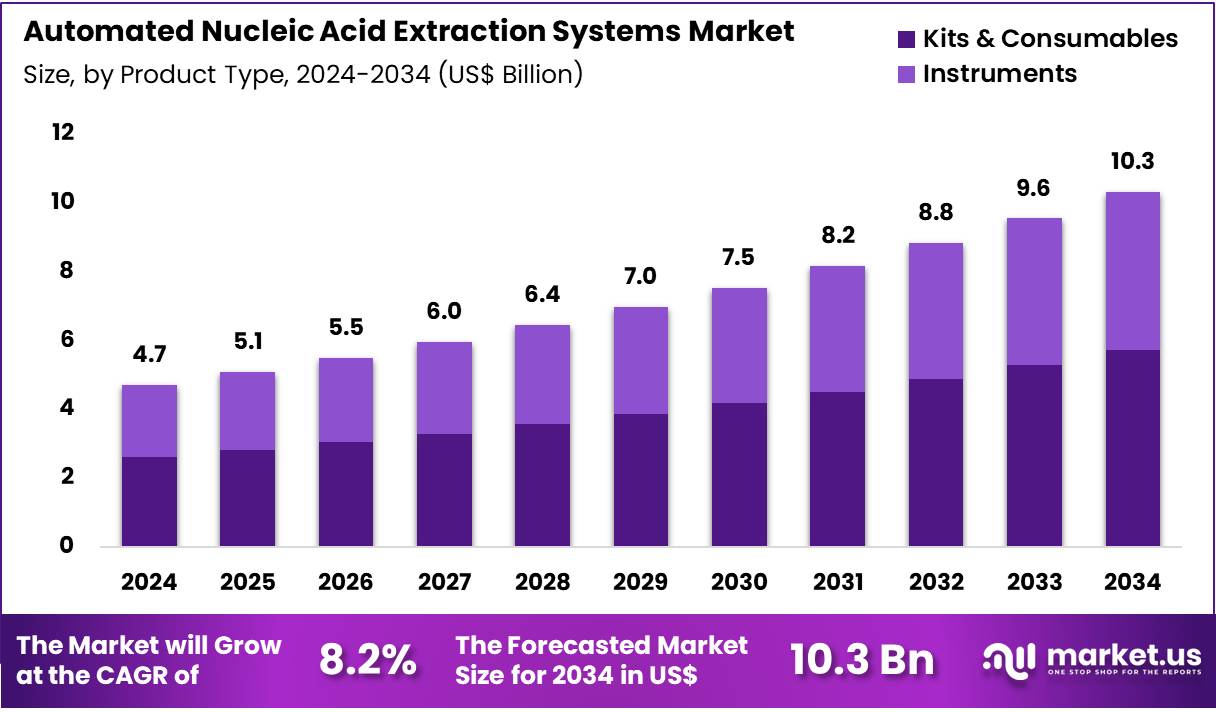
Key Takeaways
- The market was valued at US$ 4.7 Billion in 2024 and is projected to reach US$ 10.3 Billion by 2034, expanding at a CAGR of 8.2% during the forecast period.
- By product type, the market is segmented into kits & consumables and instruments, with kits & consumables accounting for the largest share of 55.3% in 2024.
- Based on end user, the market includes pharmaceutical & biotechnology companies, hospitals, forensic laboratories, diagnostic centres, and academic research institutes. Among these, pharmaceutical & biotechnology companies dominated the market with a 49.2% share in 2024.
- North America emerged as the leading regional market, capturing a 37.9% market share in 2024.
Market Segmentation Overview
- Product Type Analysis: Kits & Consumables hold 55.3% of the market share in 2024, kits & consumables dominate due to their indispensable role in automated nucleic acid extraction workflows. The increasing volume of PCR, NGS, and molecular diagnostic testing drives demand for extraction kits, reagents, buffers, and purification columns. Continuous improvements in reagent performance, automation compatibility, and sample recovery efficiency further strengthen this segment’s leading market position.
- End-User Analysis: Pharmaceutical & Biotechnology Companies accounting for 49.2% of the market share in 2024, pharmaceutical & biotechnology companies remain the largest end-user segment. Growing investments in genomics, drug discovery, gene therapy, and precision medicine require high-throughput automated extraction systems. Rising clinical research activities, biomarker development, and large-scale genetic testing continue to increase the adoption of advanced nucleic acid extraction technologies.
Statistical Information
- NIH All of Us Has Enrolled More Than 883,000 Participants: The NIH All of Us Research Program has enrolled more than 883,000 participants, with research data available from 747,000+ participants, including 535,000+ whole-genome sequences and 553,000+ genotyping arrays. Processing this scale of biospecimens requires high-throughput automated nucleic acid extraction systems.
- UK Biobank Provides Genetic Data from 500,000 Participants: The UK Biobank has generated genetic datasets for 500,000 participants, including 500,000 whole exomes, 500,000 whole genomes, and approximately 90 million imputed genetic variants, making it one of the world’s largest genomic resources and a major driver for automated DNA extraction technologies.
- NIH Database Contains More Than 1.3 Billion Genetic Variants: The latest NIH All of Us genomic release includes more than 1.3 billion genetic variants, 96,000+ structural variant records, 600,000 physical measurements, and 747,000 participant survey datasets, highlighting the massive laboratory throughput needed for nucleic acid extraction and sequencing.
- Over 598,000 Participants Have Completed Biospecimen Collection: The All of Us Research Program reports 884,000+ enrolled participants, with 598,000+ individuals completing initial program steps, including biospecimen donation for DNA analysis, creating substantial demand for automated nucleic acid extraction workflows.
- UK Biobank Directly Measured Around 850,000 Genetic Variants: UK Biobank directly measured approximately 850,000 genetic variants per participant and further imputed more than 90 million variants, creating one of the world’s largest genomic datasets and reinforcing the importance of high-quality automated nucleic acid extraction.
- Thermo Fisher KingFisher Flex Processes Up to 96 Samples in About 20 Minutes: The KingFisher™ Flex automated purification system from Thermo Fisher Scientific can purify DNA and RNA from up to 96 samples in approximately 20 minutes, depending on the extraction protocol, significantly improving laboratory throughput.
- UK Biobank Genetic Dataset Covers More Than 15 Billion Genetic Variants: The UK Biobank whole-genome sequencing project has identified over 15 billion genetic variants across nearly 500,000 participants, creating one of the largest genomic datasets available for biomedical research and increasing reliance on automated extraction technologies.
Regional Analysis
North America led the market by securing a market share of 37.9% in 2024.
North America led the Automated Nucleic Acid Extraction Systems Market with a 37.9% share in 2024, supported by advanced healthcare infrastructure, widespread adoption of molecular diagnostics, and strong investments in genomics.
According to the National Institutes of Health (NIH), the All of Us Research Program has enrolled more than 883,000 participants, including over 535,000 whole-genome sequences, increasing demand for automated DNA and RNA extraction technologies. The Centers for Disease Control and Prevention (CDC) continues nationwide genomic surveillance by analyzing millions of pathogen genome sequences, requiring high-throughput laboratory automation.
Leading companies such as Thermo Fisher Scientific, Roche Diagnostics, and QIAGEN provide systems capable of processing up to 96 samples per run, improving laboratory efficiency and accuracy. Rising applications in oncology, infectious disease testing, precision medicine, and clinical genomics, combined with continued federal funding for biomedical research and expanding sequencing capacity, continue to strengthen the region’s leadership and support sustained market growth across hospitals, diagnostic laboratories, and research institutions.
Business Opportunities
The Automated Nucleic Acid Extraction Systems Market presents significant business opportunities as demand for molecular diagnostics, genomic sequencing, and precision medicine continues to grow worldwide. Increasing adoption of next-generation sequencing (NGS), PCR-based diagnostics, and liquid biopsy testing is creating demand for faster, high-throughput extraction platforms.
Manufacturers can capitalize on opportunities by developing compact, AI-enabled, and fully automated systems that reduce processing time and improve laboratory efficiency. Expanding investments in biotechnology, pharmaceutical research, and infectious disease surveillance are also opening new revenue streams for instrument manufacturers and reagent suppliers. Emerging economies offer considerable growth potential as governments strengthen laboratory infrastructure and expand access to advanced diagnostic technologies.
Additionally, recurring demand for extraction kits, reagents, magnetic beads, and consumables provides stable long-term revenue through repeat purchases. Strategic collaborations with hospitals, diagnostic laboratories, contract research organizations, and academic institutions, along with integration of cloud-based laboratory information systems and robotics, are expected to further accelerate commercialization and market expansion over the coming decade.
Emerging Trends
- Growing adoption of high-throughput laboratory automation: Public health laboratories are increasingly using automated extraction systems to improve efficiency. According to the Association of Public Health Laboratories (APHL), 70% (23 of 33) surveyed laboratories used automated nucleic acid extraction for wastewater surveillance, reducing manual work and improving testing consistency.
- Expansion of national genomics programs: Large-scale sequencing initiatives are boosting demand for automated extraction platforms. The NIH All of Us Research Program has enrolled more than 883,000 participants and generated over 535,000 whole-genome sequences, increasing the need for reliable, high-throughput DNA and RNA extraction.
- Rapid growth of point-of-care molecular diagnostics: The World Health Organization (WHO) recommends expanded use of near-point-of-care molecular tests for diseases such as tuberculosis, increasing the need for rapid automated nucleic acid extraction technologies that deliver faster and more accurate diagnostic results.
- Magnetic bead-based extraction becoming the preferred technology: CDC-supported research found that the MagNA Pure 96 automated platform produced approximately two times higher nucleic acid yield than several alternative extraction systems, improving downstream PCR and sequencing performance.
- Faster automated workflows improving laboratory productivity: Modern automated extraction platforms can process up to 96 samples in around 20 minutes, significantly reducing hands-on time while improving reproducibility, making them increasingly attractive for hospitals, diagnostic laboratories, and research centers.
Use Cases
- Infectious disease diagnostics: Automated nucleic acid extraction systems are widely used before PCR testing for COVID-19, influenza, tuberculosis, hepatitis, and other infectious diseases. According to the CDC, the agency has analyzed more than 4 million SARS-CoV-2 genome sequences, highlighting the need for high-throughput automated extraction workflows.
- Precision medicine and cancer genomics: Automated extraction systems provide high-quality DNA and RNA for biomarker discovery and genomic profiling. The NIH All of Us Research Program has enrolled more than 883,000 participants, including over 535,000 whole-genome sequences, supporting precision medicine research.
- Drug discovery and biopharmaceutical research: Pharmaceutical and biotechnology companies use automated extraction platforms to prepare nucleic acids for gene therapy, vaccine development, and clinical research. Thermo Fisher Scientific’s KingFisher™ systems can process up to 96 samples per run, improving laboratory productivity.
- Public health surveillance and outbreak monitoring: Government laboratories use automated extraction systems for genomic surveillance and wastewater monitoring. According to the Association of Public Health Laboratories (APHL), 70% (23 of 33) surveyed public health laboratories use automated nucleic acid extraction for wastewater surveillance.
- Next-generation sequencing (NGS) sample preparation: Automated extraction systems are essential for preparing high-quality DNA and RNA before sequencing. Illumina reports that its sequencing platforms have generated more than 30 million human genomes worldwide, driving demand for automated extraction technologies.
Recent Development
- In 2026, QIAGEN N.V. announced its 2026 strategic priorities and expanded its automation portfolio with the QIAsprint Connect system and enhanced QIAsymphony Connect workflow solutions to improve high-throughput nucleic acid extraction and molecular diagnostics.
- In 2026, Thermo Fisher Scientific, Inc. expanded its molecular biology portfolio by launching the Applied Biosystems™ PowerFlex™ Thermal Cycler and continued investing in laboratory automation and precision medicine solutions for genomics research.
- In 2026, Roche Diagnostics / Roche Molecular Systems strengthened its molecular diagnostics business by advancing automated PCR and sample preparation technologies, improving laboratory efficiency and supporting high-throughput infectious disease testing.
- In 2026, Promega Corporation expanded its genomics and molecular biology product portfolio with new nucleic acid purification reagents and workflow solutions designed for research and clinical laboratory applications.
- In 2026, Agilent Technologies, Inc. introduced new automation-compatible genomics and pathology solutions to support next-generation sequencing workflows and precision medicine research across clinical laboratories.
- In 2026, PerkinElmer, Inc. continued expanding its life sciences portfolio by enhancing molecular diagnostics and laboratory automation technologies for genomic research and clinical testing applications.
Frequently Asked Questions on Automated Nucleic Acid Extraction Systems
- What factors are driving the growth of the Automated Nucleic Acid Extraction Systems Market?
Market growth is driven by increasing demand for molecular diagnostics, expanding genomics research, rising adoption of precision medicine, and greater laboratory automation. Growing use of PCR, next-generation sequencing (NGS), and infectious disease surveillance also continues to increase demand for automated extraction technologies worldwide. - Which product type dominates the Automated Nucleic Acid Extraction Systems Market?
Kits and consumables represent the leading product segment because they are required for every extraction procedure. Their recurring use in clinical diagnostics, research laboratories, and pharmaceutical applications generates continuous demand, while improvements in reagent quality and extraction efficiency further support market growth. - Which end-user segment holds the largest market share?
Pharmaceutical and biotechnology companies account for the largest share due to extensive use of automated nucleic acid extraction in drug discovery, biomarker research, gene therapy development, vaccine production, and precision medicine. These organizations require reliable, scalable, and high-throughput sample preparation solutions for research activities. - Which region leads the Automated Nucleic Acid Extraction Systems Market?
North America leads the market due to advanced healthcare infrastructure, strong genomics research programs, and widespread adoption of molecular diagnostics. Significant government funding, increasing precision medicine initiatives, and the presence of major biotechnology companies continue to support regional market leadership. - Which region is expected to grow the fastest in the coming years?
Asia Pacific is projected to record the fastest growth due to expanding healthcare infrastructure, increasing investments in biotechnology, growing genomic sequencing programs, and rising demand for molecular diagnostic testing. Government support for precision medicine and research initiatives further accelerates regional market expansion. - What are the major applications of automated nucleic acid extraction systems?
These systems are widely used in infectious disease diagnosis, oncology testing, genetic disease screening, forensic analysis, next-generation sequencing, biomarker discovery, and pharmaceutical research. Their ability to deliver high-quality DNA and RNA efficiently makes them essential for modern molecular laboratory workflows. - How is automation improving nucleic acid extraction workflows?
Automation minimizes manual handling, reduces contamination risks, improves reproducibility, and increases sample throughput. Modern automated systems enable laboratories to process large numbers of samples efficiently while shortening turnaround times and supporting high-volume molecular diagnostic and genomic testing applications.
Conclusion
The Automated Nucleic Acid Extraction Systems Market is poised for steady growth, supported by the increasing adoption of molecular diagnostics, genomics, and precision medicine worldwide. Rising demand for automated laboratory workflows, high-throughput sample processing, and accurate DNA and RNA extraction continues to drive innovation across healthcare and research sectors.
Pharmaceutical and biotechnology companies remain the leading end users, while kits and consumables generate consistent recurring demand. North America maintains market leadership through strong research infrastructure, whereas Asia Pacific offers significant growth opportunities. Continuous technological advancements and expanding genomic applications are expected to strengthen the market’s long-term development and global adoption.
Discuss your needs with our analyst
Please share your requirements with more details so our analyst can check if they can solve your problem(s)




