


Overview
New York, NY – Sep 15, 2026 – The Global At-Home Cancer Testing Market size is expected to reach around US$ 10.8 Billion by 2034, up from US$ 6.9 Billion in 2024, growing at a CAGR of 4.6% during the forecast period 2025 to 2034. In 2024, North America led the market, achieving over 38.8% market share with revenue of US$ 2.7 billion.
At-Home Cancer Testing is gaining strong momentum as demand for convenient, accurate, and early cancer screening solutions continues to rise. The market was valued at USD 1.6 billion in 2024 and is projected to reach USD 4.8 billion by 2034, registering a CAGR of 11.7% from 2025 to 2034.
According to the World Health Organization (WHO), there were around 20 million new cancer cases and 9.7 million cancer deaths worldwide in 2022, while approximately 53.5 million people were living within five years of a cancer diagnosis. The International Agency for Research on Cancer (IARC) estimates that global cancer cases could increase to 35 million annually by 2050, representing a 77% rise compared with 2022 levels.
At-home cancer testing kits enable consumers to collect blood, saliva, stool, or urine samples at home for laboratory analysis, reducing hospital visits and improving access to preventive healthcare. These tests are increasingly used for screening hereditary cancer risks and detecting biomarkers associated with colorectal, breast, prostate, cervical, and ovarian cancers.
The American Cancer Society estimates about 2.04 million new cancer cases and more than 618,000 cancer deaths in the United States in 2025, emphasizing the need for wider screening adoption.
The integration of next-generation sequencing (NGS), liquid biopsy, and AI-assisted diagnostic platforms is improving testing accuracy and turnaround time. North America held approximately 41.2% of the global market in 2024, while Asia-Pacific is expected to witness the fastest growth due to rising healthcare expenditure, expanding diagnostic laboratories, increasing awareness programs, and growing investments in precision medicine and home-based diagnostic technologies.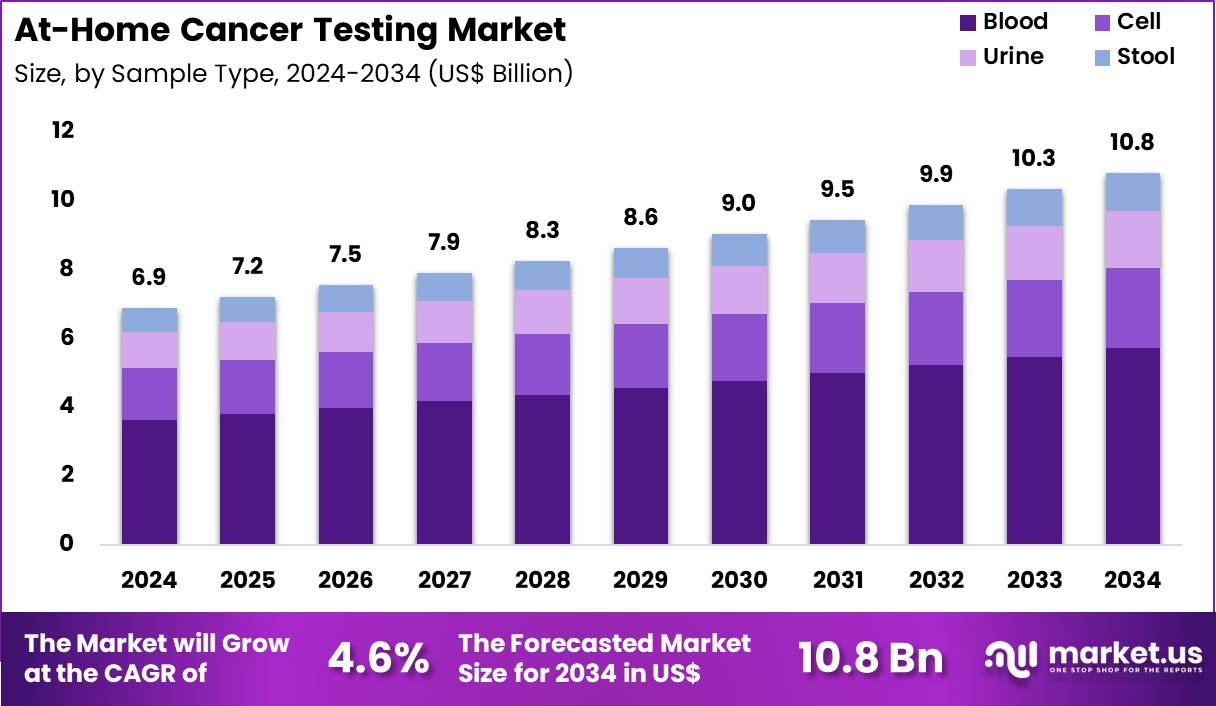
Key Takeaways
- In 2024, the At-Home Cancer Testing Market generated US$ 6.9 billion in revenue and is projected to reach US$ 10.8 billion by 2034, growing at a CAGR of 4.6% during the forecast period.
- By cancer type, the market is segmented into breast, colon, prostate, blood, and others, with the breast cancer segment leading the market by accounting for 38.4% of the total revenue in 2024.
- Based on sample type, the market includes blood, cell, urine, and stool samples. Among these, the blood segment dominated the market, capturing the highest share of 52.8% in 2024.
- In terms of distribution channel, the market is categorized into hospital pharmacies, online pharmacies, retail pharmacies, and others. The hospital pharmacies segment held the largest market share of 43.9% in 2024.
- North America emerged as the leading regional market, accounting for 38.8% of the global At-Home Cancer Testing Market revenue in 2024.
Market Segmentation Overview
- Cancer Type Analysis: Breast cancer accounted for 38.4% of the market in 2024, making it the leading cancer type segment. Its dominance is driven by increasing awareness of early detection, rising adoption of home-based genetic and biomarker tests, growing breast cancer prevalence, and continuous improvements in blood-based screening technologies. Telehealth integration and easier self-sampling further support widespread consumer adoption.
- Sample Type Analysis: Blood represented 52.8% of the market in 2024, emerging as the dominant sample type due to its ability to detect circulating tumor DNA, proteins, and other cancer biomarkers. Advances in liquid biopsy technologies, convenient micro-blood collection devices, high diagnostic accuracy, and growing preference for minimally invasive home testing continue to strengthen this segment’s market leadership.
- Distribution Channel Analysis: Hospital pharmacies captured 43.9% of the market in 2024, remaining the leading distribution channel. Their strong position is supported by patient trust, physician recommendations, availability of clinically validated testing kits, professional counselling, and integration with hospital-based cancer screening programs. Strategic collaborations with diagnostic companies further improve accessibility and encourage greater adoption of at-home cancer testing kits.
Statistical Information
- Rising Breast Cancer Cases Are Driving Early Home Testing Adoption: Breast cancer is the most commonly diagnosed cancer in women globally. According to the WHO, 2.3 million new breast cancer cases and approximately 670,000 deaths were reported in 2022. In the United States, the American Cancer Society estimates 316,950 new invasive breast cancer cases and 42,680 deaths among women in 2025, increasing demand for convenient at-home genetic and biomarker testing solutions.
- Hereditary Cancer Risk Is Increasing Consumer Interest in Home Genetic Tests: The U.S. National Cancer Institute reports that 5–10% of all cancers are hereditary. Women carrying a harmful BRCA1 mutation have a 55–72% lifetime risk of developing breast cancer, while BRCA2 mutation carriers face a 45–69% lifetime risk. These statistics continue to drive adoption of at-home DNA-based cancer risk assessment kits.
- Blood-Based Cancer Screening Is Becoming More Reliable: The FDA-approved SimpleScreen CRC blood test was validated in the PREEMPT CRC study involving 48,995 average-risk adults (45–85 years). The test demonstrated 81.1% sensitivity for detecting colorectal cancer and approximately 90% specificity, highlighting the growing reliability of blood-based cancer testing technologies.
- Colorectal Cancer Continues to Increase the Need for Home Screening: The World Health Organization estimates 1.9 million new colorectal cancer cases and more than 900,000 deaths worldwide in 2022. Colorectal cancer accounts for approximately 10% of all cancer diagnoses globally, reinforcing the importance of accessible home-based screening programs.
- Most Inherited Cancer Risk Is Not Detected by Basic Consumer Tests: The National Cancer Institute (NCI) states that although only 5–10% of cancers are inherited, many direct-to-consumer cancer genetic tests detect only a limited number of mutations. As of January 2024, the only FDA-authorized direct-to-consumer BRCA test evaluates three BRCA variants, while about 80% of cancer-causing BRCA variants are missed using this limited approach.
- Cancer Incidence Is Expected to Increase Significantly: The World Health Organization projects that annual global cancer cases will increase from 20 million in 2022 to more than 35 million by 2050, representing a 77% increase. This rising burden is expected to increase demand for accessible home-based cancer screening and early detection technologies.
- Home Stool Tests Show High Accuracy for Cancer Detection: The FDA-approved Cologuard Plus stool DNA test demonstrated 95% sensitivity for colorectal cancer detection and over 83% specificity in a clinical study involving more than 20,000 average-risk adults, highlighting the effectiveness of home-collected stool samples.
- More U.S. Adults Are Choosing Stool-Based Home Screening: According to the American Cancer Society, 74.6% of U.S. adults aged 45 years and older were up to date with colorectal cancer screening in 2023. Among screened adults, the use of stool-based home tests has steadily increased, particularly after the COVID-19 pandemic, reflecting growing consumer acceptance of at-home screening.
Regional Analysis
North America led the market by securing a market share of 38.8% in 2024.
North America dominated the At-Home Cancer Testing Market, accounting for 38.8% of the global market in 2024. The region’s leadership is supported by advanced healthcare infrastructure, strong adoption of telehealth, and increasing availability of FDA-authorized home cancer screening tests. According to the U.S. National Cancer Institute (NCI), an estimated 2,041,910 new cancer cases and 618,120 cancer deaths are expected in the United States in 2025, highlighting the growing need for early and convenient cancer detection.
The U.S. Preventive Services Task Force (USPSTF) recommends colorectal cancer screening for adults aged 45–75 years, encouraging wider adoption of stool- and blood-based home testing kits. Rising awareness of hereditary cancer risks, expanding access to saliva-based genetic tests, and continuous innovations in molecular diagnostics are further driving market growth.
In addition, strong reimbursement support, expanding pharmacy distribution networks, and increasing partnerships between healthcare providers and diagnostic companies are expected to sustain North America’s market leadership throughout the forecast period.
Business Opportunities
The At-Home Cancer Testing Market presents significant business opportunities as demand for convenient, preventive healthcare continues to grow worldwide. Companies can expand their portfolios by developing multi-cancer early detection (MCED) tests capable of identifying several cancer types from a single blood sample.
Rising awareness of hereditary cancer risk also creates opportunities for direct-to-consumer genetic testing kits supported by virtual genetic counseling services. Partnerships with telehealth providers, hospitals, and diagnostic laboratories can improve patient access through remote consultations and digital result interpretation.
Advances in liquid biopsy, next-generation sequencing (NGS), artificial intelligence, and molecular diagnostics are enabling more accurate and user-friendly home testing solutions. Expanding distribution through online pharmacies and retail healthcare platforms can further increase product adoption.
Emerging markets in Asia-Pacific, Latin America, and the Middle East offer strong growth potential due to improving healthcare infrastructure, rising cancer screening awareness, and increasing government investments in early detection and precision medicine programs.
Emerging Trends
- Liquid Biopsy is Transforming Early Cancer Detection: Liquid biopsy is becoming a major trend because it can detect cancer-related DNA in blood, saliva, or urine without surgery. The NIH reports that researchers expect liquid biopsy to become routine in clinical care within the next 3–5 years, improving early diagnosis and treatment decisions.
- FDA Expansion of Blood-Based Cancer Screening: Blood-based cancer screening is rapidly expanding. In 2025, the FDA authorized another colorectal cancer blood test. The PREEMPT CRC study included 48,995 participants, achieving 81.1% sensitivity for colorectal cancer detection and approximately 90% specificity, improving non-invasive screening options.
- Home Sample Collection is Becoming Mainstream: The FDA continues to support home-use diagnostic testing as healthcare shifts toward patient-centered care. Home tests enable convenient sample collection while reducing unnecessary clinic visits. FDA guidance notes that home diagnostics improve accessibility, privacy, and disease monitoring for millions of consumers worldwide.
- At-Home HPV Screening is Expanding Women’s Health: In 2025, the FDA approved the first at-home cervical cancer screening test. Clinical research involving more than 600 women showed home-collected samples performed as effectively as clinician-collected samples, expanding access for women aged 25–65 years.
- Multi-Cancer Detection is the Next Generation of Screening: Emerging multi-cancer early detection (MCED) blood tests can screen for more than 50 cancer types using a single blood sample. These tests combine next-generation sequencing, DNA methylation analysis, and artificial intelligence to identify cancer signals before symptoms appear.
Use Cases
- Hereditary Cancer Risk Assessment: Consumers with a family history of cancer increasingly use saliva-based genetic testing kits to identify inherited mutations such as BRCA1 and BRCA2. According to the National Cancer Institute, 5–10% of all cancers are linked to inherited genetic mutations.
- Home Colorectal Cancer Screening: Adults aged 45 years and older can complete stool- or blood-based colorectal cancer screening without visiting a hospital. FDA-approved tests allow samples to be collected at home and analyzed in certified laboratories, increasing screening participation among average-risk adults.
- Remote Cancer Monitoring Through Telehealth: Patients can collect samples at home and securely share results with healthcare providers through telemedicine platforms. This supports follow-up care, reduces hospital visits, and enables faster clinical decision-making while improving patient convenience and healthcare efficiency.
- Population Screening for Underserved Communities: Home cancer testing kits improve access for people living in rural or underserved areas where specialist cancer screening services are limited. NIH-supported research involving nearly 2,500 participants found that mailing home screening kits significantly improved cervical cancer screening participation.
- Earlier Detection of Hard-to-Diagnose Cancers: Researchers are developing blood-based tests capable of detecting cancer signals years before symptoms appear. NIH-supported studies indicate tumor-derived DNA may be detectable in blood up to three years before diagnosis, creating opportunities for earlier treatment and improved patient outcomes.
Recent Development
- In 2026, Roche Diagnostics launched the AXELIOS 1 next-generation sequencing platform and announced the acquisition of PathAI to strengthen AI-powered digital pathology and precision diagnostics, expanding its molecular testing capabilities for clinical laboratories worldwide.
- In 2026, Abbott Laboratories completed the acquisition of Exact Sciences, strengthening its cancer diagnostics portfolio. The company also reported US$12.6 billion in second-quarter sales while continuing investments in next-generation diagnostic technologies and precision healthcare solutions.
- In 2026, Thermo Fisher Scientific, Inc. expanded its advanced diagnostics portfolio by showcasing new molecular testing and laboratory automation solutions at major clinical laboratory events, supporting faster genomic analysis, precision medicine, and decentralized diagnostic workflows for healthcare providers.
- In 2026, bioMérieux SA reported €1.965 billion in first-half revenue and continued expanding its BIOFIRE® and SPOTFIRE® diagnostic platforms, supporting faster molecular testing, microbiology automation, and infectious disease detection across hospitals and clinical laboratories.
- In 2026, DiaSorin S.p.A. continued strengthening its molecular diagnostics and immunodiagnostics portfolio by expanding specialty testing solutions and showcasing innovations for laboratory medicine, precision diagnostics, and infectious disease testing at major international diagnostic conferences.
- In 2026, Becton Dickinson & Co. (BD) continued expanding its diagnostic and laboratory automation portfolio through investments in integrated specimen management, microbiology, and molecular diagnostic technologies, supporting improved clinical laboratory efficiency and patient care worldwide.
- In 2026, Bio-Rad Laboratories, Inc. continued advancing its digital PCR and quality control solutions while introducing new laboratory technologies that support precision oncology research, molecular diagnostics, and high-performance clinical testing workflows.
Frequently Asked Questions on At-Home Cancer Testing
- What factors are driving the growth of the At-Home Cancer Testing Market?
The market is growing due to increasing cancer prevalence, rising awareness of early diagnosis, expanding telehealth services, advances in molecular diagnostics, and greater consumer preference for convenient home-based healthcare. Improved genetic testing technologies and supportive screening guidelines also contribute to market expansion. - Which cancer type dominates the At-Home Cancer Testing Market?
Breast cancer testing represents the leading segment because of increasing awareness campaigns, growing adoption of hereditary genetic testing, and continuous advancements in biomarker-based screening technologies. High screening participation among women and improved accessibility of home testing kits further strengthen this segment. - Which region dominates the At-Home Cancer Testing Market?
North America holds the largest market share because of advanced healthcare infrastructure, widespread telehealth adoption, strong reimbursement policies, and high awareness of preventive cancer screening. Continuous innovation in molecular diagnostics and increasing use of FDA-authorized home testing kits also support regional leadership. - Which region is expected to witness the fastest market growth?
Asia-Pacific is projected to record the fastest growth due to increasing cancer incidence, expanding healthcare infrastructure, rising public awareness, and growing investments in molecular diagnostics. Government-supported cancer screening initiatives and rapid digital health adoption are further accelerating market development. - What technologies are shaping the At-Home Cancer Testing Market?
Key technologies include liquid biopsy, next-generation sequencing (NGS), molecular diagnostics, biomarker analysis, artificial intelligence, and digital health platforms. These innovations improve test accuracy, reduce turnaround times, and enable more personalized cancer risk assessment and early detection. - What are the future opportunities in the At-Home Cancer Testing Market?
Future opportunities include developing multi-cancer early detection tests, expanding direct-to-consumer genetic testing, integrating telehealth services, improving AI-powered diagnostics, and increasing penetration into emerging healthcare markets where demand for convenient cancer screening continues to rise. - How does telehealth support the At-Home Cancer Testing Market?
Telehealth enables healthcare professionals to recommend home testing kits, review laboratory results remotely, provide genetic counseling, and guide patients through follow-up care. This integration improves patient convenience while reducing unnecessary hospital visits and supporting continuous disease monitoring. - Why is early cancer detection important for this market?
Early detection significantly improves treatment outcomes, increases survival rates, and lowers healthcare costs. Home-based cancer testing encourages routine screening by providing convenient, minimally invasive options that help identify cancer risks before symptoms become severe.
Conclusion
The At-Home Cancer Testing Market is poised for sustained growth as healthcare systems increasingly emphasize early cancer detection, preventive care, and patient convenience. Advances in liquid biopsy, molecular diagnostics, next-generation sequencing, and AI-powered analysis are improving the accuracy and accessibility of home-based testing solutions. Rising cancer incidence, expanding telehealth services, and growing awareness of hereditary cancer risks continue to support market demand.
North America remains the leading regional market, while Asia-Pacific is expected to witness the fastest growth due to improving healthcare infrastructure and screening initiatives. Continued innovation, strategic partnerships, and expanding distribution networks will further strengthen the market’s long-term growth potential.
Discuss your needs with our analyst
Please share your requirements with more details so our analyst can check if they can solve your problem(s)




