


Overview
New York, NY – Sep 16, 2026 –The Americas COVID-19 Testing Market size is expected to be worth around US$ 9.9 Billion by 2034 from US$ 5.4 Billion in 2024, growing at a CAGR of 6.3% during the forecast period 2025 to 2034.
Americas COVID-19 Testing continues to expand as healthcare systems strengthen infectious disease monitoring, molecular diagnostics capabilities, and respiratory disease preparedness. The market was valued at approximately US$ 5.4 billion in 2024 and is expected to reach nearly US$ 9.9 billion by 2034, growing at a CAGR of 6.3% during 2025–2034. Increasing testing demand from hospitals, diagnostic laboratories, research institutions, and home-care users is supporting long-term market development.
The United States remains the largest contributor within the Americas region due to its advanced diagnostic infrastructure, high healthcare expenditure, and widespread availability of molecular and rapid testing platforms. In 2024, North America accounted for more than 80% of the regional COVID-19 testing demand, supported by large laboratory networks and government-backed surveillance programs. The region has conducted more than 1 billion COVID-19 diagnostic tests since the beginning of the pandemic, highlighting the importance of large-scale testing capabilities.
By technology, molecular diagnostic tests, including RT-PCR, represented around 55–60% of market adoption due to their high sensitivity and accuracy in detecting active infections. Antigen-based rapid tests contributed approximately 40–45% of testing volumes, driven by their quick results, lower costs, and suitability for decentralized healthcare settings.
Hospitals and diagnostic laboratories collectively accounted for nearly 65% of COVID-19 testing utilization, while home-based testing solutions continued gaining adoption due to convenience and accessibility. The growing integration of COVID-19 testing with multiplex respiratory panels, capable of detecting 3–20+ respiratory pathogens in a single workflow, is further improving diagnostic efficiency.
Increasing focus on emerging variant surveillance, point-of-care diagnostics, and digital reporting systems is expected to create new growth opportunities. By 2034, the Americas COVID-19 Testing Market is projected to remain a critical component of pandemic preparedness and infectious disease management strategies.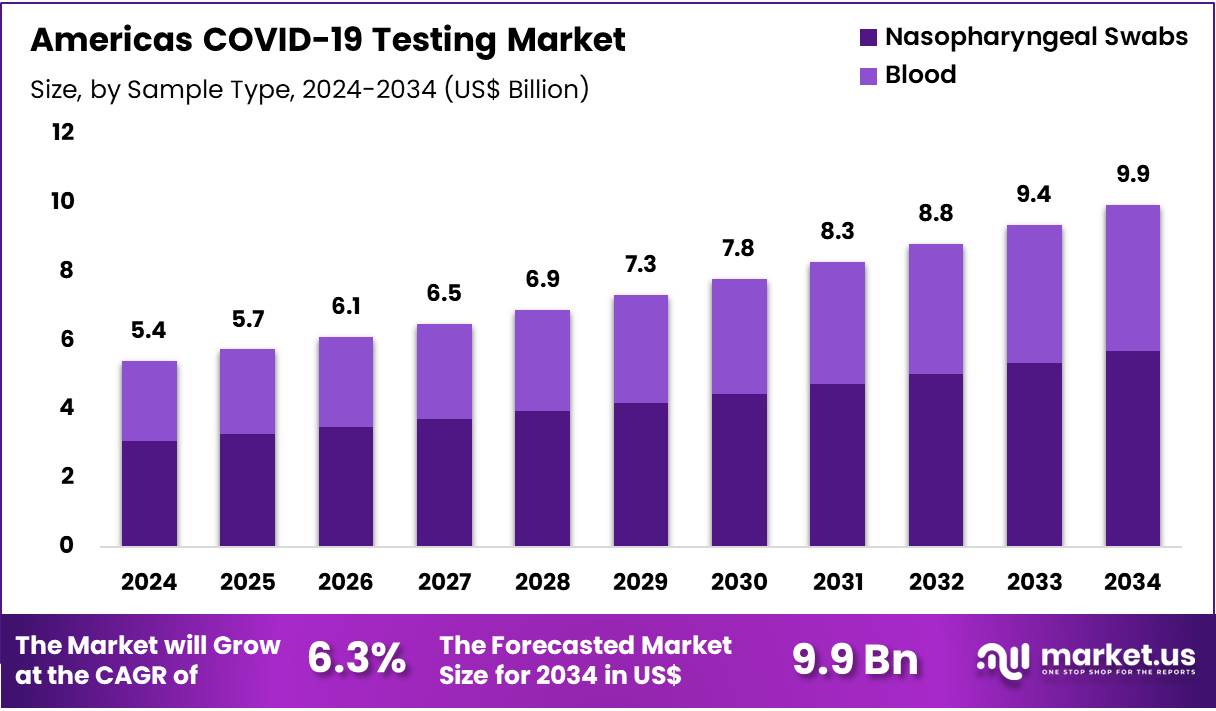
Key Takeaways
- In 2024, the Americas COVID-19 Testing Market generated revenue of approximately US$ 5.4 billion and is projected to grow at a CAGR of 6.3%, reaching around US$ 9.9 billion by 2034.
- Based on sample type, the market is segmented into nasopharyngeal swabs and blood samples. The nasopharyngeal swabs segment dominated in 2023, accounting for a market share of 57.2%, due to its widespread use in COVID-19 detection procedures.
- By test type, the market is categorized into SARS-CoV-2 antigen tests, SARS-CoV-2 IgM/IgG antibody tests, and multiplex real-time RT-PCR tests. Among these, SARS-CoV-2 antigen tests captured a significant market share of 49.6%, supported by rapid results and easy accessibility.
- Based on distribution channels, the market is segmented into hospital pharmacies, retail pharmacies, online sales channels, drug stores, and diagnostic laboratories. The hospital pharmacies segment held the leading position, contributing the highest revenue share of 46.3% due to strong adoption within healthcare facilities.
Market Segmentation Overview
- Sample Type Analysis: Nasopharyngeal swabs held a dominant market share of 57.2% due to their high accuracy in detecting SARS-CoV-2 viral RNA, particularly among symptomatic and high-risk patients. These samples are widely used across PCR, antigen, and antibody testing platforms. Hospitals and diagnostic laboratories continue adopting nasopharyngeal swabs because of their reliability, compatibility with multiple testing methods, and effectiveness in early virus detection.
- Test Type Analysis: SARS-CoV-2 antigen tests accounted for 49.6% of the market share due to their rapid detection capability, affordability, and ease of use. These tests support large-scale screening across workplaces, schools, and public health programs. Increasing adoption of home-based antigen testing kits and demand for quick diagnostic solutions are expected to maintain the leading position of antigen tests in the Americas COVID-19 Testing Market.
- Distribution Channel Analysis: Hospital pharmacies represented the largest revenue share of 46.3% due to their important role in supplying COVID-19 testing solutions within healthcare facilities. Hospitals utilize PCR and antigen testing for patient diagnosis, pre-surgical screening, and infection monitoring. Growing demand for timely testing, continuous variant surveillance, and efficient patient management is expected to strengthen hospital pharmacies’ position as a major distribution channel.
Statistical Information
- Weekly samples tested globally and in Americas: WHO reported 60,286 SARS‑CoV‑2 samples tested across 69 countries in the week 11–17 May 2026, and 45,201 samples across 62 countries in 6–12 July 2026. During May, eleven countries from the Americas, Europe, South‑East Asia had >10% weekly case increases, indicating ongoing surveillance‑driven testing despite declining overall sample volumes.
- Americas surveillance program coverage and rate rounding: Starting from the week of 11 September 2023, WHO switched Region of the Americas COVID‑19 data to aggregated national surveillance via the COVID‑19, Influenza, RSV, Other Respiratory Viruses program. Data are retrospectively included from 31 July 2023. WHO notes that rates <0.001 per 100,000 population are rounded to 0, reflecting extremely low reported incidence in some jurisdictions.
- U.S. cumulative cases, deaths and infection prevalence: The United States has 103,436,829 confirmed COVID‑19 cases and 1,238,189 deaths, with an estimated fatality rate of 1.2%. A CDC estimate in September 2021 suggested 146,585,169 suspected cases, while by November 2022 serosurveys indicated over 94.2% of Americans had been infected at least once, showing extremely high population exposure and sustained demand for diagnostic testing over multiple years.
- U.S. test positivity and emergency department visits: CDC reports national test positivity was 1.0% for the week ending 27 June 2026, rising to 2.2% for the week ending 18 July 2026; the previous week was 1.6%. During the same period, emergency department (ED) visits diagnosed as COVID‑19 were 0.1% of all ED visits, indicating low but measurable ongoing COVID activity and surveillance testing.
- U.S. state testing rollout and population coverage: An analysis of early U.S. testing shows that by August 1, 2020, New York State had tested around 30% of its population, up from about 10% on June 1. The median testing rate across all states at that time was approximately 15%, highlighting substantial interstate variation and relatively slow national rollout of testing capacity despite high demand.
- Scale of SARS‑CoV‑2 test production for U.S.: Between January 20, 2020 and December 31, 2022, approximately 6.7 billion SARS‑CoV‑2 tests were produced for the U.S. population, including 1.5 billion laboratory tests, 1.9 billion point‑of‑care tests, and 3.3 billion over‑the‑counter rapid tests. This volume underscores the enormous manufacturing and logistical scale supporting the COVID‑19 testing market in North America.
- Historical U.S. testing totals and positivity in 2020: CDC’s archived testing page shows that by August 26, 2020, the United States had reported 79,611,982 total COVID‑19 tests, of which 6,873,739 were positive, giving an overall positivity of 9%. Earlier, by May 11, 2020, CDC labs had tested 6,275 specimens and U.S. public health labs 818,682 specimens, illustrating rapid growth of laboratory‑based diagnostic capacity.
- Scale and mix of U.S. SARS‑CoV‑2 tests produced: Between Jan 20, 2020 and Dec 31, 2022, an estimated 6.7 billion SARS‑CoV‑2 tests were produced for the U.S., including 1.5 billion laboratory tests, 1.9 billion point‑of‑care tests, and 3.3 billion over‑the‑counter rapid antigen tests. Over‑the‑counter tests therefore represented about 49% of total production, illustrating the huge home‑testing segment.
Business Opportunities
The Americas COVID-19 testing market continues to create business opportunities through demand for rapid diagnostics, multiplex respiratory panels, and decentralized testing solutions. Growing adoption of at-home testing, with the U.S. government distributing more than 900 million free COVID-19 test kits, has increased consumer acceptance of self-diagnostic platforms.
Companies can explore opportunities in AI-enabled diagnostic interpretation, digital health integration, and connected testing devices that support remote monitoring. Expansion of wastewater surveillance programs, covering more than 1,300 U.S. monitoring sites, creates opportunities for laboratory service providers and environmental testing companies.
Healthcare providers also require advanced molecular and PCR-based solutions for high-risk patients and hospital infection control. Diagnostic manufacturers can benefit from developing combined COVID-19, influenza, and RSV testing platforms, improving efficiency through single-sample testing. Continued respiratory disease surveillance will support long-term demand for innovative testing technologies across North and South America.
Emerging Trends
- Wastewater Surveillance Becoming a Long-Term Monitoring Tool: CDC’s National Wastewater Surveillance System is expanding as a non-invasive COVID-19 tracking method. The program collects data from around 1,500 wastewater monitoring sites across the U.S., helping detect community infection trends even when people do not seek clinical testing.
- Growth of At-Home Combination Diagnostic Tests: Home-based testing is moving beyond COVID-19-only kits toward multi-pathogen solutions. FDA authorized the first OTC home test detecting both COVID-19 and influenza A/B, providing results in approximately 15 minutes and improving consumer access to respiratory diagnostics.
- Shift Toward Multiplex Respiratory Testing Platforms: Healthcare providers are increasingly adopting tests that identify multiple respiratory infections from one sample. FDA-authorized COVID-19 and flu combination tests support faster clinical decisions by detecting 2 major respiratory pathogens (SARS-CoV-2 and influenza) in a single workflow.
- Expansion of Digital Disease Surveillance Systems: COVID-19 monitoring is shifting from only laboratory reporting toward integrated data platforms combining testing results, wastewater signals, and healthcare indicators. CDC uses wastewater, hospitalization, and laboratory data streams to provide a broader view of respiratory virus activity.
- Increasing Adoption of Self-Testing and Decentralized Diagnostics: Consumer testing behavior continues moving toward convenient home solutions. FDA lists multiple authorized OTC COVID-19 antigen tests that provide results within 10–20 minutes, allowing individuals to perform testing without visiting healthcare facilities.
Use Cases
- Early Detection Through Wastewater Surveillance: Public health agencies use wastewater testing to identify SARS-CoV-2 circulation at the community level without individual testing. CDC’s National Wastewater Surveillance System uses data from more than 1,200 monitoring sites, helping detect increases in COVID-19 activity before healthcare reporting changes.
- Home-Based Testing for Consumer Health Management: At-home antigen tests allow individuals to quickly identify COVID-19 infections without visiting healthcare facilities. The U.S. government distributed more than 900 million free COVID-19 test kits through household programs, increasing consumer adoption of self-testing solutions.
- Hospital Testing for High-Risk Patients: Hospitals use molecular COVID-19 tests for elderly patients, immunocompromised individuals, and patients requiring admission. Accurate testing helps healthcare providers determine treatment options, apply infection control measures, and reduce transmission risks in clinical environments.
- Multiplex Testing for Respiratory Disease Diagnosis: Healthcare providers use combination diagnostic tests to detect COVID-19, influenza, and RSV from a single sample. FDA-authorized multiplex platforms improve diagnostic efficiency by providing results for multiple respiratory infections through one testing workflow.
- Point-of-Care Testing in Emergency and Outpatient Settings: Rapid molecular and antigen testing platforms are used in emergency departments, urgent care centers, pharmacies, and clinics to provide faster diagnosis. Some FDA-authorized rapid tests deliver results within 15–30 minutes, supporting quicker medical decisions.
Recent Development
- In 2026, Thermo Fisher Scientific, Inc. expanded its molecular diagnostics and laboratory automation capabilities to support infectious disease testing. The company continued developing high-throughput laboratory solutions that improve testing efficiency, scalability, and preparedness for future respiratory disease outbreaks.
- In 2026, Abbott Laboratories strengthened its point-of-care diagnostics portfolio by advancing rapid molecular and antigen testing solutions for respiratory infections. The company’s ID NOW platform continued supporting decentralized testing by delivering COVID-19 molecular results in approximately 5 minutes for positive cases and 13 minutes for negative cases.
- In 2026, Roche enhanced its molecular diagnostics capabilities through PCR-based infectious disease testing solutions. The company focused on improving diagnostic workflow efficiency, assay development speed, and laboratory preparedness to support healthcare systems managing respiratory and emerging infectious diseases.
- In 2026, Danaher (Cepheid) expanded the utilization of its GeneXpert molecular diagnostic platform across healthcare settings. The company continued supporting rapid PCR-based infectious disease testing with automated systems designed to improve turnaround time and reduce manual laboratory processing requirements.
- In 2026, Becton Dickinson & Co. (BD) advanced its molecular and point-of-care diagnostic solutions to improve respiratory infection detection. The company focused on automated testing workflows that support faster diagnosis, improved laboratory efficiency, and enhanced healthcare delivery.
- In 2026, bioMérieux SA expanded its multiplex respiratory testing capabilities through the BIOFIRE platform. The company continued developing syndromic diagnostic solutions that detect multiple respiratory pathogens from a single patient sample, supporting faster clinical decisions during seasonal outbreaks.
- In 2026, QIAGEN N.V. continued advancing molecular diagnostic technologies through integrated PCR testing platforms. The company focused on multiplex respiratory diagnostics, enabling laboratories to identify multiple pathogens from a single sample while improving workflow efficiency and testing accuracy.
Frequently Asked Questions on Americas COVID-19 Testing
- What are the major types of COVID-19 tests available in the Americas?
The major COVID-19 testing types include molecular PCR tests, rapid antigen tests, and multiplex respiratory diagnostic tests. PCR testing provides high accuracy, while antigen tests offer faster results for consumers, healthcare facilities, and community testing programs. - What factors are driving demand for COVID-19 testing in the Americas?
Demand is supported by ongoing respiratory disease surveillance, increased adoption of rapid diagnostic solutions, expansion of multiplex testing, and continued healthcare preparedness. Government agencies continue monitoring SARS-CoV-2 activity through laboratory testing and wastewater surveillance systems. - How has at-home testing changed consumer behavior?
At-home COVID-19 testing has increased consumer access to rapid diagnostics by allowing individuals to test without visiting healthcare facilities. Large-scale government distribution programs introduced millions of households to self-testing, increasing awareness and acceptance of decentralized diagnostic solutions. - Why is wastewater surveillance important for COVID-19 monitoring?
Wastewater surveillance helps detect SARS-CoV-2 activity at the community level by analyzing virus signals in wastewater samples. CDC uses wastewater monitoring systems as an additional tool to identify infection trends and support public health response planning. - What role do multiplex respiratory tests play in the market?
Multiplex respiratory tests allow healthcare providers to detect COVID-19 and other respiratory infections such as influenza and RSV using a single sample. These solutions improve diagnostic efficiency, reduce testing time, and support faster treatment decisions. - Which companies are key players in the Americas COVID-19 Testing Market?
Major companies operating in the Americas COVID-19 Testing Market include Abbott Laboratories, Roche, Thermo Fisher Scientific, Inc., Danaher (Cepheid), Becton Dickinson & Co. (BD), bioMérieux SA, QIAGEN N.V., and Siemens Healthineers. - What are the emerging trends in the Americas COVID-19 Testing Market?
Emerging trends include growth of wastewater monitoring, expansion of home-based diagnostics, development of multiplex respiratory panels, automation of laboratory testing, and integration of digital surveillance platforms to improve respiratory disease monitoring and healthcare decision-making.
Conclusion
The Americas COVID-19 Testing Market continues evolving from pandemic-focused testing toward long-term respiratory disease monitoring and healthcare preparedness. Increasing adoption of rapid diagnostics, multiplex respiratory panels, wastewater surveillance, and automated molecular testing solutions is supporting market development. Government agencies such as CDC and FDA continue strengthening testing infrastructure, regulatory support, and surveillance programs.
Leading companies including Abbott Laboratories, Roche, Thermo Fisher Scientific, Inc., Danaher (Cepheid), and others are advancing innovative diagnostic technologies. Future growth opportunities are expected from decentralized testing, digital health integration, and advanced laboratory solutions that improve early detection and management of respiratory infections across the Americas.
Discuss your needs with our analyst
Please share your requirements with more details so our analyst can check if they can solve your problem(s)




