


Overview
New York, NY – Sep 16, 2026 –The Global Zika Virus Testing Market size is expected to reach around US$ 457.8 Million by 2034, up from US$ 224.2 Million in 2024, growing at a CAGR of 7.4% during the forecast period 2025 to 2034. In 2024, North America led the market, achieving over 41.9% share with a revenue of US$ 93.9 Million.
Zika Virus Testing is expanding as healthcare systems increase focus on infectious disease surveillance, rapid diagnosis, and outbreak preparedness. According to the World Health Organization (WHO), Zika virus transmission has been reported in more than 80 countries and territories, while Aedes aegypti mosquitoes capable of spreading Zika are present in over 100 countries globally. The major 2015–2016 Zika outbreak in the Americas resulted in an estimated 3–4 million infections, creating strong demand for reliable diagnostic solutions.
The market is driven by molecular testing technologies, including RT-PCR, nucleic acid amplification tests, and serological assays. The CDC reported that Zika virus RNA can be detected in blood for approximately 7 days after symptom onset and in urine for up to 14 days, supporting the adoption of advanced testing methods. During the outbreak period, Brazil reported more than 200,000 probable Zika cases, with over 2,000 confirmed cases of congenital abnormalities associated with infection during pregnancy.
Diagnostic demand has also increased due to travel-related infections. The CDC recorded approximately 5,600 travel-associated Zika cases in the United States between 2015 and 2018, while Puerto Rico reported more than 36,000 confirmed Zika cases during 2016. Advanced automated testing platforms are reducing diagnostic turnaround times from several days to less than 24 hours in many laboratory settings.
Rising investments in mosquito surveillance, maternal health monitoring, and infectious disease preparedness are expected to support the Zika Virus Testing Market as global healthcare systems strengthen early detection and outbreak response capabilities.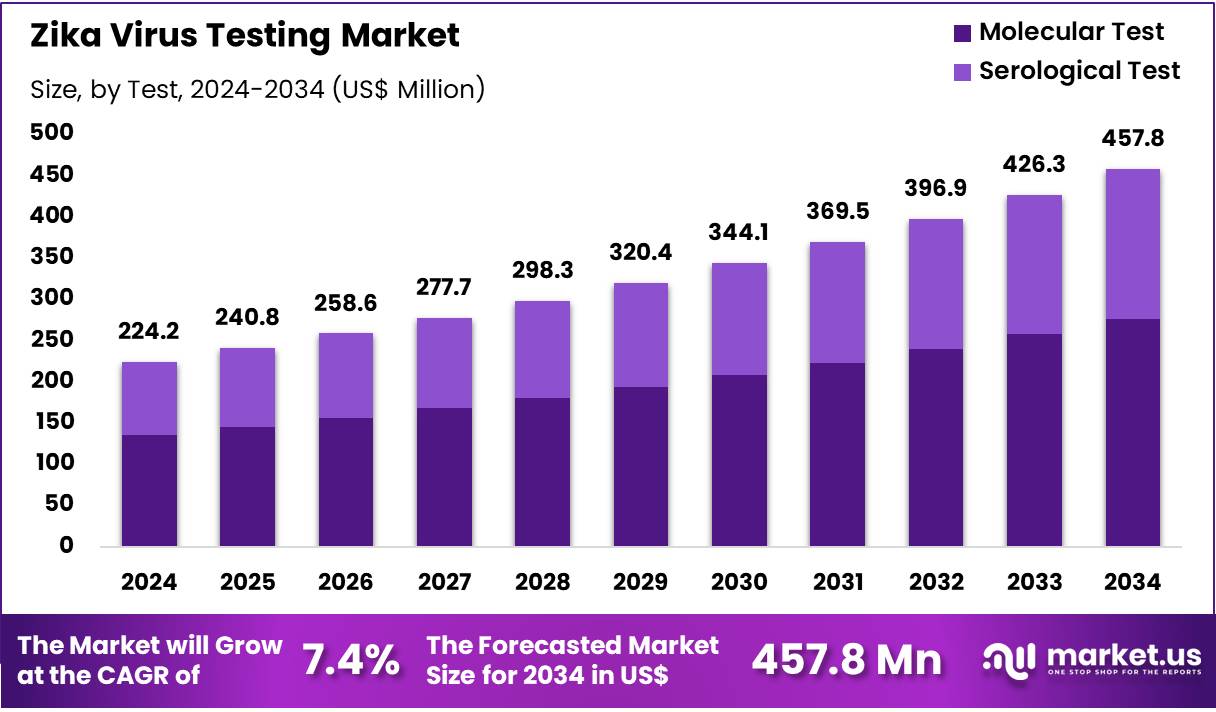
Key Takeaways
- In 2024, the Zika Virus Testing Market generated revenue of US$ 224.2 Million and is projected to grow at a CAGR of 7.4%, reaching an estimated US$ 457.8 Million by 2034.
- Based on test type, the market is segmented into molecular tests and serological tests, with molecular tests dominating in 2023 by capturing a market share of 60.4%.
- Based on end users, the market is categorized into hospitals & clinics, diagnostic laboratories, and others, with hospitals & clinics accounting for a leading share of 53.2%.
- Regionally, North America emerged as the leading market in 2024, holding a significant market share of 41.9% due to advanced diagnostic infrastructure and increased disease surveillance activities.
Market Segmentation Overview
- Test Analysis: Molecular tests held a 60.4% market share in 2023, dominating the Zika Virus Testing Market due to their high sensitivity, accuracy, and ability to detect infections during early stages. PCR-based diagnostics are widely preferred for timely identification, especially among pregnant women and high-risk populations requiring early intervention and monitoring.
- End-User Analysis: Hospitals & clinics accounted for a 53.2% market share, leading the end-user segment due to their important role in Zika diagnosis and patient care. Increasing outbreak surveillance, travel-related infections, and availability of advanced diagnostic facilities in hospitals are driving higher adoption of Zika virus testing services.
Statistical Information
- United States historical Zika cases and testing needs: CDC ArboNET data show high U.S. testing needs during 2016, when there were 224 locally acquired and 4,944 travel‑associated Zika cases in states, plus 36,367 locally acquired in territories. With case numbers dropping, CDC reports no confirmed Zika cases from U.S. territories since 2019, indicating a shift from outbreak‑level testing toward targeted testing in specific risk groups.
- Case burden in Americas driving testing demand: PAHO reports Zika surveillance data for 52 countries and territories in the Americas. During 2015–2017, several countries reported tens of thousands of suspected cases, with Brazil accounting for 97% of 55,813 reported cases in a reviewed subset of 14 countries. These volumes required massive RT‑PCR and serology testing capacity, particularly for pregnant women and newborns.
- Americas Zika incidence and implied testing volume: PAHO weekly reports show substantial country‑level burdens; one synthesis cited 55,813 Zika cases from 14 countries, with 11% laboratory‑confirmed and 97% of cases in Brazil. PAHO data for 41 countries/territories have been used to compute incidence per 100,000 population, based on case numbers reported through PLISA. Each confirmed case implies one or more NAAT plus serology tests.
- United States case concentration and policy impact: CDC‑based policy summarises that Zika cases were reported from 49 states and DC, with 48% of cases from Florida (21%), New York (19%), and California (8%). Because no confirmed cases have been detected in U.S. states or territories since 2018, routine Zika testing is not recommended, concentrating testing on pregnant women and others with clearly documented exposure.
- FDA data on asymptomatic infections and implications: FDA states that about four out of five (80%) Zika infections are asymptomatic. This means up to 20% symptomatic vs 80% silent infections, increasing reliance on testing in pregnancy, blood donation and high‑risk travel cohorts. Because symptoms are absent in most infections, targeted lab screening is necessary to detect a large share of clinically important cases.
- PAHO incidence calculations and regional heterogeneity: A PAHO‑derived dataset has calculated weekly incidence for 41 countries/territories by dividing total Zika cases by population per 100,000, showing wide heterogeneity, with some countries experiencing incidences in the hundreds of cases per 100,000 while others remained in single digits. High‑incidence countries require proportionally greater test volumes per capita, affecting regional demand for NAAT and serologic kits.
- U.S. public awareness levels and behaviour context: A U.S. study cited by CDC found Zika awareness increased from 74% of respondents in March to 95% by August, and 75% knew Zika could cause birth defects. High awareness and perceived risk drive demand for testing among pregnant women and travellers, even when actual incidence is low, linking risk perception to diagnostic utilisation.
- Comparative arbovirus burden and silent Zika circulation: PAHO emphasizes that, despite low case numbers, Zika continues silent circulation in 89 countries, with 27,000 Zika cases vs 3,000,000 dengue and 324,000 chikungunya in 2023. This contrasts high-burden arboviruses with Zika’s lower but strategically critical incidence, where each infection in pregnancy has an outsized impact on testing, monitoring and resource allocation.
Regional Analysis
North America led the market by securing a market share of 41.9% in 2024.
North America remains a significant region for Zika virus testing due to strong public health surveillance, advanced laboratory infrastructure, and continued monitoring of travel-associated infections. The United States experienced a major Zika outbreak response in 2016, with 5,168 noncongenital Zika virus disease cases reported in U.S. states and the District of Columbia, including 4,897 travel-associated cases (95%), increasing demand for molecular and serological diagnostic solutions. CDC continues surveillance through ArboNET, supporting testing among travelers, pregnant women, and individuals with possible exposure risks.
Asia Pacific is expected to witness strong growth in Zika virus testing demand due to the presence of Aedes mosquito populations, tropical climates, and continued disease surveillance requirements. WHO reports that Zika transmission persists at low levels in several Asian countries, with outbreaks occurring in regions where mosquito vectors are established. Increasing healthcare preparedness, prenatal monitoring, and laboratory expansion are supporting adoption of reliable Zika diagnostic technologies across the region.
Business Opportunities
The Zika virus testing market presents business opportunities through the development of rapid, accurate, and cost-effective diagnostic solutions. Growing demand for molecular testing, including RT-PCR-based assays, creates opportunities for diagnostic companies to expand laboratory and point-of-care testing capabilities. Healthcare providers require improved testing tools for pregnant women, travelers, and individuals in mosquito-endemic regions due to the risk of congenital Zika syndrome.
Companies can focus on developing multiplex diagnostic platforms that differentiate Zika from other mosquito-borne infections such as dengue and chikungunya. Expansion of surveillance programs by public health organizations creates opportunities for partnerships with governments and healthcare institutions.
Portable testing devices, automated laboratory systems, and improved sample processing technologies can support wider access in regions with limited diagnostic infrastructure. Increasing investments in infectious disease preparedness and outbreak monitoring will continue creating opportunities for diagnostic manufacturers and biotechnology companies.
Emerging Trends
- Increasing Adoption of Molecular RT-PCR Testing: Molecular testing is becoming a preferred approach for Zika detection due to higher accuracy and early identification of active infection. CDC recommends nucleic acid amplification testing (NAAT) as a key diagnostic method, supporting continued demand for advanced laboratory testing solutions.
- Growth of Multiplex Diagnostic Platforms: Diagnostic systems capable of detecting Zika along with dengue and chikungunya are gaining importance because these infections share similar symptoms and mosquito vectors. WHO highlights the need for differential diagnosis to improve outbreak response and patient management.
- Expansion of Prenatal Zika Testing Programs: Testing among pregnant women remains a major healthcare focus due to the risk of congenital Zika syndrome. WHO reports that Zika infection during pregnancy can cause microcephaly and other birth complications, increasing demand for reliable diagnostic monitoring.
- Development of Portable and Point-of-Care Testing Solutions: Healthcare systems are focusing on rapid and decentralized diagnostic technologies to improve access during outbreaks. FDA authorized multiple Zika diagnostic products under Emergency Use Authorization, including molecular and serological assays for clinical use.
- Strengthening Global Zika Surveillance Networks: Continuous monitoring programs are driving demand for diagnostic tools as Zika transmission remains a public health concern. WHO states that 92 countries and territories have reported evidence of mosquito-transmitted Zika virus infection, requiring ongoing surveillance and laboratory preparedness.
Use Cases
- Prenatal Screening for Pregnant Women: Zika testing is widely used for pregnant women with possible virus exposure because infection can cause congenital Zika syndrome and neurological complications in infants. WHO identifies pregnancy monitoring as a critical area due to Zika-associated birth defects.
- Travel-Associated Infection Detection: Zika diagnostic tests are used among travelers returning from regions with active or previous Zika transmission. CDC reported that 4,897 of 5,168 U.S. Zika cases in 2016 were travel-associated, highlighting the importance of travel-related testing programs.
- Outbreak Investigation and Public Health Surveillance: Governments use Zika testing for outbreak detection, transmission monitoring, and public health response. WHO reports that 92 countries and territories have documented evidence of mosquito-transmitted Zika infection, requiring continuous surveillance systems.
- Differential Diagnosis of Mosquito-Borne Diseases: Zika tests are used alongside dengue and chikungunya diagnostics because these infections have overlapping symptoms. Healthcare providers use laboratory confirmation to improve treatment decisions and outbreak management in regions where Aedes mosquitoes are present.
- Blood Safety Screening Applications: Zika testing is used in blood safety programs to reduce the risk of transfusion-associated transmission. The U.S. FDA recommended testing measures for blood donations during Zika outbreaks, supporting the use of molecular screening technologies.
Recent Development
- In 2026, Thermo Fisher Scientific, Inc. continued expanding its molecular diagnostics and laboratory automation capabilities to support infectious disease testing. The company focused on improving high-throughput workflows, advanced analytical technologies, and research solutions that help laboratories improve pathogen detection and outbreak preparedness.
- In 2026, Roche Diagnostics continued strengthening its molecular diagnostics portfolio through advanced PCR technologies, automation solutions, and digital laboratory platforms. The company focused on improving infectious disease testing efficiency by supporting faster detection, higher laboratory capacity, and integrated diagnostic workflows across healthcare systems.
- In 2026, Qiagen N.V. expanded its molecular diagnostics capabilities with new syndromic testing solutions designed for rapid pathogen identification. The company introduced advanced multiplex testing technologies capable of detecting multiple infectious targets within approximately one hour, supporting faster clinical decision-making and infectious disease monitoring.
- In 2026, bioMérieux SA continued advancing infectious disease diagnostics through molecular testing platforms, syndromic solutions, and automated microbiology systems. The company focused on improving pathogen identification speed and laboratory efficiency, supporting healthcare providers in managing infectious disease detection and surveillance requirements.
- In 2026, Danaher Corporation continued investing in diagnostics innovation through its healthcare technology businesses. The company focused on molecular diagnostics, laboratory automation, and precision testing solutions designed to improve pathogen detection capabilities, workflow efficiency, and global infectious disease preparedness.
- In 2026, Abbott Laboratories continued expanding its infectious disease diagnostics portfolio through molecular and point-of-care testing technologies. The company focused on improving rapid testing accessibility, decentralized diagnostic capabilities, and healthcare delivery solutions that support early detection of infectious diseases.
Frequently Asked Questions on Zika Virus Testing
- What are the major types of Zika virus tests?
The major Zika virus tests include molecular tests such as RT-PCR and nucleic acid amplification tests, along with serological antibody-based tests. These diagnostic methods help detect active infections and identify previous exposure to the virus. - Which technology dominates the Zika Virus Testing Market?
Molecular diagnostic technology remains a key segment in Zika testing because RT-PCR methods provide accurate detection of viral RNA during early infection stages. Healthcare laboratories widely use molecular platforms due to their sensitivity, reliability, and faster diagnostic capabilities. - What factors are driving the growth of the Zika Virus Testing Market?
The market growth is driven by increasing infectious disease surveillance, rising demand for rapid diagnostics, pregnancy-related testing requirements, government monitoring programs, and advancements in molecular testing technologies. Continued Zika transmission risks support investment in improved diagnostic solutions. - What role do government organizations play in Zika testing?
Government organizations support Zika testing through surveillance programs, diagnostic guidelines, outbreak monitoring, and laboratory networks. Agencies such as CDC, WHO, and FDA provide recommendations and regulatory support to improve testing accuracy and strengthen infectious disease preparedness. - Which regions have high demand for Zika virus testing?
Regions with tropical and subtropical climates, including parts of the Americas and Asia Pacific, show higher demand for Zika testing due to Aedes mosquito prevalence. Public health surveillance and outbreak preparedness programs continue supporting diagnostic adoption in these areas. - What opportunities exist in the Zika Virus Testing Market?
Opportunities exist in developing rapid testing platforms, portable diagnostic devices, multiplex assays, and automated laboratory solutions. Companies can expand through partnerships with healthcare systems, government surveillance programs, and research organizations focused on infectious disease prevention. - What is the future outlook for the Zika Virus Testing Market?
The future outlook for the Zika Virus Testing Market is influenced by continuous disease surveillance, technological advancements, and increasing demand for accurate diagnostics. Growth opportunities are expected from molecular testing innovation, decentralized diagnostics, and improved outbreak preparedness strategies.
Conclusion
The Zika Virus Testing Market continues to evolve due to increasing focus on infectious disease surveillance, molecular diagnostic advancements, and the need for accurate detection methods. Rising awareness of Zika-related pregnancy risks, travel-associated infections, and outbreak preparedness programs supports demand for reliable testing solutions. Technologies such as RT-PCR, multiplex assays, and automated diagnostic platforms are improving testing efficiency and accessibility.
Key diagnostic companies are investing in innovative solutions to strengthen infectious disease monitoring capabilities. With continued support from healthcare organizations, governments, and research institutions, the market is expected to witness further development through advanced testing technologies and improved global diagnostic infrastructure.
Discuss your needs with our analyst
Please share your requirements with more details so our analyst can check if they can solve your problem(s)




