


Overview
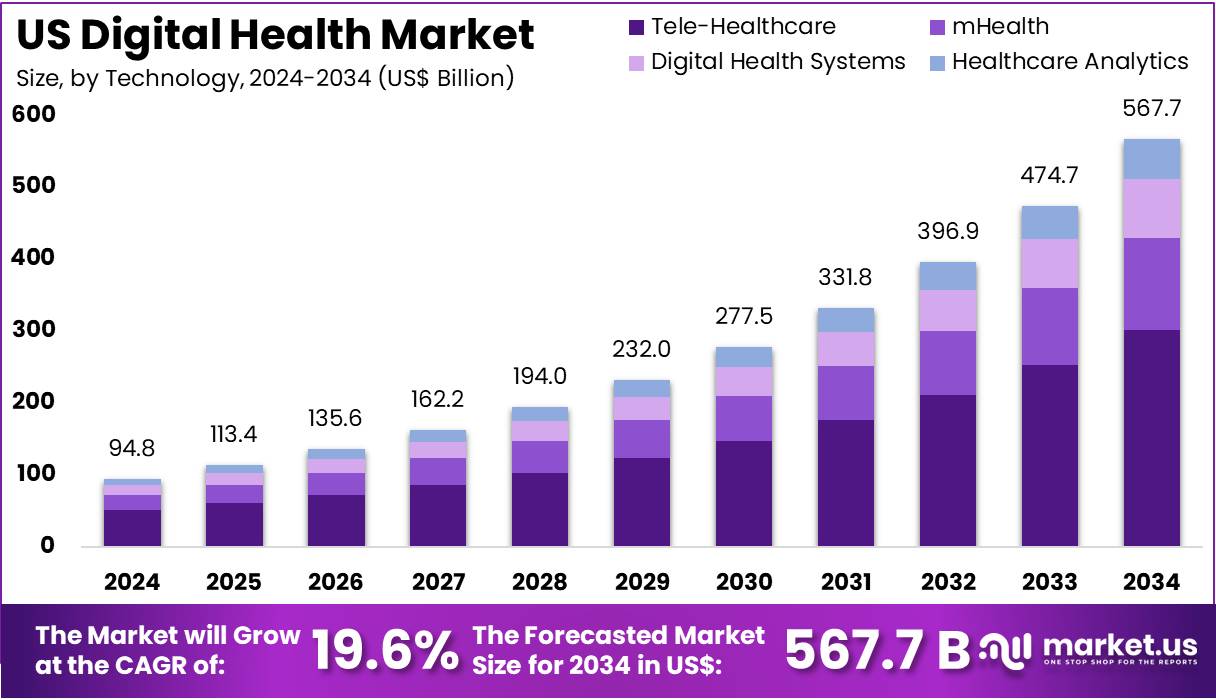
New York, NY – June 12, 2026 – The US Digital Health Market Size is expected to be worth around US$ 567.7 billion by 2034 from US$ 94.8 billion in 2024, growing at a CAGR of 19.6% during the forecast period 2025 to 2034.
The U.S. digital health market continues to experience significant growth, driven by increasing adoption of connected healthcare technologies, rising demand for remote patient monitoring, and growing emphasis on value-based care. Digital health encompasses a broad range of technologies, including telehealth platforms, mobile health applications, wearable devices, healthcare analytics solutions, electronic health records, and artificial intelligence-enabled healthcare tools.
The widespread integration of smartphones, cloud computing, and advanced data analytics has accelerated the deployment of digital health solutions across healthcare providers, payers, patients, and life sciences organizations. The market has also benefited from supportive regulatory initiatives, expanding internet penetration, and growing consumer preference for convenient and personalized healthcare services.
Telemedicine remains one of the most prominent segments within the U.S. digital health ecosystem, enabling virtual consultations and improving access to care, particularly in underserved and rural areas. Additionally, remote patient monitoring solutions are gaining traction as healthcare organizations seek to improve patient outcomes while reducing hospital readmissions and overall healthcare costs.
Artificial intelligence and machine learning technologies are increasingly being incorporated into clinical decision support, diagnostics, workflow automation, and predictive analytics applications. Furthermore, the growing prevalence of chronic diseases and an aging population continue to create demand for innovative digital healthcare solutions.
With ongoing technological advancements and increasing healthcare digitalization, the U.S. digital health market is expected to maintain strong growth momentum over the coming years.
Key Takeaways
- The U.S. digital health market was valued at US$ 94.8 billion in 2024 and is projected to reach US$ 567.7 billion by 2034, expanding at a CAGR of 19.6% during the forecast period.
- Based on product type, the market is categorized into software, hardware, and services. Among these, the services segment accounted for the largest market share of 45.7% in 2024.
- By technology, the market is segmented into tele-healthcare, mHealth, digital health systems, and healthcare analytics. The tele-healthcare segment dominated the market, capturing a revenue share of 58.4% in 2024.
- In terms of application, the market comprises obesity, cancer, respiratory diseases, fitness, mental health management, diabetes, blood pressure & ECG monitoring, cardiovascular diseases, menstrual health, and others. The diabetes segment emerged as the leading application area, representing 46.9% of the total market revenue in 2024.
- Based on end user, the market is divided into providers, payers, patients, and others. The patients segment held the dominant position, accounting for 62.5% of the overall market revenue in 2024.
Market Segmentation Analysis
- Product Type Analysis: The services segment accounted for the largest market share of 45.7% in 2024, driven by increasing adoption of digital healthcare technologies. Demand for integration, maintenance, training, and cybersecurity services continues to rise as healthcare providers implement and manage complex digital health systems.
- Technology Analysis: Tele-healthcare captured a 58.4% market share due to growing demand for remote healthcare services. Virtual consultations improve accessibility, reduce healthcare costs, and support patient convenience. Advancements in video communication, remote monitoring, and secure digital platforms continue to strengthen market growth.
- Application Analysis: The diabetes segment generated a revenue share of 46.9%, supported by the rising prevalence of diabetes and growing use of digital health tools. Mobile applications, wearable devices, and continuous glucose monitoring systems help patients manage conditions effectively through real-time health tracking.
- End-User Analysis: The patients segment held a significant revenue share of 62.5% as consumers increasingly adopt digital health solutions. Wearables, health applications, and telemedicine platforms enable proactive healthcare management, better communication with providers, and personalized care, driving continued market expansion.
Emerging Trends
- Telehealth Is Now a Normal Option: Telehealth has become a standard healthcare service across the United States. Hospitals and clinics increasingly offer virtual consultations through video or phone calls. Patients benefit from convenient access to care, reduced travel time, and improved healthcare availability, especially in rural and underserved communities.
- Easier Sharing of Health Records: Healthcare providers are improving systems that allow secure sharing of patient records across hospitals, clinics, and healthcare applications. Better data exchange helps physicians access complete medical histories, reduces duplicate testing, lowers costs, and supports faster, more accurate treatment decisions.
- Government Teams Up With Tech Firms: Government health agencies are collaborating with technology companies to develop secure and effective digital healthcare solutions. These partnerships encourage innovation, strengthen privacy protections, improve healthcare accessibility, and ensure digital tools meet standards that benefit diverse and underserved populations nationwide.
- New Safety Rules for Digital Devices: Regulatory agencies are introducing stricter guidelines for digital health applications, wearable devices, and AI-powered healthcare tools. These measures ensure product safety, effectiveness, and privacy protection. Stronger regulations increase consumer trust and support the responsible growth of digital healthcare technologies.
Use Cases
- Virtual Follow-Ups After Surgery: Healthcare providers increasingly use virtual follow-up appointments after surgeries and treatments. Through video consultations, patients can discuss recovery progress, share symptoms, and receive medical advice from home. This approach improves convenience, lowers costs, and helps detect complications earlier.
- Mobile Apps for Pregnancy and Childcare: Mobile applications provide valuable support for pregnant women and new parents by offering healthcare guidance, appointment reminders, child development tracking, and nutrition advice. Many platforms also include virtual consultations, helping families access healthcare information and support more conveniently.
- Digital Tools for Elderly Care: Wearable devices and smart healthcare technologies help older adults monitor vital signs, track physical activity, and manage medications. Features such as fall detection and emergency alerts enhance safety, while remote monitoring allows caregivers and healthcare providers to support independent living.
- AI for Hospital Efficiency: Artificial intelligence is helping hospitals improve operational efficiency by forecasting patient demand, optimizing staff scheduling, and reducing waiting times. AI-driven systems support resource management, identify urgent care needs, streamline administrative processes, and enhance overall patient care and service delivery.
Frequently Asked Questions on US Digital Health
- What factors are driving the growth of the US Digital Health Market?
Market growth is being driven by increasing adoption of telemedicine, rising prevalence of chronic diseases, growing healthcare digitization initiatives, expanding smartphone penetration, and increasing demand for remote patient monitoring solutions. Favorable government policies and advancements in artificial intelligence further support market expansion. - Which segments are included in the US Digital Health Market?
The market includes telehealth services, digital therapeutics, healthcare analytics, mobile health applications, wearable healthcare devices, electronic health records, and remote patient monitoring systems. These segments collectively enhance healthcare accessibility, patient engagement, and clinical decision-making capabilities. - Why is telehealth an important segment in the US Digital Health Market?
Telehealth has become a key segment due to its ability to provide convenient and cost-effective healthcare services remotely. It reduces hospital visits, improves healthcare access in underserved regions, and supports continuous patient management through virtual consultations and monitoring. - How is artificial intelligence influencing the US Digital Health Market?
Artificial intelligence is improving diagnostic accuracy, treatment planning, predictive analytics, and administrative workflows. AI-powered solutions help healthcare providers analyze large datasets efficiently, enabling personalized treatment approaches and enhancing operational productivity across healthcare organizations. - Who are the major end users in the US Digital Health Market?
Major end users include hospitals, clinics, healthcare providers, insurance companies, patients, and government healthcare agencies. These stakeholders utilize digital health solutions to improve healthcare outcomes, optimize resource utilization, and enhance patient engagement and satisfaction. - How does remote patient monitoring contribute to market growth?
Remote patient monitoring enables healthcare professionals to track patient health conditions in real time outside traditional clinical environments. This approach improves chronic disease management, reduces hospital readmissions, lowers healthcare costs, and enhances overall patient outcomes. - How are government initiatives supporting the US Digital Health Market?
Government initiatives are encouraging healthcare digitization through funding programs, regulatory reforms, interoperability standards, and telehealth reimbursement policies. These measures are accelerating technology adoption while improving healthcare access, efficiency, and quality across the United States healthcare ecosystem. - What opportunities exist for investors in the US Digital Health Market?
Investors can benefit from opportunities in telehealth platforms, digital therapeutics, AI-powered healthcare solutions, remote monitoring technologies, and healthcare cybersecurity. Growing healthcare digitalization and increasing demand for technology-enabled care continue to attract significant investment activity.
Conclusion
The U.S. digital health market is positioned for substantial growth, expanding from US$ 94.8 billion in 2024 to US$ 567.7 billion by 2034 at a CAGR of 19.6%. Growth is being supported by increasing adoption of telehealth, remote patient monitoring, healthcare analytics, artificial intelligence, and connected care solutions.
The rising prevalence of chronic diseases, growing patient engagement, and continued healthcare digitalization are accelerating market demand. Strong government support, improved data interoperability, and advancements in digital technologies are further strengthening the market landscape. As innovation continues, digital health solutions are expected to play a critical role in improving healthcare accessibility, efficiency, and patient outcomes across the United States.
Discuss your needs with our analyst
Please share your requirements with more details so our analyst can check if they can solve your problem(s)




