


Overview
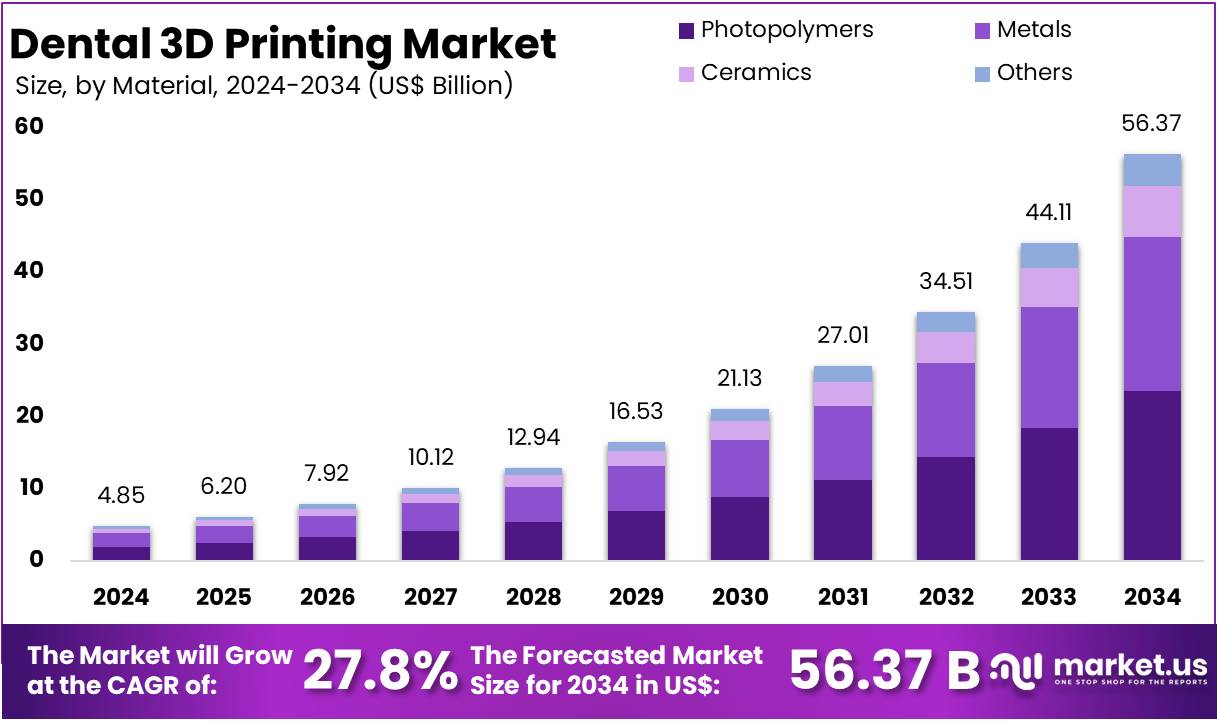
New York, NY – July 15, 2026 – Global Dental 3D Printing Market Size is expected to be worth around US$ 56.37 Billion by 2034 from US$ 4.85 Billion in 2024, growing at a CAGR of 27.8% during the forecast period 2025 to 2034. North America held a dominant market position, capturing more than a 39.7% share and holds US$ 1.93 Billion market value for the year.
Dental 3D printing is an advanced manufacturing technology that enables the rapid production of highly accurate dental models, crowns, bridges, aligners, surgical guides, dentures, and implants using digital design files. The process begins with an intraoral scan or digital impression, which is converted into a three-dimensional model using computer-aided design (CAD) software. This digital model is then produced layer by layer using specialized 3D printers and biocompatible materials, ensuring precision and consistency.
The adoption of dental 3D printing has transformed modern dentistry by improving workflow efficiency, reducing production time, and enhancing treatment accuracy. Compared with conventional manufacturing methods, 3D printing minimizes material waste, shortens turnaround times, and supports greater customization to meet individual patient requirements. Dental laboratories and clinics are increasingly integrating this technology to streamline production and deliver high-quality restorations with improved fit and functionality.
Growing demand for cosmetic dentistry, clear aligners, and digital dental solutions is supporting the expansion of dental 3D printing worldwide. Continuous advancements in printing technologies, materials, and software are further improving product quality and broadening clinical applications. As digital dentistry continues to evolve, dental 3D printing is expected to play a significant role in enhancing patient care, optimizing operational efficiency, and supporting innovation across the global dental industry.
Key Takeaways
- The global Dental 3D Printing market was valued at US$ 4.85 billion in 2024 and is projected to reach US$ 56.37 billion by 2034, expanding at a CAGR of 27.8% during the forecast period.
- By Material, the market is segmented into Photopolymers, Metals, Ceramics, and Others. Photopolymers accounted for the largest share of 41.9% in 2024.
- By Technology, the market is categorized into Vat Photopolymerization, Selective Laser Sintering (SLS), PolyJet Technology, Fused Deposition Modeling (FDM), and Metal Extrusion Technology. Vat Photopolymerization emerged as the leading technology with a 51.3% market share in 2024.
- By Application, the market is divided into Orthodontics, Prosthodontics, Implantology, and Others. Orthodontics held the dominant position with a 39.9% share of the market in 2024.
- By End User, the market is segmented into Dental Laboratories and Clinics, Hospitals & Clinics, and Academic & Research Institutes. Dental Laboratories and Clinics represented the largest segment, accounting for 55.6% of the market share in 2024.
- North America dominated the global Dental 3D Printing market with a 39.7% market share in 2024.
Regional Analysis
North America continues to lead the Dental 3D Printing market, supported by the rapid adoption of advanced digital dentistry technologies and innovative dental materials. High-precision dental resins are enhancing restorative workflows by delivering superior accuracy, aesthetics, and durability for crowns, bridges, and other dental restorations.
Recent innovations, including premium resin materials compatible with next-generation 3D printers, enable dental professionals to manufacture permanent restorations with greater efficiency and consistency. These advancements support same-day dental procedures, reducing treatment times while improving patient satisfaction and clinical productivity.
The ability to produce highly customized restorations in-house also minimizes dependence on external dental laboratories, lowering operational costs and accelerating service delivery. Advanced resin formulations provide excellent translucency, surface finish, and polishability, eliminating several conventional post-processing steps and simplifying production.
As dental clinics and laboratories continue to adopt digital workflows, ongoing improvements in 3D printing materials and equipment are expected to strengthen North America’s leadership, driving higher standards of precision, efficiency, and patient care across restorative and cosmetic dentistry.
Emerging Trends
- Multi-material Printing: Multi-material 3D printing enables dental professionals to manufacture models with different material properties in a single build. Hard and soft sections can be combined, improving realism, functionality, and aesthetics while reducing production steps, increasing efficiency, and supporting the fabrication of advanced dental restorations.
- Increased Printing Speed: Advancements in dental 3D printing systems have significantly accelerated manufacturing, with some technologies producing models and prosthetics up to ten times faster than earlier systems. Higher printing speed improves laboratory productivity, shortens patient waiting times, and enables quicker delivery of customized dental solutions.
- Volumetric Printing: Volumetric printing creates dental models through a three-dimensional process instead of conventional layer-by-layer manufacturing. This approach minimizes support requirements, reduces material waste, shortens post-processing, and delivers highly accurate dental structures, enabling faster, more efficient, and cost-effective production for clinical applications.
Use Cases
- Custom Dental Implants and Prosthetics: Dental 3D printing enables production of customized implants and prosthetics designed to match each patient’s anatomy. Accurate fitting improves comfort, functionality, and durability while reducing treatment time, minimizing adjustments, lowering follow-up visits, and enhancing overall patient satisfaction through personalized restorative dental solutions.
- Educational Models and Tools: Dental institutions use 3D printing to create realistic educational models that enhance practical learning experiences. Students gain hands-on training with complex dental cases, improving clinical skills, treatment understanding, and procedural confidence while bridging theoretical knowledge with real-world dental practice and applications.
- Innovative Dental Solutions: Advanced dental 3D printing supports the development of innovative treatment solutions, including detailed tooth and gum structures for reconstructive procedures. Improved precision, design flexibility, and material innovation enable more effective surgical planning, better rehabilitation outcomes, and expanded possibilities in restorative dentistry.
- Rapid Prototyping: Rapid prototyping with dental 3D printing allows laboratories and clinics to quickly design, test, and refine dental devices before production. Faster product development encourages innovation, improves design accuracy, reduces development costs, and accelerates the introduction of advanced dental technologies into clinical practice.
Frequently Asked Questions on Dental 3D Printing
- What factors are driving the growth of the Dental 3D Printing Market?
The market is expanding due to rising demand for personalized dental restorations, increasing prevalence of dental disorders, growing adoption of CAD/CAM technologies, advancements in biocompatible printing materials, and the need for faster, cost-effective dental manufacturing processes across clinics and laboratories. - What are the major applications of Dental 3D Printing?
Dental 3D printing is widely used in orthodontics, prosthodontics, implantology, and oral surgery. It enables the production of clear aligners, crowns, bridges, dentures, surgical guides, and implant models with high accuracy, improving treatment outcomes and workflow efficiency. - Which materials are commonly used in Dental 3D Printing?
Common materials used in dental 3D printing include photopolymers, metals, ceramics, and composite materials. Photopolymer resins are the most widely adopted because they provide excellent precision, smooth surface finish, aesthetic appearance, and compatibility with various dental restoration applications. - Which technology dominates the Dental 3D Printing Market?
Vat Photopolymerization is the leading technology in the Dental 3D Printing Market due to its superior printing accuracy, smooth surface quality, and ability to produce detailed dental restorations. It is extensively used for manufacturing aligners, crowns, surgical guides, and dental models. - Who are the major end users in the Dental 3D Printing Market?
Dental laboratories and clinics represent the largest end-user segment, as they extensively use 3D printing for producing customized dental restorations and orthodontic appliances. Hospitals, academic institutions, and research organizations also contribute to market demand through clinical and research applications. - Which region leads the Dental 3D Printing Market?
North America holds the largest share of the Dental 3D Printing Market, supported by advanced healthcare infrastructure, widespread adoption of digital dentistry, strong investments in research and development, and the presence of leading manufacturers offering innovative dental 3D printing solutions. - What are the key benefits of Dental 3D Printing?
Dental 3D printing improves manufacturing accuracy, reduces treatment turnaround time, minimizes material waste, lowers production costs, and enables highly customized dental restorations. These advantages enhance operational efficiency for dental professionals while improving comfort and treatment outcomes for patients. - What is the future outlook for the Dental 3D Printing Market?
The Dental 3D Printing Market is expected to witness strong long-term growth due to continuous advancements in printing technologies, increasing use of digital workflows, rising demand for cosmetic dentistry, and expanding adoption of patient-specific dental solutions across developed and emerging healthcare markets.
Conclusion
The global dental 3D printing market is experiencing strong growth, driven by increasing adoption of digital dentistry, rising demand for customized dental restorations, and continuous advancements in printing technologies and biocompatible materials. The technology enhances treatment accuracy, reduces production time, minimizes material waste, and improves operational efficiency for dental laboratories and clinics.
North America maintains market leadership due to advanced healthcare infrastructure and widespread implementation of digital workflows. Emerging innovations such as multi-material, volumetric, and high-speed printing are expanding clinical capabilities and improving patient outcomes. With growing applications across orthodontics, prosthodontics, and implantology, dental 3D printing is expected to remain a transformative technology supporting the future of modern dentistry.
Discuss your needs with our analyst
Please share your requirements with more details so our analyst can check if they can solve your problem(s)




