


Overview
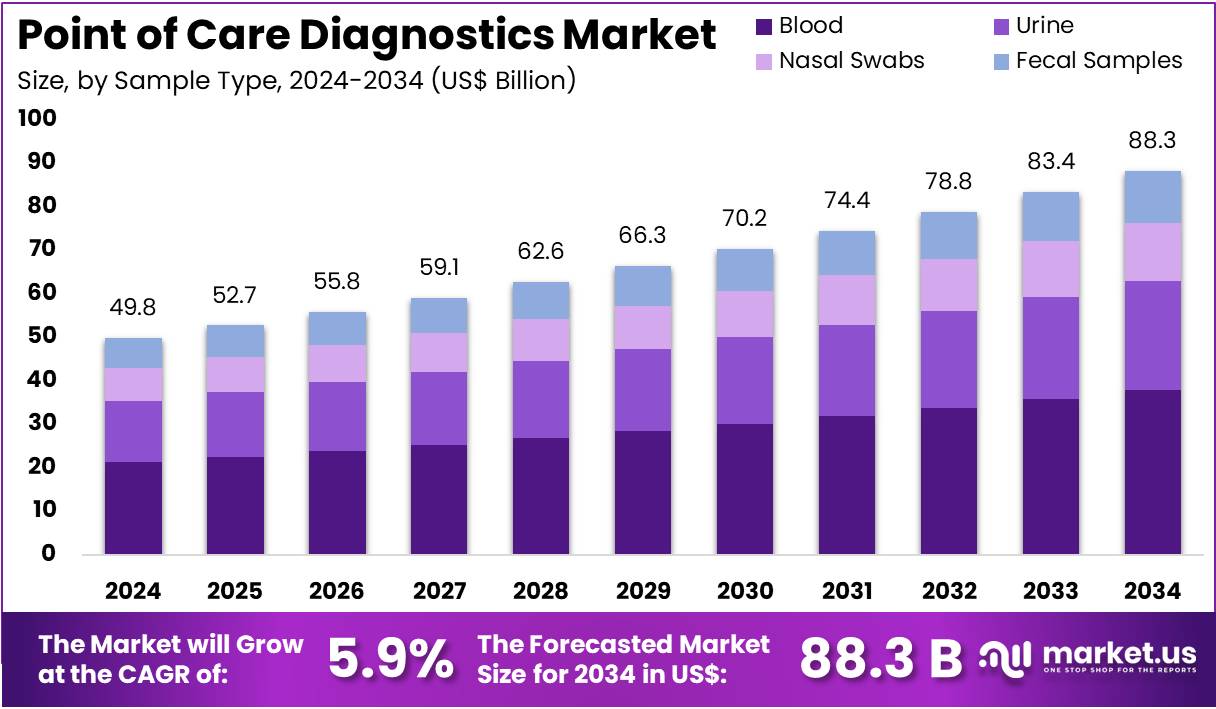
New York, NY – July 24, 2026 – The Global Point of Care Diagnostics Market Size is expected to be worth around US$ 88.3 billion by 2034 from US$ 49.8 billion in 2024, growing at a CAGR of 5.9% during the forecast period 2025 to 2034. North America held a dominant market position, capturing more than a 43.8% share and holding a US$ 21.8 billion market value for the year.
The Point-of-Care (POC) Diagnostics Market is witnessing significant growth due to the rising demand for rapid, accessible, and cost-effective diagnostic solutions. POC diagnostics enable healthcare providers to perform testing and obtain immediate results at or near the patient’s location, reducing dependence on centralized laboratories and improving clinical decision-making. The increasing burden of chronic diseases, including diabetes, cardiovascular disorders, and infectious diseases, is creating strong demand for faster disease detection and continuous patient monitoring.
The growing global geriatric population is another major factor supporting market expansion, as older adults are more vulnerable to multiple health conditions requiring frequent diagnostic evaluations. According to the United Nations, the global population aged 65 years and above is expected to reach more than 1.5 billion by 2050, increasing the need for efficient diagnostic technologies.
Technological advancements, including portable analyzers, molecular testing platforms, and smartphone-enabled diagnostic devices, are further accelerating the adoption of POC solutions. These innovations are improving testing accuracy, usability, and accessibility, particularly in remote and underserved regions. Healthcare organizations and research institutions, including the National Institute of Biomedical Imaging and Bioengineering (NIBIB), are supporting the development of next-generation POC technologies through research initiatives.
Additionally, increasing investments from governments and private organizations, along with continuous product launches by leading healthcare companies, are strengthening market growth. The rising focus on decentralized healthcare delivery and early disease diagnosis is expected to further drive the adoption of POC diagnostics across hospitals, clinics, home healthcare, and community settings.
Key Takeaways
- In 2024, the Point-of-Care Diagnostics Market generated revenue of US$ 49.8 billion and is projected to grow at a CAGR of 5.9%, reaching US$ 88.3 billion by 2034.
- Based on product type, the market is segmented into glucose testing, HbA1c testing, coagulation testing, fertility/pregnancy testing, infectious disease testing, cardiac marker testing, and others. Glucose testing dominated the segment with a 38.5% market share in 2023.
- By technology, the market is categorized into lateral flow assays, molecular diagnostics, immunoassay analyzers, glucose monitoring systems, and rapid tests. Lateral flow assays accounted for a significant market share of 41.3%.
- Based on application, the market includes blood glucose monitoring, infectious disease testing, cardiac marker testing, cancer marker testing, and drug abuse testing. Blood glucose monitoring emerged as the leading application segment with a 35.0% revenue share.
- By sample type, the market is divided into blood, urine, nasal swabs, and fecal samples. The blood sample segment held the largest revenue share of 42.9%.
- Based on end-user, the market is segmented into hospitals & clinics, laboratories, home care settings, and physician offices. Hospitals & clinics dominated the segment with a 51.2% market share.
- Regionally, North America led the Point-of-Care Diagnostics Market with a 43.8% market share in 2023.
Statistical Information
- CLIA‑Waived Point‑of‑Care Testing in Pharmacies: Pharmacies holding a CLIA certificate of waiver increased from 12,157 locations in 2019 to 29,011 locations in 2023, a rise from 21.4% to 51.6% of all pharmacies.
- CLIA‑Waived Point‑of‑Care Testing in Clinical Laboratories: CDC notes that recent surveys show about 70% of all clinical laboratories in the United States perform only CLIA‑waived testing, rather than moderate or high complexity testing.
- Community Diagnostic Centres and POC Testing: NHS England reported about 1.63 million people waiting for the 15 major diagnostic tests, and set a commitment that at least 92% of patients should wait no longer than 18 weeks from referral to treatment, incentivizing POC deployment to reduce delays.
- Point‑of‑Care Tests Availability in Primary Health Facilities: Clinical laboratories in the same region offered a median of 11 of 72 tests on the WHO Essential Diagnostics List, with frequent provision of POC or basic tests such as malaria, HIV, pregnancy, HBsAg, urinalysis, HCV antibody, syphilis, glucose and complete blood count.
- Public Preferences and Attitudes Toward Point‑of‑Care Testing: A multi‑year survey (2020–2022) found that community members continued to show support for the use of point‑of‑care tests across 16 different test types.
- CLIA‑Waived POC Test Menu Growth: The CLIA Currently Waived Analytes database lists commercially marketed in vitro test systems categorized as CLIA‑waived by FDA since January 31, 2000, and by CDC before that date.
- National Regulatory Context for POC and Home Testing: For many molecular diagnostic POC tests, FDA generally expects positive and negative agreement of at least 95%; however, for near‑patient POC settings a positive agreement of ≥80% may be acceptable when risk‑mitigating limitations are included in the intended use.
- Consumer Response to At‑Home POC COVID‑19 Tests: When given a negative result in high pretest‑probability scenarios, 33% of participants using the authorized instructions failed to quarantine appropriately, compared with 14% in the intervention group and 24% in the control group, indicating that instruction design influences behavior.
Regional Analysis
North America led the Point-of-Care Diagnostics Market with a 43.8% market share in 2023.
North America remains a major region for Point-of-Care (POC) diagnostics due to advanced healthcare infrastructure, high healthcare spending, and strong adoption of innovative diagnostic technologies. The aging population and increasing prevalence of chronic diseases, including diabetes and cardiovascular conditions, are increasing demand for rapid testing solutions.
According to the U.S. Census Bureau, the population aged 65 years and older is projected to reach 82 million by 2050, creating greater demand for accessible monitoring tools. The region also benefits from strong regulatory support from the U.S. Food and Drug Administration (FDA) and continuous innovation by healthcare companies developing portable diagnostic systems. Asia Pacific is experiencing rapid growth due to expanding healthcare access, rising chronic disease burden, and increasing investment in digital health technologies.
The International Diabetes Federation (IDF) estimates that diabetes cases in the Western Pacific region will continue increasing significantly, driving demand for affordable and easy-to-use diagnostic devices. Government healthcare initiatives and improved medical infrastructure are accelerating POC adoption across hospitals, clinics, and remote healthcare settings.
Emerging Trends
- Integration of Digital Health and Connected Diagnostics: Digital connectivity is becoming a major trend in POC diagnostics, with devices increasingly linked to mobile applications, cloud platforms, and electronic health records. The FDA highlights that combining POC tests with digital tools improves data collection, reporting, and clinical decision-making.
- Rise of At-Home and Self-Testing Solutions: Home-based diagnostic testing is expanding as consumers seek convenient healthcare access. The National Institute of Biomedical Imaging and Bioengineering (NIBIB) reports that rapid diagnostic tests can provide results within an hour or less, supporting faster treatment decisions for infectious diseases and chronic conditions.
- Growth of Multiplex Testing Platforms: Multiplex POC systems that detect multiple diseases from a single sample are gaining attention. NIBIB-supported programs have accelerated development of combination tests, including COVID-19 and influenza A/B tests, improving testing efficiency during respiratory disease outbreaks.
- Expansion of Portable Molecular Diagnostics: Portable molecular testing technologies are emerging as important tools for decentralized healthcare. WHO has recommended near-point-of-care diagnostic approaches for tuberculosis, helping improve access to faster testing in areas where traditional laboratory facilities are limited.
- AI and Data Analytics in Point-of-Care Testing: Artificial intelligence is being integrated with diagnostic platforms to improve interpretation, workflow automation, and patient monitoring. The NIBIB supports POC technology development focused on rapid, accurate, easy-to-use systems with automated data analysis capabilities.
Use Cases
- Diabetes Management and Continuous Monitoring: Blood glucose monitoring remains one of the most widely used POC applications, enabling patients and healthcare providers to track glucose levels quickly. Portable glucose monitoring systems support regular disease management and reduce dependence on laboratory-based testing.
- Infectious Disease Detection and Outbreak Control: POC diagnostics are increasingly used for rapid identification of infectious diseases, including respiratory infections and tuberculosis. NIBIB states that rapid tests allow diagnosis close to patients and can support immediate treatment decisions, often during a single healthcare visit.
- Emergency and Critical Care Applications: Hospitals and emergency departments are adopting POC testing for faster clinical decisions, including cardiac marker testing, blood analysis, and infection screening. NIBIB emphasizes real-time medical evaluation at the location of patient care as a key goal of POC technologies.
- Remote Healthcare and Rural Diagnostics: Portable POC devices are improving healthcare access in remote regions by reducing dependence on centralized laboratories. WHO highlights that equitable access to quality diagnostics is essential for disease prevention, screening, treatment monitoring, and public health surveillance.
- Home Healthcare and Patient Self-Management: Consumer-focused diagnostic devices are supporting home healthcare by allowing individuals to monitor health conditions outside hospitals. FDA reports increasing adoption of non-laboratory-based tests and emphasizes the importance of digital data transmission for effective healthcare management.
Frequently Asked Questions on Point of Care Diagnostics Market
- What factors are driving the growth of the Point-of-Care Diagnostics Market?
The Point-of-Care Diagnostics Market is expanding due to increasing chronic diseases, aging populations, demand for rapid testing, and advancements in portable diagnostic technologies. Healthcare decentralization and improved access to testing in remote areas are also contributing to market adoption. - Which product segment dominates the Point-of-Care Diagnostics Market?
Glucose testing is among the leading product segments in the Point-of-Care Diagnostics Market due to the rising prevalence of diabetes globally. These devices enable quick blood glucose monitoring and help patients and healthcare providers manage diabetes effectively. - How are technological advancements influencing POC diagnostics?
Innovations such as molecular diagnostics, artificial intelligence, smartphone-connected devices, and automated analyzers are improving POC diagnostic accuracy and efficiency. These technologies enable faster testing, better data integration, and improved healthcare decision-making across various clinical environments. - What are the major applications of Point-of-Care Diagnostics?
Major applications include blood glucose monitoring, infectious disease testing, cardiac marker testing, pregnancy testing, cancer biomarker detection, and drug abuse testing. These solutions support early diagnosis, timely treatment, and improved patient care outcomes. - Why is North America a leading region in the Point-of-Care Diagnostics Market?
North America leads due to advanced healthcare infrastructure, high healthcare expenditure, strong regulatory frameworks, and rapid adoption of innovative medical technologies. Increasing cases of chronic diseases and demand for convenient diagnostic solutions continue to support regional growth. - How does POC diagnostics support diabetes management?
POC diagnostics helps diabetes management by providing rapid glucose and HbA1c testing. These solutions allow regular monitoring of blood sugar levels, support treatment adjustments, and help reduce disease complications through early detection and continuous patient management. - What role do government organizations play in POC diagnostics development?
Organizations such as the FDA, NIH, and NIBIB support POC diagnostics through research programs, regulatory guidance, and technology development initiatives. These efforts aim to improve diagnostic accuracy, affordability, accessibility, and healthcare delivery efficiency. - What is the future outlook for the Point-of-Care Diagnostics Market?
The future of the POC Diagnostics Market will focus on connected devices, home-based testing, AI-powered diagnostics, and portable molecular platforms. Growing demand for personalized healthcare, early disease detection, and remote patient monitoring will drive continued market development.
Conclusion
The Point-of-Care (POC) Diagnostics Market is experiencing strong growth due to rising chronic disease prevalence, an aging population, and increasing demand for rapid and accessible healthcare solutions. Advancements in digital health, molecular diagnostics, AI integration, and portable testing devices are transforming diagnostic practices by enabling faster and more accurate decision-making.
North America continues to lead due to advanced healthcare infrastructure, while Asia Pacific shows significant growth potential with expanding healthcare access and disease management needs. With continuous innovation, government support, and increasing adoption across hospitals, homes, and remote settings, POC diagnostics is expected to play a vital role in the future of decentralized healthcare.
Discuss your needs with our analyst
Please share your requirements with more details so our analyst can check if they can solve your problem(s)




