


Overview
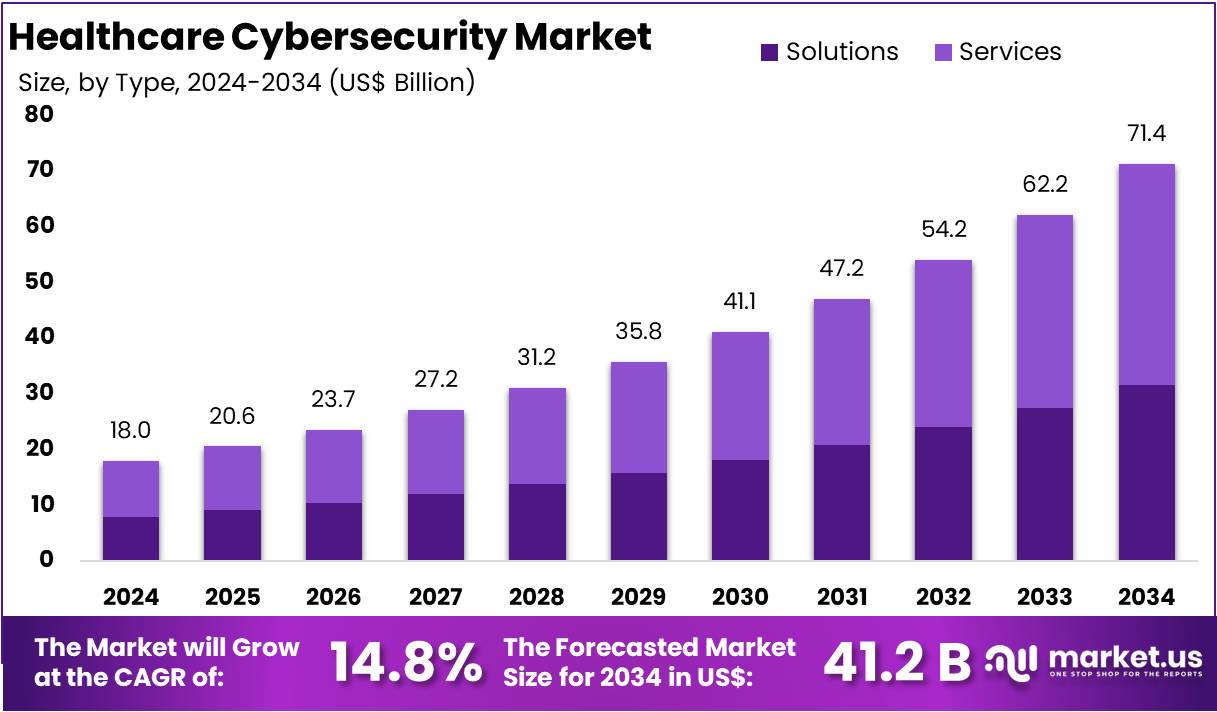
New York, NY – July 06, 2026 – The Healthcare Cybersecurity Market size is expected to be worth around US$ 71.36 billion by 2034 from US$ 17.95 billion in 2024, growing at a CAGR of 14.8% during the forecast period 2025 to 2034.
Healthcare cybersecurity refers to the technologies, solutions, and practices used to protect healthcare organizations, medical devices, patient records, and digital healthcare systems from cyber threats, unauthorized access, and data breaches. As healthcare providers increasingly adopt electronic health records (EHRs), cloud-based platforms, telehealth services, connected medical devices, and artificial intelligence, the need for robust cybersecurity measures has become a critical priority. Healthcare organizations manage highly sensitive patient information, making them frequent targets for ransomware attacks, phishing campaigns, malware, and other cyber threats.
The healthcare cybersecurity market is experiencing steady growth due to the rapid digital transformation of healthcare infrastructure, growing adoption of Internet of Medical Things (IoMT) devices, and stringent regulatory requirements for patient data protection. Governments and healthcare institutions worldwide are increasing investments in advanced cybersecurity solutions to safeguard clinical operations, maintain regulatory compliance, and ensure uninterrupted patient care. Technologies such as endpoint security, identity and access management, network security, cloud security, encryption, and security information and event management (SIEM) are widely implemented to strengthen cyber resilience.
North America holds a significant share of the healthcare cybersecurity market, supported by advanced healthcare IT infrastructure, high cybersecurity spending, and strict data privacy regulations. Meanwhile, the Asia-Pacific region is expected to witness the fastest growth, driven by expanding digital healthcare initiatives, rising healthcare expenditures, and increasing awareness regarding cybersecurity risks. Continuous innovation in threat detection, artificial intelligence-based security solutions, and zero-trust security frameworks is expected to support the long-term growth of the global healthcare cybersecurity market.
Key Takeaways
- In 2024, the Healthcare Cybersecurity market generated US$ 95 billion in revenue and is projected to reach US$ 71.36 billion by 2034, expanding at a CAGR of 14.8% during the forecast period.
- By Type, the market is segmented into Solutions and Services, with Services dominating the market in 2024, accounting for 55.6% of the total market share.
- Based on Solution Type, the market comprises Identity and Access Management (IAM), Data Loss Prevention (DLP), Antivirus and Antimalware, Log Management and SIEM, Firewall, Encryption and Tokenization, Compliance and Policy Management, Patch Management, and Others. Among these, Identity and Access Management (IAM) held the largest share of 19.7% in 2024.
- By Threat, the market is categorized into Malware, Advanced Persistent Threats (APT), Distributed Denial of Service (DDoS), Spyware, Phishing, Ransomware, and Others, with Malware leading the segment with a 25.9% market share.
- In terms of Security, the market is divided into Network Security, Endpoint Security, Cloud Security, and Application Security, with Network Security accounting for the largest share of 30.5% in 2024.
- Based on Deployment Mode, the market is segmented into On-Premises and Cloud-Based, with On-Premises emerging as the leading segment, capturing 56.8% of the market in 2024.
- By End User, Hospitals represented the largest segment, contributing 40.2% of the global Healthcare Cybersecurity market revenue in 2024.
- North America dominated the global Healthcare Cybersecurity market, holding a 30.0% market share in 2023.
Healthcare Cybersecurity Statistics
Cybersecurity Premiums and Coverage
- Cyber insurance premiums increased by 46% for large healthcare organizations over the past year.
- Medium-sized healthcare organizations experienced a 50% increase in cyber insurance premiums during the same period.
- Only 52% of Healthcare Delivery Organizations (HDOs) include medical device security as part of their cyber insurance coverage.
- Healthcare Delivery Organizations with a Chief Information Security Officer (CISO) overseeing medical device security reported an 18% increase in Healthcare Industry Cybersecurity Practices (HICP) coverage.
- HICP coverage improved from 45% to 63% when medical device security was managed by a CISO.
Data Breaches and Cyberattacks
- More than 540 healthcare organizations experienced data breaches in 2023, exposing the personal information of approximately 112 million individuals, compared to 48.6 million individuals affected across 590 organizations in 2022.
- In January 2024, 24 healthcare data breaches involving more than 10,000 records each were reported, including one incident that exposed 500,000 records and another affecting over 2 million records.
- The largest healthcare data breach in 2023 compromised approximately 11.27 million records, while another major breach exposed nearly 4 million records.
- Around 88% of healthcare organizations experienced at least one cyberattack in 2023, with organizations facing an average of 40 cyberattacks annually.
- Approximately 80% of healthcare data breaches reported in 2023 were attributed to hacking-related incidents.
- Globally reported healthcare cyber incidents increased from 32 in 2022 to 121 in 2023, highlighting a significant rise in attacks targeting the healthcare sector.
Financial Impact
- Regulatory penalties associated with healthcare cyberattacks can reach up to $1.5 million per year.
- The average financial impact of disruptions to healthcare operations caused by cyberattacks reached $1.3 million in 2023, representing a 30% increase compared to the previous year.
- The cyberattack on Change Healthcare is projected to result in losses of up to $1.6 billion.
Workforce Challenges
- The healthcare industry reported a workforce shortage of approximately 78,000 employees as of July 2022 compared to February 2020.
- The healthcare sector is expected to require an additional 275,000 nurses between 2020 and 2030, with nursing employment projected to grow by 9%.
- Around 61% of healthcare cybersecurity professionals identify staffing shortages as the primary obstacle to maintaining effective cybersecurity.
- Approximately 84% of healthcare organizations report difficulties attracting qualified cybersecurity professionals due to intense market competition.
- Nearly 67% of organizations face challenges in retaining experienced cybersecurity personnel.
- Around 55% cite limited hiring budgets, while 43% report that non-competitive compensation affects cybersecurity recruitment efforts.
Training and Awareness
- Security awareness training is provided to 91.8% of IT staff, compared with 69% of clinicians, 44% of contractors, and only 29% of vendors.
- Approximately 89% of healthcare cybersecurity professionals receive phishing detection and response training, while only 47% receive training focused on insider threats.
Cybersecurity Practices
- Around 57% of healthcare organizations continue to rely on single-factor authentication for at least some systems.
- Only 9.4% of organizations have implemented phishing-resistant multi-factor authentication.
- Approximately 45% of healthcare organizations do not maintain a comprehensive inventory of the data they store and where it is located.
- Around 38% lack formal data classification processes to manage sensitive information effectively.
- Nearly 31% of organizations report insufficient internal collaboration on cybersecurity initiatives.
- Another 31% indicate that their cybersecurity policies and procedures are outdated.
- Approximately 23% identify a lack of executive leadership support as a barrier to strengthening cybersecurity initiatives.
Regional Analysis
North America Leads the Healthcare Cybersecurity Market
North America holds a leading position in the healthcare cybersecurity market, supported by its advanced healthcare infrastructure, widespread adoption of digital health technologies, and increasing investments in cybersecurity solutions. The region has witnessed a growing number of cyberattacks targeting hospitals, healthcare providers, insurance companies, and research organizations, prompting greater focus on protecting sensitive patient information and maintaining operational continuity. Rising incidents of ransomware, phishing, malware, and data breaches have accelerated the adoption of comprehensive cybersecurity frameworks across the healthcare sector.
Stringent regulatory requirements, including healthcare data privacy and security standards, have further encouraged organizations to strengthen their cybersecurity capabilities. The rapid implementation of electronic health records (EHRs), telemedicine platforms, cloud-based healthcare applications, and connected medical devices has expanded the digital ecosystem, increasing the need for advanced security technologies to safeguard critical healthcare infrastructure.
Healthcare organizations across North America are increasingly deploying solutions such as identity and access management, endpoint security, network security, encryption, and security information and event management (SIEM) to enhance cyber resilience. In addition, the integration of artificial intelligence, machine learning, and Zero Trust security frameworks is improving threat detection and response capabilities. Continuous investments in digital transformation, combined with growing awareness of cyber risks and regulatory compliance, are expected to support the sustained growth of the North American healthcare cybersecurity market throughout the forecast period.
Emerging Trends
- IoT and IoMT Device Security: The adoption of IoT and IoMT devices in healthcare continues to expand, supporting remote monitoring and connected care. However, the growing number of networked endpoints increases cybersecurity risks, requiring stronger endpoint protection, continuous monitoring, firmware updates, and advanced threat detection to safeguard sensitive healthcare systems.
- Blockchain Technology: Blockchain technology is gaining adoption in healthcare by providing secure, transparent, and tamper-resistant data management. It strengthens patient record integrity, improves data traceability, enhances privacy protection, reduces unauthorized modifications, and supports secure information sharing among healthcare providers while ensuring regulatory compliance.
- Cloud Security: Healthcare organizations are increasingly migrating data and applications to cloud environments, making cloud security a critical priority. Strong encryption, continuous monitoring, access management, penetration testing, and data loss prevention solutions help protect sensitive patient information from cyberattacks while ensuring regulatory compliance and operational resilience.
- Ransomware Threats: Healthcare remains one of the most targeted sectors for ransomware attacks because uninterrupted services are essential. Organizations are strengthening cybersecurity through regular vulnerability assessments, employee awareness training, multi-factor authentication, network segmentation, and incident response planning to minimize disruptions and protect critical patient information.
- Biometric Authentication: Biometric authentication is becoming widely adopted across healthcare organizations to strengthen identity verification and access control. Technologies including fingerprint, facial recognition, and iris scanning reduce reliance on passwords, improve user convenience, prevent unauthorized access, and enhance overall protection of sensitive healthcare systems and patient data.
- Regulatory Compliance and Evolving Data Privacy Regulations: Healthcare providers must continuously adapt to evolving data privacy regulations and cybersecurity standards. Maintaining compliance with healthcare security requirements involves implementing robust governance frameworks, regular audits, employee training, risk assessments, and updated security policies to protect patient information while avoiding regulatory penalties.
Use Cases
- Securing Remote Healthcare Delivery: The rapid expansion of telehealth services requires secure digital platforms that protect patient information during remote consultations. Healthcare providers implement encrypted communications, strong authentication, secure access controls, and continuous monitoring to prevent unauthorized access while ensuring regulatory compliance and maintaining patient confidence.
- Protecting Connected Medical Devices: Healthcare organizations secure connected medical devices through regular software updates, vulnerability assessments, endpoint monitoring, and network segmentation. These cybersecurity measures protect medical equipment from cyber threats, maintain reliable device performance, safeguard patient safety, and ensure uninterrupted clinical operations across healthcare facilities.
- Enhanced Patient Data Management: Healthcare providers improve patient data management by adopting blockchain, biometric authentication, and advanced encryption technologies. These solutions enhance data accuracy, strengthen privacy protection, support secure information sharing, reduce breach risks, and help organizations comply with evolving healthcare data protection regulations and standards.
- Cloud Data Security: Healthcare organizations using cloud platforms implement encryption, continuous monitoring, identity management, and secure backup solutions to protect sensitive patient information. Employee cybersecurity awareness training, compliance with security standards, and proactive threat detection further strengthen cloud environments against evolving cyber risks and unauthorized access.
- Emergency Preparedness and Ransomware Protection: Healthcare organizations establish comprehensive ransomware preparedness strategies through regular data backups, disaster recovery planning, network segmentation, employee awareness training, and incident response protocols. These measures enable rapid recovery from cyberattacks, minimize operational disruptions, protect patient information, and ensure continuity of essential healthcare services.
Frequently Asked Questions on Healthcare Cybersecurity
- Why is healthcare cybersecurity important?
Healthcare cybersecurity is important because healthcare organizations manage highly sensitive patient information and critical medical systems that are frequent targets of cyberattacks. Effective cybersecurity helps prevent data breaches, ransomware attacks, financial losses, operational disruptions, and risks to patient safety while maintaining trust and regulatory compliance. - What are the major cyber threats facing the healthcare sector?
The healthcare sector faces cyber threats including ransomware, phishing, malware, insider threats, distributed denial-of-service (DDoS) attacks, credential theft, and attacks targeting connected medical devices. These threats can disrupt healthcare operations, expose confidential patient information, and compromise the delivery of critical medical services. - Which technologies are commonly used in healthcare cybersecurity?
Healthcare cybersecurity commonly utilizes technologies such as endpoint detection and response (EDR), firewalls, intrusion detection systems, encryption, identity and access management (IAM), multi-factor authentication (MFA), security information and event management (SIEM), artificial intelligence, and cloud security solutions to strengthen organizational resilience. - How does healthcare cybersecurity improve patient safety?
Healthcare cybersecurity improves patient safety by protecting connected medical devices, electronic health records, and hospital information systems from unauthorized access and cyberattacks. Secure digital infrastructure minimizes treatment disruptions, preserves accurate medical records, and supports uninterrupted clinical operations during emergencies. - Which regions lead the healthcare cybersecurity market?
North America leads the healthcare cybersecurity market owing to advanced healthcare infrastructure, widespread digitalization, high cybersecurity spending, and strict regulatory frameworks. Europe also represents a significant market, while Asia-Pacific is experiencing rapid growth due to expanding healthcare investments and digital transformation initiatives. - How is artificial intelligence influencing the healthcare cybersecurity market?
Artificial intelligence is transforming the healthcare cybersecurity market by improving threat detection, anomaly identification, automated incident response, predictive risk analysis, and security monitoring. AI-powered solutions enable healthcare organizations to detect sophisticated cyber threats more efficiently while reducing response times and operational complexity. - What opportunities exist in the healthcare cybersecurity market?
The healthcare cybersecurity market offers opportunities through increased adoption of cloud security, zero-trust architecture, managed detection and response services, Internet of Medical Things (IoMT) security, and AI-driven cybersecurity platforms. Expanding digital healthcare ecosystems continue creating demand for advanced security technologies worldwide. - How are government initiatives supporting the healthcare cybersecurity market?
Government initiatives support the healthcare cybersecurity market by promoting cybersecurity standards, funding digital healthcare security projects, strengthening critical infrastructure protection, and encouraging healthcare organizations to adopt advanced security technologies. These initiatives improve resilience against growing cyber threats across healthcare systems. - What is the future outlook for the healthcare cybersecurity market?
The healthcare cybersecurity market is expected to experience sustained growth due to increasing digital healthcare adoption, expanding cloud infrastructure, rising cybersecurity investments, and growing demand for AI-powered security platforms. Continuous innovation and stricter regulatory compliance are anticipated to further accelerate long-term market expansion.
Conclusion
The global healthcare cybersecurity market is expected to witness sustained growth as healthcare organizations continue accelerating digital transformation and expanding connected healthcare ecosystems. Rising cyber threats, increasing adoption of cloud platforms, IoMT devices, artificial intelligence, and telehealth services are driving continuous investments in advanced cybersecurity solutions.
Regulatory compliance requirements and the growing need to protect sensitive patient data are further strengthening market demand. North America remains the leading regional market, while Asia-Pacific is emerging as the fastest-growing region. Ongoing advancements in zero-trust security, AI-powered threat detection, and managed security services are expected to enhance cyber resilience and support long-term market growth worldwide.
Discuss your needs with our analyst
Please share your requirements with more details so our analyst can check if they can solve your problem(s)




