


Overview
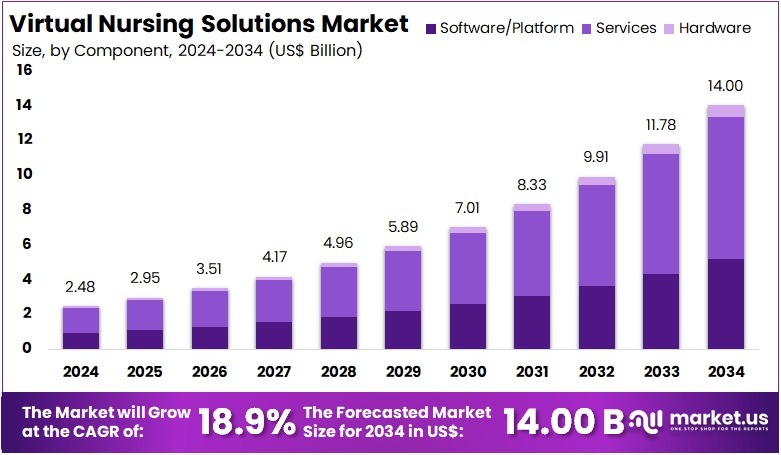
New York, NY – July 08, 2026 –The Global Virtual Nursing Solutions Market Size is expected to be worth around US$ 14.00 billion by 2034 from US$ 2.48 billion in 2024, growing at a CAGR of 18.9% during the forecast period 2025 to 2034.
Virtual Nursing Solutions is a healthcare technology and clinical services provider focused on enhancing patient care through virtual nursing support. The company delivers remote nursing services that help hospitals, health systems, and healthcare providers improve clinical workflows, optimize staffing resources, and enhance the patient experience. By integrating experienced registered nurses with secure digital communication technologies, Virtual Nursing Solutions enables healthcare organizations to provide continuous patient support while reducing the administrative burden on bedside care teams.
The company’s services are designed to assist with patient admissions, discharge education, medication reviews, care coordination, documentation support, and patient monitoring. This approach allows bedside nurses to devote more time to direct patient care while maintaining high standards of safety, efficiency, and clinical quality.
Virtual Nursing Solutions emphasizes collaboration with healthcare organizations to address workforce challenges, improve operational efficiency, and support better clinical outcomes. Its technology-enabled care model is intended to strengthen nursing capacity, reduce staff burnout, and promote consistent patient engagement throughout the care journey.
Through innovation and evidence-based practices, Virtual Nursing Solutions continues to support the transformation of healthcare delivery by expanding access to skilled nursing expertise beyond traditional bedside settings. The company’s commitment to quality care, operational excellence, and patient-centered services positions it as a trusted partner for healthcare providers seeking modern, scalable virtual nursing solutions.
Key Takeaways
- In 2024, the Virtual Nursing Solutions market was valued at US$ 4.8 billion and is projected to reach US$ 14.00 billion by 2034, expanding at a CAGR of 18.9% during the forecast period.
- Based on Component, the market is segmented into Software/Platform, Services, and Hardware. Among these, the Services segment dominated the market in 2024, accounting for 58.4% of the total market share.
- By Mode of Delivery, the market is categorized into Cloud-based, Web-based, and On-premises. The Cloud-based segment held the leading position with a 41.1% market share in 2024.
- Based on Application, the market is divided into Chronic Disease Management, Post-acute Care, Elderly Care, Mental Health Support, Post-Operative and Post Discharge Care, and Others. The Chronic Disease Management segment emerged as the largest contributor, capturing 31.0% of the market revenue in 2024.
- By End User, the market is segmented into Hospitals, Nursing Homes and Long-term Care Facilities, Home Healthcare, and Others. The Hospitals segment led the market with a 51.3% revenue share in 2024.
- North America remained the leading regional market, representing 39.6% of the global Virtual Nursing Solutions market revenue in 2024.
Regional Analysis
North America Dominates the Virtual Nursing Solutions Market
North America accounted for the largest share of the virtual nursing solutions market, supported by the rapid adoption of digital healthcare technologies, increasing demand for remote patient care, and ongoing efforts to address the shortage of skilled nursing professionals. Healthcare providers across the region are increasingly implementing virtual nursing solutions to improve clinical efficiency, enhance patient outcomes, and reduce the administrative burden on bedside nursing staff.
The widespread adoption of telehealth platforms, remote patient monitoring systems, and artificial intelligence (AI)-enabled healthcare technologies has accelerated market growth. Virtual nursing solutions are being utilized for chronic disease management, post-acute care, discharge planning, medication management, and elderly care, enabling healthcare organizations to deliver continuous, patient-centered care while optimizing operational efficiency. Growing investments in digital health infrastructure and favorable healthcare technology adoption are expected to further strengthen the regional market throughout the forecast period.
A notable industry development occurred in March 2025, when Emory Healthcare deployed an integrated virtual nursing pilot at Emory University Hospital Midtown in collaboration with VirtuSense Technologies. The initiative combines telehealth equipment with AI-powered patient monitoring technology to assist nurses with routine clinical tasks, improve patient surveillance, and strengthen fall prevention efforts. This deployment reflects the region’s continued focus on leveraging advanced technologies to enhance care quality and improve nursing workforce efficiency.
Emerging Trends
- Enhanced Regulatory and Reimbursement Support: Regulatory reforms and expanded reimbursement policies continue to strengthen virtual nursing adoption. Medicare has extended telehealth flexibilities introduced during the COVID-19 Public Health Emergency through December 31, 2025, allowing eligible providers to bill for virtual nursing, remote monitoring, and other telehealth services.
- Improved Patient Throughput and Documentation: Virtual nursing integration into hospital admission and triage workflows has improved operational efficiency. Evidence from a government review published in May 2025 showed reduced patient wait times, more accurate nursing documentation, and fewer workflow interruptions during initial patient assessments and evaluations.
- Growing Nurse Adoption of Telehealth Modalities: Telehealth adoption among nurses continues to increase, particularly within emergency care settings. Recent findings indicate that 36.35% of emergency nurses use telehealth in clinical practice, compared with 15.40% among other inpatient nurses, reflecting broader acceptance of virtual nursing technologies.
Use Cases
- Emergency Department Triage and Assessment: Virtual nursing platforms support emergency department triage by enabling nurses to conduct remote patient assessments through secure video or audio consultations. This approach improves patient prioritization, optimizes resource allocation, reduces emergency department congestion, and enhances the efficiency of frontline clinical operations.
- Home-Based Chronic Disease Monitoring: Virtual nursing enables continuous monitoring of patients with chronic diseases through Remote Patient Monitoring services. Medicare reimbursement supports tracking vital signs and symptoms for conditions including heart failure and diabetes, reducing unnecessary hospital visits while improving long-term disease management and patient outcomes.
- Facility Fee Adjustments to Support Telehealth Infrastructure: Medicare increased the Originating Site Facility Fee by 3.5%, from US$29.96 in 2024 to US$31.01 in 2025. The adjustment helps healthcare providers offset technology, cybersecurity, and staffing expenses required to maintain reliable virtual nursing and telehealth infrastructure.
Frequently Asked Questions on Virtual Nursing Solutions
- How do Virtual Nursing Solutions improve patient care?
Virtual Nursing Solutions improve patient care by enabling continuous remote monitoring, timely clinical interventions, faster communication between healthcare professionals and patients, and enhanced patient education. These services reduce delays in care, support chronic disease management, improve treatment adherence, and contribute to better patient outcomes while minimizing unnecessary hospital visits. - Which healthcare settings use Virtual Nursing Solutions?
Virtual Nursing Solutions are widely adopted across hospitals, outpatient clinics, long-term care facilities, rehabilitation centers, skilled nursing facilities, and home healthcare environments. They are also increasingly used in rural healthcare systems to improve access to qualified nursing professionals and provide consistent patient support regardless of geographic location. - What technologies support Virtual Nursing Solutions?
Virtual Nursing Solutions rely on telehealth platforms, secure video conferencing systems, electronic health records, remote patient monitoring devices, wearable health technologies, cloud-based communication platforms, artificial intelligence, and secure data management systems. These technologies enable efficient communication, real-time patient monitoring, and seamless clinical documentation. - What are the major benefits of Virtual Nursing Solutions?
The primary benefits include improved patient satisfaction, enhanced nursing efficiency, reduced staff burnout, better clinical workflows, lower hospital readmission rates, increased healthcare accessibility, and optimized resource utilization. These advantages support healthcare organizations in addressing workforce shortages while maintaining high standards of patient care. - How do Virtual Nursing Solutions help healthcare providers?
Virtual Nursing Solutions enable healthcare providers to optimize nursing resources, reduce administrative burdens, improve staff productivity, enhance care coordination, and support faster patient discharge processes. These solutions also help hospitals manage increasing patient volumes while maintaining quality care and reducing operational costs. - Which regions are leading the Virtual Nursing Solutions Market?
North America currently leads the Virtual Nursing Solutions Market due to advanced healthcare infrastructure, widespread telehealth adoption, favorable reimbursement policies, and significant investments in healthcare technology. Europe and Asia-Pacific are also experiencing strong growth driven by healthcare modernization and increasing digital health initiatives. - Which technologies are influencing the Virtual Nursing Solutions Market?
Artificial intelligence, machine learning, remote patient monitoring, wearable medical devices, cloud computing, Internet of Things (IoT), predictive analytics, and electronic health record integration are among the key technologies shaping the Virtual Nursing Solutions Market by improving operational efficiency and patient outcomes. - What opportunities exist in the Virtual Nursing Solutions Market?
The market offers significant opportunities through expanding remote patient monitoring programs, increasing home healthcare services, integrating artificial intelligence into nursing workflows, improving rural healthcare access, and developing advanced virtual care platforms that support personalized and preventive healthcare delivery. - What is the future outlook for the Virtual Nursing Solutions Market?
The Virtual Nursing Solutions Market is expected to witness sustained growth as healthcare organizations increasingly adopt digital care models, invest in advanced virtual care technologies, and focus on addressing workforce shortages. Continued innovation, supportive regulations, and expanding telehealth infrastructure are expected to strengthen long-term market development.
Conclusion
The global Virtual Nursing Solutions market is positioned for robust growth, supported by increasing digital healthcare adoption, expanding telehealth infrastructure, and persistent nursing workforce shortages. Healthcare providers are leveraging virtual nursing to improve clinical efficiency, optimize resource utilization, enhance patient engagement, and reduce administrative burdens.
Favorable reimbursement policies, technological advancements such as artificial intelligence and remote patient monitoring, and rising demand for home-based and chronic disease care are accelerating market expansion. North America remains the leading regional market, while emerging opportunities across other regions are expected to drive future growth. Continuous innovation and supportive regulatory frameworks will further strengthen long-term market development.
Discuss your needs with our analyst
Please share your requirements with more details so our analyst can check if they can solve your problem(s)




