


Overview
New York, NY – July 24, 2026 – The Global Edge Computing In Healthcare Market size is expected to be worth around US$ 57.3 billion by 2034 from US$ 6.3 billion in 2024, growing at a CAGR of 24.7% during the forecast period 2025 to 2034. North America held a dominant market position, capturing more than a 41.7% share and holding a US$ 2.6 billion market value for the year.
The Edge Computing in Healthcare Market is witnessing rapid growth as healthcare organizations increasingly adopt real-time data processing solutions to improve clinical decision-making, patient monitoring, and operational efficiency. Unlike traditional cloud-based systems, edge computing processes healthcare data closer to the point of generation, enabling faster response times, enhanced reliability, and improved data security for critical medical applications.
The rising adoption of AI-powered healthcare technologies, smart medical devices, remote patient monitoring, and hospital-at-home care models is accelerating demand for edge infrastructure. Hospitals and healthcare providers are deploying edge servers and AI-enabled computing platforms in intensive care units, operating rooms, diagnostic imaging centers, and outpatient settings to analyze large volumes of patient data with minimal latency.
Edge computing is becoming essential for supporting applications such as real-time medical imaging analysis, predictive analytics, robotic surgery assistance, wearable health monitoring, and automated clinical documentation. The integration of advanced technologies, including 5G connectivity, artificial intelligence, machine learning, and privacy-preserving analytics, is further expanding the capabilities of healthcare edge solutions.
Growing concerns regarding healthcare data privacy, cybersecurity, and regulatory compliance are also encouraging organizations to shift toward localized data processing models. Government healthcare initiatives supporting digital health transformation, remote care delivery, and AI innovation are creating favorable opportunities for market expansion.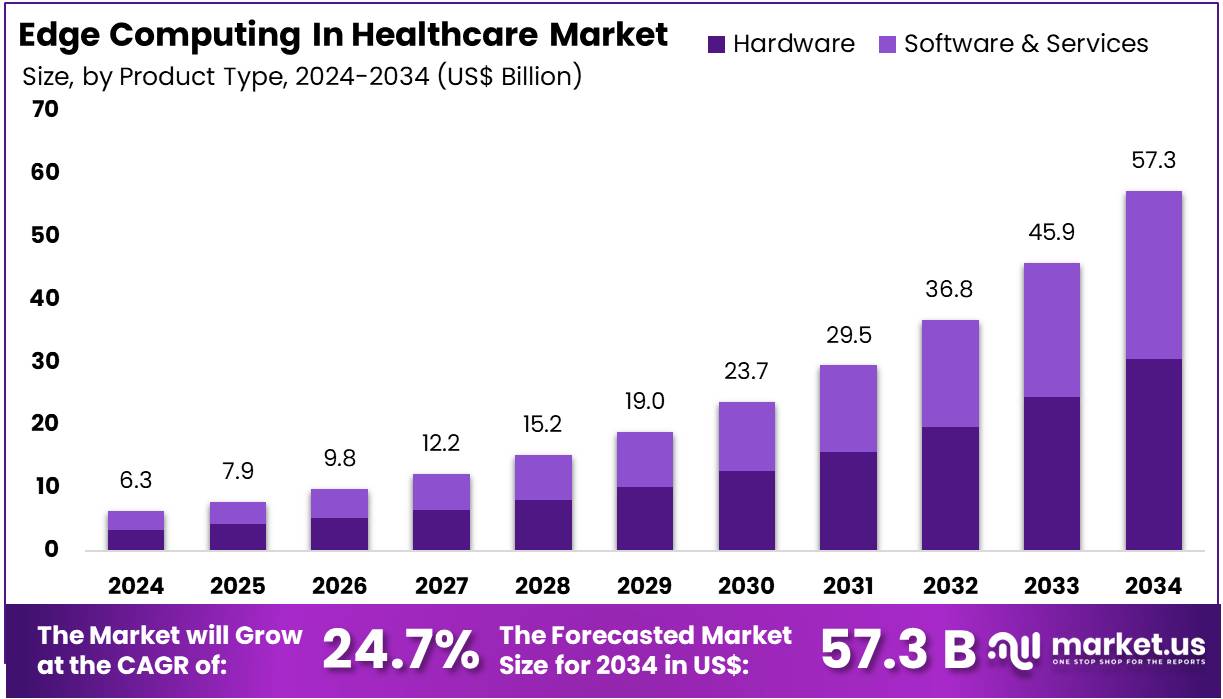
Key Takeaways
- In 2024, the Edge Computing in Healthcare Market generated revenue of US$ 6.3 billion and is projected to grow at a CAGR of 24.7%, reaching approximately US$ 57.3 billion by 2034.
- Based on product type, the market is segmented into hardware and software & services. The hardware segment dominated the market in 2023, accounting for a 53.5% market share.
- Based on application, the market is categorized into telehealth & remote patient monitoring, robotic surgery, diagnostics, ambulances, and other applications. Among these, telehealth & remote patient monitoring held a leading share of 39.4%.
- Based on end user, the market is segmented into hospitals & clinics, home care & long-term care centers, and ambulatory care & other facilities. The hospitals & clinics segment dominated the market, capturing the largest revenue share of 60.7%.
- Regionally, North America dominated the Edge Computing in Healthcare Market in 2024, accounting for a significant 41.7% market share.
Statistical Information
- Hospitals Increasingly Use APIs for Healthcare Data Access: Nearly 90% of U.S. hospitals used APIs to enable patients and applications to access electronic health record (EHR) information.
- Advanced Clinical Analytics Adoption Is Growing in Hospitals: Critical access hospitals increased adoption of advanced electronic health record functions from 21% in 2014 to 56% in 2023, supporting demand for real-time healthcare data processing.
- Digital Patient Engagement Capabilities Are Expanding: 80% of U.S. hospitals adopted all four major patient engagement capabilities, including online access, viewing, downloading, transmitting health records, and secure messaging by 2024.
- Connected Medical Devices Are Increasing Healthcare Data Volumes: Healthcare organizations are deploying connected medical technologies such as patient monitors, wearable sensors, smart imaging systems, and connected implants that continuously generate clinical data requiring rapid processing.
- Edge AI Supports Real-Time Biomedical Signal Processing: Research has demonstrated that edge AI hardware can process healthcare signals such as ECG, EEG, and continuous patient monitoring data with reduced dependence on centralized cloud systems.
- Healthcare AI Applications Require Local Computing Capabilities: Healthcare AI workloads, including medical imaging analysis, clinical decision support, and patient monitoring, are increasing demand for localized computing infrastructure.
- Hospitals Are Increasing Participation in Health Data Exchange Networks: More than 60% of U.S. hospitals were aware of and planned participation in the Trusted Exchange Framework and Common Agreement (TEFCA) in 2023.
Regional Analysis
North America dominated the Edge Computing in Healthcare Market in 2024, accounting for a significant 41.7% market share.
North America remains a leading region in the edge computing in healthcare market due to advanced healthcare infrastructure, strong adoption of AI-based medical technologies, and increasing demand for real-time data processing. The United States is experiencing rapid deployment of AI-enabled medical devices, with the FDA maintaining a list of cleared AI/ML-based healthcare devices that support digital health innovation.
The growing adoption of remote patient monitoring, connected medical devices, and secure healthcare data management is encouraging hospitals to integrate edge computing solutions for faster clinical decision-making. Additionally, increasing focus on cybersecurity and patient data protection is supporting localized data processing adoption. Asia Pacific is expected to witness significant growth in edge computing adoption due to expanding digital healthcare infrastructure, increasing telehealth usage, and rising deployment of connected medical devices.
Governments across the region are investing in digital health transformation to improve healthcare accessibility and remote care delivery. The growing need for faster diagnostics, decentralized healthcare services, and efficient management of large healthcare datasets is driving demand for edge-based processing technologies in hospitals, clinics, and remote healthcare settings.
Emerging Trends
- AI-Powered Edge Computing for Real-Time Clinical Decisions: Healthcare providers are increasingly adopting AI-enabled edge platforms to process medical data instantly near the point of care. NVIDIA’s IGX and Holoscan platforms support real-time AI applications for medical devices, robotics, and imaging workflows, improving response speed and reducing dependency on cloud processing.
- Growth of Smart Medical Devices and IoMT Integration: The increasing use of connected healthcare devices, including wearable sensors, intelligent monitoring systems, and diagnostic equipment, is driving demand for edge processors. These systems analyze patient data locally and enable faster alerts for critical conditions.
- Edge AI Adoption in Surgical Robotics and Medical Imaging: Hospitals are deploying edge computing solutions to support robotic surgery, image-guided procedures, and AI-assisted diagnostics. NVIDIA reported adoption of IGX with Holoscan by medical technology companies for surgical copilots, robotics, and diagnostic applications.
- Privacy-Focused Healthcare Data Processing: Healthcare organizations are moving toward localized computing models to improve patient data security and reduce risks associated with transferring sensitive medical information. Edge systems enable on-site AI analysis while supporting secure healthcare workflows and regulatory requirements.
- Expansion of Remote Patient Monitoring Infrastructure: Remote patient monitoring is becoming a major edge computing application as hospitals use connected devices to track vital signs outside traditional facilities. AI-enabled monitoring systems support early detection of patient deterioration and continuous healthcare management.
Use Cases
- Real-Time Medical Imaging Analysis: Edge computing enables faster processing of high-volume imaging data from CT, MRI, ultrasound, and endoscopy systems. AI models running closer to imaging devices can assist clinicians with quicker diagnosis and workflow optimization. NVIDIA Holoscan supports real-time streaming and imaging applications at the edge.
- AI-Assisted Robotic Surgery: Surgical robots require extremely low latency for accurate movement control and visualization. Edge computing platforms provide local AI processing capabilities that help surgeons receive real-time insights during procedures. NVIDIA highlighted healthcare robotics and surgical AI as key medical edge applications.
- Hospital-at-Home and Virtual Care Monitoring: Edge computing supports hospital-at-home programs by processing data from wearable devices, remote monitoring tools, and connected medical equipment. CMS has expanded the Acute Hospital Care at Home initiative, encouraging technology-supported care delivery models.
- Intelligent Ambulance and Emergency Care Systems: Edge processors can analyze patient information during transportation, enabling faster emergency decisions through real-time monitoring of vital signs, ECG data, and medical device outputs before hospital arrival. AI-enabled healthcare edge systems are designed for rapid sensor data processing.
- Clinical Automation and AI Healthcare Assistants: Edge computing is supporting AI-based documentation tools, voice assistants, and on-premise medical support systems by processing information locally with lower latency. Research on edge-based medical assistants shows potential for privacy-focused healthcare support using compact AI models.
Frequently Asked Questions on Edge Computing In Healthcare
- What are the major factors driving the Edge Computing in Healthcare Market?
The market is driven by increasing adoption of AI-powered medical devices, remote patient monitoring, smart healthcare systems, and hospital-at-home programs. The growing need for real-time data processing, improved cybersecurity, and faster clinical decision-making is encouraging healthcare providers to implement edge solutions. - How is AI influencing the Edge Computing in Healthcare Market?
Artificial intelligence is accelerating edge computing adoption by enabling instant analysis of medical images, patient data, and clinical information. AI-enabled edge platforms help healthcare professionals achieve faster diagnosis, improve workflow efficiency, and support advanced applications such as robotic surgery and predictive analytics. - What role does edge computing play in remote patient monitoring?
Edge computing supports remote patient monitoring by processing data from wearable devices, sensors, and connected medical equipment locally. This allows healthcare providers to detect health changes quickly, deliver timely interventions, and improve continuous monitoring while reducing dependence on centralized cloud systems. - Why are hospitals adopting edge computing solutions?
Hospitals are adopting edge computing to manage increasing healthcare data volumes and support advanced technologies such as AI diagnostics, medical imaging, and robotic surgery. Local data processing improves system reliability, reduces response time, enhances patient safety, and supports efficient clinical operations. - What is the future outlook of the Edge Computing in Healthcare Market?
The future growth of edge computing in healthcare will be supported by increasing AI adoption, IoT-enabled medical devices, 5G connectivity, and digital healthcare transformation. Healthcare providers are expected to invest in edge infrastructure to enable faster, safer, and more personalized care delivery. - How does 5G support Edge Computing in Healthcare?
5G enhances edge computing by providing high-speed connectivity, low latency, and reliable communication between healthcare devices and processing systems. It supports applications such as remote monitoring, connected ambulances, robotic surgery assistance, and real-time AI-powered healthcare services.
Conclusion
The Edge Computing in Healthcare Market is transforming modern healthcare by enabling faster data processing, real-time clinical insights, and secure management of sensitive patient information. The increasing adoption of AI-powered medical devices, remote patient monitoring, robotic surgery, and smart healthcare systems is accelerating demand for edge-based solutions.
Advancements in 5G, IoT, and AI technologies are further strengthening the role of edge computing in connected care delivery. With growing focus on digital health transformation, data privacy, and efficient healthcare services, edge computing is expected to become a critical technology for improving patient outcomes, operational efficiency, and next-generation healthcare infrastructure worldwide.
Discuss your needs with our analyst
Please share your requirements with more details so our analyst can check if they can solve your problem(s)




