


Overview
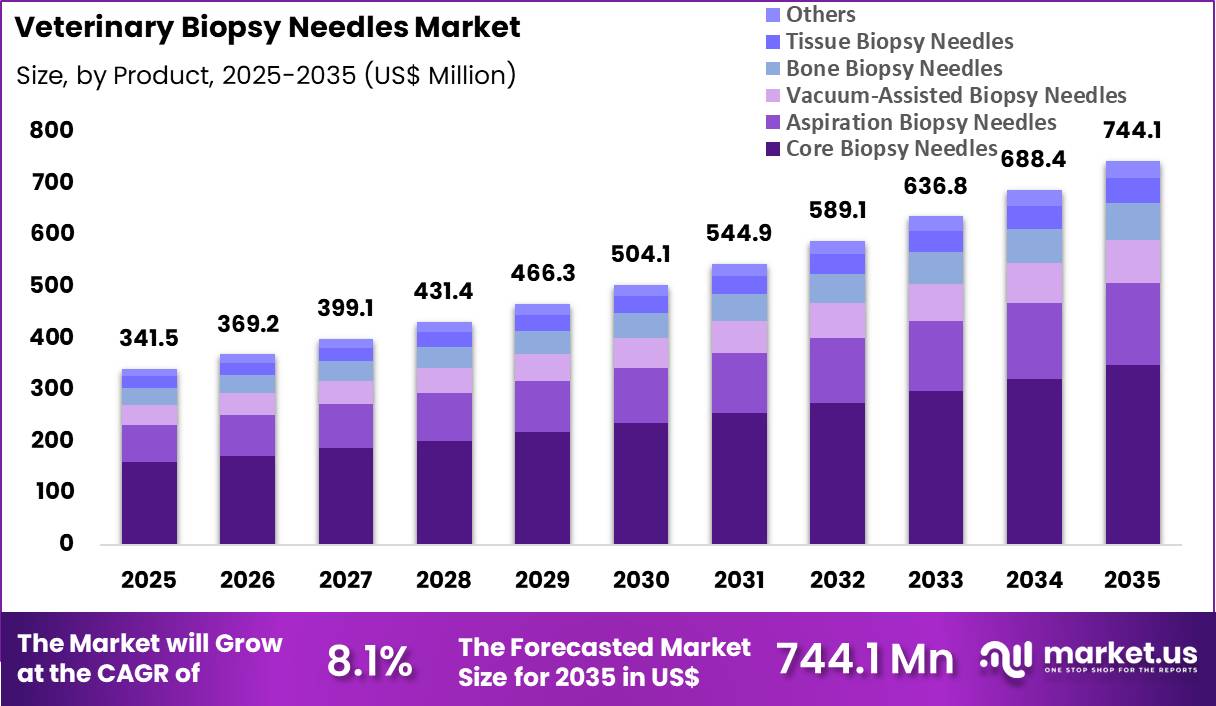
New York, NY – Nov 19 2026 – The Global Veterinary Biopsy Needles Market size is expected to be worth around US$ 744.1 Million by 2035 from US$ 341.5 Million in 2025, growing at a CAGR of 8.1% during the forecast period 2026-2035. In 2025, North America led the market, achieving over 38.4% share with a revenue of US$ 131.1 Million.
Veterinary biopsy needles are specialized medical instruments used to collect tissue samples from animals for diagnostic and pathological examination. These needles play an important role in veterinary healthcare by supporting the early detection, diagnosis, and monitoring of various diseases, including cancer, infections, and inflammatory conditions.
Veterinary biopsy needles are commonly used in veterinary hospitals, diagnostic laboratories, research institutions, and animal healthcare facilities. They are designed to obtain tissue samples from different organs and body tissues while minimizing surgical intervention and discomfort to animals. Common types include core biopsy needles, fine needle aspiration needles, and automated biopsy needles.
The growing adoption of minimally invasive diagnostic procedures, increasing awareness of animal health, and rising prevalence of chronic diseases in companion and livestock animals are supporting demand for veterinary biopsy needles. Technological advancements, including improved needle designs, enhanced precision, and safety features, are further contributing to product development.
Additionally, increasing pet ownership, higher expenditure on veterinary care, and expanding veterinary diagnostic infrastructure are expected to create new growth opportunities in the market. As veterinary medicine continues to advance, veterinary biopsy needles are anticipated to remain essential tools for accurate tissue sampling and improved diagnostic outcomes.
Key Takeaways
- In 2025, the Veterinary Biopsy Needles Market generated revenue of US$ 341.5 Million and is projected to grow at a CAGR of 8.1%, reaching US$ 744.1 Million by 2035.
- Based on product type, the market is segmented into aspiration biopsy needles, core biopsy needles, vacuum-assisted biopsy needles, bone biopsy needles, tissue biopsy needles, and others. Among these, core biopsy needles dominated the market, accounting for a 46.8% share.
- By animal type, the market is categorized into companion animals, livestock animals, and others. The companion animals segment dominated the market, capturing a 67.2% share.
- Based on application, the market is segmented into tumor diagnosis, infectious disease diagnosis, inflammatory disease diagnosis, diagnostic, therapeutic, and research applications. Tumor diagnosis emerged as the leading segment, accounting for 48.3% of the total market revenue.
- By end user, the market is classified into veterinary hospitals, veterinary clinics, research institutes, and others. Veterinary hospitals held the dominant position, representing 56.0% of the market revenue.
- Regionally, North America dominated the Veterinary Biopsy Needles Market, accounting for the largest market share of 38.4%.
Key Market Segments
- Product Analysis: Core biopsy needles dominated the product segment with a 46.8% market share, driven by their ability to collect intact tissue samples for accurate histopathological evaluation. Compared with aspiration needles, these devices provide larger samples, supporting reliable tumor and organ disease diagnosis. Growing adoption of advanced veterinary pathology techniques is further supporting segment growth.
- Animal Type Analysis: Companion animals dominated the animal type segment with a 67.2% market share, supported by rising pet ownership and increasing expenditure on veterinary healthcare. Dogs and cats frequently require biopsy procedures for tumor, infectious disease, and inflammatory disease diagnosis. Growing awareness of pet health and increasing access to advanced veterinary treatments are further driving segment demand.
- Application Analysis: Tumor diagnosis led the application segment with a 48.3% market share, driven by the increasing need for accurate cancer detection in companion animals. Biopsy procedures enable veterinarians to identify tumor characteristics, confirm malignancy, and determine appropriate treatment strategies. Expanding veterinary oncology services and improved diagnostic imaging technologies are further supporting market growth.
- End-User Analysis: Veterinary hospitals dominated the end-user segment with a 56.0% market share, owing to their advanced diagnostic infrastructure and specialized veterinary professionals. These facilities offer imaging-guided biopsy procedures, surgical capabilities, and access to pathology services. Increasing demand for specialized veterinary treatments and advanced diagnostic services is further strengthening the adoption of biopsy needles in hospitals.
Regional Analysis
North America Dominates the Veterinary Biopsy Needles Market
North America held the largest share of the Veterinary Biopsy Needles Market, accounting for 38.4% in 2025. Regional growth is supported by increasing pet ownership, rising veterinary healthcare expenditure, and expanding access to specialized animal healthcare services. Veterinary hospitals and specialty clinics increasingly adopt biopsy procedures for the diagnosis of tumors, infections, and chronic diseases.
Advanced diagnostic imaging, growing veterinary oncology services, and improved pathology infrastructure are further strengthening regional demand. Additionally, increasing awareness of early disease detection among pet owners is encouraging the adoption of advanced veterinary diagnostic procedures.
Asia Pacific is Expected to Register the Highest CAGR
Asia Pacific is projected to record the highest CAGR during the forecast period, driven by rising pet ownership, expanding veterinary infrastructure, and growing livestock healthcare requirements.
Countries such as China, India, Japan, and Australia are witnessing increased investments in veterinary diagnostic facilities. Government initiatives, expanding veterinary hospital networks, and the growing availability of affordable biopsy instruments are expected to create significant growth opportunities across the regional market.
Emerging Trends
- Increasing adoption of minimally invasive biopsy procedures: Veterinary clinics are increasingly using fine-needle aspiration and core needle biopsy techniques to collect tissue samples with less surgical intervention. These procedures can reduce patient discomfort, shorten recovery time, and support faster diagnostic decisions.
- Growing use of ultrasound-guided biopsy needles: Ultrasound-guided biopsy is gaining importance for collecting samples from internal organs, abdominal masses, and other difficult-to-reach locations. This approach helps veterinarians identify the target area more accurately and supports safer tissue collection.
- Rising demand for advanced veterinary cancer diagnosis: The growing focus on early cancer detection in dogs and cats is supporting demand for biopsy needles. Tissue samples help veterinarians identify tumor types, evaluate cancer severity, and select suitable treatment options.
- Development of improved needle designs and sampling techniques: Manufacturers are focusing on biopsy devices that support consistent tissue collection, easier handling, and better sample quality. Manual and semi-automatic core biopsy devices are also being used where controlled tissue collection is important.
- Increasing importance of advanced laboratory testing: Veterinary biopsy samples are increasingly being used for histopathology and additional laboratory examinations, including immunohistochemistry. These techniques provide information about tissue structure and disease characteristics, supporting more detailed diagnosis and treatment planning.
Use Cases
- Diagnosis of tumors and cancer: Veterinary biopsy needles are used to collect samples from suspicious lumps, skin masses, and internal tumors in animals. The collected tissue helps identify whether a growth is benign or malignant and supports decisions regarding surgery and other cancer treatments.
- Liver and kidney disease investigation: Biopsy needles are used to collect tissue samples from organs such as the liver and kidneys when further investigation is required. Histopathological examination helps identify tissue damage, inflammation, and other abnormalities that cannot always be confirmed through routine testing.
- Diagnosis of skin and soft tissue conditions: Veterinarians use needle-based sampling to investigate skin lumps, subcutaneous masses, and abnormal tissue growths. These samples help distinguish between inflammatory conditions, infections, and different types of tumors, allowing appropriate treatment decisions to be made.
- Examination of lymph nodes and abnormal tissue: Biopsy needles can be used to collect samples from enlarged lymph nodes and other abnormal tissue areas. These samples help investigate suspected infections, inflammatory diseases, and cancers, particularly when additional tissue information is required for diagnosis.
- Diagnosis of diseases in livestock animals: Veterinary tissue sampling supports the investigation of abnormal organs and suspected diseases in livestock, including cattle, sheep, and other farm animals. Laboratory examination of collected specimens helps veterinarians investigate disease conditions and support appropriate animal health management.
Frequently Asked Questions About Veterinary Biopsy Needles
- What are veterinary biopsy needles used for?
Veterinary biopsy needles are used to collect samples from suspicious lumps, internal organs, lymph nodes, skin lesions, and other abnormal tissues. The collected samples help identify diseases and support accurate treatment planning. - What are the different types of veterinary biopsy needles?
Common types include fine-needle aspiration needles, core biopsy needles, and specialized needle biopsy devices. Fine needles collect cells, while core biopsy needles collect small tissue sections for detailed microscopic examination. - Are veterinary biopsy procedures painful for animals?
Veterinary biopsy procedures may cause some discomfort, depending on the sampling location and technique. Local anesthesia, sedation, or general anesthesia may be used when necessary to improve animal comfort and procedural safety. - Which animals can undergo needle biopsy procedures?
Needle biopsy procedures can be performed in several animal species, including dogs, cats, cattle, horses, and other veterinary patients. The selected needle and sampling method depend on the animal’s size and clinical condition. - Which animal segment dominates the veterinary biopsy needles market?
Companion animals, particularly dogs and cats, represent an important application segment because of increasing veterinary visits and cancer investigations. However, livestock animals also require biopsy procedures for selected disease diagnosis and tissue examination. - Which product type is commonly used in the veterinary biopsy needles market?
Fine-needle aspiration and core biopsy needles are important product categories. Fine needles are commonly used for initial cell collection, whereas core biopsy devices are selected when tissue structure is required for detailed laboratory examination. - Which application segment contributes to veterinary biopsy needle demand?
Oncology diagnosis represents an important application area because tissue examination helps identify tumor characteristics and guide treatment decisions. Other applications include liver disease investigation, kidney disorders, skin conditions, and lymph node examination. - What factors are creating opportunities in the veterinary biopsy needles market?
Opportunities are emerging from improvements in veterinary diagnostic equipment, increasing access to ultrasound-guided procedures, advanced laboratory testing, and greater awareness of early disease detection. These developments may encourage wider adoption of biopsy devices.
Conclusion
The Veterinary Biopsy Needles Market is expected to witness significant growth, driven by increasing pet ownership, rising veterinary healthcare expenditure, and growing demand for minimally invasive diagnostic procedures. Valued at US$ 341.5 million in 2025, the market is projected to reach US$ 744.1 million by 2035, registering a CAGR of 8.1%.
Core biopsy needles, companion animals, tumor diagnosis, and veterinary hospitals remain the leading market segments. North America currently dominates the market, while Asia Pacific is expected to record the highest growth. Technological advancements and expanding veterinary diagnostic infrastructure will further support market expansion.
Discuss your needs with our analyst
Please share your requirements with more details so our analyst can check if they can solve your problem(s)



