


Overview
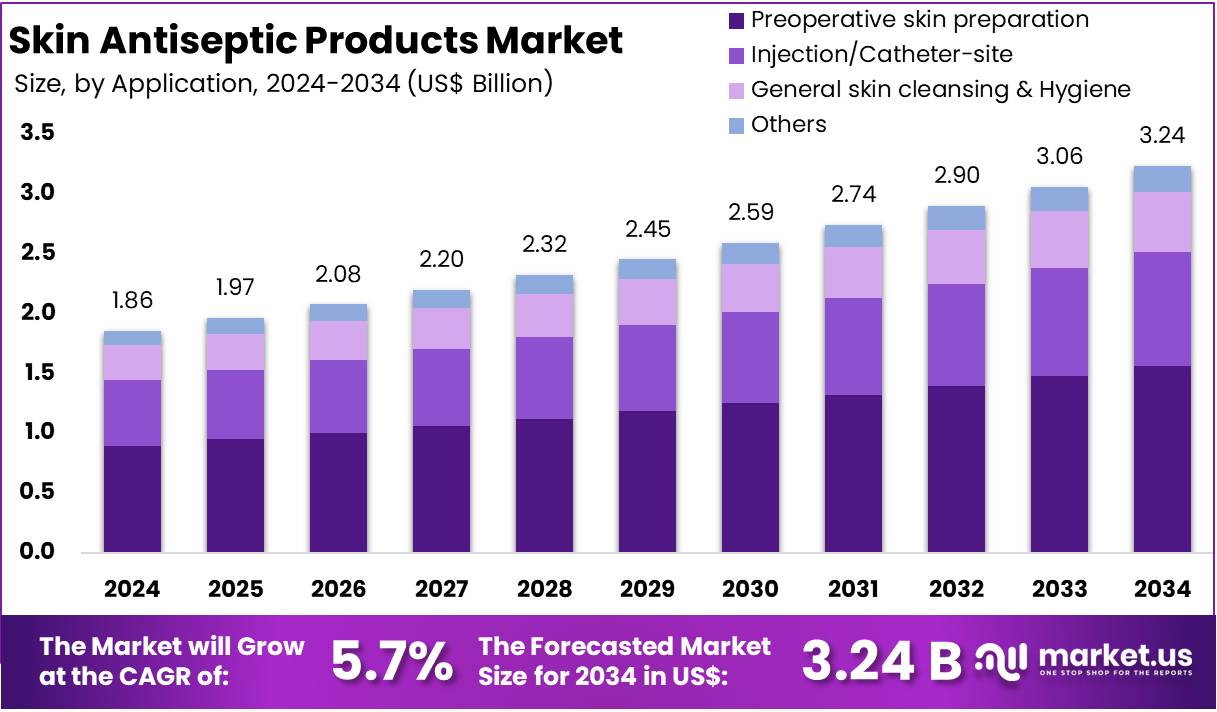
New York, NY – Aug 27, 2026 – The Global Skin Antiseptic Products Market size is expected to be worth around US$ 3.24 Billion by 2034, from US$ 1.83 Billion in 2024, growing at a CAGR of 5.7% during the forecast period from 2025 to 2034. North America held a dominant market position, capturing more than a 34.4% share and holding US$ 639.84 Million market value for the year.
The Skin Antiseptic Products Market is witnessing steady growth due to increasing surgical procedures, rising awareness about infection prevention, and the growing demand for effective hygiene solutions across hospitals, clinics, and home-care settings. Skin antiseptics are widely used before surgeries, injections, wound management, and healthcare procedures to reduce the risk of healthcare-associated infections (HAIs) caused by bacteria, viruses, and fungi.
The global healthcare sector performs millions of invasive procedures annually, creating strong demand for antiseptic solutions such as alcohol-based preparations, iodine-based products, chlorhexidine-based formulations, and other antimicrobial agents. According to the World Health Organization (WHO), approximately 1 in 10 patients worldwide is affected by healthcare-associated infections, highlighting the importance of effective infection prevention practices.
The market is supported by the increasing adoption of surgical site infection (SSI) prevention protocols. The Centers for Disease Control and Prevention (CDC) recommends appropriate skin preparation using antiseptic agents before surgical procedures to reduce infection risks. Alcohol-based formulations, particularly those containing 70% isopropyl alcohol or ethanol, remain among the most commonly used antiseptic solutions due to their rapid antimicrobial action.
Hospitals and healthcare facilities are also expanding the use of advanced antiseptic products with longer-lasting protection and improved skin compatibility. Rising healthcare expenditure, increasing outpatient procedures, and growing awareness of personal hygiene are further accelerating market expansion. With continuous innovation in formulations, packaging, and delivery systems, the Skin Antiseptic Products Market is expected to play a critical role in global infection control strategies.
Key Takeaways
- The global skin antiseptic products market is expected to grow from US$ 1.83 billion in 2024 to approximately US$ 3.24 billion by 2034, expanding at a CAGR of 5.7% during the forecast period.
- Alcohol-based formulations held the dominant market position in 2024, accounting for 38.1% of the global market, driven by widespread adoption in healthcare facilities and personal hygiene applications.
- The solutions segment led the product form category in 2024, capturing more than 40.0% market share due to its ease of application, convenience, and compatibility across various clinical environments.
- Preoperative skin preparation emerged as the leading application segment in 2024, holding over 48.3% share, supported by increasing focus on surgical site infection prevention and strict healthcare hygiene protocols.
- Hospitals and clinics accounted for the largest end-user share in 2024 at 54.1%, fueled by high surgical procedure volumes and consistent demand for infection prevention solutions.
- Drug stores and pharmacies dominated the distribution channel segment in 2024 with more than 52.2% share, highlighting their importance in improving consumer access to skin antiseptic products.
- North America maintained the leading position in the global skin antiseptic products market in 2024, capturing a 34.4% share valued at US$ 639.84 million, supported by advanced healthcare infrastructure and strong infection control standards.
Statistical Information
- A 2026 clinical study of a skin antiseptic containing 2% chlorhexidine gluconate (CHG) and 70% isopropyl alcohol (IPA) in 66 healthy volunteers showed bacterial reductions on abdominal skin of 2.75 log10 at 10 minutes, 2.03 log10 after 7 days, and 1.53 log10 after 10 days.
- The same 2026 skin antisepsis study reported that CHG-IPA preparation achieved bacterial reductions on groin skin of 3.59 log10 at 10 minutes, 2.80 log10 after 7 days, and 2.42 log10 after 10 days, demonstrating extended antimicrobial persistence.
- A 2025–2026 randomized clinical trial evaluating chlorhexidine-based skin antisepsis for peripheral catheter preparation found that Gram-positive bacterial counts decreased by 76.4% with 1% CHG, 90% with 2% CHG, 90% with 4% CHG, and 30% with 70% isopropyl alcohol at 96 hours after catheterization.
- A 2025 hand-hygiene monitoring technology study collected 7,200 hand hygiene gesture samples from 10 subjects using sanitizer-based WHO hand-rubbing procedures and achieved 91% recognition accuracy using a mmWave-based monitoring system.
- The same 2025 automated hand hygiene monitoring system operated at a distance of 1.5 meters and improved performance over previous approaches by 31%–43% through beam-steering and deep-learning techniques.
- The 2025 WHO hand hygiene guideline review identified alcohol-based hand rub as an effective alternative for hand hygiene and included evidence from a systematic review published in 2025 evaluating effectiveness across hygiene materials.
- A 2025 technical study on automated hospital hand hygiene recording evaluated an IoT-connected monitoring system during a 3-hour real hospital evaluation period to record and measure hand hygiene activity data.
- A 2025 research system for hand hygiene gesture recognition used multiple mmWave beam directions and maintained performance with only a 5% accuracy reduction when users were positioned 30 degrees away from the main detection direction.
Regional Analysis
In 2024, North America maintained a leading position in the Skin Antiseptic Products Market, accounting for more than 34.4% share with a market value of US$ 639.84 million. The region’s growth was driven by advanced healthcare infrastructure, strong infection prevention practices, and high adoption of antiseptic solutions in hospitals, clinics, and outpatient facilities. Increasing surgical procedures, including elective and minimally invasive surgeries, supported the demand for pre-operative skin preparation products.
Hospitals and long-term care centers continued to follow strict hygiene protocols, encouraging the use of alcohol-based, iodine-based, and chlorhexidine formulations. Strong distribution networks through healthcare suppliers, pharmacies, and online platforms improved product accessibility.
Continuous innovation in product formulations and packaging further expanded usage across clinical and home-care settings. These factors collectively strengthened North America’s market leadership and supported long-term growth prospects.
Emerging Trends
- Rising Adoption of Alcohol-Based Antiseptic Products: Healthcare facilities are increasing the use of alcohol-based antiseptics for hand hygiene and skin preparation because of their fast microbial killing ability. Products containing 60% or higher alcohol concentration are recommended by the CDC when soap and water are unavailable, driving demand in hospitals and clinics.
- Increasing Use of Chlorhexidine-Based Formulations: Chlorhexidine gluconate (CHG) products are gaining importance for surgical skin preparation and infection prevention. Healthcare organizations are adopting CHG-alcohol combinations due to their broad antimicrobial activity and longer-lasting protection. WHO recommends alcohol-based chlorhexidine solutions as a preferred option for surgical site skin preparation.
- Growing Demand for Hospital Infection Control Solutions: Hospitals are strengthening infection prevention programs due to rising awareness of healthcare-associated infections (HAIs). Hand hygiene initiatives using antiseptic products have improved compliance rates, with some healthcare programs reporting increases from 38% to 63%, supporting market expansion.
- Development of Skin-Friendly Antiseptic Formulations: Manufacturers are focusing on advanced antiseptic products that provide effective microbial protection while minimizing skin irritation. New formulations include moisturizers and conditioning agents to support frequent usage by healthcare workers who may perform hand hygiene activities multiple times per shift.
Use Cases
- Surgical Skin Preparation: Skin antiseptic products are widely used before surgical procedures to reduce microorganisms on the skin and lower the risk of surgical site infections. Alcohol-based chlorhexidine solutions and iodine-based preparations are commonly used in operating rooms according to global infection prevention guidelines.
- Injection and Vaccination Site Cleaning: Antiseptic wipes, swabs, and solutions are used before injections, vaccinations, blood collection, and intravenous procedures. These products help remove bacteria from the skin surface and improve safety during routine medical procedures performed in hospitals, clinics, and vaccination centers.
- Hand Hygiene in Healthcare Facilities: Alcohol-based hand rubs represent one of the largest applications of skin antiseptics. Healthcare workers use these products before and after patient contact to prevent infection transmission. CDC recommends alcohol-based hand sanitizers containing 60% or more alcohol for effective hand hygiene.
- Catheter and Medical Device Placement: Skin antiseptics play an important role during catheter insertion and other medical device procedures. Healthcare providers use antiseptic solutions to disinfect insertion sites and reduce infection risks associated with invasive devices, supporting demand in hospitals and intensive care units.
- Homecare and Personal Hygiene Applications: Consumers increasingly use antiseptic products for daily hygiene, wound cleaning, and protection during travel or outdoor activities. Portable antiseptic sprays, wipes, and gels are gaining popularity due to increased awareness of infection prevention and improved personal healthcare practices.
Frequently Asked Questions on Skin Antiseptic Products
- Why are skin antiseptic products important in healthcare?
Skin antiseptic products help prevent infections by reducing bacteria, viruses, and other microorganisms on the skin surface. Hospitals, surgical centers, and clinics use these products before injections, surgeries, catheter placements, and other procedures requiring infection control. - What are the major types of skin antiseptic products?
The major types include alcohol-based antiseptics, chlorhexidine-based solutions, povidone-iodine products, hydrogen peroxide formulations, antiseptic wipes, and sprays. These products are available in different forms such as liquids, gels, foams, and pre-moistened applicators. - What factors are driving the growth of the skin antiseptic products market?
The market growth is supported by increasing healthcare-associated infection prevention efforts, rising surgical procedures, growing awareness about hygiene, expansion of healthcare facilities, and higher adoption of advanced antiseptic formulations with improved safety and effectiveness. - Which product segment dominates the skin antiseptic products market?
Alcohol-based antiseptic products hold a significant position due to their rapid antimicrobial action, wide usage in hospitals, and effectiveness against various microorganisms. Their availability in solutions, wipes, and hand hygiene formulations supports strong demand across healthcare settings. - How are hospitals using skin antiseptic products?
Hospitals use skin antiseptics for surgical site preparation, injection procedures, wound cleaning, catheter insertion, and patient hygiene. These products are essential components of infection prevention protocols designed to reduce healthcare-associated infections and improve patient safety. - What role do government regulations play in the skin antiseptic products market?
Government agencies establish safety standards, quality requirements, and usage guidelines for antiseptic products. Regulatory oversight ensures that manufacturers meet effectiveness, labeling, and safety requirements while supporting the development of reliable infection prevention solutions. - Which end users contribute most to skin antiseptic product demand?
Hospitals, clinics, ambulatory surgical centers, diagnostic laboratories, and home healthcare users are major consumers. Hospitals represent a leading demand source because antiseptics are routinely required for surgeries, patient care procedures, and infection prevention activities. - What is the future outlook for the skin antiseptic products market?
The skin antiseptic products market is expected to grow steadily due to increasing healthcare awareness, rising infection prevention needs, expanding medical procedures, and continuous product innovations. Demand will remain strong across hospitals, healthcare facilities, and personal hygiene applications.
Conclusion
The skin antiseptic products market is evolving due to the rising focus on patient safety, infection control, and preventive healthcare practices worldwide. Growing hospital admissions, increasing surgical interventions, and strict regulatory guidelines for hygiene management are driving product adoption across hospitals, clinics, and home care settings.
Innovations in formulations, including alcohol-based antiseptics, chlorhexidine solutions, and advanced skin preparation products, are enhancing effectiveness and convenience. Developed regions continue to support market growth through strong healthcare systems, while emerging economies are creating new opportunities through expanding medical infrastructure. Overall, the market is expected to maintain consistent growth as infection prevention remains a global healthcare priority.
Discuss your needs with our analyst
Please share your requirements with more details so our analyst can check if they can solve your problem(s)




