


Overview
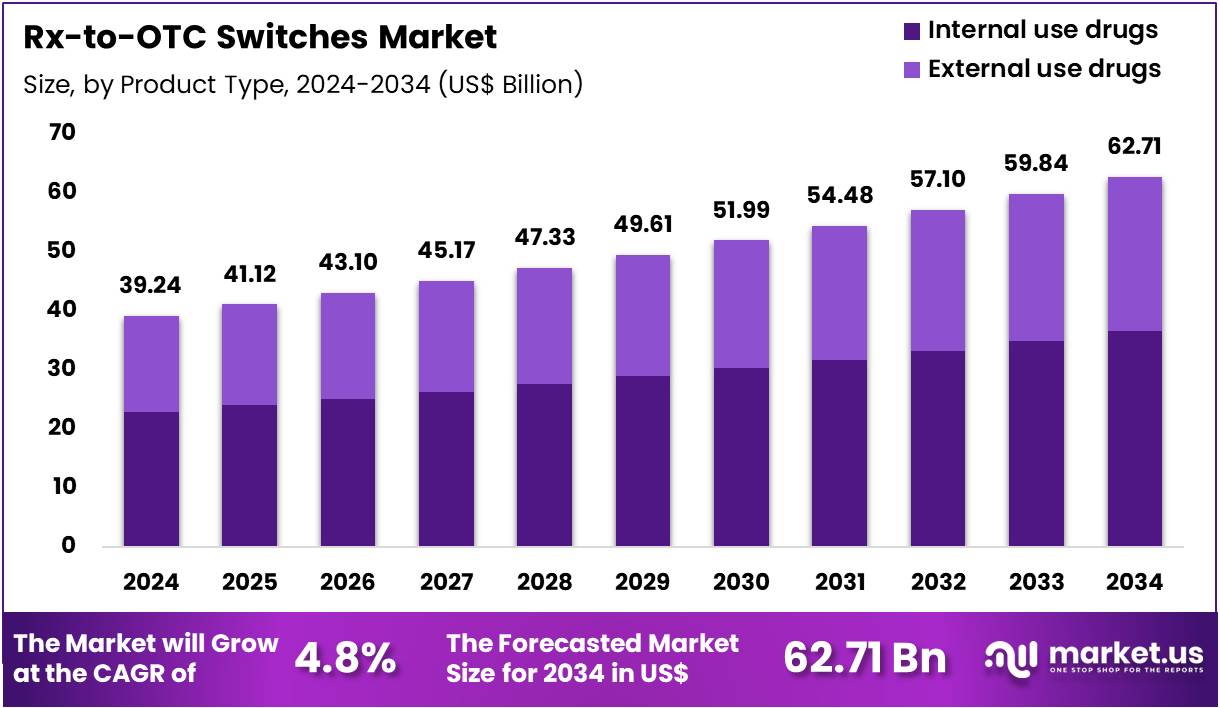
New York, NY – Aug 27, 2026 – Global Rx-to-OTC Switches Market size is expected to be worth around US$ 62.71 Billion by 2034 from US$ 39.24 Billion in 2024, growing at a CAGR of 4.8% during the forecast period from 2025 to 2034. In 2024, North America led the market, achieving over 41.5% share with a revenue of US $16.28 Billion.
The global Rx-to-OTC Switches Market is witnessing steady growth as pharmaceutical companies increasingly convert prescription-only medicines into over-the-counter (OTC) products to improve consumer access, support self-care, and expand revenue opportunities.
Rx-to-OTC switching allows approved prescription medicines with established safety profiles to become available without a doctor’s prescription after regulatory evaluation. The trend is supported by rising healthcare costs, increasing consumer preference for convenient treatment options, and growing awareness of preventive healthcare.
In recent years, regulatory agencies have approved multiple Rx-to-OTC switches across therapeutic categories, including pain management, allergy relief, gastrointestinal disorders, dermatology, and women’s health.
In the United States, the U.S. Food and Drug Administration (FDA) has approved more than 100 prescription medicines for OTC status since the first switch approvals in the 1970s, helping expand access to widely used treatments. In 2023, the FDA approved the first OTC daily oral contraceptive in the U.S., representing a major milestone in consumer healthcare accessibility.
The market is also benefiting from increasing global self-medication trends. According to healthcare industry observations, OTC medicines account for approximately 30% of pharmaceutical sales in many developed markets, reflecting strong consumer demand for non-prescription therapies. Digital health platforms, pharmacist-led consultations, and improved product labeling are further supporting safe OTC adoption.
Pharmaceutical companies are investing in clinical studies, regulatory submissions, and consumer education programs to achieve successful switches. With healthcare systems focusing on reducing physician workload and improving treatment availability, Rx-to-OTC switches are expected to remain an important growth area in the pharmaceutical industry through the coming years.
Key Takeaways
- Market Size: The global Rx-to-OTC Switches Market is projected to reach approximately US$62.71 billion by 2034, increasing from US$39.24 billion in 2024.
- Market Growth: The market is expected to expand at a compound annual growth rate (CAGR) of 4.8% during the forecast period from 2025 to 2034.
- Product Type Analysis: Internal-use drugs dominated the global Rx-to-OTC Switches Market in 2024, capturing an estimated 58.3% market share.
- Therapeutic Area Analysis: Pain management products represented the leading therapeutic segment in 2024, accounting for approximately 31.2% of the total market share.
- Distribution Channel Analysis: Retail pharmacies and drug stores emerged as the largest distribution channel in 2024, holding an estimated 34.1% share of the global market.
- Regional Analysis: North America held the leading position in the global Rx-to-OTC Switches Market in 2024, accounting for more than 41.5% share with a market value of approximately US$16.28 billion.
Statistical Information
- In 2026, the FDA Prescription-to-Nonprescription Switch List recorded 2 new Rx-to-OTC switch approvals: Rextovy (naloxone nasal spray) approved on June 16, 2026, and Differin Epiduo Acne Gel approved on May 22, 2026.
- A 2026 peer-reviewed analysis of FDA switch approvals identified 45 total Rx-to-OTC switch approvals involving 30 unique active ingredients between 2001 and 2025, providing a quantified historical operational dataset for the switch pathway.
- FDA requires Rx-to-OTC switch applications to include 2 major evidence categories: safety/efficacy data and consumer-use studies demonstrating that users can understand safe and effective use without healthcare professional supervision.
- Rx-to-OTC switches are processed through 2 regulatory pathways: full switch and partial switch, allowing either complete conversion to nonprescription status or conversion of only selected conditions of use.
- FDA recognizes 2 main pathways for OTC drug availability: approved NDA-based products and OTC monograph-based products, with Rx-to-OTC switches requiring an approved NDA process.
- FDA’s FY 2026 OTC Monograph Drug User Fee Program set the Monograph Drug Facility fee at $19,188, compared with $37,556 in FY 2025, representing a 49% decrease in the facility fee level.
- FDA’s FY 2026 OTC Monograph Order Request (OMOR) fee was $587,529 for Tier 1 requests and $117,505 for Tier 2 requests, compared with $559,777 and $111,955 respectively in FY 2025.The
- FDA reported that the FY 2026 OMUFA program target facility-fee revenue was $16,885,000, calculated using registered OTC monograph drug facility information.
- OTC switch development requires consumer understanding testing because FDA evaluates whether users can correctly interpret labeling; these studies are designed to measure safe self-selection and correct product use before approval. FDA specifies that switch submissions must include consumer-use data demonstrating safe and effective self-medication.
- A 2026 OTC instruction-comprehension study evaluated 2 different drug instruction designs and reported measurable improvements in response time and usability compared with traditional text-based instructions.
Regional Analysis
North America maintained a leading position in the Rx-to-OTC Switches Market in 2024, accounting for more than 41.5% market share with a market value of approximately US$ 16.28 billion. The region’s dominance is supported by advanced healthcare infrastructure, high consumer awareness, and well-established regulatory pathways for prescription-to-nonprescription drug transitions. Growing demand for self-care solutions has encouraged consumers to adopt OTC medicines due to their accessibility, convenience, and lower healthcare costs.
Strong retail pharmacy networks and expanding online pharmacy platforms have improved product availability across different population groups. Regulatory agencies continue to support safe OTC switch approvals through evidence-based evaluation processes. Additionally, pharmaceutical innovation, including improved formulations and consumer-friendly delivery systems, has strengthened market growth. Rising healthcare costs and increasing preference for self-management are expected to further drive North America’s market expansion during the forecast period.
Emerging Trends
- Rising Adoption of Self-Care Healthcare Models: Healthcare systems worldwide are promoting self-care by shifting suitable prescription medicines to OTC availability. Regulatory agencies such as the U.S. FDA evaluate safety, effectiveness, and consumer understanding before approval. In 2023, FDA approved Opill, the first nonprescription daily oral contraceptive in the United States, expanding access to preventive healthcare.
- Growth of Consumer-Friendly Drug Labeling Solutions: Clear labeling and digital education tools are becoming important trends in Rx-to-OTC conversions. FDA requires studies showing consumers can understand and correctly follow OTC instructions. Companies are increasingly using simplified labels, QR codes, mobile applications, and digital reminders to improve medication safety and reduce misuse risks.
- Increasing Focus on Women’s Health OTC Products: Women’s healthcare is emerging as a major growth area for Rx-to-OTC switches. The FDA approval of Opill in 2023 created a new pathway for over-the-counter contraception access. The product contains 0.075 mg norgestrel and demonstrates how regulatory approvals can improve the availability of essential healthcare products.
- Expansion of Preventive and Chronic Care Treatments: Rx-to-OTC switches are increasingly targeting conditions where early treatment improves outcomes, including allergies, gastrointestinal disorders, pain management, and dermatological conditions. Regulatory agencies prioritize medicines with established safety records, predictable dosing, and low monitoring requirements. This approach supports broader consumer access while maintaining medication safety standards.
- Increasing Regulatory Support for Innovative Switch Applications: Regulatory pathways for Rx-to-OTC switches are becoming more structured, encouraging pharmaceutical companies to develop new candidates. FDA reviews consumer behavior studies, safety databases, and clinical evidence before approval. The process supports conversion of medicines with strong risk-benefit profiles into accessible OTC healthcare solutions.
Use Cases
- Contraception Access Without Prescription Requirements: A major use case of Rx-to-OTC switching is expanding access to reproductive healthcare products. In 2023, FDA approved Opill as the first OTC daily oral contraceptive in the U.S. This transition allows consumers to obtain contraception directly from pharmacies and retail locations without visiting a healthcare provider.
- Allergy and Respiratory Treatment Accessibility: OTC switches are widely used for allergy medicines, enabling faster symptom management. Antihistamines and nasal treatments have moved from prescription-only categories to OTC availability after demonstrating safe consumer use. These products support millions of users managing seasonal allergies, with improved convenience and reduced healthcare visits.
- Pain Relief and Fever Management: Pain and fever medications represent one of the largest OTC application areas. Medicines containing active ingredients such as ibuprofen and acetaminophen are available without prescriptions after extensive safety evaluation. OTC availability supports quick treatment for common conditions while requiring clear dosage limits to prevent misuse.
- Emergency Medicine Availability in Communities: Rx-to-OTC switching is improving access to emergency treatments. In 2023, FDA approved the first OTC naloxone nasal spray, allowing broader availability of opioid overdose reversal medication. This use case demonstrates how OTC pathways can support public health initiatives by making critical medicines easier to obtain.
- Dermatology and Digestive Health Applications: Skin care and digestive health products are increasingly benefiting from Rx-to-OTC conversion. Treatments for acne, heartburn, and gastrointestinal symptoms can reach consumers faster through retail channels. These applications reduce pressure on healthcare providers and support convenient management of common health conditions with proper labeling guidance.
Frequently Asked Questions on Rx-to-OTC Switches
- Why are Rx-to-OTC switches important for healthcare systems?
Rx-to-OTC switches improve access to commonly used treatments, support self-care, and reduce pressure on healthcare providers. They allow patients to manage minor health conditions independently while maintaining safety through approved labeling and consumer education. - What factors drive the growth of the Rx-to-OTC Switches Market?
The market is growing due to increasing demand for self-medication, rising healthcare costs, aging populations, regulatory support, and consumer preference for convenient treatment options. Pharmaceutical companies are also investing in product lifecycle expansion through OTC conversions. - Which regulatory agencies approve Rx-to-OTC switches?
Regulatory agencies such as the U.S. Food and Drug Administration (FDA), European Medicines Agency (EMA), and other national health authorities evaluate safety, effectiveness, labeling requirements, and consumer usability before approving prescription medicines for OTC availability. - What types of medicines commonly undergo Rx-to-OTC switches?
Commonly switched medicines include allergy treatments, pain relievers, gastrointestinal drugs, dermatology products, and respiratory medications. These categories generally have well-established safety profiles and can be used effectively by consumers with proper instructions. - How do Rx-to-OTC switches benefit pharmaceutical companies?
Rx-to-OTC switches create new revenue opportunities by extending product life cycles, reaching wider consumer markets, and improving brand visibility. Companies can also reduce dependence on prescription channels while expanding accessibility for established therapies. - What role does digital healthcare play in the Rx-to-OTC Switches Market?
Digital healthcare platforms support OTC medicine adoption by providing online consultations, medication information, symptom guidance, and pharmacy access. Digital tools help consumers make informed decisions while improving awareness about newly switched OTC products. - What is the future outlook for the Rx-to-OTC Switches Market?
The future outlook remains positive as healthcare systems increasingly promote self-care solutions. Growing consumer demand, technological advancements, and continued regulatory evaluation of suitable prescription medicines are expected to support market expansion in coming years.
Conclusion
The Rx-to-OTC Switches Market is positioned for significant transformation as patients increasingly prefer convenient, accessible, and cost-effective healthcare options. The transition of prescription medicines to over-the-counter availability enables consumers to manage common health conditions while reducing pressure on healthcare providers.
Growth is supported by regulatory approvals, pharmaceutical innovation, expanding self-medication trends, and rising healthcare awareness. With advancements in drug safety evaluation and improved consumer education, more therapeutic categories are expected to explore OTC conversion opportunities. The market will continue evolving as companies focus on developing safe, effective, and user-friendly medicines that support the global shift toward self-care and preventive healthcare practices.
Discuss your needs with our analyst
Please share your requirements with more details so our analyst can check if they can solve your problem(s)




