


Overview
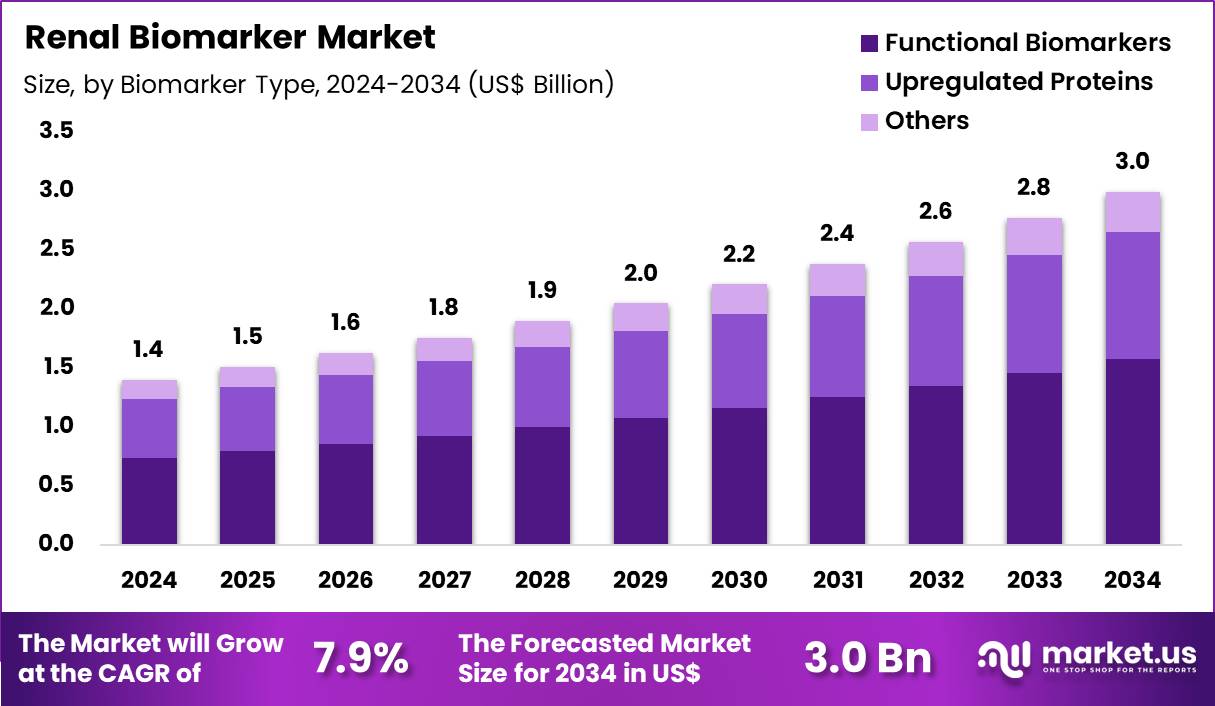
New York, NY – Sep 30, 2026 – The Global Renal Biomarker Market size is expected to be worth around US$ 3.0 Billion by 2034 from US$ 1.4 Billion in 2024, growing at a CAGR of 7.9% during the forecast period 2025 to 2034. In 2024, North America led the market, achieving over 46.7% share with a revenue of US$ 653.8 Million.
Renal biomarkers are measurable substances in blood, urine, or other biological samples that provide important information about kidney health and function. These biomarkers are widely used to support the detection, diagnosis, monitoring, and management of kidney-related conditions, including chronic kidney disease (CKD) and acute kidney injury (AKI).
Common renal biomarkers include serum creatinine, blood urea nitrogen (BUN), estimated glomerular filtration rate (eGFR), and urinary albumin. Emerging biomarkers, such as cystatin C, neutrophil gelatinase-associated lipocalin (NGAL), and kidney injury molecule-1 (KIM-1), are also being studied for their potential to identify kidney damage at earlier stages.
The combined assessment of serum creatinine and cystatin C can improve the accuracy of estimated kidney function, while urine albumin testing helps identify kidney damage.
Growing research into renal biomarkers is supporting the development of more precise diagnostic approaches and improved patient monitoring. These advances are also creating opportunities for innovation in clinical laboratory testing, diagnostic technologies, and kidney disease research. However, biomarker results must be interpreted alongside a patient’s medical history, clinical findings, and other laboratory results.
Key Takeaways
- In 2024, the Renal Biomarker Market generated revenue of US$ 1.4 billion and is projected to grow at a CAGR of 7.9%, reaching US$ 3.0 billion by 2034.
- Based on biomarker type, the market is segmented into functional biomarkers, upregulated proteins, and others. Among these, functional biomarkers dominated the market in 2024, accounting for a 52.5% market share.
- By technique, the market is categorized into immunoassays, mass spectrometry, point-of-care tests, enzyme-linked immunosorbent assay (ELISA), molecular diagnostics, and others. ELISA held the largest share, accounting for 42.3% of the market in 2024.
- Based on end user, the market is segmented into hospitals, diagnostic laboratories, academic & research institutes, and others. Hospitals dominated the market, accounting for the largest revenue share of 56.8% in 2024.
- North America dominated the global renal biomarker market in 2024, accounting for a 46.7% market share.
Key Market Segments
- Biomarker Type Analysis: Functional biomarkers held a 52.5% market share, supported by their established role in evaluating kidney function. Their ability to assess glomerular filtration and tubular performance makes them widely used for chronic kidney disease and acute kidney injury monitoring, supporting continued clinical adoption.
- Technique Analysis: Enzyme-linked immunosorbent assay (ELISA) accounted for 42.3% of the renal biomarker market, supported by high sensitivity, quantitative accuracy, and cost efficiency. Standardized workflows, broad reagent availability, laboratory familiarity, and compatibility with high-throughput testing continue to support its widespread adoption.
- End-User Analysis: Hospitals accounted for 56.8% of the renal biomarker market, driven by high patient volumes and comprehensive kidney disease management. Routine diagnostic testing, inpatient monitoring, emergency care, nephrology services, and advanced laboratory infrastructure contribute to the strong adoption of renal biomarkers in hospitals.
Regional Analysis
North America led the Renal Biomarker Market in 2024, accounting for 46.7% of the global market. Growth has been supported by the rising burden of chronic kidney disease, increasing adoption of early diagnostic technologies, and advancements in precision nephrology.
Growing use of biomarkers such as NGAL, KIM-1, cystatin C, and albuminuria is supporting kidney injury assessment and disease monitoring. Pharmaceutical and diagnostic collaborations are also contributing to the development of multiplex assays and companion diagnostic solutions. Increasing healthcare expenditure and improved access to point-of-care testing are further supporting market expansion.
Asia Pacific is projected to register the highest CAGR during the forecast period. Market growth is being driven by rising healthcare needs, expanding patient populations, increasing awareness of kidney disease, and greater adoption of advanced diagnostic technologies.
Investments in affordable immunoassays, biomarker validation, primary-care screening, and rural healthcare infrastructure are expected to improve testing accessibility. Growing research collaborations and biotechnology investments are further supporting the development and adoption of renal biomarkers across the region.
Emerging Trends
- Greater use of multi-biomarker testing: Kidney assessment is increasingly moving beyond a single measurement. Combining eGFR with urine albumin and other biological markers can provide a broader view of kidney function and damage. KDIGO recommends urine albumin-to-creatinine ratio (ACR) as a key initial measurement for albuminuria.
- Growing interest in early acute kidney injury detection: Newer biomarkers such as NGAL, KIM-1, TIMP-2, and IGFBP7 are being studied for detecting kidney injury before conventional changes become clearly visible. This is particularly relevant in hospital settings where rapid identification of AKI can support earlier clinical intervention.
- Expansion of cystatin C-based kidney assessment: Cystatin C is gaining attention as an additional marker for estimating kidney filtration. The National Kidney Foundation notes that eGFR can be calculated using creatinine, cystatin C, or both, providing laboratories and clinicians with alternatives when creatinine-based estimates may be less reliable.
- Increasing focus on biomarker qualification for drug development: Pharmaceutical companies are increasingly evaluating biomarkers as tools for clinical development. The FDA has established a formal Biomarker Qualification Program to assess whether biomarkers can reliably support defined uses in drug-development programs.
- Development of more specialized kidney injury biomarkers: Research is expanding toward biomarkers that can indicate specific forms or locations of renal injury rather than only overall kidney filtration. Biomarkers including KIM-1, NGAL, IL-18, L-FABP, and others are being investigated for different types of tubular and renal damage.
Use Cases
- Chronic kidney disease screening and monitoring: Renal biomarkers are used to identify and follow chronic kidney disease. NIDDK identifies urine albumin and eGFR as the two key markers for CKD evaluation, particularly among people with risk factors such as diabetes, hypertension, cardiovascular disease, or family history.
- Acute kidney injury diagnosis: Biomarkers can support the early identification of AKI, particularly in hospital and critical-care environments. Research and clinical guidance have examined markers such as urinary NGAL and L-FABP because kidney tubular injury may occur before conventional laboratory changes become apparent.
- Assessment of kidney-damaging effects of medicines: Renal biomarkers are used in drug research to evaluate potential kidney toxicity and treatment-related renal injury. FDA biomarker programs support the development of reliable biomarkers that can improve medical-product development and help reduce uncertainty during regulatory evaluation.
- Disease progression and risk assessment: Changes in eGFR and albuminuria can help healthcare professionals understand kidney-disease progression and patient risk. Persistent reduction in eGFR or elevated urine albumin can provide important information for diagnosis, monitoring, and treatment planning.
- Clinical trials and precision treatment research: Biomarkers can help identify suitable trial participants, monitor biological responses, and evaluate treatment effects. FDA describes several possible contexts for biomarkers, including enrichment, response assessment, and other defined uses within drug-development programs.
Frequently Asked Questions About Renal Biomarker
- What are the main renal biomarkers used today?
The main established markers include serum creatinine, eGFR, and urine albumin-to-creatinine ratio. Cystatin C is also used in selected situations to estimate kidney filtration. Newer research biomarkers include NGAL, KIM-1, TIMP-2, IGFBP7, and L-FABP. - Why are renal biomarkers important?
Renal biomarkers help detect kidney abnormalities, monitor disease progression, and assess treatment effects. Their importance comes from the fact that kidney disease may remain without obvious symptoms during earlier stages, making laboratory measurements important for identifying changes in kidney health. - What is the role of eGFR as a renal biomarker?
eGFR provides an estimate of how effectively the kidneys filter waste from blood. It is calculated mainly from blood creatinine and, in some approaches, cystatin C. Healthcare professionals use eGFR to assess kidney function and classify chronic kidney disease. - What is the importance of urine albumin in kidney testing?
Urine albumin is an important indicator of kidney damage because excess albumin can enter urine when kidney filtering structures are damaged. The urine albumin-to-creatinine ratio is recommended by KDIGO as a preferred initial measurement for assessing albuminuria. - What is driving demand in the renal biomarker market?
Market demand is supported by the need for earlier kidney-disease detection, increasing clinical use of laboratory testing, development of new kidney therapies, and growing pharmaceutical interest in biomarkers for clinical trials and drug-development programs. - How are pharmaceutical companies using renal biomarkers?
Pharmaceutical companies use renal biomarkers to study drug safety, kidney injury, treatment response, and disease progression during development programs. Biomarkers can also support patient selection and clinical-trial assessment when their intended use is scientifically and regulatorily supported. - What is the difference between established and emerging renal biomarkers?
Established renal biomarkers such as creatinine, eGFR, and urine albumin are widely incorporated into kidney assessment. Emerging markers such as NGAL, KIM-1, TIMP-2, and IGFBP7 are being investigated for additional information, particularly around earlier or more specific kidney injury. - What factors could support future market expansion?
Future expansion can be supported by greater emphasis on early kidney-disease identification, development of targeted therapies, increased clinical research, improved laboratory technologies, and wider use of biomarkers in pharmaceutical development. Regulatory frameworks may also support validated biomarker adoption.
Conclusion
The renal biomarker market is expected to experience steady growth as the need for early kidney disease detection, accurate diagnosis, and continuous patient monitoring increases.
Established biomarkers such as serum creatinine, eGFR, and urine albumin remain central to clinical practice, while emerging markers including cystatin C, NGAL, and KIM-1 are expanding diagnostic capabilities.
Increasing adoption of multi-biomarker testing, advanced laboratory techniques, and biomarker applications in pharmaceutical research is creating new market opportunities. North America currently represents a major market, while Asia Pacific is expected to record strong growth. Continued research, clinical validation, technological development, and improved healthcare access will further support market expansion.
Discuss your needs with our analyst
Please share your requirements with more details so our analyst can check if they can solve your problem(s)




