


Overview
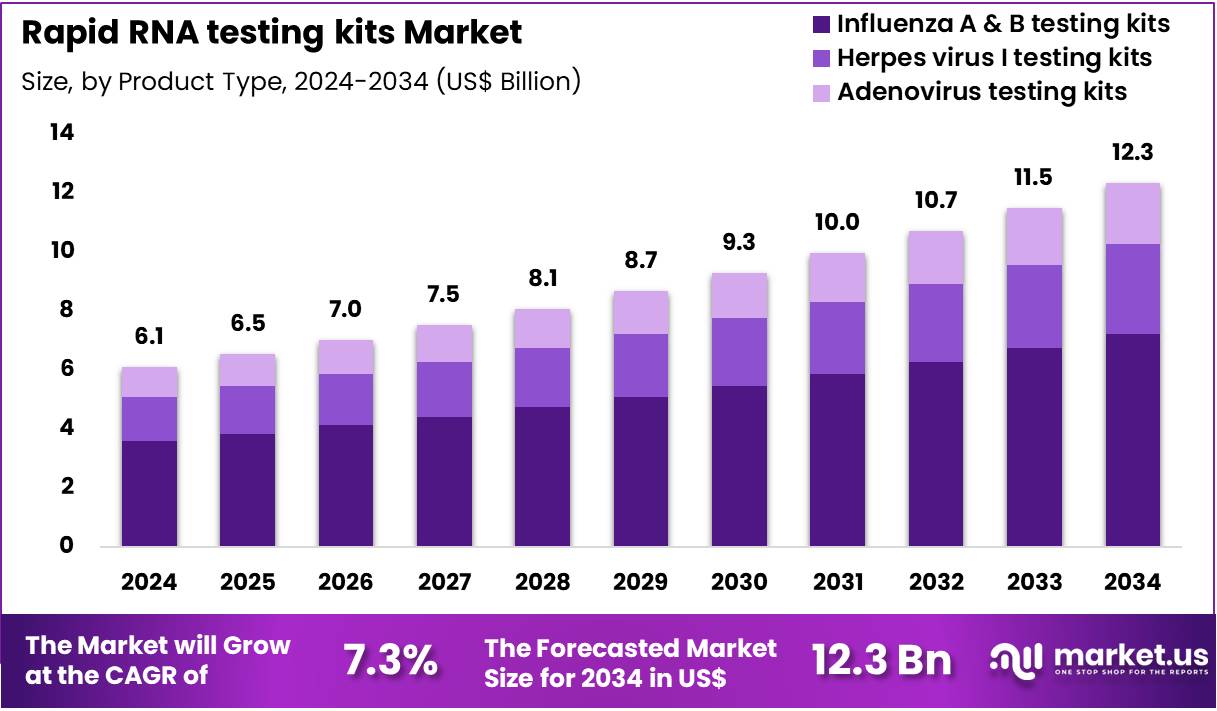
New York, NY – Aug 28, 2026 – The Global Rapid RNA Testing Kits Market size is expected to be worth around US$ 12.3 Billion by 2034, up from US$ 6.1 Billion in 2024, growing at a CAGR of 7.3% during the forecast period of 2025 to 2034. In 2024, North America led the market, achieving over 40.4% share with a revenue of US$ 2.5 Billion.
Rapid RNA testing kits are advanced molecular diagnostic tools designed to detect RNA from viruses and other pathogens within a short time, helping healthcare providers diagnose infectious diseases quickly and accurately. These kits are widely used for detecting respiratory viruses, including influenza, COVID-19, respiratory syncytial virus (RSV), and other emerging viral infections.
Most rapid RNA tests use technologies such as reverse transcription polymerase chain reaction (RT-PCR) or isothermal amplification to deliver results in approximately 15 to 60 minutes, significantly reducing the waiting time compared to conventional laboratory testing.
The growing demand for rapid diagnosis, decentralized healthcare, and point-of-care testing is accelerating the adoption of rapid RNA testing kits worldwide. According to the World Health Organization (WHO), respiratory viruses continue to cause millions of infections annually, highlighting the importance of timely molecular diagnostics. Modern rapid RNA testing platforms can achieve analytical sensitivity above 95% under recommended testing conditions, supporting early treatment decisions and effective infection control.
Healthcare systems, diagnostic laboratories, hospitals, emergency departments, airports, and community clinics are increasingly integrating these kits into routine screening programs. Continuous advancements in portable analyzers, automated sample processing, and multiplex assays capable of detecting 2 to 5 pathogens in a single test are further improving diagnostic efficiency.
As governments continue investing in infectious disease surveillance and laboratory capacity, rapid RNA testing kits are expected to remain a critical component of global public health preparedness and modern molecular diagnostics.
Key Takeaways
- In 2024, the market was valued at US$ 6.1 billion and is projected to reach US$ 12.3 billion by 2034, expanding at a CAGR of 7.3% during the forecast period.
- By product type, the market is segmented into influenza A & B testing kits, herpes virus I testing kits, and adenovirus testing kits. The influenza A & B testing kits segment dominated the market in 2024, accounting for 58.6% of the total share.
- Based on end-user, the market comprises pharmaceutical & biotech companies, academic & research institutions, and diagnostic centres. Among these, pharmaceutical & biotech companies emerged as the leading segment, capturing 49.3% of the market in 2024.
- North America held the largest regional share, contributing 40.4% of the global market revenue in 2024.
Statistical Information
- WHO reported in 2025 that rapid molecular and rapid diagnostic tests can deliver results within 15–30 minutes, enabling decentralized infectious disease testing outside centralized laboratories.
- The WHO’s 2025 accessibility guidance for rapid diagnostic tests spans 127 pages, establishing quantitative usability requirements for professional-use and self-testing diagnostics, including RNA-based rapid tests.
- The FDA-authorized Aptitude Metrix COVID/Flu multiplex molecular RNA test (2025) provides results in approximately 20 minutes, making it one of the fastest FDA-authorized molecular home tests.
- The FDA-cleared Visby Medical OTC molecular RNA test (2026) delivers COVID-19 and Influenza A/B results in 30 minutes.
- Visby Medical’s 2026 molecular RNA assay has a SARS-CoV-2 limit of detection (LoD) of 20 viral copies per swab.
- The same Visby molecular test reports an influenza limit of detection ranging from 90 to 270 viral copies per swab.
- The Aptitude Metrix multiplex molecular RNA test has a reported SARS-CoV-2 analytical sensitivity of 500 genome equivalents (GE) per swab.
- The Aptitude Metrix assay reports influenza detection limits between 1,000 and 2,000 genome equivalents (GE) per swab.
- A 2025 peer-reviewed meta-analysis found FDA-authorized rapid diagnostic tests achieved pooled post-approval sensitivity of 84.5%, while pre-approval sensitivity was 86.5%, representing only a 2.0 percentage-point difference.
- The same 2025 study reported virtually no change in specificity after market authorization, with an absolute difference of 0.0% between pre- and post-approval performance.
Regional Analysis
North America dominated the Rapid RNA Testing Kits Market, accounting for 40.4% of the global market share in 2024. The region benefits from advanced molecular diagnostic infrastructure, strong public health surveillance programs, and widespread adoption of rapid nucleic acid testing in hospitals, emergency departments, and decentralized healthcare settings. Growing investments in point-of-care molecular diagnostics, combined with continued innovation in RNA-based assays by leading manufacturers, have strengthened market growth.
Regulatory support from the U.S. Food and Drug Administration (FDA) for nucleic acid-based diagnostic technologies and government funding for infectious disease preparedness have further accelerated product development and commercialization. Increasing demand for rapid detection of respiratory viruses, including influenza, RSV, and SARS-CoV-2, continues to support market expansion.
Asia Pacific is projected to register the fastest CAGR during the forecast period. Rising healthcare investments, expanding laboratory capacity, and government initiatives to improve infectious disease surveillance are driving demand for rapid RNA testing solutions across China, India, Japan, South Korea, and Southeast Asia.
Regional health authorities are increasing access to molecular diagnostics through public healthcare programs and decentralized testing networks. The World Health Organization also emphasizes expanding access to quality-assured molecular testing to improve viral disease diagnosis, further supporting the adoption of rapid RNA testing technologies across the region.
Emerging Trends
- Growth of home-based molecular RNA testing: Healthcare systems are expanding access to home molecular RNA tests that deliver laboratory-quality results without visiting a clinic. Several FDA-authorized molecular tests now support home sample collection or home use, improving early diagnosis and reducing healthcare burden.
- Increased use of multi-pathogen respiratory panels: Rapid RNA platforms are shifting from single-virus detection to panels that identify 3 or more respiratory viruses in one test, including influenza A, influenza B, RSV, and SARS-CoV-2. This improves diagnostic efficiency and supports appropriate treatment selection.
- Expansion of respiratory surveillance networks: More than 450 public health and clinical laboratories now contribute molecular testing data through the CDC’s National Respiratory and Enteric Virus Surveillance System (NREVSS). This trend is increasing demand for standardized rapid RNA testing across healthcare laboratories.
- Greater adoption in infection prevention programs: Hospitals increasingly use rapid RNA testing before patient placement and isolation decisions. Faster molecular confirmation helps reduce unnecessary isolation, supports antimicrobial stewardship programs, and improves infection-control workflows during respiratory virus seasons.
- Improved virus subtype identification: Modern RNA testing kits can identify influenza A(H1N1)pdm09 and A(H3N2) subtypes alongside routine influenza detection. This enables earlier recognition of circulating strains and strengthens national outbreak monitoring and public health response.
Use Cases
- Screening patients before hospital admission: Hospitals use rapid RNA tests during admission to quickly identify infectious respiratory viruses, helping reduce hospital-acquired infections and improving patient placement decisions while protecting healthcare workers during respiratory virus seasons.
- Long-term care and nursing facilities: Nursing homes use rapid RNA testing to confirm respiratory infections among elderly residents. Early molecular diagnosis enables faster isolation, targeted antiviral treatment, and better outbreak control in high-risk populations.
- Public health laboratory surveillance: Government laboratories use rapid RNA kits to monitor weekly respiratory virus activity. CDC surveillance currently collects molecular testing information from 450+ laboratories, supporting national tracking of influenza, RSV, adenovirus, SARS-CoV-2, and other respiratory pathogens.
- Pediatric respiratory disease diagnosis: Children often present similar symptoms for multiple viral infections. Multiplex RNA testing allows clinicians to detect several respiratory viruses from a single specimen, reducing repeat sampling and improving treatment decisions in pediatric care.
- Seasonal influenza preparedness programs: Healthcare organizations use rapid RNA testing during annual influenza seasons to monitor circulating strains, support vaccination impact assessments, and guide antiviral therapy recommendations, improving preparedness for seasonal respiratory outbreaks.
Frequently Asked Questions on Rapid RNA Testing Kits
- How do rapid RNA testing kits work?
These kits identify specific RNA sequences by extracting genetic material and amplifying the target using molecular techniques. The amplified RNA is then detected through specialized reagents, providing highly accurate results that support early diagnosis and faster clinical decision-making. - Which diseases can rapid RNA testing kits detect?
Rapid RNA testing kits are commonly used to detect influenza, COVID-19, respiratory syncytial virus (RSV), dengue, hepatitis C, and several emerging viral infections. Multiplex assays can simultaneously identify multiple pathogens from a single patient sample, improving diagnostic efficiency. - What factors are driving the rapid RNA testing kits market?
Market growth is supported by increasing infectious disease outbreaks, greater demand for point-of-care diagnostics, government investments in disease surveillance, technological improvements in molecular testing, and expanding healthcare infrastructure that encourages rapid and accurate diagnostic solutions worldwide. - Which region leads the rapid RNA testing kits market?
North America currently leads the rapid RNA testing kits market due to its advanced healthcare infrastructure, high adoption of molecular diagnostics, favorable regulatory environment, substantial research funding, and strong public health programs supporting rapid infectious disease detection. - Who are the major end users of rapid RNA testing kits?
Hospitals, diagnostic laboratories, clinics, and public health agencies are the primary users of rapid RNA testing kits. Demand is also increasing in decentralized healthcare facilities and emergency care settings where quick diagnosis improves patient management and outbreak response. - What technological trends are shaping the rapid RNA testing kits market?
The market is advancing through multiplex molecular assays, portable point-of-care devices, automated sample preparation, cartridge-based platforms, AI-assisted result interpretation, and cloud-connected diagnostic systems that improve testing speed, accuracy, and workflow efficiency across healthcare settings. - What is the future outlook for the rapid RNA testing kits market?
The market is expected to grow steadily as healthcare systems prioritize rapid diagnostics, pandemic preparedness, decentralized testing, and molecular innovation. Continued investments in research, automation, and portable testing technologies are likely to expand adoption across clinical and public health applications.
Conclusion
The Rapid RNA Testing Kits market is expected to witness steady growth over the coming decade, driven by the increasing demand for fast, accurate, and decentralized molecular diagnostics for infectious diseases. Rising adoption of point-of-care testing, continuous advancements in isothermal amplification technologies, and expanding applications in pharmaceutical research and clinical diagnostics are strengthening market expansion.
North America remains the leading regional market due to its advanced healthcare infrastructure and strong diagnostic capabilities. Meanwhile, increasing investments in healthcare systems, disease surveillance programs, and rapid testing technologies across emerging economies are expected to create significant growth opportunities.
As healthcare providers continue to prioritize early disease detection and timely treatment decisions, rapid RNA testing kits will play an increasingly important role in improving patient outcomes and supporting global public health preparedness.
Discuss your needs with our analyst
Please share your requirements with more details so our analyst can check if they can solve your problem(s)




