


Overview
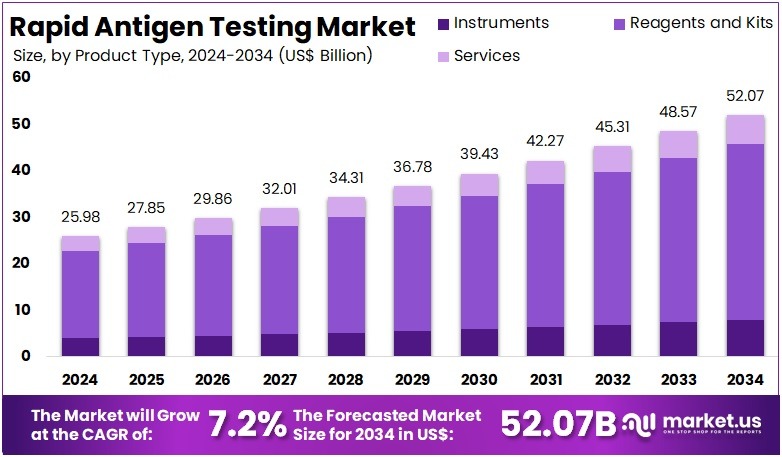
New York, NY – Sep 02, 2026 – The Rapid Antigen Testing Market Size is expected to be worth around US$ 52.07 Billion by 2034 from US$ 25.98 Billion in 2024, growing at a CAGR of 7.2% during the forecast period 2025 to 2034. North America held a dominant market position, capturing more than a 34.8% share and holds US$ 9.04 Billion market value for the year.
The global Rapid Antigen Testing market is witnessing strong demand due to the growing need for fast, affordable, and decentralized diagnostic solutions. Rapid antigen tests typically deliver results within 10–30 minutes and achieve diagnostic accuracy levels exceeding 90% for many symptomatic infections when used according to manufacturer instructions.
More than 1,000 rapid antigen diagnostic products have been developed worldwide for infectious disease detection, with applications extending beyond COVID-19 to influenza, RSV, strep throat, dengue, malaria, and other viral and bacterial infections.
These tests are widely used in hospitals, diagnostic laboratories, physician offices, pharmacies, airports, schools, workplaces, and home-care settings. Point-of-care testing now accounts for a significant share of infectious disease diagnostics, helping reduce laboratory turnaround time from 24–48 hours to less than 30 minutes.
The market is also benefiting from multiplex testing technologies that can detect 2–4 respiratory pathogens using a single sample, improving clinical efficiency. Governments continue to invest billions of dollars in pandemic preparedness, disease surveillance, and diagnostic infrastructure, encouraging the adoption of rapid testing platforms.
Increasing healthcare expenditure, expanding access to self-testing kits, and technological advancements in lateral flow immunoassays are further accelerating market growth. Industry estimates indicate that the global rapid antigen testing market is projected to grow at a high single-digit CAGR through 2034, supported by rising infectious disease incidence, expanding point-of-care healthcare services, and continuous product innovation.
Growing manufacturing capacity, stronger distribution networks, and increased diagnostic accessibility are expected to support millions of rapid tests performed annually across both developed and emerging healthcare markets.
Key Takeaways
- In 2024, the global Rapid Antigen Testing market was valued at US$ 98 billion and is projected to reach US$ 52.07 billion by 2034, expanding at a CAGR of 7.2% during the forecast period.
- By Product Type, the market is segmented into Instruments, Reagents and Kits, and Services. Among these, Reagents and Kits dominated the market in 2024, accounting for 72.8% of the total market share.
- By Technology, the market is categorized into Lateral Flow Immunoassays (LFA), Fluorescence Immunoassays (FIA), Chemiluminescence Immunoassays (CLIA), and Others. Lateral Flow Immunoassays (LFA) emerged as the leading technology, capturing 58.3% of the market share in 2024.
- By Application, the market is classified into Infectious Diseases, Sexually Transmitted Infections, and Others. Infectious Diseases represented the largest segment, holding 79.5% of the market share in 2024.
- By End User, the market is divided into Hospitals & Clinics, Diagnostic Laboratories & Reference Centres, Home Care, and Others. Hospitals & Clinics led the segment with a 34.7% market share in 2024.
- North America held the dominant regional position in 2024, accounting for 34.8% of the global Rapid Antigen Testing market.
Market segmentation
- Product Type Analysis: Reagents and kits dominated the rapid antigen testing market with a 72.8% share in 2024 due to their widespread use in point-of-care, laboratory, and home testing. Their affordability, single-use design, rapid 5–20-minute results, and broad infectious disease applications continue driving consistent global demand.
- Technology Analysis: Lateral Flow Immunoassays (LFA) accounted for 58.3% of the market in 2024 because they deliver rapid, low-cost results with minimal equipment. Their portability and ease of use support mass screening, home diagnostics, community healthcare programs, emergency settings, and resource-limited environments worldwide.
- Application Analysis: Infectious diseases remained the leading application segment in 2024, driven by extensive testing for COVID-19, influenza, RSV, dengue, malaria, and streptococcal infections. Rapid antigen tests enable early diagnosis, prompt treatment decisions, outbreak control, and effective public health surveillance across healthcare systems.
- End-User Analysis: Hospitals and clinics captured the largest 34.7% market share in 2024, supported by increasing demand for rapid patient triage, emergency diagnostics, and point-of-care testing. Growing adoption of home-based self-testing and laboratory screening further strengthens utilization across diverse healthcare settings.
Statistical Information
- WHO-prequalified rapid antigen tests provide results within 15–30 minutes, enabling decentralized testing outside laboratories in 2025.
- A 2025 peer-reviewed systematic review reported an average rapid antigen test specificity of 99.4% across evaluated studies.
- The same 2025 review reported an average specificity of 99.6% for another evaluated testing group, confirming consistently low false-positive rates.
- When used for screening, pooled rapid antigen test sensitivity ranged from 40.6% to 42.1%, depending on the screening setting.
- Among asymptomatic people tested at COVID-19 testing centres, pooled sensitivity reached 56.7%.
- In emergency department evaluations, pooled rapid antigen test sensitivity was 54.7%.
- Across 14 commercially available rapid antigen assays evaluated in 2025, brand-specific sensitivity ranged from 36.3% to 78.8% when manufacturer instructions were followed.
- The review found that all but four evaluated assays achieved the WHO minimum acceptable specificity criterion of 97%.
- In December 2025, WHO granted prequalification to 2 SARS-CoV-2 rapid antigen diagnostic tests, marking the first WHO-prequalified rapid antigen tests for COVID-19.
Regional Analysis
North America Dominates the Rapid Antigen Testing Market
North America accounted for the largest share of the Rapid Antigen Testing market in 2024, supported by advanced healthcare infrastructure, widespread access to diagnostic services, and strong public health surveillance systems. The United States continues to lead regional demand due to the extensive use of point-of-care testing in hospitals, clinics, pharmacies, and home-care settings.
According to the U.S. Centers for Disease Control and Prevention (CDC), seasonal respiratory viruses such as influenza, COVID-19, and RSV continue to create significant demand for rapid diagnostic tools. The region also benefits from high healthcare spending, favorable regulatory pathways through the U.S. Food and Drug Administration (FDA), and continued innovation by leading diagnostic manufacturers.
Canada complements regional growth through national preparedness programs and investments in decentralized testing. Increasing adoption of multiplex rapid antigen assays, digital readers, and self-testing kits further strengthens the market. Strong reimbursement systems, established distribution networks, and ongoing infectious disease monitoring continue to reinforce North America’s market leadership.
Asia Pacific is Expected to Register the Fastest Growth
Asia Pacific is projected to record the fastest growth in the Rapid Antigen Testing market due to its large population, rising infectious disease burden, and expanding healthcare infrastructure. Countries including China, India, Japan, and South Korea are investing heavily in point-of-care diagnostics to improve early disease detection and reduce pressure on centralized laboratories.
According to the World Health Organization (WHO), the region continues to experience a high number of dengue, influenza, and other infectious disease cases, supporting greater adoption of rapid antigen tests. Expanding healthcare coverage, government disease surveillance programs, and increasing awareness of early diagnosis are further accelerating market growth.
The growing availability of self-testing kits through pharmacies and e-commerce platforms is also boosting accessibility, particularly in urban and semi-urban areas. Continuous investments in local diagnostic manufacturing, digital healthcare, and laboratory modernization are expected to support sustained regional expansion throughout the forecast period.
Business opportunities
The Rapid Antigen Testing market offers significant business opportunities as healthcare providers increasingly adopt fast, affordable, and decentralized diagnostic solutions. Rising demand for home-based self-testing, multiplex antigen assays capable of detecting multiple pathogens from a single sample, and digital point-of-care platforms is creating new revenue streams for manufacturers.
Companies can expand their presence by developing AI-enabled readers, smartphone-connected testing solutions, and cloud-based reporting systems that improve diagnostic accuracy and support real-time disease surveillance.
Emerging economies in Asia Pacific, Latin America, and Africa present substantial growth potential due to expanding healthcare infrastructure, increasing government investments in infectious disease control, and wider access to diagnostic services. Opportunities are also growing through long-term government procurement programs, hospital partnerships, pharmacy-based testing, and telehealth integration.
In addition, expanding applications in veterinary diagnostics, workplace screening, travel health, and food safety testing enable companies to diversify their product portfolios while strengthening recurring demand for rapid antigen testing solutions.
Emerging Trends
- WHO Quality Assurance is Expanding Global Adoption: In December 2025, the WHO prequalified its first two SARS-CoV-2 rapid antigen tests, making them eligible for procurement by UN agencies and supporting wider access to quality-assured diagnostics, particularly in low- and middle-income countries.
- Rapid Results Continue to Drive Point-of-Care Testing: Modern rapid antigen tests deliver results in 15–30 minutes, allowing testing in clinics, pharmacies, community health centers, and mobile settings without centralized laboratories. This trend is expanding decentralized healthcare and improving outbreak response capabilities.
- Self-Testing is Becoming More Accessible: The CDC states that home antigen tests provide results in 10–15 minutes, making self-testing easier for patients. Growing consumer demand for convenient diagnostics continues to support adoption of over-the-counter rapid antigen testing.
- Continuous Regulatory Approvals are Supporting Innovation: The U.S. FDA granted multiple 510(k) clearances during 2025 for new over-the-counter COVID-19 rapid antigen self-tests, highlighting continued product innovation and expansion of consumer diagnostic options.
- Decentralized Testing is Strengthening Public Health Preparedness: WHO emphasizes that rapid antigen tests support outbreak detection, healthcare worker protection, and pandemic preparedness because they are affordable, portable, and usable outside laboratories, improving healthcare access in resource-limited settings
Use Cases
- Respiratory Virus Screening in Healthcare Facilities: The CDC recommends rapid antigen tests for respiratory viruses because they provide results within 15–30 minutes, helping clinicians begin treatment earlier and reduce disease transmission in hospitals, urgent care centers, and outpatient clinics.
- Home-Based Disease Detection: Rapid antigen self-tests enable individuals to detect infections at home within 10–15 minutes, reducing unnecessary clinic visits and allowing quicker isolation and treatment decisions when respiratory symptoms appear.
- Community and Mobile Health Programs: WHO recommends rapid antigen tests for community outreach and mobile healthcare because they require no complex laboratory infrastructure and produce results in 15–30 minutes, making them suitable for remote and underserved populations.
- Public Health Surveillance and Outbreak Control: Rapid antigen tests are increasingly used for early outbreak detection and infection monitoring. WHO notes that decentralized testing improves surveillance by enabling faster identification of infectious cases and timely public health interventions.
- Workplace and School Screening Programs: Rapid antigen testing supports routine screening in workplaces and educational institutions because results are available in 15–30 minutes, allowing organizations to quickly identify infectious individuals and maintain safer environments during respiratory virus seasons.
Recent Development
- In February 2025, Thermo Fisher Scientific announced the acquisition of Solventum’s Purification & Filtration business for approximately US$4.1 billion, strengthening its bioprocessing and diagnostics capabilities that support infectious disease testing workflows.
- In October 2025, Thermo Fisher Scientific announced an agreement to acquire Clario Holdings for approximately US$8.9 billion, enhancing its clinical research and diagnostic data solutions portfolio.
- In April 2026, QuidelOrtho completed the acquisition of LEX Diagnostics for approximately US$100 million, adding an ultra-fast molecular point-of-care platform that complements rapid antigen testing with near-patient PCR capabilities.
Frequently Asked Questions on the Rapid Antigen Testing
- How does the Rapid Antigen Testing Market support healthcare?
The rapid antigen testing market supplies easy-to-use diagnostic kits that help healthcare providers identify infectious diseases quickly. Rising demand for decentralized testing, improved healthcare access, and the need for faster clinical decisions continue to drive market growth across developed and emerging healthcare systems. - What factors are driving the Rapid Antigen Testing Market?
Growing awareness of infectious disease surveillance, increasing demand for point-of-care diagnostics, expanding government preparedness programs, and technological improvements in diagnostic devices are major growth drivers. The market also benefits from increased investments in healthcare infrastructure and rapid response capabilities during disease outbreaks. - What are the advantages of rapid antigen testing?
Rapid antigen tests provide results within minutes, require minimal laboratory infrastructure, are simple to perform, and are generally more affordable than many molecular diagnostic methods. These benefits make them suitable for emergency care, community screening, travel, educational institutions, and remote healthcare settings. - Which end-use sectors contribute most to the Rapid Antigen Testing Market?
Hospitals, diagnostic laboratories, physician clinics, pharmacies, home healthcare, educational institutions, workplaces, airports, and public health agencies represent major end users. Their increasing focus on early disease detection and infection prevention continues to support sustained demand for rapid antigen testing products. - Which regions are leading the Rapid Antigen Testing Market?
North America remains a leading regional market because of advanced healthcare infrastructure, high diagnostic adoption, supportive regulatory systems, and strong public health programs. Europe and the Asia-Pacific are also experiencing significant growth due to increasing healthcare investments and expanded infectious disease monitoring initiatives. - How is technology improving rapid antigen testing?
Manufacturers are introducing digital readers, smartphone-enabled interpretation, multiplex testing, AI-assisted result analysis, and improved assay sensitivity. These innovations enhance diagnostic accuracy, reduce interpretation errors, enable electronic reporting, and improve patient management across clinical and decentralized healthcare environments.
Conclusion
The rapid antigen testing market continues to play a vital role in modern healthcare by enabling fast, affordable, and accessible diagnosis of infectious diseases. Growing demand for point-of-care testing, increasing awareness of early disease detection, and continuous improvements in test sensitivity and digital integration are supporting long-term market expansion.
The adoption of multiplex assays, home-based testing, and connected diagnostic platforms is further broadening the market’s applications beyond COVID-19 to influenza, RSV, dengue, and other infectious diseases.
With strong support from healthcare systems and public health programs, the market is expected to witness steady growth through 2034, driven by innovation, decentralized healthcare delivery, and expanding global disease surveillance initiatives.
Discuss your needs with our analyst
Please share your requirements with more details so our analyst can check if they can solve your problem(s)




