


Overview
New York, NY – Sep 10, 2026 – The Global Radial Compression Devices Market size is expected to be worth around US$ 438.0 Million by 2034 from US$ 214.5 Million in 2024, growing at a CAGR of 7.4% during the forecast period 2025 to 2034. In 2024, North America led the market, achieving over 39.6% share with a revenue of US$ 84.9 Million.
The global Radial Compression Devices Market is experiencing consistent growth, supported by the increasing adoption of transradial access for cardiovascular procedures and continuous innovation in hemostasis technologies.
In 2024, the market was valued at approximately USD 620 million and is projected to reach around USD 1.15 billion by 2034, expanding at a compound annual growth rate (CAGR) of 6.4% during the forecast period. The growing preference for minimally invasive cardiac interventions and improved patient outcomes is driving demand for radial compression devices across hospitals and specialty cardiac centers worldwide.
The market is closely linked to the rising burden of cardiovascular diseases (CVDs). According to the World Health Organization (WHO), nearly 17.9 million people die each year from CVDs, representing about 32% of all global deaths.
Clinical evidence also shows that transradial access reduces major bleeding complications by up to 50% compared with femoral access, while more than 70% of percutaneous coronary intervention (PCI) procedures in many developed healthcare systems are now performed through the radial artery. Furthermore, over 7 million coronary angiography and PCI procedures are conducted globally each year, creating sustained demand for effective radial compression solutions.
North America accounts for nearly 38% of the global market, driven by high procedure volumes and advanced healthcare infrastructure, while the Asia-Pacific region is projected to register the fastest growth due to increasing healthcare expenditure, expanding catheterization laboratories, and a rapidly aging population. These factors are expected to create significant opportunities for manufacturers over the next decade.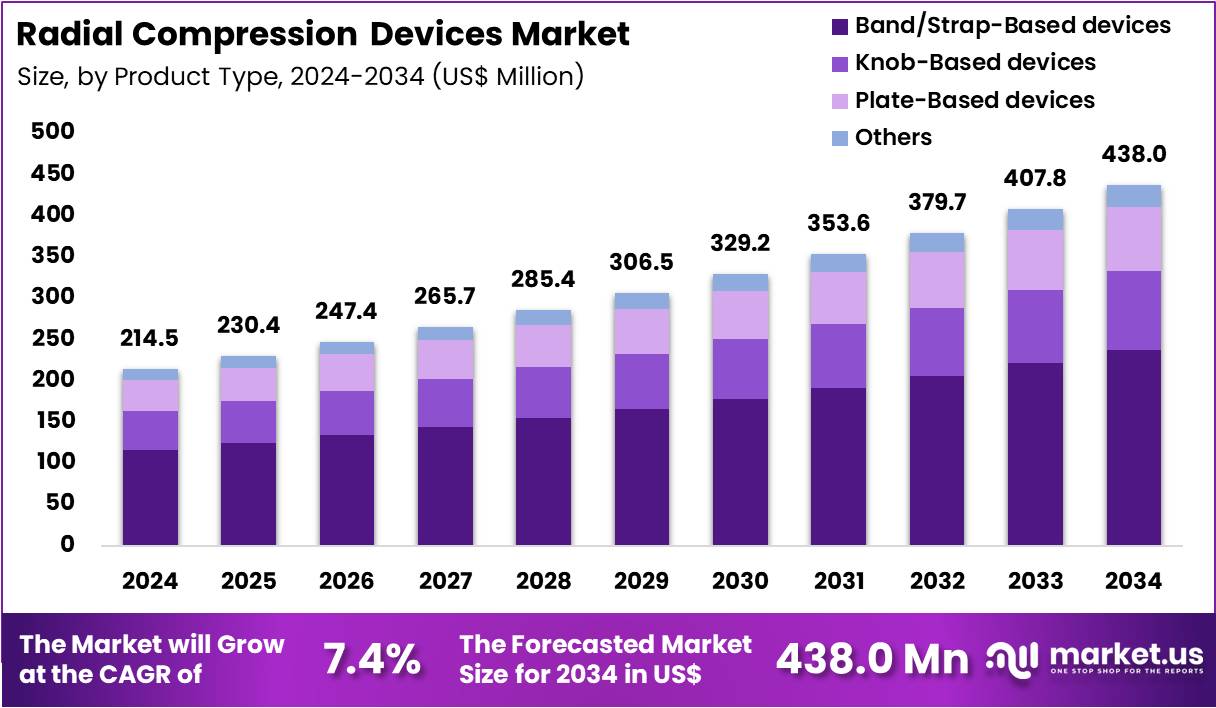
Key Takeaways
- In 2024, the global Radial Compression Devices Market generated US$ 214.5 million in revenue and is projected to reach US$ 438.0 million by 2034, growing at a CAGR of 7.4% during the forecast period.
- By Product Type, the market is segmented into Band/Strap-Based Devices, Knob-Based Devices, Plate-Based Devices, and Others. Band/Strap-Based Devices dominated the segment in 2024, accounting for 54.2% of the total market share.
- Based on Usage, the market is categorized into Disposable and Reusable devices. The Disposable segment held the largest share, capturing 77.5% of the market in 2024.
- By End User, the market is segmented into Hospitals, Independent Catheterization Laboratories, Ambulatory Surgical Centers, and Specialized Clinics. Hospitals emerged as the leading end-user segment, holding 43.1% of the market share in 2024.
- North America was the leading regional market in 2024, accounting for 39.6% of the global Radial Compression Devices Market share.
Statistical Information
- Rising Burden of Cardiovascular Diseases is Increasing Demand for Radial Procedures: Cardiovascular disease (CVD) remains the leading cause of death worldwide, causing approximately 17.9 million deaths every year, representing 32% of all global deaths. The growing number of coronary angiography and PCI procedures has directly increased the need for reliable radial compression devices to achieve hemostasis after transradial access.
- Radial Access is Rapidly Replacing Femoral Access in PCI Procedures: According to the American College of Cardiology analysis of the U.S. National Cardiovascular Data Registry (CathPCI Registry), radial access use in PCI increased from 20% in 2013 to 58% in 2022 across 6.65 million PCI procedures. Radial access was associated with lower in-hospital mortality, fewer major bleeding events, and fewer vascular complications than femoral access.
- Radial Artery Occlusion Can Be Reduced with Proper Compression: Clinical research involving 400 patients found that shortening compression time from 6 hours to 2 hours reduced early radial artery occlusion from 12% to 5.5% and chronic occlusion from 8.5% to 3.5%, without increasing bleeding complications.
- FDA MAUDE Database Highlights Importance of Reliable Compression Devices: An analysis of the U.S. FDA MAUDE database reviewed 372 adverse event reports involving transradial compression devices. Among reported patient injuries, 39.2% involved bleeding, 12.9% hematoma, and 59% of device leaks were caused by air leakage, demonstrating the importance of device quality and proper use.
- Global Survey Shows TR Band is the Preferred Hemostasis Device: An international survey published in the Journal of the American College of Cardiology found that the TR Band was the most frequently used radial compression device in the United States (54.4%) and Japan (69.8%), reflecting strong physician preference for dedicated radial hemostasis systems.
- Long-Term Clinical Trial Demonstrates Low Complication Rates: The RadCom randomized clinical trial reported a 5% radial artery occlusion rate at 90 days, 7% bleeding incidence, and 4% hematoma occurrence following transradial procedures, confirming that modern radial compression devices provide safe and effective hemostasis.
- Company-Sponsored Clinical Data Supports Radial Access Safety: Terumo-sponsored clinical data reported a 93.3% primary efficacy rate for radial-to-peripheral interventions. At 30-day follow-up, radial artery occlusion was 2.8%, while only seven access-site complications were observed, supporting the safety of radial compression technologies.
- Radial Artery Occlusion Falls Naturally After Follow-Up: A systematic review covering 66 studies and 31,345 patients found that radial artery occlusion (RAO) occurred in 7.7% of patients within the first 2b4 hours, decreasing to 5.5% after one week or longer. The review also showed that shorter compression times and higher-dose heparin significantly reduced RAO risk.
- TR Band Was the Most Frequently Used Compression Device in the U.S.: An international physician survey found that TR Band (Terumo) was used by 54.4% of U.S. operators and 69.8% of Japanese operators, making it the most commonly used dedicated radial compression device in those countries.
Regional Analysis
North America led the market by securing a market share of 39.6% in 2024.
North America accounted for 39.6% of the global Radial Compression Devices Market in 2024, driven by its advanced cardiovascular care infrastructure, widespread adoption of transradial access, and high volume of coronary interventions.
According to the Centers for Disease Control and Prevention (CDC), heart disease caused approximately 702,880 deaths in the United States in 2022, sustaining demand for diagnostic angiography and percutaneous coronary intervention (PCI).
The American College of Cardiology (ACC) supports radial artery access as the preferred approach for many PCI procedures because it lowers bleeding complications and improves patient outcomes.
Asia-Pacific is expected to register the fastest CAGR during the forecast period due to rising cardiovascular disease prevalence, expanding catheterization laboratories, and growing healthcare investments.
Countries including China, Japan, and South Korea continue to increase the adoption of transradial interventions, while regional manufacturers and expanding physician training programs improve access to advanced radial compression devices. These factors are expected to accelerate market growth across the region.
Emerging Trends
- Growing Adoption of Radial-First Procedures: Hospitals are increasingly adopting radial artery access for coronary angiography and PCI because it reduces bleeding and speeds patient recovery. Studies covering 31,345 patients reported radial artery occlusion of 7.7% within 24 hours, falling to 5.5% after one week with improved hemostasis techniques.
- Focus on Patent Hemostasis Technology: Manufacturers are introducing compression devices that maintain blood flow while achieving hemostasis. Research involving 400 patients showed reducing compression time from 6 hours to 2 hours lowered early radial artery occlusion from 12% to 5.5% without increasing bleeding complications.
- Regulatory Support for Advanced Compression Devices: The U.S. FDA continues clearing new radial compression devices for temporary hemostasis after transradial procedures, encouraging innovation in adjustable pressure systems, ergonomic designs, and patient safety features for hospitals and catheterization laboratories.
- Increasing Use of Ultrasound-Based Follow-Up: Healthcare providers are increasingly using Doppler ultrasound to confirm radial artery patency after procedures. A prospective study of 2,004 patients reported a 4.6% incidence of radial artery occlusion, supporting better post-procedure monitoring and early intervention.
- Shift Toward Distal Radial Access: Cardiology centers are increasingly adopting distal radial access because it helps preserve the main radial artery and lowers access-site complications. Clinical reviews indicate this approach may further reduce radial artery occlusion while maintaining procedural safety and patient comfort.
Use Cases
- Hemostasis After Coronary Angiography: Radial compression devices are widely used after diagnostic coronary angiography to stop bleeding safely. Clinical evidence shows transradial access reduces vascular complications compared with femoral access while allowing patients to recover and walk sooner after the procedure.
- Post-PCI Bleeding Management: Hospitals routinely use radial compression devices after percutaneous coronary intervention (PCI). Clinical studies involving 400 patients found optimized compression significantly reduced radial artery occlusion while maintaining effective bleeding control and minimizing hematoma formation.
- Day-Care Cardiac Procedures: Radial compression devices support same-day discharge by enabling rapid hemostasis and early ambulation. Their ease of application helps hospitals improve patient flow, reduce hospital stay, and enhance procedural efficiency following minimally invasive cardiac interventions.
- Use in Interventional Radiology: Interventional radiology departments use radial compression devices after arterial catheterization to control bleeding and protect vascular access. FDA-cleared devices are specifically indicated for temporary radial artery hemostasis following percutaneous transradial procedures.
- Preserving Future Radial Artery Access: Radial compression devices using patent hemostasis techniques help preserve radial artery function for future cardiac procedures or bypass grafting. A meta-analysis of 66 studies involving 31,345 patients supports shorter compression and optimized anticoagulation to lower occlusion rates.
Frequently Asked Questions on Radial Compression Devices
- Which product type holds the largest market share?
Band/strap-based radial compression devices lead the market because they provide effective pressure control, are easy to use, improve patient comfort, and are widely adopted by hospitals and catheterization laboratories for post-procedure hemostasis. - Why do disposable radial compression devices dominate the market?
Disposable devices dominate because they reduce infection risks, eliminate sterilization requirements, support hospital infection-control policies, and provide reliable single-use performance, making them the preferred option in high-volume healthcare facilities. - Which end-user segment contributes the highest market revenue?
Hospitals account for the largest market share because they perform the majority of coronary angiography and PCI procedures while maintaining advanced catheterization laboratories and specialized cardiovascular teams that require reliable radial compression devices. - Why does North America lead the Radial Compression Devices Market?
North America dominates due to advanced healthcare infrastructure, widespread adoption of radial-first procedures, strong reimbursement systems, high cardiovascular procedure volumes, and the presence of leading medical device manufacturers. - Why is Asia-Pacific expected to witness the fastest market growth?
Asia-Pacific is projected to grow rapidly because of increasing cardiovascular disease cases, expanding healthcare infrastructure, rising investments in catheterization laboratories, and greater adoption of minimally invasive cardiac procedures across the region. - How is technology influencing the Radial Compression Devices Market?
Technology is improving device performance through better pressure adjustment mechanisms, enhanced patient comfort, transparent monitoring designs, and innovations that reduce complications while maintaining effective hemostasis after radial procedures.
Conclusion
The Radial Compression Devices Market is poised for sustained growth as healthcare providers increasingly adopt transradial access for cardiovascular procedures due to its clinical and economic advantages. Rising cardiovascular disease prevalence, expanding catheterization laboratories, and growing demand for minimally invasive interventions continue to support market expansion.
Technological innovations, including patent hemostasis systems and ergonomic compression devices, are improving patient safety and procedural outcomes. North America remains the leading regional market because of its advanced healthcare infrastructure, while Asia-Pacific is expected to witness the fastest growth.
Continued product innovation, favorable clinical guidelines, and increasing procedural volumes are expected to create significant opportunities for market participants over the coming decade.
Discuss your needs with our analyst
Please share your requirements with more details so our analyst can check if they can solve your problem(s)




