
Overview
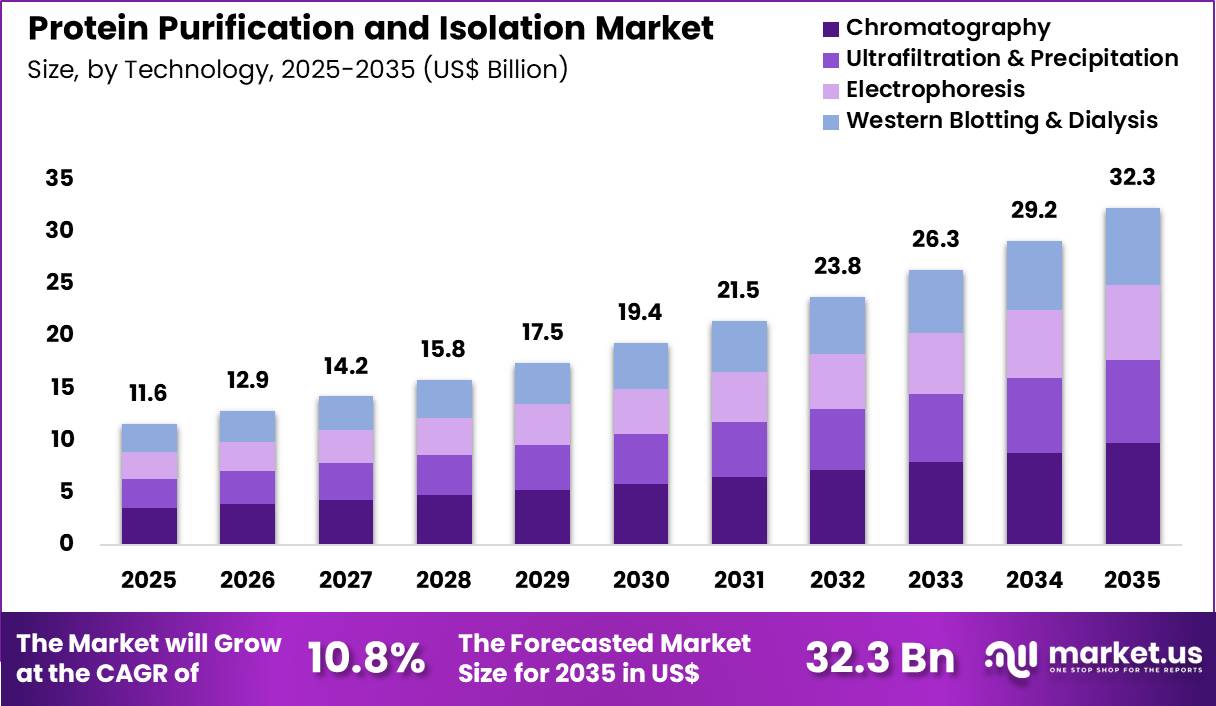
New York, NY – Nov 04 2026 – The Global Protein Purification and Isolation Market size is expected to be worth around US$ 32.3 billion by 2035 from US$ 11.6 billion in 2025, growing at a CAGR of 10.8% during the forecast period 2026-2035. In 2025, North America led the market, achieving over 38.3% share with a revenue of US$ 4.4 Billion.
Protein purification and isolation are essential processes in biotechnology, pharmaceutical research, and life sciences. These techniques involve separating specific proteins from complex biological mixtures such as cells, tissues, blood, and microorganisms. The primary objective is to obtain highly purified proteins while maintaining their natural structure, biological activity, and functional properties.
Protein purification plays an important role in drug development, vaccine production, enzyme manufacturing, diagnostic testing, and biomedical research. Common techniques include chromatography, filtration, centrifugation, precipitation, electrophoresis, and membrane-based separation. These methods help researchers isolate target proteins based on their size, charge, solubility, and binding properties.
Growing demand for biopharmaceuticals, monoclonal antibodies, recombinant proteins, and advanced therapeutic products is increasing the importance of efficient purification technologies. Pharmaceutical and biotechnology companies are investing in advanced purification systems to improve product quality, increase processing efficiency, and reduce manufacturing costs.
Additionally, advancements in automated purification equipment, single-use technologies, and high-performance chromatography are supporting the development of scalable and reliable protein processing solutions. Increasing research activities in genomics, proteomics, and personalized medicine are also creating new opportunities for protein purification and isolation technologies.
Key Takeaways
- In 2025, the Protein Purification and Isolation Market recorded revenue of US$ 11.6 Billion and is projected to reach US$ 32.3 Billion by 2035, expanding at a CAGR of 10.8% during the forecast period.
- By product, the market is categorized into instruments and consumables, with consumables dominating the segment with a 63.4% market share.
- Based on technology, the market includes ultrafiltration and precipitation, chromatography, electrophoresis, and western blotting and dialysis. Among these, chromatography accounted for a significant market share of 30.1%.
- By application, the market is segmented into drug screening, biomarker discovery, protein-protein interaction studies, and diagnostics. Protein-protein interaction studies emerged as the leading segment, capturing a 31.7% revenue share.
- Based on end users, the market is classified into academic and research institutes, pharmaceutical and biotechnology companies, hospitals, and CROs and clinical laboratories. Academic and research institutes dominated with a 38.5% revenue share.
- Regionally, North America dominated the Protein Purification and Isolation Market, accounting for a 38.3% market share.
Key Market Segments
- Product Analysis: Consumables dominated the product segment with a 63.4% market share, driven by their regular use in protein extraction and purification procedures. Laboratories require resins, columns, buffers, filtration units, and purification kits for ongoing research activities. Growing proteomics studies, increasing laboratory investments, and demand for reliable experimental results continue to support consumables adoption.
- Technology Analysis: Chromatography led the technology segment with a 30.1% market share, supported by its accuracy and effectiveness in separating complex protein mixtures. Techniques such as affinity, ion exchange, and size exclusion chromatography are widely used in research and biopharmaceutical production. Rising biologics development and demand for high-purity proteins further strengthen segment growth.
- Application Analysis: Protein-protein interaction studies dominated the application segment with a 31.7% market share, driven by growing research into cellular functions, disease mechanisms, and molecular pathways. Scientists use purified proteins to investigate biological interactions and identify potential drug targets. Increasing investments in drug discovery, structural biology, and precision medicine continue to support demand.
- End-User Analysis: Academic and research institutes accounted for the largest end-user share of 38.5%, supported by extensive research activities in molecular biology, proteomics, and cellular science. Universities and research centers regularly use purification technologies for laboratory experiments. Government funding, academic collaborations, and expanding life science programs further strengthen demand across research institutions.
Regional Analysis
North America is leading the Protein Purification and Isolation Market
North America accounted for 38.3% of the Protein Purification and Isolation Market in 2024, driven by strong biopharmaceutical research, advanced healthcare infrastructure, and growing biologics development. Increasing production of monoclonal antibodies and recombinant proteins strengthened demand for chromatography resins and filtration systems.
Additionally, expanding proteomics research, academic collaborations, and investments in automated purification technologies supported regional growth. The National Institutes of Health reported a fiscal year 2023 budget of USD 47.5 billion, highlighting strong federal support for biomedical research.
Asia Pacific is expected to register the highest CAGR during the forecast period
Asia Pacific is projected to experience the fastest growth, supported by expanding biotechnology industries, increasing research funding, and rising biologics manufacturing.
Government initiatives promoting domestic pharmaceutical production are encouraging investments in purification technologies. Growing research activities in universities and laboratories are further increasing demand for advanced separation systems. Additionally, biosimilar development, affordable purification solutions, and international research collaborations are creating significant growth opportunities across the region.
Emerging Trends
- Increasing Adoption of Continuous Purification Technologies: Biopharmaceutical manufacturers are increasingly exploring continuous purification processes to improve production efficiency. These technologies allow proteins to move through multiple purification stages with fewer interruptions, helping manufacturers improve productivity, reduce processing time, and maintain consistent product quality.
- Growing Demand for Single-Use Purification Systems: Single-use purification technologies are gaining attention because they reduce cleaning requirements and support flexible manufacturing operations. Disposable filtration units, chromatography components, and processing bags help facilities reduce equipment preparation time and manage different biological products more efficiently.
- Advancements in High-Resolution Protein Characterization: Research laboratories are adopting advanced analytical techniques to understand protein structure, purity, and stability. Improved characterization methods help identify impurities, protein variations, and structural changes, supporting better quality assessment during pharmaceutical development and manufacturing.
- Integration of Automated and Digital Processing Technologies: Automation and digital monitoring are becoming important in protein purification workflows. Modern systems help researchers control processing conditions, monitor purification steps, and reduce manual handling. These improvements support reproducibility, operational efficiency, and better control over manufacturing processes.
- Rising Focus on High-Purity Biologics Manufacturing: The growing development of monoclonal antibodies, recombinant proteins, and other biological medicines is increasing demand for advanced purification methods. Manufacturers are improving filtration, chromatography, and impurity removal processes to achieve required protein purity, safety, and product consistency.
Use Cases
- Monoclonal Antibody Production: Protein purification is widely used in monoclonal antibody manufacturing to separate target antibodies from unwanted biological materials. Chromatography and filtration help remove impurities and improve product quality, supporting the production of antibody-based medicines used in cancer treatment and immune-related diseases.
- Vaccine and Therapeutic Protein Development: Pharmaceutical researchers use protein isolation techniques to obtain purified biological components required for vaccine and therapeutic development. These methods help separate target proteins from production materials and support product testing, formulation, and manufacturing quality requirements.
- Biomarker Discovery and Disease Research: Researchers isolate proteins from biological samples to identify biomarkers associated with diseases. These proteins help scientists investigate disease-related changes and understand biological processes, supporting research into cancer, neurological disorders, and other health conditions.
- Structural Biology and Protein Interaction Studies: Purified proteins are essential for studying molecular structures and interactions between biological molecules. Research institutes use isolated proteins for crystallography, structural analysis, and protein interaction experiments to understand cellular functions and identify potential therapeutic targets.
- Recombinant Protein Production: Biotechnology companies use purification technologies to recover recombinant proteins produced through genetically engineered microorganisms or mammalian cells. These purified proteins are used in laboratory research, diagnostic development, enzyme production, and the manufacturing of therapeutic products.
Frequently Asked Questions About Protein Purification and Isolation
- What are the common methods of protein purification?
Common protein purification methods include chromatography, ultrafiltration, precipitation, centrifugation, electrophoresis, and dialysis. Researchers select suitable techniques based on protein characteristics, sample composition, required purity levels, and intended applications. - Which industries use protein purification and isolation technologies?
Pharmaceutical, biotechnology, healthcare, academic research, and diagnostic industries widely use protein purification technologies. These solutions support drug discovery, vaccine development, biomarker research, recombinant protein production, and advanced biological investigations. - What factors affect protein purification efficiency?
Protein characteristics, sample quality, temperature, pH, buffer composition, and purification methods influence overall efficiency. Selecting suitable separation techniques and maintaining appropriate processing conditions help improve protein recovery, purity, and biological activity. - What is driving the growth of the Protein Purification and Isolation Market?
Market growth is driven by increasing biologics production, rising proteomics research, expanding drug discovery activities, and growing demand for recombinant proteins. Technological improvements in chromatography, filtration, and automated purification systems further support market expansion. - Which technology holds a significant share in the market?
Chromatography holds a significant position because it provides effective protein separation based on different molecular properties. Affinity, ion exchange, and size exclusion chromatography are commonly used in research laboratories and biopharmaceutical manufacturing operations. - Which application contributes significantly to market demand?
Protein-protein interaction studies contribute significantly to market demand because researchers increasingly investigate molecular interactions, cellular functions, and disease mechanisms. Purified proteins support structural analysis, biological experiments, and the identification of potential therapeutic targets. - Which end users contribute to the Protein Purification and Isolation Market?
Academic and research institutes, pharmaceutical and biotechnology companies, hospitals, contract research organizations, and clinical laboratories contribute to market demand. These organizations use purification technologies for scientific investigations, drug development, diagnostic research, and biological testing.
Conclusion
The Protein Purification and Isolation Market is experiencing strong growth, driven by increasing demand for biologics, monoclonal antibodies, recombinant proteins, and advanced drug development. Chromatography and consumables continue to play important roles in supporting efficient protein separation and purification. Growing investments in proteomics research, automated equipment, and single-use technologies are further improving processing efficiency and product quality.
North America maintains its market leadership, while Asia Pacific offers significant growth opportunities due to expanding biotechnology and pharmaceutical industries. With the market projected to reach US$ 32.3 Billion by 2035, technological advancements and rising research activities will continue to support market expansion.
Discuss your needs with our analyst
Please share your requirements with more details so our analyst can check if they can solve your problem(s)