


Overview
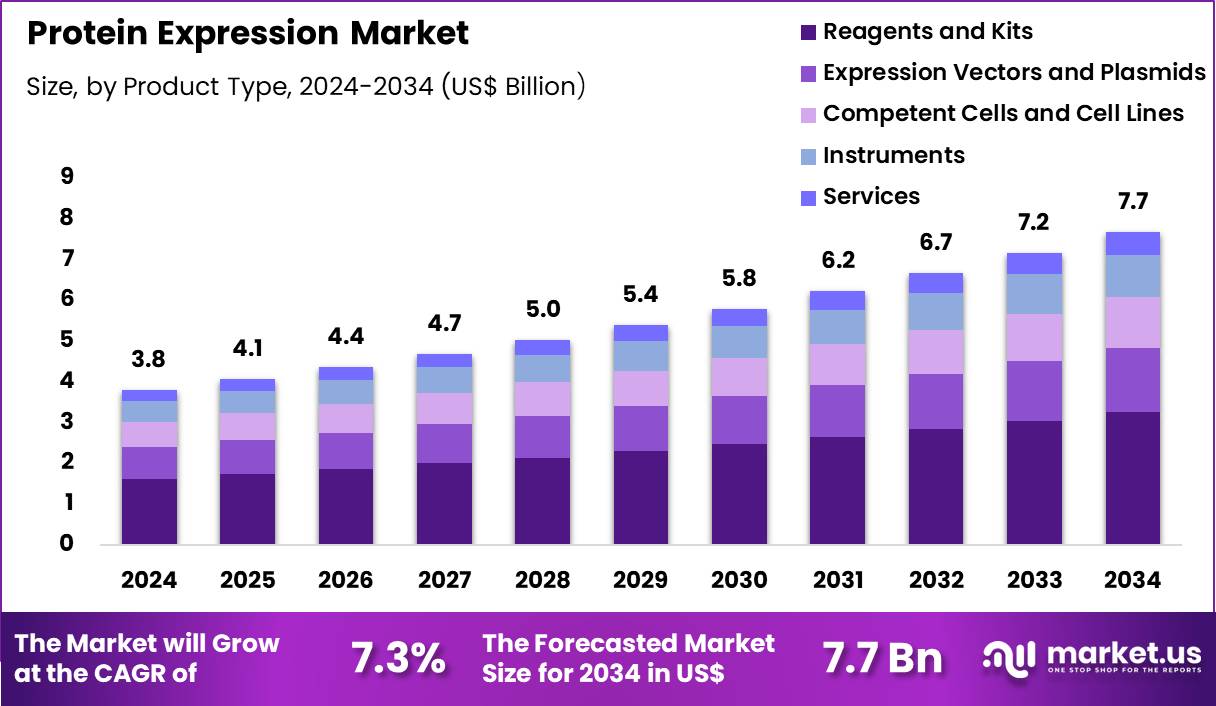
New York, NY – Sep 30, 2026 – The Global Protein Expression Market size is expected to be worth around US$ 7.7 Billion by 2034 from US$ 3.8 Billion in 2024, growing at a CAGR of 7.3% during the forecast period 2025 to 2034. In 2024, North America led the market, achieving over 41.7% share with a revenue of US$ 1.6 Billion.
The global protein expression market is being supported by increasing research activity in molecular biology, biotechnology, drug discovery, and biopharmaceutical development. Protein expression refers to the production of specific proteins using biological systems such as bacterial, yeast, insect, and mammalian cells. These systems are widely used for research, diagnostic development, therapeutic protein production, and vaccine-related applications.
The growing development of biologic medicines has increased the requirement for reliable protein production technologies. Recombinant proteins, antibodies, enzymes, and other protein-based products are being extensively studied and manufactured for pharmaceutical and biotechnology applications. Advances in gene engineering, cell culture, expression vectors, and purification technologies are also improving protein yield, quality, and scalability.
Academic institutions, pharmaceutical companies, biotechnology firms, and research laboratories represent major users of protein expression technologies. Bacterial expression systems continue to be widely used because of their relatively simple operation and cost advantages, while mammalian systems are increasingly important for producing complex proteins requiring appropriate folding and post-translational modifications.
The market is also being influenced by growing investments in life sciences research, expansion of biologics pipelines, and increasing adoption of advanced protein engineering techniques. Emerging technologies, including cell-free protein expression and automated expression platforms, are further broadening application opportunities across research and biopharmaceutical manufacturing.
Key Takeaways
- In 2024, the market generated revenue of US$ 3.8 billion and is projected to reach US$ 7.7 billion by 2034, registering a CAGR of 7.3% during the forecast period.
- By expression system, the market is segmented into prokaryotic expression systems, yeast expression systems, insect cell expression systems, mammalian cell expression systems, cell-free protein expression systems, and plant-based and algal expression systems. Mammalian cell expression systems dominated the segment in 2023, accounting for a 38.0% market share.
- By product type, the market is categorized into reagents and kits, expression vectors and plasmids, competent cells and cell lines, instruments, and services. Reagents and kits accounted for a significant 42.5% share of the market.
- Based on workflow stage, the market is segmented into gene cloning and vector design, host cell transformation or transfection, protein expression and induction, and protein purification and characterization. Protein expression and induction held the largest share, accounting for 36.6% of market revenue.
- By application, the market is divided into therapeutic protein development, research applications, diagnostic applications, and industrial and enzyme applications. Therapeutic protein development led the segment with a 45.1% revenue share.
- By end user, the market is segmented into pharmaceutical and biotechnology companies, academic and research institutions, CROs & CDMOs, and others. Pharmaceutical and biotechnology companies accounted for a significant 48.5% market share.
- North America dominated the global market in 2024, accounting for a 41.7% market share.
Key Market Segments
- Expression System Analysis: Mammalian cell expression systems accounted for 38.0% of the protein expression market in 2024. Their dominance is supported by the ability to produce complex proteins with appropriate folding and post-translational modifications. Growing demand for monoclonal antibodies, recombinant hormones, and other biologics further supports adoption.
- Product Type Analysis: Reagents and kits represented 42.5% of the protein expression market, supported by their widespread use across research and production workflows. Ready-to-use solutions improve reproducibility, reduce experimental variability, and simplify complex procedures. Increasing standardization and high-throughput research continue to support recurring demand.
- Workflow Stage Analysis: Protein expression and induction accounted for 36.6% of the protein expression market. This stage directly influences protein yield, quality, and production efficiency. Advances in promoters, induction methods, automation, and process optimization are improving reproducibility and scalability across research and commercial protein production.
- Application Analysis: Therapeutic protein development accounted for 45.1% of the protein expression market, driven by expanding biologics pipelines and increasing development of antibodies, enzymes, cytokines, and recombinant proteins. Advances in expression technologies, manufacturing scalability, and growing demand for targeted therapies continue to support segment expansion.
- End-User Analysis: Pharmaceutical and biotechnology companies held 48.5% of the protein expression market, reflecting extensive use of protein expression technologies in drug discovery, development, and manufacturing. Growing biologics pipelines, increased research investment, regulatory requirements, and demand for scalable production platforms continue to strengthen adoption across this end-user segment.
Regional Analysis
North America accounted for 41.7% of the global protein expression market in 2024, supported by strong biotechnology research, biopharmaceutical production, and investment in recombinant therapeutics. The region benefits from widespread adoption of mammalian expression systems, particularly CHO-based platforms, for producing monoclonal antibodies and other complex therapeutic proteins.
Government-funded research, advanced screening technologies, established CRO networks, and sophisticated biomanufacturing infrastructure further support market development. Growing adoption of personalized medicine and gene-editing technologies is also encouraging improvements in protein expression efficiency and stability.
Asia Pacific is expected to register the highest CAGR during the forecast period. Market expansion is being supported by increasing government investment in biotechnology, growing pharmaceutical manufacturing capabilities, and rising demand for affordable biologic therapies.
Countries such as India, China, Indonesia, and South Korea are strengthening research and production infrastructure for recombinant proteins, biosimilars, vaccines, and therapeutic enzymes. Increasing technology transfers, development of domestic biomanufacturing capabilities, and adoption of advanced expression platforms are expected to create further opportunities across the region.
Emerging Trends
- Increasing use of advanced mammalian expression systems: Mammalian cells, particularly CHO and HEK293 systems, continue to be important for complex therapeutic proteins because they can provide appropriate protein folding and post-translational modifications. This supports their continued use in monoclonal antibody and other biologic manufacturing.
- Growing adoption of AI and process automation: AI, machine learning, advanced process analytics, and digital technologies are increasingly being applied to biopharmaceutical manufacturing. NIST and NIIMBL identify AI-based process optimization, real-time analytics, and data-driven manufacturing as important technology areas for future biomanufacturing.
- Shift toward faster and flexible expression platforms: Demand for rapid protein production is encouraging the use of transient expression, insect-cell systems, cell-free platforms, and other flexible technologies. These approaches can reduce development time and support early-stage research, rapid-response manufacturing, and production of difficult proteins.
- Greater focus on product quality and protein characterization: Protein aggregation, impurities, folding, glycosylation, and other quality attributes are receiving greater attention as biologic manufacturing expands. NIST is developing reference materials and measurement technologies to improve characterization and quality control of protein-based medicines.
- Development of next-generation expression platforms: Research is moving beyond conventional bacterial and mammalian systems toward engineered hosts and improved expression technologies. Current development includes novel protein expression platforms designed to improve manufacturing flexibility, productivity, process understanding, and production of next-generation therapeutics.
Use Cases
- Therapeutic protein manufacturing: Protein expression is widely used to manufacture therapeutic proteins, including monoclonal antibodies and other recombinant medicines. Mammalian cell platforms are particularly important when proteins require complex structures and post-translational modifications for biological activity.
- Vaccine development and production: Recombinant protein expression can be used to produce specific antigens and other protein components used in vaccine research and manufacturing. Insect, bacterial, yeast, and mammalian systems can be selected according to the required protein characteristics and production objectives.
- Diagnostic products: Expressed proteins are used as antigens, antibodies, enzymes, and other biological components in diagnostic research and testing. Recombinant production allows these materials to be generated with greater consistency and without relying only on biological extraction from natural sources.
- Drug discovery and research: Protein expression supports drug discovery by providing purified target proteins, enzymes, antibodies, receptors, and other research materials. These products are used for structural studies, screening, assay development, protein engineering, and evaluation of potential therapeutic candidates.
- Protein engineering and personalized biologics research: Expression technologies enable researchers to produce modified proteins for studying structure, function, stability, and therapeutic performance. Engineered expression systems can support development of improved biologics and research into proteins with specific biological or manufacturing characteristics.
Frequently Asked Questions About Protein Expression
- What are the main protein expression systems?
The major protein expression systems include bacterial, yeast, insect-cell, and mammalian-cell platforms. E. coli is commonly selected for relatively simple proteins, while mammalian systems are preferred when complex folding or post-translational modifications are required. - Why is E. coli used for protein expression?
E. coli is widely used because it grows quickly, is relatively inexpensive, and can provide high protein production for many applications. It is particularly useful for proteins that do not require complex mammalian post-translational modifications. - Why are mammalian cells important for protein expression?
Mammalian cells are important because they can produce complex proteins with folding and post-translational modifications that more closely resemble human proteins. CHO cells are widely used for manufacturing therapeutic monoclonal antibodies and other biologic medicines. - What factors determine the choice of an expression system?
The expression system is selected according to protein structure, required modifications, production scale, yield, cost, development speed, and intended application. Simple proteins may suit bacterial systems, while complex therapeutic proteins often require yeast, insect, or mammalian platforms. - Which technologies are shaping the protein expression market?
Major technologies include bacterial, yeast, insect-cell, mammalian-cell, transient, and cell-free expression systems. Newer developments increasingly combine engineered production hosts with automation, artificial intelligence, process analytics, and advanced manufacturing controls. - What is the role of protein expression in biologic drug manufacturing?
Protein expression provides the biological production mechanism for many recombinant medicines. Genetically engineered cells are cultivated to produce therapeutic proteins, which are subsequently processed, purified, tested, and formulated under controlled manufacturing conditions. - Why is protein quality important in the market?
Protein quality directly affects the safety, consistency, and performance of biologic products. Characteristics such as structure, glycosylation, aggregation, and impurities must be carefully controlled because variations can affect product performance and potentially create unwanted immune responses. - What is the future outlook for protein expression technologies?
Future development is expected to emphasize faster expression, improved productivity, flexible manufacturing, advanced analytics, AI-supported processes, and better quality control. These developments are intended to support increasingly complex biologics and more efficient biopharmaceutical production.
Conclusion
The global protein expression market is expected to expand steadily, supported by increasing demand for biologics, recombinant proteins, vaccines, diagnostics, and research applications. Growing adoption of mammalian expression systems, reagents and kits, automated platforms, and advanced protein engineering is improving production efficiency and product quality.
Pharmaceutical and biotechnology companies remain major users, while North America continues to represent a leading regional market. Asia Pacific is expected to experience strong growth due to increasing biotechnology investments and expanding biomanufacturing capabilities.
In the coming years, AI, cell-free expression, automation, and advanced characterization technologies are expected to create new opportunities and strengthen the scalability of protein expression applications.
Discuss your needs with our analyst
Please share your requirements with more details so our analyst can check if they can solve your problem(s)




