


Overview
New York, NY – Sep 29, 2026 – The Global Prefilled Formalin Vials Market size is expected to be worth around US$ 683.6 Million by 2034 from US$ 396.4 Million in 2024, growing at a CAGR of 5.6% during the forecast period 2025 to 2034. In 2024, North America led the market, achieving over 36.8% share with a revenue of US$ 145.9 Million.
Prefilled formalin vials are ready-to-use specimen containers containing a measured quantity of formalin, primarily used for the preservation and fixation of biological tissue samples. These vials are widely utilized in hospitals, pathology laboratories, diagnostic centers, research institutions, and academic laboratories, where reliable tissue preservation is essential for histopathological examination and diagnosis.
The use of prefilled vials helps standardize the formalin-to-tissue ratio, reduces preparation time, and minimizes direct handling of formalin by laboratory personnel. Increasing demand for pathology and diagnostic testing, along with the growing number of surgical procedures and biopsy examinations, is supporting the adoption of these products.
Product development is increasingly focused on leak-resistant packaging, improved labeling, secure closures, and convenient vial sizes suitable for different specimen requirements. Manufacturers are also emphasizing workplace safety and compliance with laboratory handling and transportation requirements.
The market is expected to benefit from the expansion of diagnostic infrastructure, rising awareness of standardized specimen collection practices, and increasing demand for efficient laboratory workflows. Growth opportunities are also being created through the development of specialized vial formats and improved packaging solutions designed to enhance safety, convenience, and sample integrity.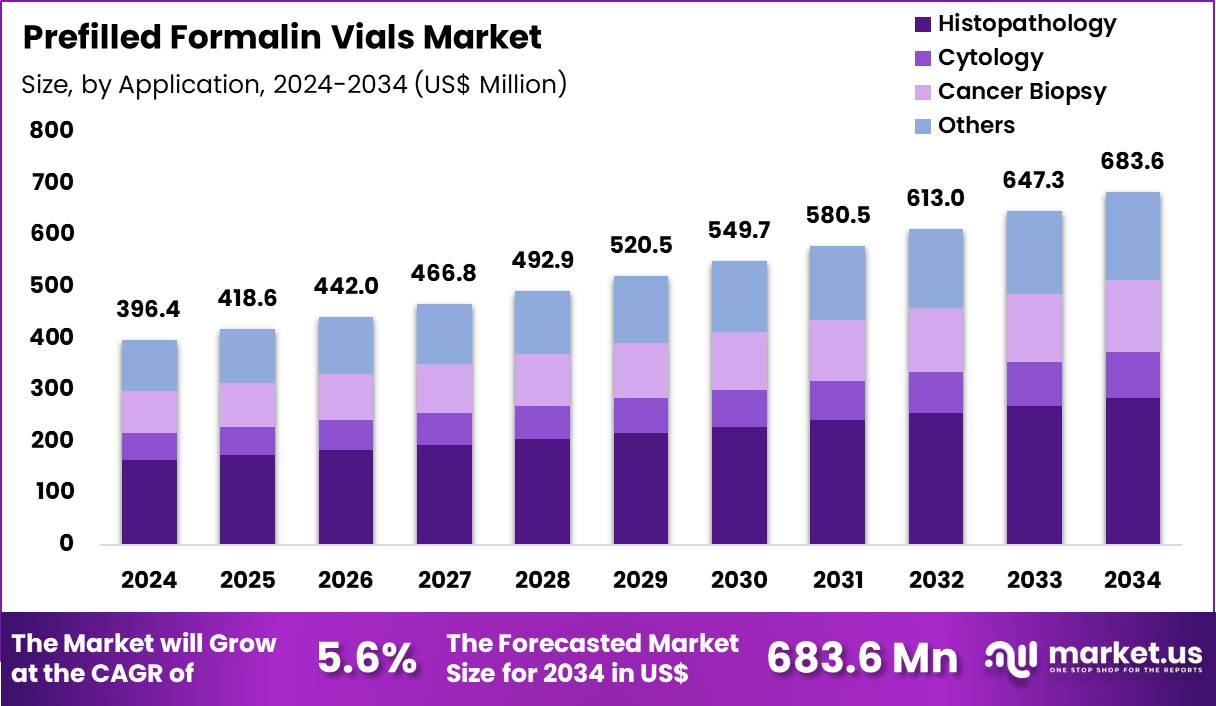
Key Takeaways
- In 2024, the market generated US$ 396.4 million in revenue and is projected to reach US$ 683.6 million by 2034, registering a CAGR of 5.6% during the forecast period.
- By volume, the market is segmented into <10 mL, 10–20 mL, 20–60 mL, 60–120 mL, 120–500 mL, and 500 mL–1 litre. The 60–120 mL segment dominated in 2024, accounting for a market share of 25.2%.
- Based on packaging type, the market is categorized into polypropylene (PP) prefilled vials & jars and high-density polyethylene (HDPE) containers. The PP prefilled vials & jars segment held the dominant position, with a market share of 81.0%.
- By application, the market is segmented into histopathology, cytology, cancer biopsy, and others. The histopathology segment accounted for the largest revenue share, representing 41.6% of the market in 2024.
- By end user, the market is classified into hospitals & surgical centers, diagnostic laboratories, forensic laboratories, veterinary hospitals & clinics, contract research organizations (CROs), and others. Hospitals & surgical centers represented the leading segment, accounting for 37.3% of the total market revenue.
- Regionally, North America dominated the global market in 2024, accounting for a market share of 36.8%.
Key Market Segments
- Volume Analysis: The 60–120 mL segment held 25.2% of the market, supported by its suitability for small to medium tissue specimens. Its balanced capacity facilitates proper fixation, efficient handling, and transportation. Increasing workflow standardization, inventory efficiency, and adherence to fixation practices continue to support demand.
- Packaging Type Analysis: Polypropylene prefilled vials and jars accounted for 81.0% of the market, supported by strong chemical resistance, lightweight construction, and durability. PP packaging enables reliable formalin storage and transportation while supporting leak-resistant closures, visual inspection, efficient manufacturing, and cost-effective procurement across healthcare settings.
- Application Analysis: Histopathology represented 41.6% of the market, driven by increasing tissue-based diagnostic procedures and biopsy volumes. Prefilled containers support standardized fixation, reduce handling variability, and improve laboratory efficiency. Growing cancer screening, diagnostic workloads, quality assurance practices, and standardized laboratory protocols are sustaining adoption.
- End-User Analysis: Hospitals and surgical centers accounted for 37.3% of the market, reflecting their high volume of surgical and biopsy procedures. Prefilled containers support safer specimen handling, reduce preparation requirements, and facilitate standardized workflows. Centralized procurement, occupational safety practices, and expanding surgical activity continue to strengthen demand.
Regional Analysis
North America Leads the Prefilled Formalin Vials
North America accounted for 36.8% of the global prefilled formalin vials market in 2024. Market growth has been supported by increasing pathology workloads, rising biopsy procedures, and greater emphasis on standardized specimen preservation. Hospitals and diagnostic laboratories are increasingly adopting ready-to-use vials to improve fixation consistency, reduce handling requirements, and support laboratory safety.
Growing oncology screening and chronic disease diagnosis are further contributing to demand. The adoption of leak-resistant, tamper-evident, and standardized packaging is also supporting use across clinical and research settings. According to the Centers for Disease Control and Prevention, anatomic pathology accounts for approximately 350 million tests annually in the United States.
Asia Pacific to Record the Highest CAGR
Asia Pacific is expected to register the highest CAGR during the forecast period, supported by expanding healthcare infrastructure, increasing cancer diagnosis, and growing pathology testing volumes. Rising investments in diagnostic facilities and improved laboratory practices are encouraging adoption of prefilled formalin vials.
Standardized specimen handling, growing clinical research activities, and increasing awareness of laboratory safety are expected to further support regional market expansion.
Emerging Trends
- Growing Standardization of Tissue Fixation: Healthcare facilities are increasingly adopting standardized fixation practices to improve specimen quality. WHO guidance recommends adequate formalin volume relative to tissue size, supporting the use of prefilled containers with controlled and consistent volumes.
- Increasing Demand for Ready-to-Use Containers: Prefilled vials are gaining relevance as laboratories seek to simplify specimen collection and reduce preparation steps. Immediate placement of biopsy specimens into formalin is recommended in pathology workflows, supporting demand for ready-to-use solutions.
- Greater Focus on Laboratory Safety: Formaldehyde is a toxic and volatile chemical, creating stronger emphasis on safe handling and exposure reduction. Sealed, prefilled containers can support safer specimen collection by limiting unnecessary handling of formalin during routine procedures.
- Rising Importance of Molecular Pathology: FFPE tissue is increasingly used for molecular testing, including DNA, RNA, and biomarker analysis. As fixation conditions can affect downstream molecular results, laboratories are placing greater emphasis on controlled fixation time, formalin concentration, and specimen handling.
- Expansion of Traceability and Standardized Workflows: Pathology laboratories are placing greater focus on controlling pre-analytical variables, including fixation time, tissue size, fixative composition, and fixative-to-tissue ratio. This trend is supporting demand for standardized containers that can be integrated into documented laboratory procedures.
Use Cases
- Biopsy Specimen Collection: Prefilled formalin vials are used for immediate preservation of biopsy samples before laboratory processing. Rapid fixation helps limit tissue deterioration and supports subsequent histopathological examination.
- Histopathology Testing: Tissue specimens are routinely fixed in formalin before paraffin embedding and microscopic examination. Prefilled containers support consistent preservation for routine diagnostic histopathology workflows.
- Cancer Diagnosis and Screening: Formalin-fixed tissue is widely used in the assessment of tumor specimens. Proper fixation supports morphological examination and immunohistochemistry, which are important components of cancer diagnosis and characterization.
- Molecular and Biomarker Testing: FFPE specimens can serve as sources for DNA, RNA, protein, and biomarker analysis. Controlled fixation is therefore important when tissue samples are intended for downstream molecular or research applications.
- Clinical Research and Biobanking: Research programs use formalin-fixed tissue to create standardized specimen collections for future pathological and molecular studies. Organizations such as IARC use buffered formalin fixation and FFPE processing within standardized research protocols.
Frequently Asked Questions About Prefilled Formalin Vials
- What is the primary purpose of prefilled formalin vials?
The primary purpose of prefilled formalin vials is to preserve tissue specimens by preventing decomposition and maintaining cellular structure. They are widely used in histopathology, biopsy collection, surgical pathology, and other diagnostic laboratory applications requiring reliable fixation. - What type of formalin is commonly used in prefilled vials?
Neutral buffered formalin, typically formulated around 10% concentration, is widely used in prefilled specimen vials. Its buffering system helps maintain suitable pH conditions during tissue fixation and supports preservation of morphological characteristics required for subsequent laboratory examination. - What are the advantages of using prefilled formalin vials?
Prefilled formalin vials provide standardized reagent volume, convenient specimen handling, reduced preparation time, and improved workflow consistency. They can also minimize direct handling of formalin during collection, supporting safer and more controlled laboratory operations. - Where are prefilled formalin vials used?
Prefilled formalin vials are used in hospitals, diagnostic laboratories, pathology departments, research institutions, and outpatient healthcare settings. Their applications include biopsy preservation, surgical specimen collection, histological processing, and tissue-based diagnostic procedures requiring formalin fixation. - How should prefilled formalin vials be stored?
Prefilled formalin vials should generally be stored according to the manufacturer’s instructions, away from incompatible materials, excessive heat, and direct exposure. Appropriate labeling, secure closure, ventilation, and chemical safety procedures should also be maintained throughout storage and handling. - What factors are driving the prefilled formalin vials market?
Market growth is being supported by increasing biopsy and surgical procedures, expanding pathology testing, greater laboratory standardization, and demand for convenient specimen collection products. Adoption is also encouraged by efforts to improve workflow efficiency and reduce manual reagent preparation. - Which regions are important for the prefilled formalin vials market?
Demand is observed across North America, Europe, Asia-Pacific, Latin America, and the Middle East and Africa. Regional market development varies according to healthcare expenditure, pathology infrastructure, diagnostic volumes, regulatory requirements, laboratory modernization, and availability of healthcare services. - What is the future outlook for the prefilled formalin vials market?
The market outlook is linked to continued demand for tissue-based diagnostics, pathology testing, and standardized specimen collection. Growth opportunities are expected to be shaped by healthcare infrastructure expansion, laboratory automation, product innovation, safety requirements, and increasing diagnostic activity worldwide.
Conclusion
The global prefilled formalin vials market is poised for steady growth, supported by increasing diagnostic testing, rising biopsy and surgical procedures, and the expansion of pathology infrastructure. Valued at US$ 396.4 million in 2024, the market is projected to reach US$ 683.6 million by 2034, registering a CAGR of 5.6%.
Demand is being driven by the adoption of standardized specimen preservation practices, with polypropylene packaging, histopathology applications, and hospitals and surgical centers representing key segments. North America currently leads the market, while Asia Pacific presents significant growth opportunities through healthcare infrastructure development and diagnostic capacity expansion.
Discuss your needs with our analyst
Please share your requirements with more details so our analyst can check if they can solve your problem(s)




