


Overview
New York, NY – Sep 10, 2026 –The Global Phlebotomy Equipment Market size is expected to be worth around US$ 16.38 billion by 2034 from US$ 10.25 billion in 2024, growing at a CAGR of 4.8% during the forecast period 2025 to 2034. In 2024, North America led the market, achieving over 35.6% share with a revenue of US$ 3.65 billion.
Phlebotomy Equipment is growing due to the increasing demand for blood-based diagnostic testing, rising chronic disease burden, expansion of clinical laboratories, and growing adoption of safety-engineered blood collection devices. Phlebotomy equipment includes needles, evacuated blood collection tubes, lancets, syringes, blood collection sets, specimen containers, and safety accessories used for collecting and handling blood samples.
The rising prevalence of chronic diseases is a major factor supporting market growth. According to the World Health Organization (WHO), noncommunicable diseases (NCDs) caused approximately 43 million deaths in 2021, representing nearly 75% of non-pandemic-related deaths globally.
Cardiovascular diseases accounted for around 19 million deaths, while cancers contributed approximately 10 million deaths, increasing the requirement for regular blood testing, disease screening, and treatment monitoring.
The growing need for blood collection services is also strengthening demand for phlebotomy products. WHO reports that approximately 120.4 million blood donations are collected globally every year, highlighting the importance of reliable, sterile, and efficient blood collection equipment across healthcare systems. Blood collection devices play a critical role in transfusion services, diagnostic testing, emergency care, and surgical procedures.
Diabetes and metabolic disorders are further increasing the frequency of blood testing procedures. In the United States alone, millions of people require regular blood glucose monitoring and laboratory assessments, creating consistent demand for collection needles, tubes, and related accessories.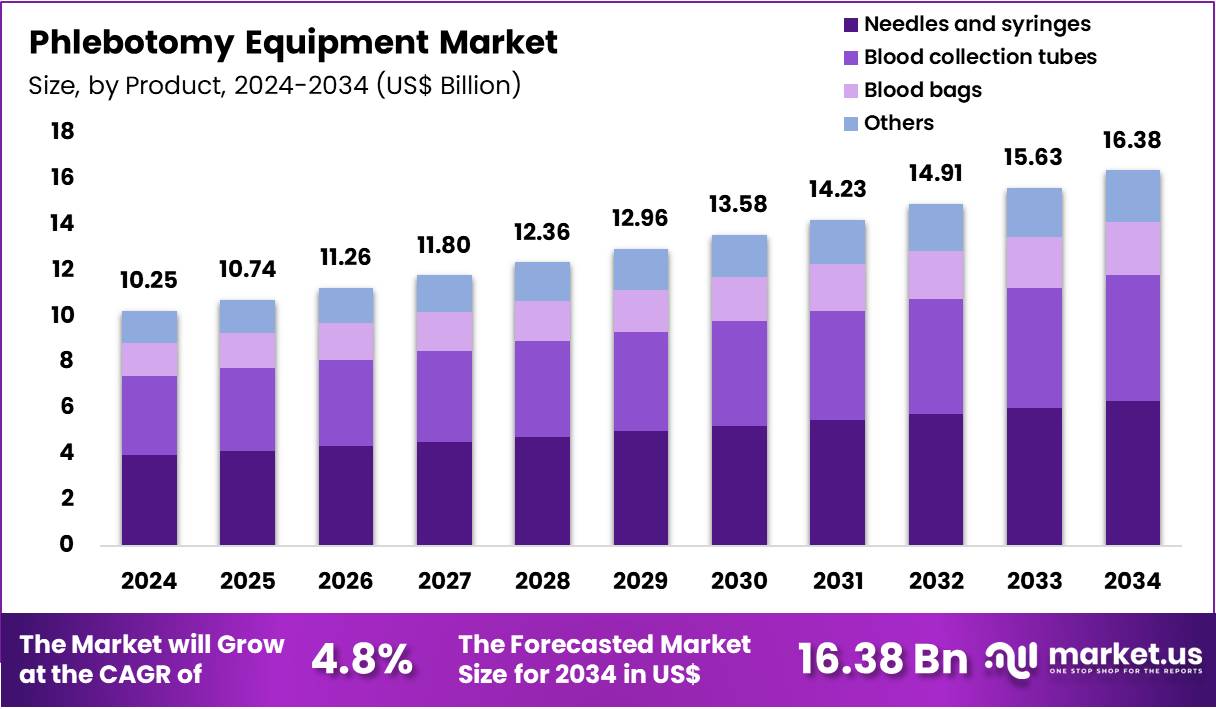
Key Takeaways
- In 2024, the Phlebotomy Equipment Market generated revenue of US$ 10.25 billion and is projected to grow at a CAGR of 4.8%, reaching approximately US$ 16.38 billion by 2034.
- The Product segment includes needles and syringes, blood collection tubes, blood bags, and others. Among these, needles and syringes dominated the market in 2024, accounting for a market share of 38.5%.
- The End-User segment comprises hospitals & clinics, diagnostic centers, and others. Hospitals & clinics held the leading position in 2024, capturing a market share of 55.4% due to the high volume of blood collection procedures performed in healthcare facilities.
- North America emerged as the leading regional market in 2024, holding a market share of 35.6%, supported by advanced healthcare infrastructure, increasing diagnostic testing, and widespread adoption of safety-focused blood collection devices.
Statistical Information
- Diabetes Monitoring Driving Demand for Needles, Syringes and Blood Collection Accessories: Diabetes management requires frequent blood testing, increasing the utilization of phlebotomy-related products. The Centers for Disease Control and Prevention (CDC) estimates that approximately 40.1 million people in the United States had diagnosed or undiagnosed diabetes in 2023, representing about 12.0% of the population. Additionally, approximately 115.2 million U.S. adults had prediabetes, increasing the need for glucose monitoring and diagnostic blood assessments.
- Blood Collection Equipment Demand Supported by Voluntary Donation Growth: Voluntary blood donation systems continue expanding, creating demand for sterile collection products such as blood bags and collection tubes. WHO data indicates that voluntary unpaid donors contributed to more than 85% of estimated global blood donations in 2023. Additionally, 80 countries collect over 90% of their blood supply from voluntary unpaid donors, requiring efficient collection and storage equipment.
- High-Income Countries Driving Adoption of Advanced Blood Collection Devices: High-income countries contribute significantly to global blood collection activities and have higher adoption of advanced phlebotomy products. WHO reports that 36% of the world’s 120.4 million blood donations are collected in high-income countries, even though these regions represent only around 15% of the global population. The blood donation rate in high-income countries is approximately 28.9 donations per 1,000 people, compared with 8.5 donations per 1,000 people in lower-middle-income countries.
- High-Income Countries Driving Adoption of Advanced Blood Collection Devices: High-income countries contribute significantly to global blood collection activities and have higher adoption of advanced phlebotomy products. WHO reports that 36% of the world’s 120.4 million blood donations are collected in high-income countries, even though these regions represent only around 15% of the global population. The blood donation rate in high-income countries is approximately 28.9 donations per 1,000 people, compared with 8.5 donations per 1,000 people in lower-middle-income countries.
- Diabetes Prevalence Supporting Frequent Blood Sample Collection: Diabetes management requires regular blood testing, increasing demand for needles, lancets, and blood collection accessories. The CDC reports that approximately 38.4 million people in the United States had diabetes in 2021, including 29.7 million diagnosed cases and 8.7 million undiagnosed cases. Additionally, around 97.6 million U.S. adults had prediabetes during the same period.
Regional Analysis
North America led the market by securing a market share of 35.6% in 2024.
North America holds a strong position in the phlebotomy equipment market due to advanced healthcare systems, high diagnostic testing volumes, and strict adoption of safe blood collection practices. The United States has one of the largest clinical laboratory networks globally, with laboratory testing playing a critical role in disease diagnosis and treatment decisions.
According to the CDC, millions of Americans undergo routine blood testing annually for conditions such as diabetes, cardiovascular diseases, infections, and cancer. The region also benefits from OSHA regulations promoting safety-engineered needles and sharps injury prevention in healthcare facilities, increasing demand for advanced phlebotomy products. Asia Pacific is experiencing increasing demand for phlebotomy equipment due to expanding healthcare infrastructure, rising chronic disease cases, and growing access to diagnostic services.
The International Diabetes Federation reports that the Western Pacific region has one of the highest diabetes burdens globally, increasing the need for regular blood monitoring. Government healthcare programs, increasing hospital capacity, and expansion of diagnostic laboratories are supporting the adoption of blood collection tubes, needles, and safety devices across the region.
Emerging Trends
- Increasing Adoption of Safety-Engineered Blood Collection Devices: Healthcare facilities are increasingly adopting safety needles, retractable lancets, and evacuated tube systems to reduce needlestick injuries. WHO recommends safety-engineered devices for blood collection practices. These technologies improve worker protection, and global healthcare systems are focusing on safer equipment standards for routine blood sampling procedures.
- Growth of Automated and Vacuum Blood Collection Systems: Vacuum-assisted blood collection systems are becoming more common due to faster sample collection, improved accuracy, and reduced contamination risks. The FDA classifies vacuum-assisted blood collection systems and blood specimen collection devices as regulated medical devices, supporting wider adoption in hospitals and laboratories.
- Rising Demand Due to Expansion of Global Blood Donation Programs: The expansion of blood donation networks is increasing demand for blood bags, collection tubes, and sterile phlebotomy accessories. WHO reports that approximately 120.4 million blood donations are collected globally each year from 168 reporting countries, requiring reliable collection and testing infrastructure.
- Digital Integration and Laboratory Workflow Improvement: Hospitals and laboratories are focusing on improved specimen tracking, automation, and quality management systems to reduce collection errors. CDC highlights that accurate blood sample collection is essential because laboratory results support diagnosis, treatment decisions, and infection management across healthcare systems.
- Growing Use of Single-Use Sterile Phlebotomy Products: Single-use needles, syringes, lancets, and collection tubes are becoming standard practices to improve infection prevention. WHO recommends sterile single-use equipment for every patient blood sampling procedure and emphasizes adequate availability of supplies to maintain safe healthcare practices.
Use Cases
- Diagnostic Blood Testing in Hospitals and Clinical Laboratories: Phlebotomy equipment is widely used for routine diagnostic testing, including blood chemistry, hematology, infection screening, and disease monitoring. WHO identifies blood drawing as one of the most common invasive healthcare procedures, supporting continuous demand for needles, tubes, and specimen collection devices.
- Blood Donation and Transfusion Services: Blood collection equipment is essential for donor collection programs and transfusion services. WHO reports that more than 120 million blood donations are collected annually, requiring sterile collection systems, blood bags, and testing accessories to maintain safe blood supplies worldwide.
- Chronic Disease Monitoring Applications: Phlebotomy products support regular monitoring of chronic diseases such as diabetes, cardiovascular disorders, and kidney diseases. Increasing disease screening programs require frequent blood sample collection for diagnosis and treatment evaluation, increasing the need for reliable needles, tubes, and lancets. WHO reports that noncommunicable diseases cause approximately 41 million deaths annually, driving diagnostic demand.
- Infectious Disease Testing and Public Health Screening: Blood collection devices are widely used for detecting infections such as HIV, hepatitis B, hepatitis C, and other bloodborne diseases. CDC emphasizes that blood safety programs require screening of donated blood and accurate laboratory testing to prevent disease transmission and improve patient safety.
- Emergency Care, Surgery, and Critical Care Applications: Hospitals use phlebotomy equipment extensively in emergency departments, intensive care units, and surgical settings where rapid blood testing is required. CDC notes that the U.S. healthcare system requires approximately 29,000 units of red blood cells daily, highlighting the importance of efficient blood collection and transfusion infrastructure.
Frequently Asked Questions on Phlebotomy Equipment
- What factors are driving the growth of the phlebotomy equipment market?
The phlebotomy equipment market is driven by increasing diagnostic testing, rising chronic disease prevalence, expanding blood donation programs, and growing adoption of safety-engineered devices. Hospitals and laboratories require reliable blood collection products for disease detection, patient monitoring, and emergency healthcare services. - What are the major applications of phlebotomy equipment?
Phlebotomy equipment is mainly used for diagnostic testing, blood donation, transfusion services, chronic disease monitoring, infectious disease screening, and emergency care. These applications require accurate blood collection methods to support disease diagnosis, treatment decisions, and continuous patient health monitoring. - Which end-users use phlebotomy equipment?
Major end-users of phlebotomy equipment include hospitals, clinics, diagnostic laboratories, blood banks, research institutions, and ambulatory care centers. Hospitals and clinics represent significant users because they perform large numbers of blood collection procedures for inpatient and outpatient healthcare services. - How does chronic disease prevalence impact the phlebotomy equipment market?
Increasing cases of chronic diseases such as diabetes, cardiovascular disorders, and cancer are increasing the need for regular blood testing. Frequent monitoring and laboratory assessments require continuous use of needles, tubes, and other phlebotomy products across healthcare facilities. - What role do blood donation programs play in market growth?
Blood donation programs significantly contribute to phlebotomy equipment demand by requiring sterile collection systems, blood bags, tubes, and accessories. Global blood collection initiatives depend on reliable equipment to maintain safe blood supplies for transfusions, surgeries, trauma care, and emergency medical procedures. - How are technological advancements influencing phlebotomy equipment?
Technological advancements are improving blood collection safety, efficiency, and accuracy through vacuum blood collection systems, automated specimen handling, ergonomic designs, and integrated safety features. These innovations help healthcare providers reduce errors, improve workflow, and enhance patient and healthcare worker protection. - Which region dominates the phlebotomy equipment market?
North America leads the phlebotomy equipment market due to advanced healthcare infrastructure, high diagnostic testing volumes, strong regulatory standards, and widespread adoption of safety-focused devices. The region’s developed laboratory networks and healthcare facilities support continuous demand for blood collection products. - Why is Asia Pacific considered a growing market for phlebotomy equipment?
Asia Pacific is experiencing rapid growth due to expanding healthcare infrastructure, increasing diagnostic access, rising chronic disease cases, and government-supported screening programs. Growing investments in hospitals, laboratories, and preventive healthcare initiatives are increasing demand for blood collection devices across the region.
Conclusion
The Phlebotomy Equipment Market is expected to witness steady growth due to increasing diagnostic testing, rising chronic disease burden, expanding blood donation programs, and growing demand for safe blood collection solutions. Advancements in safety-engineered needles, vacuum blood collection systems, and sterile disposable products are improving healthcare efficiency and reducing occupational risks.
Hospitals, diagnostic laboratories, and blood banks remain key users, supported by increasing healthcare investments worldwide. North America continues to hold a strong position due to advanced infrastructure, while Asia Pacific presents significant growth opportunities through expanding healthcare access and diagnostic services. Overall, innovation and safety-focused practices will continue shaping market development.
Discuss your needs with our analyst
Please share your requirements with more details so our analyst can check if they can solve your problem(s)




