


Overview
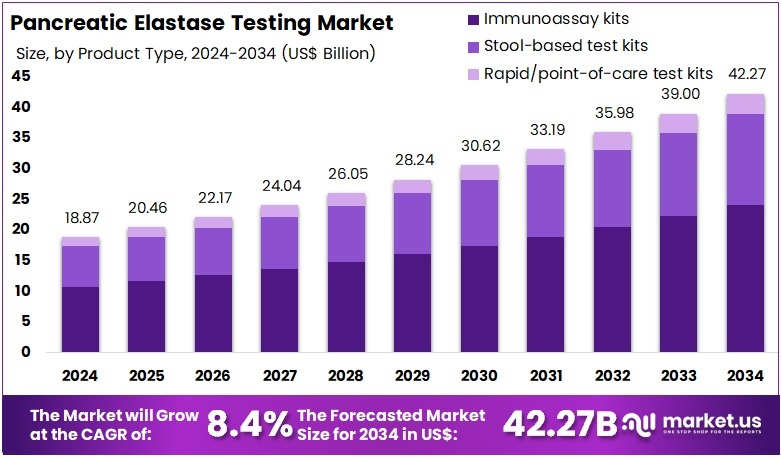
New York, NY – Sep 03, 2026 –The Pancreatic Elastase Testing Market size is expected to be worth around US$ 42.27 Billion by 2034 from US$ 18.87 Billion in 2024, growing at a CAGR of 8.4% during the forecast period 2025 to 2034.
The global Pancreatic Elastase Testing Market is witnessing steady growth as healthcare providers increasingly adopt non-invasive diagnostic methods for evaluating pancreatic exocrine function. Pancreatic elastase-1 (PE-1) testing is a stool-based diagnostic procedure used to detect exocrine pancreatic insufficiency (EPI), a condition associated with inadequate secretion of digestive enzymes. The test measures elastase levels in fecal samples, with values below 200 µg/g of stool generally indicating pancreatic insufficiency and levels below 100 µg/g suggesting severe impairment.
Growing cases of chronic pancreatitis, cystic fibrosis, pancreatic cancer, and gastrointestinal disorders are driving demand for accurate pancreatic function assessment. According to healthcare studies, exocrine pancreatic insufficiency affects approximately 50%–80% of patients with chronic pancreatitis and can occur in up to 90% of individuals with advanced pancreatic disease. The increasing focus on early diagnosis and personalized treatment approaches is supporting market expansion.
Technological advancements in enzyme-linked immunosorbent assay (ELISA)-based diagnostic platforms are improving testing accuracy, workflow efficiency, and laboratory automation. Modern pancreatic elastase tests provide results within approximately 1–3 days, enabling faster clinical decision-making compared with more complex pancreatic function tests.
The market is also benefiting from rising healthcare expenditure, improved diagnostic infrastructure, and increasing awareness among physicians regarding digestive enzyme disorders. Hospitals, diagnostic laboratories, and specialty clinics are adopting pancreatic elastase testing as a reliable screening tool due to its non-invasive nature and high clinical utility.
Continuous research in gastrointestinal diagnostics and expansion of laboratory testing capabilities are expected to create new growth opportunities for the pancreatic elastase testing industry in the coming years.
Key Takeaways
- In 2024, the pancreatic elastase testing market generated US$ 18.87 billion in revenue and is projected to grow at a CAGR of 8.4%, reaching approximately US$ 42.27 billion by 2034.
- The Product Type segment includes Immunoassay kits, Stool-based test kits, and Rapid/point-of-care test kits. Among these, Immunoassay kits dominated the market in 2024, accounting for the largest share of 57.1%.
- The Application segment comprises infectious disease testing, Oncology testing, Human genetic testing, Blood screening, Forensic applications, and Others. Chronic pancreatitis emerged as the leading application in 2024, holding a market share of 46.5%.
- The End-User segment is categorized into Hospitals and diagnostic centres, Stand-alone diagnostic laboratories, Research laboratories, and Pharmaceutical & biotechnology companies. Hospitals led the segment in 2024, capturing a market share of 51.7%.
- North America dominated the global pancreatic elastase testing market in 2024, accounting for a significant market share of 37.8%, supported by advanced diagnostic infrastructure and increasing adoption of pancreatic function testing.
Market Segmentation
Product Type Analysis
- Immunoassay Kits: Immunoassay kits lead the pancreatic elastase testing market with around 57.1% share, supported by high accuracy, clinical validation, and compatibility with automated ELISA analyzers. These kits enable reliable elastase detection across different concentration ranges in hospitals and reference laboratories.
- Stool-Based Test Kits: Stool-based test kits hold nearly 35.0% share, driven by increasing adoption of fecal elastase testing as a non-invasive first-line diagnostic method for chronic pancreatitis and fat-malabsorption disorders. Their simple sample collection and patient-friendly approach support wider clinical acceptance.
- Rapid/POC Kits: Rapid and point-of-care kits account for approximately 5.0% share, gaining demand in outpatient clinics and smaller diagnostic centers. Advances in lateral-flow immunoassay technology are improving testing speed, supporting faster gastrointestinal assessments and decentralized diagnostic decision-making.
Indication Analysis
- Chronic Pancreatitis: Chronic pancreatitis dominates pancreatic elastase testing utilization with approximately 46.5% share, due to increasing disease prevalence and the need for monitoring progressive exocrine pancreatic dysfunction. Fecal elastase testing provides a reliable, non-invasive approach for evaluating pancreatic enzyme insufficiency.
- Type 1 Diabetes: Type 1 diabetes contributes nearly 20.0% share as autoimmune pancreatic damage increases the risk of exocrine pancreatic insufficiency. Pancreatic elastase testing helps physicians assess digestive enzyme deficiency and guide nutritional management and enzyme replacement therapy.
- Cystic Fibrosis: Cystic fibrosis represents around 18.0% share, supported by routine pancreatic function monitoring in children and adolescents. Elastase testing is widely incorporated into cystic fibrosis care pathways, with newborn screening programs increasing early detection and long-term disease management.
End-User Analysis
- Hospitals: Hospitals account for the largest share at approximately 51.7%, driven by their advanced gastroenterology departments and high-volume diagnostic capabilities. Their ability to perform automated ELISA-based testing supports widespread use for chronic pancreatitis evaluation and cystic fibrosis monitoring.
- Diagnostic Laboratories: Diagnostic laboratories capture nearly 35.0% share, supported by increasing outsourcing of specialized tests, automation adoption, and centralized laboratory networks. These facilities provide efficient stool-based testing services, improving accessibility and availability of pancreatic elastase diagnostics worldwide.
Statistical Information
- Fecal pancreatic elastase-1 testing uses a quantitative threshold of less than 200 µg/g stool to indicate pancreatic exocrine insufficiency, while values below 100 µg/g are associated with severe pancreatic insufficiency.
- Pancreatic elastase-1 stool testing demonstrates approximately 73%–100% sensitivity and 55%–100% specificity ranges for detecting pancreatic exocrine insufficiency depending on disease severity and reference standard used.
- The fecal elastase-1 assay requires approximately 100 mg of stool sample for laboratory testing, enabling non-invasive pancreatic function assessment compared with direct pancreatic stimulation tests.
- Commercial pancreatic elastase immunoassays typically provide analytical measurement ranges extending from approximately 15 µg/g to more than 500 µg/g of stool, allowing evaluation across mild to severe pancreatic dysfunction.
- Fecal elastase testing generally produces laboratory results within approximately 1–3 working days after sample receipt, supporting routine outpatient diagnosis of pancreatic exocrine insufficiency.
- ELISA-based pancreatic elastase testing workflows commonly involve incubation and detection steps completed within approximately 2–4 hours after sample preparation in laboratory settings.
- Pancreatic elastase testing is recommended for evaluating exocrine pancreatic insufficiency in patients with chronic pancreatitis, where severe pancreatic enzyme deficiency occurs in approximately 30%–90% of advanced cases.
- In cystic fibrosis populations, pancreatic insufficiency affects approximately 85%–90% of patients, making fecal elastase measurement an important monitoring tool for pancreatic function assessment.
- Fecal elastase-1 testing has reported diagnostic accuracy values exceeding 90% in detecting moderate-to-severe pancreatic exocrine insufficiency when compared with direct pancreatic function testing methods.
Regional Analysis
North America dominates the pancreatic elastase testing market, accounting for 37.8% share in 2024, supported by advanced diagnostic infrastructure, high adoption of non-invasive gastrointestinal testing, and widespread availability of automated immunoassay platforms. The region benefits from strong healthcare systems, increasing diagnosis of pancreatic disorders, and the presence of leading diagnostic technology providers.
In July 2025, QuidelOrtho Corporation and BÜHLMANN Laboratories AG introduced fPELA® turbo assays on VITROS™ systems through a MicroTip™ Partnership Assay, enabling pancreatic insufficiency testing with results delivered in less than 10 minutes and simplified stool sample preparation using CALEX® Cap technology.
Europe represents the second-largest regional market, driven by established clinical practices, increasing awareness of exocrine pancreatic insufficiency, and growing utilization of fecal elastase testing across hospitals and diagnostic laboratories. Countries including Germany, the UK, and Italy continue to support regional growth through advanced gastroenterology care networks.
Business opportunities
The pancreatic elastase testing market presents significant business opportunities due to increasing demand for non-invasive diagnostic solutions for exocrine pancreatic insufficiency (EPI), chronic pancreatitis, cystic fibrosis, and diabetes-related pancreatic disorders. Companies can capitalize on the growing adoption of fecal elastase testing by developing high-sensitivity immunoassay kits, automated laboratory platforms, and rapid testing technologies that improve diagnostic efficiency.
Growing laboratory automation and integration of pancreatic elastase assays with clinical chemistry analyzers create opportunities for diagnostic manufacturers to expand their product portfolios. Partnerships between assay developers and diagnostic platform providers can improve test accessibility, reduce turnaround time, and support high-throughput testing in hospitals and reference laboratories.
The expansion of decentralized healthcare and outpatient diagnostics also creates opportunities for rapid point-of-care pancreatic function testing. Manufacturers investing in easy-to-use stool collection systems, improved sample stabilization technologies, and faster detection methods can address unmet needs in smaller clinics and remote healthcare settings.
Increasing screening and monitoring requirements among patients with chronic pancreatitis, cystic fibrosis, and diabetes provide opportunities for healthcare providers and diagnostic laboratories to establish specialized gastrointestinal testing services. Additionally, rising research activities in digestive disorders and personalized medicine are expected to encourage innovation in pancreatic biomarker testing and next-generation diagnostic platforms.
Emerging Trends
- Growing Adoption of Non-Invasive Diagnostic Testing: The demand for fecal pancreatic elastase testing is increasing as healthcare providers prefer non-invasive methods for evaluating exocrine pancreatic insufficiency. The test uses stool samples and helps identify pancreatic dysfunction, with elastase levels below 200 µg/g indicating abnormal pancreatic enzyme activity.
- Automation and High-Throughput Laboratory Integration: Diagnostic laboratories are adopting automated immunoassay platforms to improve pancreatic elastase testing efficiency. New assay integrations with clinical chemistry systems enable faster processing, with some platforms delivering gastrointestinal biomarker results in less than 10 minutes, improving laboratory workflow.
- Rising Focus on Early Pancreatic Disease Detection: Early identification of pancreatic enzyme deficiency is becoming a major trend due to increasing awareness of chronic pancreatitis and related disorders. Studies show exocrine pancreatic insufficiency occurs in approximately 50%–80% of chronic pancreatitis patients, increasing demand for accurate testing solutions.
- Increasing Pediatric Testing Applications: Pancreatic elastase testing is gaining importance in pediatric care, especially for cystic fibrosis patients requiring regular pancreatic monitoring. Approximately 85%–90% of individuals with cystic fibrosis experience pancreatic insufficiency, creating continuous demand for reliable diagnostic evaluation.
- Improved Stool Collection and Testing Technologies: Manufacturers are developing improved sample preparation and extraction technologies to simplify pancreatic elastase testing procedures. Advanced stool extraction systems enhance laboratory consistency, reduce handling complexity, and support increasing diagnostic volumes in hospitals and reference laboratories.
Use Cases
- Chronic Pancreatitis Diagnosis and Monitoring: Pancreatic elastase testing is widely used to evaluate pancreatic enzyme production in chronic pancreatitis patients. The test helps determine disease severity, with elastase levels below 100 µg/g stool indicating severe exocrine pancreatic insufficiency requiring clinical management.
- Cystic Fibrosis Patient Management: Fecal elastase testing supports cystic fibrosis care by measuring pancreatic function throughout patient life. Healthcare providers use results to guide nutritional interventions and pancreatic enzyme replacement therapy, especially among children identified through newborn screening programs.
- Diabetes-Associated Pancreatic Function Assessment: The test is increasingly applied in diabetes management because pancreatic disorders can affect digestive enzyme production. Research indicates exocrine pancreatic abnormalities may occur in up to 50% of diabetes patients, supporting additional pancreatic evaluation.
- Investigation of Gastrointestinal Symptoms: Pancreatic elastase testing helps diagnose patients experiencing chronic diarrhea, unexplained weight loss, and nutrient absorption problems. The non-invasive procedure assists physicians in distinguishing pancreatic enzyme deficiency from other gastrointestinal disorders requiring different treatment approaches.
- Reference Laboratory and Hospital Testing Services: Hospitals and diagnostic laboratories use pancreatic elastase assays as part of specialized gastrointestinal testing services. Centralized laboratories improve access to testing by processing samples from multiple healthcare facilities and supporting accurate pancreatic function assessment.
Recent Development
- In 2025, BÜHLMANN Laboratories AG continued development of automated gastrointestinal diagnostic workflows by promoting fPELA® turbo compatibility with multiple clinical chemistry analyzer platforms. The assay provides a measuring range of 10–5,000 µg/g and delivers pancreatic elastase results in approximately 10 minutes after extraction preparation.
- In April 2025, BÜHLMANN Laboratories AG strengthened its leadership structure by appointing Christian Eberle as Chief Executive Officer and Eric Hrimech as Global Chief Commercial Officer, supporting expansion activities across its in-vitro diagnostics portfolio, including gastrointestinal biomarker testing solutions.
- In May 2025, BÜHLMANN Diagnostics Corp. showcased its pancreatic elastase testing portfolio at Digestive Disease Week (DDW) 2025, highlighting fPELA® turbo as an automated solution for pancreatic insufficiency testing and demonstrating its application in routine laboratory workflows.
Frequently Asked Questions on Pancreatic Elastase Testing
- Why is pancreatic elastase testing important?
Pancreatic elastase testing helps physicians detect reduced digestive enzyme production at an early stage. The test supports diagnosis, disease monitoring, and treatment planning for patients experiencing malabsorption, weight loss, digestive problems, and pancreatic disorders requiring enzyme replacement therapy. - How does pancreatic elastase testing work?
The test analyzes a stool sample to measure elastase-1 concentration, an enzyme produced by pancreatic cells. Low elastase levels indicate impaired pancreatic function. Laboratory immunoassay methods, including ELISA-based technologies, are commonly used for accurate quantitative measurement. - What conditions require pancreatic elastase testing?
Pancreatic elastase testing is mainly used for chronic pancreatitis, cystic fibrosis, pancreatic cancer, and diabetes-related pancreatic dysfunction. It helps evaluate exocrine pancreatic insufficiency and supports clinical decisions regarding nutritional management and pancreatic enzyme replacement therapy. - What do pancreatic elastase test results indicate?
Pancreatic elastase levels above 200 µg/g stool generally indicate normal pancreatic function. Values between 100–200 µg/g suggest mild to moderate insufficiency, while levels below 100 µg/g are associated with severe exocrine pancreatic insufficiency. - What factors are driving the pancreatic elastase testing market growth?
The pancreatic elastase testing market is expanding due to increasing gastrointestinal disorders, rising chronic pancreatitis cases, growing awareness of non-invasive diagnostics, and adoption of automated immunoassay platforms that improve testing efficiency in hospitals and diagnostic laboratories. - Which product type dominates the pancreatic elastase testing market?
Immunoassay kits represent the leading product category due to their high accuracy, clinical validation, and compatibility with automated laboratory analyzers. These kits are widely used in hospitals and reference laboratories for reliable pancreatic enzyme deficiency assessment. - What are the future opportunities in the pancreatic elastase testing market?
Future opportunities include development of rapid point-of-care testing solutions, integration with automated diagnostic platforms, improved stool sample technologies, and expansion of gastrointestinal testing services. Increasing demand for personalized healthcare approaches will further support innovation in pancreatic diagnostics
Conclusion
The pancreatic elastase testing market is expected to experience steady growth as healthcare systems increasingly prioritize early diagnosis of exocrine pancreatic insufficiency and related gastrointestinal disorders. The rising adoption of non-invasive stool-based testing, automated immunoassay platforms, and advanced laboratory workflows is improving diagnostic efficiency.
Innovations such as automated fPELA® turbo assay integration with high-throughput clinical chemistry systems are further strengthening market development. Expanding diagnostic infrastructure, growing awareness, and technological advancements will continue creating opportunities for manufacturers and healthcare providers globally.
Discuss your needs with our analyst
Please share your requirements with more details so our analyst can check if they can solve your problem(s)




