


Overview
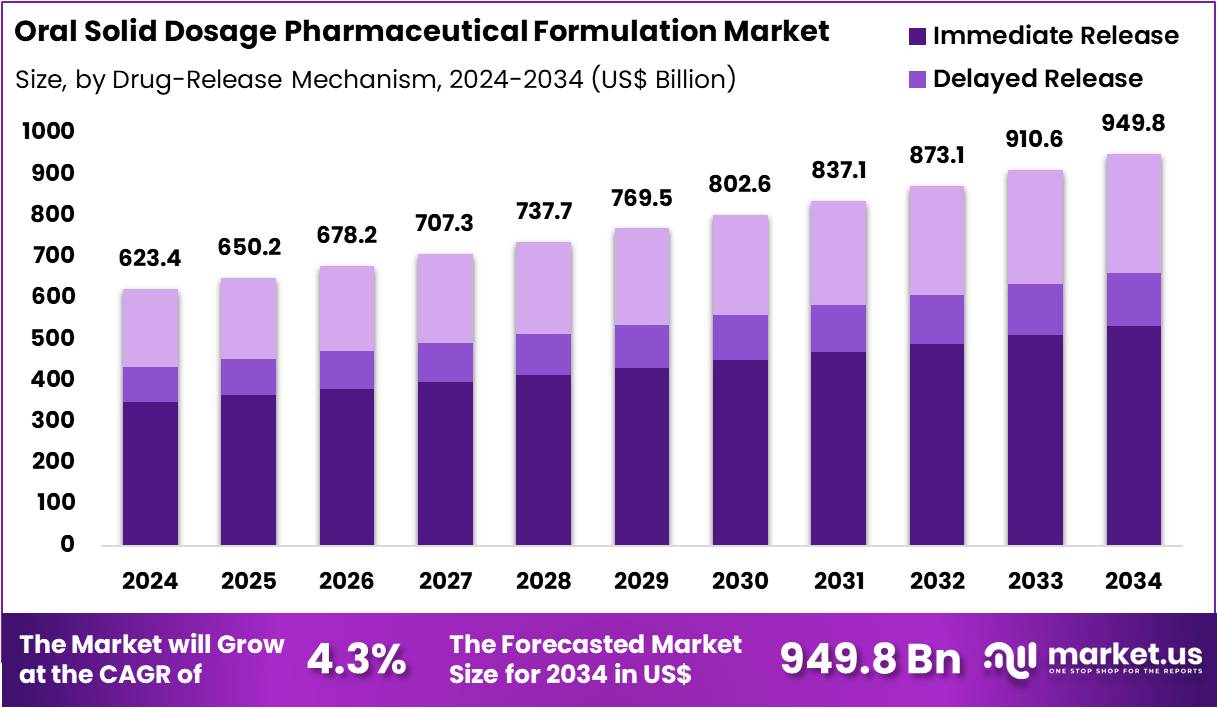
New York, NY – Aug 31, 2026 – The Global Oral Solid Dosage Pharmaceutical Formulation Market size is expected to be worth around US$ 949.8 Billion by 2034 from US$ 623.4 Billion in 2024, growing at a CAGR of 4.3% during the forecast period from 2025 to 2034. In 2024, North America led the market, achieving over 34.2% share with a revenue of US$ 213.2 Billion.
The global Oral Solid Dosage (OSD) Pharmaceutical Formulation market represents one of the most widely adopted segments of the pharmaceutical industry, driven by the increasing demand for tablets, capsules, and other solid medication forms. Oral solid dosage forms account for a significant share of prescription and over-the-counter medicines due to their advantages, including improved stability, accurate dosing, cost-effectiveness, and ease of administration.
The market is witnessing steady growth as pharmaceutical companies expand manufacturing capabilities to support rising healthcare demand, generic drug production, and advanced drug delivery technologies. According to industry estimates, the global oral solid dosage pharmaceutical formulation market is valued at several hundred billion dollars and is expected to grow at a CAGR of around 6–8% during the forecast period, supported by increasing chronic disease prevalence and pharmaceutical innovation.
Tablets remain the dominant dosage form, representing more than 50% of oral solid formulations globally due to their scalability, longer shelf life, and patient convenience. Capsules are also gaining adoption, particularly for specialized formulations, nutraceutical applications, and controlled-release therapies.
The expansion of contract development and manufacturing organizations (CDMOs), automation in pharmaceutical production, and increasing investments in continuous manufacturing technologies are further strengthening market growth. In addition, advancements such as modified-release tablets, orally disintegrating tablets, and combination drug formulations are improving therapeutic outcomes.
Growing demand for affordable medicines, rising generic drug consumption, and increasing pharmaceutical manufacturing activities in emerging economies are expected to create significant opportunities for oral solid dosage formulation providers in the coming years.
Key Takeaways
- Market Size: The global Oral Solid Dosage Pharmaceutical Formulation Market is projected to reach approximately US$949.8 billion by 2034, increasing from US$623.4 billion in 2024, driven by rising demand for cost-effective, convenient, and widely adopted drug delivery solutions.
- Market Growth: The market is expected to expand at a CAGR of 4.3% from 2025 to 2034, supported by growing pharmaceutical production, increasing prevalence of chronic diseases, and continuous advancements in oral drug formulation technologies.
- Product Type Analysis: Tablets dominated the market in 2024, accounting for 39.7% of the global share, due to their advantages such as high patient acceptance, precise dosing, longer shelf life, and widespread use across multiple therapeutic segments.
- Application Analysis: Immediate-release formulations held the leading position in 2024 with a 56.1% market share, driven by their straightforward manufacturing methods, cost efficiency, rapid therapeutic action, and strong adoption among healthcare professionals.
- End-Use Analysis: Generic oral solid dosage products captured 68.3% of the global market share in 2024, reflecting their extensive utilization due to affordability, accessibility, and increasing demand across developed and developing healthcare markets.
- Regional Analysis: North America emerged as the leading regional market in 2024, accounting for more than 34.2% of the global share with revenue of US$213.2 billion, supported by advanced pharmaceutical infrastructure, high healthcare spending, and the strong presence of major drug manufacturers.
Statistical Information
- Continuous manufacturing approaches for oral solid dosage (OSD) production were reported to reduce production time by nearly 90%, improve product quality by 40%, and increase production efficiency by 90% compared with conventional manufacturing approaches.
- Continuous pharmaceutical manufacturing systems for solid dosage production were reported to reduce energy and water consumption by 25–50% and require 30–50% less manufacturing space compared with traditional production methods.
- A 2026 pharmaceutical manufacturing scheduling study using solid oral dosage facility data achieved makespan reductions of 88.1%, 77.6%, and 54.9% across three industrial production scenarios by applying constraint-based optimization methods.
- The same 2026 solid oral dosage scheduling optimization study reduced total production tardiness by 72.1%, 58.7%, and 18.2% across three evaluated industrial cases.
- A 2025 digital formulation and self-driving tableting platform developed for tablet formulation achieved production of an in-specification tablet within 6 hours from material characterization to optimized formulation settings.
- The 2025 self-driving tableting platform operated using less than 5 grams of API while supporting small-batch manufacturing of up to 1,440 tablets for formulation development and testing.
- The same automated tablet development system completed manufacturing and real-time quality control activities within 24 hours for small-batch tablet production workflows.
- A continuous granulation-based tablet manufacturing case study reported resource consumption reductions of 10.19% at the process level, 15.21% at the plant level, and 2.38% at the overall industrial level compared with batch production.
Regional Analysis
North America maintains a leading position in the oral solid dosage (OSD) pharmaceutical formulation market due to its advanced pharmaceutical infrastructure, strong research ecosystem, and well-established regulatory environment.
Agencies such as the U.S. Food and Drug Administration support strict quality standards, encouraging innovation in tablet, capsule, and other solid dosage formulations. The region benefits from significant pharmaceutical manufacturing capabilities, increasing generic drug production, and growing demand for chronic disease treatments.
Aging populations and rising healthcare expenditure have further supported the consumption of prescription and over-the-counter oral medicines. In addition, the presence of contract development and manufacturing organizations (CDMOs), advanced formulation technologies, and strong academic research networks has accelerated product development.
Reliable supply chains, widespread healthcare access, and rapid adoption of new therapies continue to strengthen North America’s dominance in the global OSD pharmaceutical formulation market.
Emerging Trends
- Advanced Modified-Release Tablet Technologies: Pharmaceutical companies are increasingly developing modified-release tablets and capsules to improve drug effectiveness and patient convenience. In 2025, research focused on advanced coatings and polymer systems enabled controlled release over several hours. These technologies support chronic disease treatments requiring consistent drug levels.
- AI-Based Formulation and Digital Development: Artificial intelligence is emerging as a major trend in oral solid dosage development by reducing formulation trial time. In 2025, digital formulation platforms demonstrated the ability to optimize tablet properties using predictive models, automation, and quality analysis with development cycles completed within 24 hours in research settings.
- Growth of Patient-Friendly Dosage Forms: The market is shifting toward easier-to-use oral formulations, including orally disintegrating tablets, chewable tablets, and mini-tablets. These approaches address swallowing difficulties among elderly and pediatric patients. WHO emphasizes that essential medicines should be available in appropriate dosage forms to improve healthcare access globally.
- Continuous Manufacturing Adoption: Continuous manufacturing is gaining importance in oral solid dosage production because it improves process control, reduces variability, and supports flexible production. FDA initiatives in 2025 highlighted increased focus on innovative pharmaceutical manufacturing approaches to strengthen supply reliability and domestic production capabilities.
- Next-Generation Capsule Development: Capsule technologies are advancing through enteric coatings, dual-layer designs, and specialized polymers that improve stability and targeted delivery. Research published in 2025 highlighted applications for sensitive molecules, including peptides and advanced therapies, expanding capsule use beyond traditional small-molecule medicines.
Use Cases
- Chronic Disease Management Applications: Oral solid dosage products remain widely used for long-term disease management, including cardiovascular, diabetes, and neurological treatments. WHO’s 2025 Essential Medicines List included more than 520 medicines, demonstrating the continued importance of reliable tablet and capsule formulations for global healthcare systems.
- Pediatric and Geriatric Medication Solutions: OSD formulations are increasingly customized for children and older adults through smaller tablets, dispersible formulations, and improved swallowing characteristics. WHO’s Essential Medicines framework includes 374 medicines specifically for children in the 2025 edition, supporting demand for age-appropriate dosage forms.
- Targeted Gastrointestinal Drug Delivery: Advanced oral formulations are being used for targeted gastrointestinal delivery through pH-sensitive coatings and controlled-release systems. These approaches help protect active ingredients from stomach conditions and improve absorption. Recent capsule research highlighted improved delivery strategies for complex molecules requiring enhanced stability.
- Generic Drug Manufacturing Expansion: Oral solid dosage formulations are widely applied in generic medicine production because tablets and capsules offer scalability, stability, and cost advantages. Over 150 countries use national essential medicine lists based on WHO guidance, supporting continued demand for affordable oral medicines.
- Combination Therapy and Polypharmacy Management: Fixed-dose combination tablets are increasingly used to simplify treatment by combining multiple active ingredients into a single dose. Emerging polypill technologies are being explored for personalized therapies, enabling controlled release patterns and improving medication adherence in complex treatment areas.
Frequently Asked Questions on Oral Solid Dosage Pharmaceutical Formulation
- What are the most common types of Oral Solid Dosage formulations?
The most common oral solid dosage formulations include tablets, capsules, granules, and powders. Tablets dominate due to their manufacturing efficiency, accurate dosage delivery, cost-effectiveness, and availability in immediate-release, extended-release, and delayed-release formats. - Why are tablets widely preferred in pharmaceutical manufacturing?
Tablets are widely preferred because they provide high stability, easy handling, accurate dosing, and lower production costs. They can also incorporate advanced technologies such as film coating and controlled-release mechanisms to improve drug performance and patient convenience. - What are the key advantages of Oral Solid Dosage medicines?
Oral solid dosage medicines offer several advantages, including longer shelf life, easier transportation, better storage conditions, precise dosing, and improved patient acceptance. These benefits make them one of the most widely manufactured and consumed pharmaceutical dosage forms. - What factors are driving the Oral Solid Dosage Pharmaceutical Formulation Market growth?
Market growth is driven by rising chronic disease cases, increasing demand for generic medicines, pharmaceutical manufacturing expansion, and advancements in formulation technologies. Growing healthcare access and demand for affordable medications are further supporting global adoption of oral solid dosage products. - How are advanced technologies changing oral solid dosage manufacturing?
Technologies such as continuous manufacturing, automation, artificial intelligence, and advanced coating systems are improving production efficiency and quality control. These innovations help pharmaceutical companies reduce manufacturing errors, optimize processes, and develop more effective oral solid dosage medicines. - What role do generic drugs play in the Oral Solid Dosage Market?
Generic drugs play an important role by providing affordable alternatives to branded medicines. Increasing patent expirations, healthcare cost reduction initiatives, and rising demand for accessible treatments are encouraging pharmaceutical companies to expand generic oral solid dosage production. - What is the future outlook for the Oral Solid Dosage Pharmaceutical Formulation Market?
The future outlook remains positive due to increasing medicine demand, technological advancements, and expanding pharmaceutical production. Companies are focusing on innovative formulations, personalized medicines, and sustainable manufacturing practices to improve efficiency and support long-term market development.
Conclusion
The global oral solid dosage pharmaceutical formulation market is expected to maintain steady growth, supported by increasing chronic disease prevalence, aging populations, and strong demand for convenient drug delivery solutions.
Tablets and capsules continue to dominate due to their stability, affordability, and patient acceptance, while innovations in modified-release technologies, personalized formulations, and advanced manufacturing processes are creating new opportunities. Continued pharmaceutical investments and regulatory support will further strengthen market expansion globally.
Discuss your needs with our analyst
Please share your requirements with more details so our analyst can check if they can solve your problem(s)




