


Overview
New York, NY – Sep 21, 2026 – The Global Phytopathological Disease Diagnostics Market size is expected to be worth around US$ 169.0 Million by 2034 from US$ 107.8 Million in 2024, growing at a CAGR of 4.6% during the forecast period 2025 to 2034. In 2024, North America led the market, achieving over 36.6% share with a revenue of US$ 39.5 Million.
Phytopathological Disease Diagnostics is gaining importance as crop diseases increasingly threaten agricultural productivity, food security, and farmer incomes. Phytopathological diagnostics are used to identify fungal, bacterial, viral, and nematode pathogens through techniques such as PCR, ELISA, lateral-flow assays, microscopy, immunoassays, and DNA/RNA sequencing.
Growing demand for rapid and accurate pathogen identification is encouraging adoption across agricultural laboratories, research institutions, seed companies, farms, and plant quarantine facilities.
The scale of the challenge is substantial. According to the Food and Agriculture Organization (FAO), plant pests and diseases can cause losses of up to 40% of global crop production annually, while the associated economic damage exceeds US$ 220 billion each year. FAO also estimates that plant pests and diseases can reduce global crop yields by approximately 20% to 40% per year, creating strong demand for early detection and disease-management technologies.
Food-security requirements are another major growth driver. FAO indicates that global food production needs to increase by approximately 50% by 2050, while 80% of the additional food demand is expected to come from plant products. In 2025, FAO further highlighted that transboundary pests and diseases destroy up to 40% of global crops annually.
Technological development is shifting diagnostics toward portable PCR systems, multiplex testing, sequencing, digital imaging, biosensors, and AI-assisted disease recognition. Faster field-level testing can support early intervention, reduce unnecessary pesticide applications, improve crop yields, and strengthen plant biosecurity.
Climate change and the increasing movement of agricultural products are further increasing the need for rapid pathogen surveillance and reliable diagnostic infrastructure.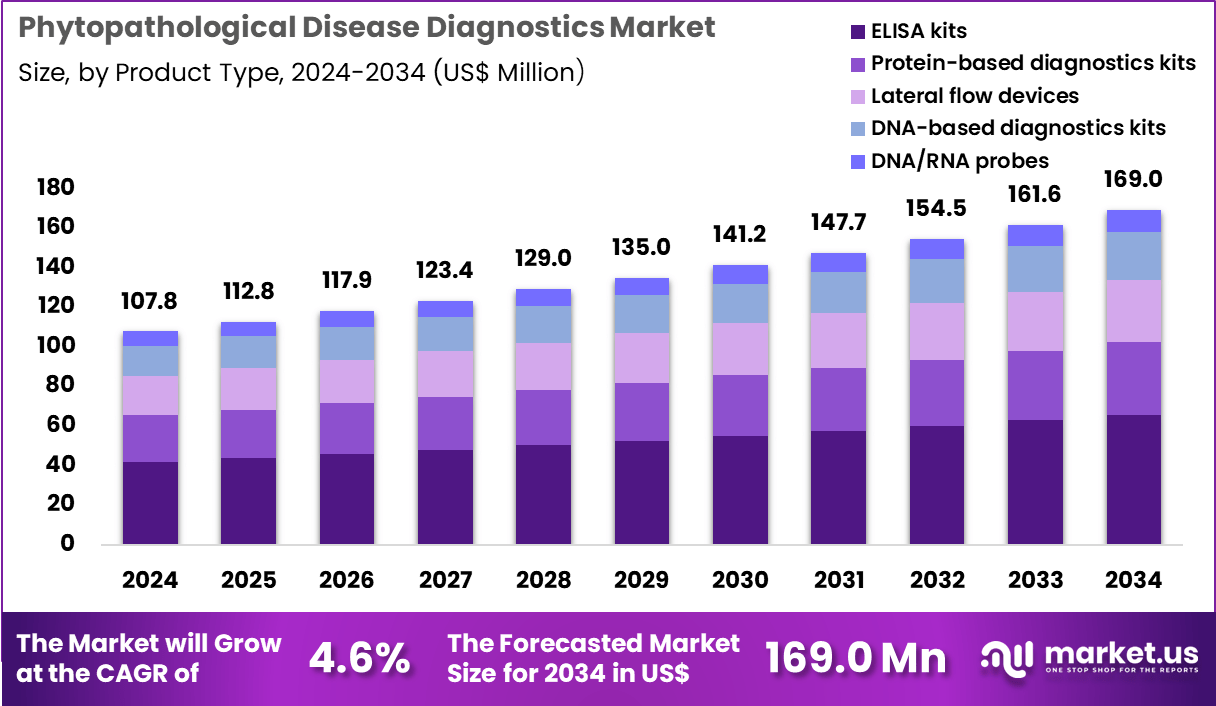
Key Takeaways
- In 2024, the Phytopathological Disease Diagnostics Market generated revenue of US$ 107.8 million and is projected to expand at a CAGR of 4.6%, reaching approximately US$ 169.0 million by 2034.
- By product type, the market includes ELISA kits, protein-based diagnostic kits, lateral flow devices, DNA-based diagnostic kits, and DNA/RNA probes. ELISA kbits dominated in 2024, accounting for a 38.9% market share.
- Based on test type, the market is segmented into PCR-based assays, serological tests, microarray assays, isothermal amplification assays, and electronic technology-based tests. PCR-based assays represented the leading segment, with a 44.1% share.
- By sample type, the market comprises plants, seeds, grains, and fruits. The plants segment held the largest position in 2024, representing 53.4% of total market revenue.
- Based on end user, the market is categorized into agricultural laboratories, food processing laboratories, contract research organizations, academic and research institutes, and others. Agricultural laboratories led the segment with a 47.5% revenue share.
- Regionally, North America maintained its leading position in the Phytopathological Disease Diagnostics Market in 2024, accounting for approximately 36.6% of the global market share.
Market Segmentation Overview
- Product Type Analysis: ELISA kits, accounting for 38.9% of the market, are expected to maintain dominance due to their cost-effective and practical pathogen detection capabilities. These kits support early identification of bacterial, viral, and fungal infections across farms and greenhouses. Their simple workflow, limited equipment requirements, rapid results, and suitability for large-scale screening encourage adoption in agricultural disease surveillance programs.
- Test Type Analysis: PCR-based assays, holding 44.1%, are projected to remain the leading test type because of their high sensitivity and ability to detect low pathogen concentrations during early infections. PCR supports accurate identification of plant pathogens and strains, quarantine testing, phytosanitary certification, and outbreak management. Increasing adoption of portable PCR systems and advances in molecular diagnostics further strengthen segment growth.
- Sample Type Analysis: Plants, representing 53.4% of the market, are expected to remain the dominant sample type because plant tissue provides direct evidence of pathogen infection and disease progression. Regular testing helps identify symptomatic and asymptomatic infections before widespread crop damage occurs. Increasing crop production, climate-related disease risks, preventive monitoring, and stricter agricultural regulations support continued demand for plant-based diagnostics.
- End-User Analysis: Agricultural laboratories, accounting for 47.5%, are anticipated to remain the leading end-user segment due to their role in crop disease investigation, pathogen identification, and certification. These laboratories support government surveillance and commercial farming operations while adopting automated molecular testing technologies. Growing agricultural trade, precision farming, emerging phytopathogens, and stricter phytosanitary requirements are further increasing laboratory-based diagnostic demand.
Statistical Information
- qPCR Detected Plant Pathogens Directly From Crude Extracts: The qPCR protocol detected citrus and potato pathogens directly from crude plant extracts without DNA purification. At the analytical detection limit, mean quantification-cycle values were 37.2 ± 0.2 for lemon extracts, 34.8 ± 0.0 for mandarin extracts, and 35.1 ± 0.1 for potato extracts. Eliminating DNA-purification steps can reduce reagent use, operator time, and turnaround time in high-volume plant-diagnostic laboratories.
- Global Crop Losses from Plant Pests and Diseases: Plant pests and diseases create a major global need for crop-health monitoring and diagnostics. FAO reports that up to 40% of global food crops are lost annually because of plant pests and diseases, while economic losses associated with agricultural trade exceed US$220 billion every year.
- Wheat Disease Losses in the United States and Canada: A USDA-supported study evaluated pathogen-related wheat losses across 29 U.S. states and Ontario, Canada, covering 2018–2021. During the four years, plant pathogens were estimated to reduce wheat production by 560 million bushels, equivalent to 7.8% of total wheat production across the surveyed region.
- Wheat Disease Losses Reached US$2.9 Billion: The USDA-supported wheat assessment estimated that pathogen-related losses during 2018–2021 were worth approximately US$2.9 billion. Estimated annual losses ranged from 111 million bushels in 2018 to 188 million bushels in 2019. Average pathogen-related losses were approximately US$18.10 per acre.
- Digital PCR Detected Fewer Than Five DNA Copies: A 2025 comparison found droplet digital PCR had a limit of detection of 4.6 copies per reaction, while qPCR achieved 3.8 copies per reaction. Both methods had a limit of quantification of 8 copies per reaction. Digital PCR showed lower bias at 0.9% and a relative standard deviation of 10.4%, supporting its value in precise low-concentration pathogen quantification
- Digital PCR Raised Soil Sample Positivity By Twelve Points: A 2025 plant-pathogen study analysed 68 infected tobacco-root samples and 145 surrounding-soil samples. Droplet digital PCR produced a 96.4% positive rate, compared with 83.9% for qPCR, an improvement of 12.5 % points. Diagnostic ROC area under the curve was 0.913 for ddPCR versus 0.885 for qPCR, supporting use in low-pathogen soil surveillance.
- Fungal qPCR Reached One Hundred Per cent Replicate Detection: A fungal plant-pathogen qPCR assay detected pure target DNA at 100 femtograms per reaction. In plant-pathogen DNA mixtures, the validated limit was 1 picogram per reaction, which is 10 times higher due to plant-DNA interference. The assay detected pathogen DNA in 100% of 24 replicates tested above the validated threshold. Such reliability supports diagnostic use for pathogen quantification in complex plant samples.
- Portable Plant Test Delivered Ninety-Six Laboratory Correlation: A field trial of a portable plant-disease diagnostic product reported 96% correlation with laboratory-based diagnosis. The Pocket Diagnostic test returned results in approximately 3–10 minutes and cost $10–$20 per test. This represented approximately 10%–20% of the cost of conventional laboratory testing, supporting use in nurseries, crop fields, glasshouses, plant-trade inspections, and rapid disease-screening programmes.
Regional Analysis
North America led the market by securing a market share of 36.6% in 2024.
North America has strong plant-disease diagnostic infrastructure supported by extensive government and university laboratory networks. In the U.S., the National Plant Diagnostic Network is led by 5 regional laboratories and 1 support laboratory, while the Southern Plant Diagnostic Network connects 11 states and 1 U.S. territory. USDA also estimates that crop losses from plant pathogens that did not originate in the U.S. cost approximately US$21 billion annually. USDA APHIS further uses PCR, molecular diagnostics, and high-throughput sequencing for regulated pathogens.
Asia Pacific faces substantial plant-health pressures from transboundary diseases affecting major food crops. FAO reports that transboundary plant diseases cause approximately US$43.8 billion in recurring annual losses across eight major crops in the region.
A regional assessment covering 11 Asia-Pacific countries identified 23 priority diseases, including 6 bacterial, 11 fungal, and 5 viral diseases; 42% were associated with cereal crops such as rice, wheat, barley, and corn. These pressures support greater investment in surveillance, molecular diagnostics, and coordinated plant-health systems.
Business Opportunities
The Phytopathological Disease Diagnostics Market presents significant business opportunities as agricultural producers seek faster and more accurate pathogen detection. Companies can develop portable PCR, LAMP, ELISA, biosensor, and lateral-flow systems for rapid field testing, reducing dependence on centralized laboratories. High-throughput laboratories can expand multiplex PCR and sequencing services to simultaneously identify bacterial, fungal, viral, and viroid pathogens.
Digital agriculture creates opportunities for AI-based disease recognition, drone-assisted crop monitoring, remote sensing, and mobile diagnostic platforms. Increasing international movement of agricultural products also supports growth in phytosanitary testing and certification services, particularly for exporters and quarantine authorities. Another opportunity exists in clean-plant certification, where nurseries and breeding programs require regular pathogen screening of propagation materials.
Companies can also develop specialized assays for emerging pathogens and provide contract diagnostic services to agricultural laboratories, universities, seed producers, and biotechnology firms. Integrating laboratory diagnostics with GIS, predictive analytics, and real-time surveillance could further create comprehensive plant-health management solutions.
Emerging Trends
- Multiplex PCR Diagnostics: USDA is developing multiplex molecular assays capable of detecting multiple plant pathogens in fewer reactions. A 2025–2026 USDA project is developing a 4-reaction multiplex assay for citrus bacterial pathogens, supporting faster and more specific disease identification.
- High-Throughput Sequencing: USDA APHIS is using Illumina and MinION sequencing technologies for plant-virus diagnostics. This trend enables laboratories to identify known and potentially unknown pathogens and strengthens agricultural biosecurity and disease surveillance.
- Digital Disease Surveillance: USDA’s National Plant Diagnostic Network includes 5 regional laboratories and 1 support laboratory, supported by coordinated reporting and diagnostic information systems. Digital networks are improving communication, disease tracking, and response to emerging agricultural threats.
- Early-Warning Technologies: FAO reports that plant pests and diseases can destroy up to 40% of global crops annually. Climate change is also changing pathogen distribution, increasing adoption of early-warning systems, digital monitoring, predictive models, and rapid diagnostic technologies.
- Integrated Plant Health: Sustainable disease management increasingly combines diagnostics with continuous monitoring and early intervention. FAO emphasizes integrated approaches because approximately 80% of the world’s food supply comes from plants, making rapid disease identification important for protecting agricultural productivity and food security.
Use Cases
- Crop Disease Detection: Diagnostic tests help farmers and laboratories identify bacterial, fungal, viral, and viroid infections before diseases spread widely. USDA laboratories use PCR, sequencing, and other molecular methods to confirm regulated pathogens and support timely crop-protection decisions.
- Plant Quarantine: Phytopathological diagnostics are used to screen imported plants and planting materials for regulated pathogens. USDA APHIS combines ELISA, PCR, electron microscopy, and high-throughput sequencing in quarantine programs to prevent infected materials from entering agricultural production systems.
- Seed Health Testing: Molecular diagnostics can identify pathogens carried through seeds before planting. USDA research is developing high-throughput testing methods for bacterial, fungal, viral, viroid, and oomycete pathogens, helping improve seed health and reduce disease transmission between growing seasons.
- Disease Surveillance: Government diagnostic networks use laboratory results and digital reporting to track emerging plant diseases. The USDA National Plant Diagnostic Network includes 5 regional laboratories and 1 support laboratory, helping coordinate disease identification and improve responses to agricultural outbreaks.
- Early Disease Warning: Diagnostic information can support early-warning systems that identify disease threats before major crop losses occur. FAO reports that plant pests and diseases can affect up to 40% of global crops annually, making early detection important for food security and sustainable crop protection.
Recent Development
- In June 2026, Neogen Corporation offered a 10% discount on its Molecular Detection System bundle in the U.S. and Canada through August 31, 2026. The system supports simultaneous testing for multiple pathogens and provides same- or next-day results.
- In June 2026, Eurofins Scientific SE completed the acquisition of Laboratoř Postoloprty, an agricultural testing laboratory in the Czech Republic with 35+ years of experience and 30 employees. The laboratory provides soil, plant, fertilizer, water, and other agricultural analyses.
- In 2026, Intertek Group PLC continued expanding agricultural DNA testing through its AgriTech services. The company uses DNA and protein analysis for pathogen screening, marker-assisted breeding, GMO testing, species identification, and seed and crop testing.
- In 2026, Bureau Veritas SA continued providing agricultural testing services covering plants, water, fertilizers, and phytosanitary products. Its agricultural services also include precision-farming solutions such as drone-based crop monitoring and related inspection capabilities.
- In 2026, SGS SA continued strengthening seed and agricultural laboratory testing services, including seed and grain analysis and phytosanitary testing. Its agricultural testing capabilities support crop quality assessment and international export requirements.
- In 2026, Bio-Rad Laboratories, Inc. continued advancing digital PCR technologies for sensitive molecular analysis. Its droplet digital PCR platforms support precise nucleic-acid quantification and applications in pathogen and biological research.
- In 2026, Romer Labs Division Holding GmbH continued providing analytical testing solutions covering mycotoxins, allergens, GMOs, and microbial contaminants, supporting quality and safety testing throughout agricultural and food supply chains.
Frequently Asked Questions About Phytopathological Disease Diagnostics
- What is the Phytopathological Disease Diagnostics Market?
The Phytopathological Disease Diagnostics Market covers diagnostic kits, instruments, testing services, and technologies used to identify plant pathogens. These solutions support farmers, laboratories, researchers, seed producers, and regulatory authorities in preventing crop diseases and reducing agricultural losses. - What factors are driving market growth?
Growing crop losses from plant diseases, increasing international agricultural trade, climate-related pathogen spread, stronger phytosanitary regulations, and greater adoption of molecular testing are supporting demand for faster and more accurate phytopathological disease diagnostic solutions. - Which diagnostic technologies are widely used?
Common technologies include PCR, quantitative PCR, ELISA, lateral-flow assays, DNA and RNA probes, microscopy, sequencing, and isothermal amplification. Molecular methods are increasingly important because they can identify pathogens with greater specificity and sensitivity than symptom-based diagnosis. - What role does PCR play in plant disease diagnosis?
PCR enables detection of specific pathogen DNA or RNA, including infections that may not yet produce visible symptoms. Its sensitivity and specificity make it useful for quarantine testing, crop surveillance, seed testing, pathogen confirmation, and research applications. - How is sequencing changing plant disease diagnostics?
Sequencing can identify known pathogens and help characterize previously unrecognized organisms or pathogen strains. High-throughput sequencing allows laboratories to analyze complex samples and provides broader genetic information for surveillance, outbreak investigation, pathogen characterization, and agricultural biosecurity. - Who uses phytopathological disease diagnostic services?
Major users include agricultural laboratories, government quarantine agencies, universities, research institutions, seed companies, growers, food-processing organizations, biotechnology companies, and contract research laboratories requiring reliable information about plant pathogens and crop health. - What opportunities exist for diagnostic companies?
Companies can develop portable molecular testing systems, rapid field kits, high-throughput laboratory platforms, sequencing services, digital surveillance tools, and pathogen-specific assays. Integrated solutions combining diagnostics, artificial intelligence, remote sensing, and predictive analytics also offer opportunities. - Which region has strong market potential?
North America has strong potential because of established agricultural laboratories, government-supported plant-health networks, advanced molecular technologies, and extensive agricultural production. Europe also benefits from strict phytosanitary requirements, while Asia Pacific faces substantial disease-management needs across major crop-producing economies.
Conclusion
The Phytopathological Disease Diagnostics Market is gaining importance as plant diseases, invasive pathogens, climate variability, and international agricultural trade increase pressure on global crop production. Diagnostic technologies such as PCR, ELISA, sequencing, molecular assays, and rapid testing systems are improving the speed and accuracy of pathogen identification.
Government-supported surveillance networks and laboratory infrastructure are further strengthening disease monitoring and agricultural biosecurity. North America benefits from advanced diagnostic capabilities, while Asia Pacific offers opportunities due to significant crop production and emerging disease threats.
Future growth is expected through portable diagnostics, high-throughput testing, digital surveillance, AI-based detection, and integrated early-warning solutions that support sustainable crop protection and food security.
Discuss your needs with our analyst
Please share your requirements with more details so our analyst can check if they can solve your problem(s)




