


Overview
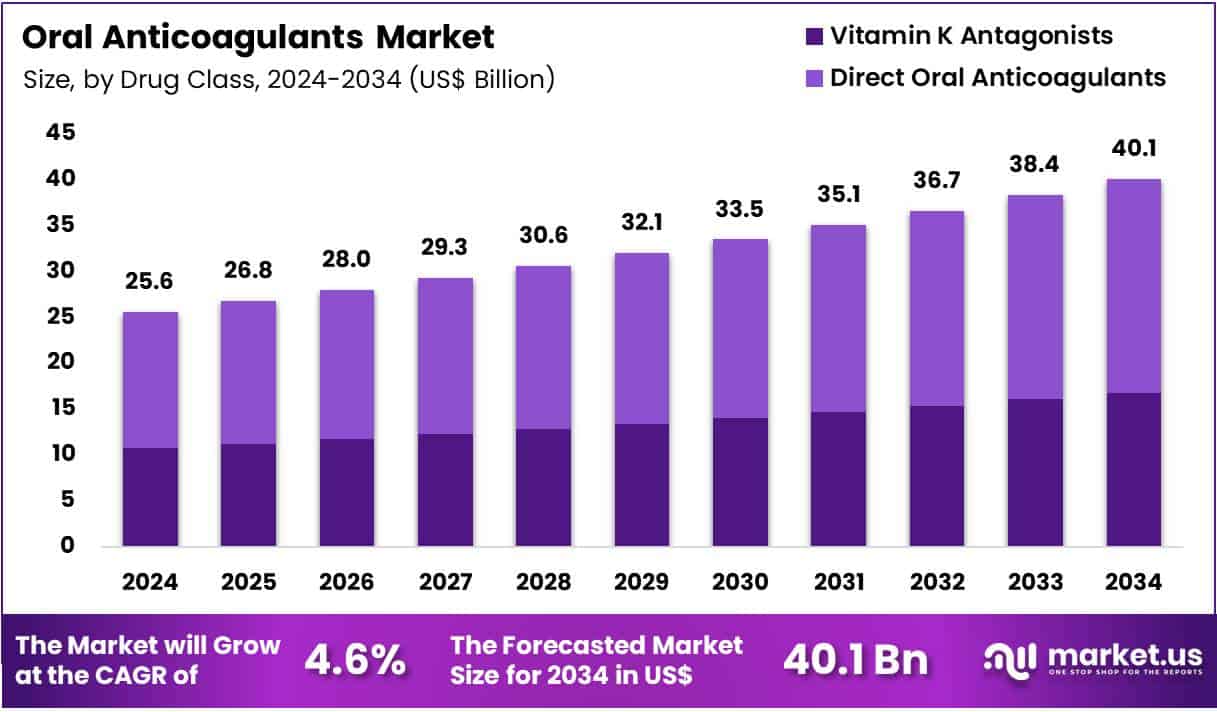
New York, NY – Aug 31, 2026 – The Global Oral Anticoagulants Market size is expected to be worth around US$ 40.1 Billion by 2034 from US$ 25.6 Billion in 2024, growing at a CAGR of 4.6% during the forecast period from 2025 to 2034. In 2024, North America led the market, achieving over 40.5% share with a revenue of US$ 10.4 Billion.
The global oral anticoagulants market is witnessing steady growth as the burden of cardiovascular diseases, atrial fibrillation, deep vein thrombosis (DVT), and pulmonary embolism (PE) continues to rise worldwide. Oral anticoagulants help prevent harmful blood clots and reduce the risk of stroke and other serious cardiovascular complications.
According to the World Health Organization (WHO), cardiovascular diseases are responsible for approximately 17.9 million deaths each year, representing around 32% of all global deaths, highlighting the growing need for effective anticoagulant therapies.
Direct Oral Anticoagulants (DOACs), including factor Xa inhibitors and direct thrombin inhibitors, are increasingly replacing traditional vitamin K antagonists due to their predictable dosing, fewer dietary restrictions, and reduced need for routine blood monitoring. Growing awareness of stroke prevention and improved clinical guidelines are supporting wider adoption across hospitals and outpatient settings.
The aging global population is another key market driver. According to the United Nations, the number of people aged 65 years and above is projected to reach 1.6 billion by 2050, significantly increasing the population at risk of thromboembolic disorders.
In addition, the Centers for Disease Control and Prevention (CDC) estimates that about 12.1 million people in the United States could have atrial fibrillation by 2030, further strengthening demand for long-term anticoagulant treatment.
Continuous product innovation, expanding regulatory approvals, and increasing healthcare investments are expected to support sustained market growth over the coming decade, making oral anticoagulants an essential segment of modern cardiovascular care.
Key Takeaways
- Market Size: The global Oral Anticoagulants market was valued at US$25.6 billion in 2024 and is projected to reach US$40.1 billion by 2034.
- Market Growth: The market is anticipated to expand at a CAGR of 4.6% during the forecast period from 2025 to 2034.
- Drug Class Analysis: In 2024, Direct Oral Anticoagulants (DOACs) held the leading position, accounting for 58.1% of the global market share.
- Indication Analysis: Non-valvular Atrial Fibrillation (NVAF) emerged as the largest indication segment in 2024, capturing 41.2% of the market share.
- Distribution Channel Analysis: Retail Pharmacies dominated the distribution landscape in 2024, contributing 48.7% of the overall market share
- Regional Analysis: North America remained the leading regional market in 2024, accounting for more than 40.5% of the global market and generating US$10.4 billion in revenue.
Statistical Information
- Four-factor prothrombin complex concentrate (4F-PCC) administered at 25–50 U/kg achieved effective haemostasis in 69.1% of patients treated for major bleeding associated with factor Xa inhibitors, according to evidence summarized in the 2025 guideline.
- The same guideline reports a 2.3% thromboembolic event rate following 4F-PCC treatment for major DOAC-related bleeding.
- Activated prothrombin complex concentrate (FEIBA) is recommended at a dose of 25–50 U/kg for the management of life-threatening DOAC-related bleeding when clinically appropriate.
- The 2025 guideline recommends resuming oral anticoagulation 1–6 weeks after a major bleeding event, depending on individual thrombotic and bleeding risks.
- A 2026 American College of Cardiology scientific statement reports that nonadherence to long-term oral anticoagulants can reach 30% in real-world practice, highlighting the need for adherence monitoring programs.
- A 2025 real-world cohort study evaluated 163,593 patients receiving oral anticoagulants for venous thromboembolism recurrence prevention, providing one of the largest comparative effectiveness datasets published during 2025.
- The 2025 DOAC guideline recommends using a fixed-dose regimen for routine therapy without routine coagulation monitoring, reflecting continued emphasis on simplified anticoagulation management compared with vitamin K antagonists.
Regional Analysis
North America dominated the oral anticoagulants market in 2024, accounting for over 40.5% of global revenue, supported by a high prevalence of atrial fibrillation, venous thromboembolism, and other cardiovascular diseases.
Strong reimbursement systems, advanced healthcare infrastructure, and widespread adoption of direct oral anticoagulants (DOACs) accelerated regional growth. Clinical guidelines from major health organizations also encouraged the use of newer anticoagulants over traditional therapies.
Europe remained a significant market, driven by its aging population, universal healthcare systems, and broad access to innovative anticoagulant medicines. Favorable treatment guidelines and increasing awareness of stroke prevention continued to support demand.
Asia-Pacific registered the fastest growth due to expanding healthcare coverage, rising cardiovascular disease cases, growing healthcare investments, and improving access to advanced medicines. Increased availability of generic oral anticoagulants further boosted adoption across developing economies.
Latin America and the Middle East & Africa experienced steady expansion, supported by improving healthcare infrastructure, increasing diagnosis of thrombotic disorders, and gradual access to anticoagulant therapies, although reimbursement limitations and unequal healthcare access continued to restrain faster market growth.
Emerging Trends
- Direct Oral Anticoagulants (DOACs) are replacing warfarin: Clinical guidelines released in 2025 continue to recommend DOACs as the preferred treatment for most patients with atrial fibrillation and venous thromboembolism because they provide similar protection with a lower risk of intracranial bleeding and do not require routine INR monitoring.
- Growing availability of generic medicines: In May 2025, the U.S. FDA approved 7 generic rivaroxaban tablet products, increasing competition and improving patient access to oral anticoagulant therapy for stroke prevention and thromboembolic disorders.
- Greater focus on personalized dosing: The latest 2025 DOAC guidance emphasizes dose selection based on kidney function, age, body weight, and bleeding risk. This trend supports safer prescribing while reducing complications during long-term anticoagulant therapy.
- Expansion of perioperative anticoagulation management: Healthcare providers are increasingly following standardized 2025 protocols for temporary interruption and restarting of DOACs around surgeries. These recommendations help lower bleeding events while maintaining protection against thrombosis in high-risk patients.
- Improved bleeding management strategies: New clinical guidance highlights the increasing use of specific reversal agents and structured emergency treatment pathways for major bleeding. These protocols improve physician confidence and encourage broader adoption of DOAC therapy across hospitals.
Use Cases
- Stroke prevention in atrial fibrillation: Oral anticoagulants are widely prescribed for patients with non-valvular atrial fibrillation to reduce stroke risk. Recent clinical recommendations identify DOACs as first-line therapy for most eligible patients because of their proven effectiveness and simplified treatment.
- Treatment of venous thromboembolism (VTE): According to the CDC (2025), up to 900,000 people in the United States develop VTE each year, with 60,000–100,000 deaths annually. Oral anticoagulants are essential for treating deep vein thrombosis and pulmonary embolism while preventing recurrence.
- Secondary prevention after blood clots: Long-term oral anticoagulant therapy is commonly used after an initial VTE episode because approximately 33% of patients experience recurrence within 10 years, making extended treatment important for high-risk populations.
- Cancer-associated thrombosis management: Modern clinical recommendations increasingly support the use of selected DOACs for many patients with cancer-associated venous thromboembolism, offering convenient oral treatment while reducing dependence on long-term injectable anticoagulants.
- Prevention of post-surgical blood clots: Oral anticoagulants are routinely prescribed after major hip and knee replacement surgeries to prevent postoperative venous thrombosis. Updated clinical guidance supports their use as an effective option for reducing hospital-associated thrombotic complications.
Frequently Asked Questions on Oral Anticoagulants
- What factors are driving the Oral Anticoagulants Market?
The market is expanding due to the growing prevalence of atrial fibrillation, venous thromboembolism, and other cardiovascular conditions. Increasing elderly populations, improved clinical guidelines, better patient compliance with oral therapies, and the introduction of safer direct oral anticoagulants are encouraging healthcare providers to prescribe these medicines more frequently worldwide. - Which drug type dominates the Oral Anticoagulants Market?
Direct oral anticoagulants (DOACs) currently dominate the market because they offer predictable anticoagulant effects, require fewer routine blood monitoring tests, and have fewer food and drug interactions than warfarin. Their ease of use, strong clinical evidence, and growing physician preference continue to support increasing adoption across healthcare systems. - Which regions hold the largest share of the Oral Anticoagulants Market?
North America leads the Oral Anticoagulants Market due to advanced healthcare infrastructure, high diagnosis rates, favorable reimbursement systems, and strong adoption of innovative therapies. Europe also represents a significant market, while Asia-Pacific is experiencing rapid growth driven by expanding healthcare access, increasing cardiovascular disease prevalence, and improving treatment awareness. - What are the main applications of oral anticoagulants?
Oral anticoagulants are primarily prescribed to prevent strokes in patients with atrial fibrillation and to treat or prevent deep vein thrombosis and pulmonary embolism. They are also used after certain orthopedic surgeries and in selected cardiovascular conditions where preventing blood clot formation significantly improves patient outcomes. - How is technology influencing the Oral Anticoagulants Market?
Digital healthcare technologies are improving anticoagulant management through electronic prescribing, remote patient monitoring, clinical decision-support systems, and mobile health applications. These innovations help physicians optimize treatment decisions, improve medication adherence, reduce adverse events, and support personalized patient care across healthcare settings. - Who are the major end users in the Oral Anticoagulants Market?
Hospitals remain the largest end users because they diagnose and manage most cardiovascular emergencies and initiate anticoagulant therapy. Specialty clinics, outpatient centers, and home healthcare services also contribute significantly, supported by increasing long-term treatment needs and the convenience of oral medications for chronic disease management. - What is the future outlook for the Oral Anticoagulants Market?
The Oral Anticoagulants Market is expected to experience steady long-term growth as cardiovascular diseases continue to increase globally. Continued research, expanded indications for direct oral anticoagulants, improved patient education, and broader access to advanced therapies are expected to strengthen market demand throughout the coming years.
Conclusion
The global oral anticoagulants market is expected to witness steady growth over the coming years, supported by the rising prevalence of atrial fibrillation, deep vein thrombosis, pulmonary embolism, and other cardiovascular disorders. Growing preference for direct oral anticoagulants (DOACs), due to their predictable dosing, lower monitoring requirements, and improved patient convenience, continues to reshape treatment practices.
Expanding healthcare access, increasing awareness of stroke prevention, and a rapidly aging population are further strengthening market demand. North America remains the leading regional market, while Asia-Pacific is expected to present significant growth opportunities as healthcare infrastructure and diagnosis rates improve.
Although challenges such as bleeding risks, high therapy costs, and limitations in certain patient populations remain, continued clinical innovation, supportive treatment guidelines, and broader access to advanced therapies are expected to sustain long-term market expansion.
Overall, the oral anticoagulants market is positioned for stable and consistent growth, driven by ongoing advancements in cardiovascular care and the increasing adoption of safer, more effective oral anticoagulant therapies worldwide.
Discuss your needs with our analyst
Please share your requirements with more details so our analyst can check if they can solve your problem(s)




