


Overview
New York, NY – Sep 22, 2026 – The Global One Step RT-qPCR Kits Market size is expected to be worth around US$ 178.2 Million by 2034 from US$ 111.5 Million in 2024, growing at a CAGR of 4.8% during the forecast period 2025 to 2034. In 2024, North America led the market, achieving over 37.7% share with a revenue of US$ 42.0 Million.
One-step RT-qPCR kits combine reverse transcription and quantitative PCR in one reaction, helping laboratories reduce processing time and simplify RNA analysis. Demand for these kits is increasing because of their applications in virus detection, gene expression analysis, cancer research, drug discovery, genetic studies, and epidemiological testing.
Virus detection represented a significant application, accounting for approximately 46.2% of the market in 2024, while probe-based detection held around a 57.4% share. Diagnostic laboratories were the leading end-user segment, representing approximately 44.7% of revenue.
By reaction capacity, 400-reaction kits accounted for about 33.8% of the market in 2024, reflecting demand from laboratories processing larger sample volumes. Kit formats include liquid, lyophilized, and master-mix formulations, providing flexibility for research and diagnostic workflows. Technological improvements in enzymes, fluorescence detection, sensitivity, and multiplex testing are further supporting adoption.
Regional demand is led by North America, which captured approximately 37.7% of global revenue in 2024, equivalent to about US$42.0 million. The United States is also expected to expand at approximately 3.0% CAGR, while China and Japan are forecast to grow at 5.3% and 5.9%, respectively.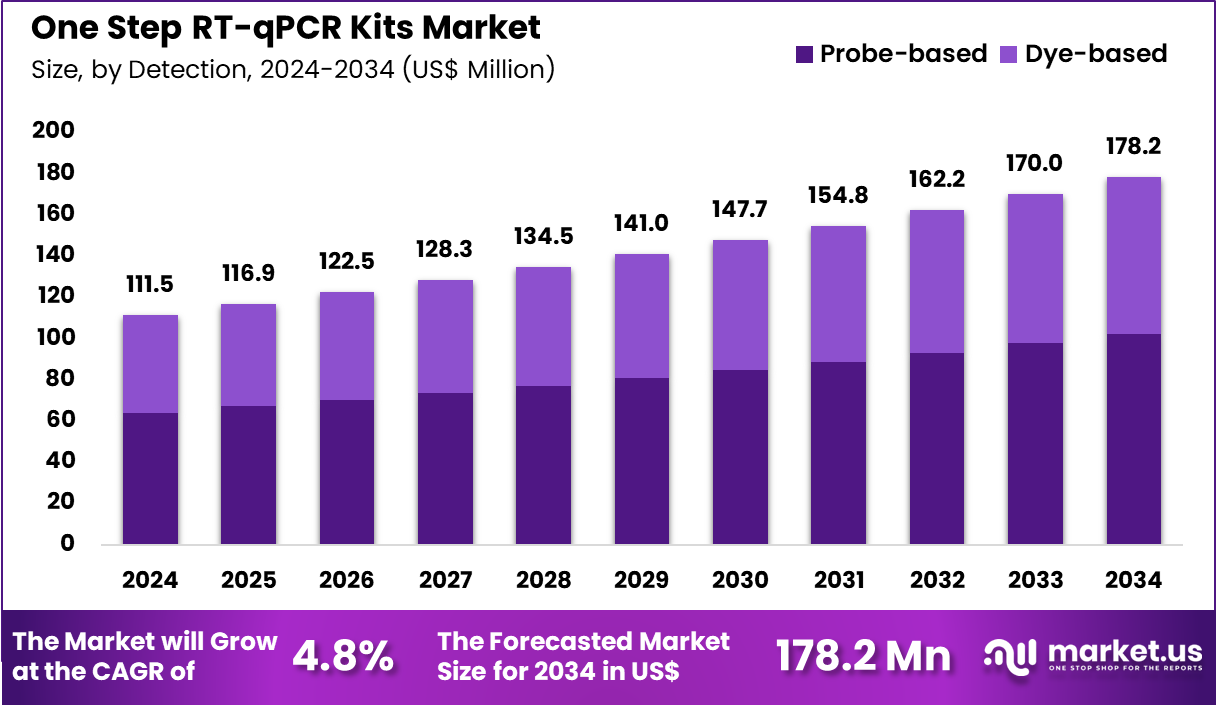
Key Takeaways
- In 2024, the One Step RT-qPCR Kits Market generated revenue of US$111.5 million, growing at a CAGR of 4.8%, and is projected to reach US$178.2 million by 2034.
- The reaction segment includes 400 rxn, 50 rxn, 25 rxn, 200 rxn, 100 rxn, and others, with the 400 rxn segment leading in 2024 with a market share of 33.8%.
- Based on application, the market is segmented into virus detection, single cell RT-PCR, multiplexing, gene expression analysis, and others. Among these, virus detection accounted for the largest share at 46.2%.
- By detection, the market is categorized into probe-based and dye-based technologies. The probe-based segment dominated the market in 2024, capturing the largest revenue share of 57.4%.
- By end user, the market is segmented into diagnostic laboratories, reference laboratories, hospitals, academic and research institutes, and others. Diagnostic laboratories held the leading position with a revenue share of 44.7%.
- North America dominated the One Step RT-qPCR Kits Market in 2024, accounting for a significant market share of 37.7%.
Market Segmentation Overview
- Reaction Analysis: 400 rxn, holding 33.8% of the market, is expected to dominate due to its suitability for high-volume molecular testing. Large-capacity kits help laboratories process more samples per batch while reducing reagent costs and workflow interruptions. Increasing infectious disease surveillance, automated testing, pandemic preparedness, and demand from high-throughput laboratories are expected to support the segment’s continued growth.
- Application Analysis: Virus detection, accounting for 46.2%, is projected to remain the leading application as demand for rapid and accurate pathogen identification increases. One Step RT-qPCR kits combine reverse transcription and amplification in a single reaction, supporting faster results. Expanding infectious disease surveillance, respiratory virus monitoring, zoonotic disease testing, and viral research are expected to strengthen segment demand.
- Detection Analysis: Probe-based detection, holding 57.4%, is expected to maintain its leading position because of its high specificity and reliable target identification. Probe-based assays are widely preferred for detecting low-concentration and multiple viral targets. Growing infectious disease diagnostics, oncology research, multiplex testing, and improvements in fluorescent probe technologies are expected to support continued adoption across molecular laboratories.
- End-User Analysis: Diagnostic laboratories, representing 44.7%, are expected to remain the leading end-user segment because they process large volumes of clinical samples. Increasing demand for rapid disease diagnosis, outbreak surveillance, and molecular confirmation testing is encouraging laboratories to adopt automated RT-qPCR workflows. Investments in diagnostic infrastructure and expanding testing networks are expected to further drive segment growth.
Statistical Information
- Probe Based One Step RT qPCR Can Detect Ten RNA Copies Per Reaction: A one-step probe-based RT-qPCR assay detected SARS-CoV-2 N-gene RNA at 10 copies per reaction. With a total reaction volume of 20 μL, this equates to roughly 500 RNA copies per mL. The reported detection threshold was comparable with some approved commercial SARS-CoV-2 diagnostic kits.
- Dye-Based One-Step Assay Required One Hundred Copies Per Reaction: In the same evaluation, a dye-based one-step RT-qPCR format detected approximately 100 RNA copies per reaction, equivalent to roughly 5,000 copies per mL. Its detection threshold was therefore 10 times higher than the probe-based workflow, which detected 10 copies per reaction. This illustrates the practical sensitivity difference that assay chemistry and detection format can create.
- Pooled Saliva Workflow Detected Five Viral Copies at Fifty Per cent Probability: A pooled-saliva RT-qPCR workflow detected 5 viral genome copies in 10 μL of isolated RNA with a 50% probability of detection. It detected 18.8 copies in the same RNA volume with 95% probability. These figures show that one-step RT-qPCR workflows can retain low-copy detection capability while using saliva-based collection approaches.
- Saliva Screening Assay Reached Eighty-Nine Point Eight Per cent Sensitivity: In a side-by-side comparison, a saliva screening RT-qPCR assay achieved 89.8% sensitivity and 100% specificity. The comparison commercial in-vitro diagnostic RT-qPCR assay achieved 73.5% sensitivity and 100% specificity in that study. This result is assay- and study-specific, but demonstrates how primer design, workflow, sample preparation, and assay optimisation affect diagnostic performance.
- Pooling Four Samples Produced No False Negative Pools: A study processed 1,475 individual clinical samples in 374 pools of four samples. The pooled RT-qPCR strategy produced a 0.8% false-positive-pool rate and no false-negative pools. Pooling can therefore increase screening throughput when infection prevalence is low, but positive pools still require follow-up testing of individual samples.
- Six-Month Weekly Screening Identified Eighteen Infections: In a 6-month weekly prophylactic testing programme involving 113 people, a two-tier RT-qPCR approach identified 18 infected individuals. This corresponds to detection in approximately 15.9% of the participants during the programme. The study reported detection of several asymptomatic infections, demonstrating the value of repeated molecular screening where early identification is operationally important.
Regional Analysis
North America led the market by securing a market share of 37.7% in 2024.
North America dominated the One Step RT-qPCR Kits Market in 2024, capturing a 37.7% market share. The region benefits from advanced molecular diagnostic infrastructure, widespread adoption of automated testing platforms, and strong demand for infectious-disease surveillance.
In the United States, CDC estimated approximately 51 million influenza illnesses, 710,000 hospitalizations, and 45,000 deaths during the 2024–2025 flu season, supporting continued demand for rapid molecular diagnostics.
Asia Pacific is projected to register the highest CAGR during the forecast period. Growing healthcare expenditure, expanding laboratory infrastructure, increasing infectious-disease surveillance, and rising biotechnology research are supporting adoption across China, Japan, India, South Korea, and Southeast Asia.
WHO continues to strengthen laboratory and genomic surveillance networks across the region to improve preparedness for emerging pathogens. Increasing pharmaceutical research and demand for gene-expression analysis are further encouraging laboratories to adopt efficient One Step RT-qPCR workflows, supporting strong regional market expansion.
Business Opportunities
The One Step RT-qPCR Kits Market presents significant business opportunities through expanding infectious disease testing, molecular diagnostics, and biotechnology research. Manufacturers can capitalize on growing demand for high-throughput kits, particularly 400-reaction formats, which support large sample volumes and improve laboratory efficiency.
The development of multiplex RT-qPCR assays provides another opportunity by enabling simultaneous detection of multiple pathogens while reducing testing time and reagent consumption. Increasing laboratory automation also creates demand for automation-compatible, ready-to-use kits that simplify workflows and minimize manual handling. Asia Pacific offers attractive expansion opportunities as healthcare infrastructure, molecular testing capacity, and pharmaceutical research continue to develop.
Companies can strengthen their presence through regional distribution partnerships and localized reagent supply. Additionally, growing applications in gene-expression analysis, oncology research, virology, and pathogen surveillance create opportunities for specialized assay development. Advances in probe chemistry, enzyme stability, and lyophilized formulations can further support product differentiation and long-term commercial growth.
Emerging Trends
- Multiplex testing is expanding: FDA guidance recognizes multiplex molecular assays that can detect several respiratory viruses in one test, including influenza A/B, RSV, parainfluenza, hMPV, rhinovirus, and adenovirus. This trend is encouraging One Step RT-qPCR kit development for faster and broader pathogen screening.
- Pathogen surveillance is becoming more advanced: WHO is strengthening genomic surveillance through the International Pathogen Surveillance Network. In 2025, WHO established 3 communities of practice focused on genomic data, emergency response, and wastewater surveillance, increasing demand for rapid molecular screening technologies.
- Wastewater testing is gaining attention: WHO identifies wastewater and environmental surveillance as an important tool for detecting pathogens circulating in communities. In 2025, WHO published surveillance summaries covering pathogens including antimicrobial resistance and arboviruses, creating new opportunities for RNA-based testing.
- Metagenomics is emerging in public health: WHO reported in 2025 that an increasing number of countries are considering metagenomics for pathogen surveillance. One Step RT-qPCR can complement these approaches by providing targeted, rapid detection before detailed sequencing and genomic analysis.
- Pandemic preparedness is strengthening: In April 2026, WHO announced US$1.8 million in catalytic funding for pathogen genomic and wastewater surveillance in low- and middle-income countries. This investment supports stronger detection systems and may increase demand for accessible molecular testing technologies.
Use Cases
- Respiratory virus detection: One Step RT-qPCR kits can support simultaneous or targeted detection of respiratory pathogens such as influenza and RSV. CDC estimated 51 million influenza illnesses and 710,000 hospitalizations in the U.S. during the 2024–2025 season, supporting continued demand for rapid molecular testing.
- Gene-expression research: One Step RT-qPCR is widely useful for measuring RNA expression because reverse transcription and amplification occur in one workflow. This helps researchers study gene activity in cancer, infectious diseases, drug development, and cellular biology, while reducing handling steps and potential contamination.
- Pathogen surveillance: Public-health laboratories can use RT-qPCR for targeted detection of RNA pathogens during routine surveillance and outbreaks. WHO’s pathogen-surveillance initiatives increasingly combine molecular testing with genomic approaches, helping laboratories identify circulating threats and select samples for deeper sequencing.
- Wastewater surveillance: RT-qPCR can detect viral RNA in wastewater samples, providing community-level information about pathogen circulation. WHO identifies wastewater surveillance as a useful public-health approach, creating opportunities for One Step RT-qPCR workflows in environmental monitoring and early outbreak detection.
- Multiplex molecular testing: One Step RT-qPCR kits can support multiplex assays designed to detect multiple targets within one reaction. FDA guidance covers respiratory viral multiplex assays, including influenza A/B and RSV, helping laboratories improve testing efficiency and provide faster differential diagnosis.
Recent Development
- In January 2026, QIAGEN announced plans to expand its QIAcuity digital PCR portfolio with thousands of new gene-expression assays, strengthening molecular biology and biopharmaceutical research applications. The expansion supports growing demand for streamlined RNA analysis and integrated PCR workflows, creating opportunities for advanced one-step RT-qPCR chemistry solutions.
- In January 2026, Roche launched the cobas BV/CV test, a PCR-based molecular diagnostic solution designed to improve vaginitis detection. The automated workflow reduces manual processing and turnaround time, supporting demand for efficient PCR technologies and simplified molecular testing workflows in clinical laboratories.
- In July 2026, Bio-Rad Laboratories launched Vericheck ddPCR Kits compatible with its QX700 platform. The kits provide sensitive DNA detection and quantification with 7-colour multiplexing, supporting biopharmaceutical quality control and cell and gene therapy workflows and strengthening demand for advanced PCR reagents.
- In March 2026, Roche launched the cobas MPX-E assay, a 4-in-1 donor screening test designed to strengthen blood-supply safety. The development highlights continued expansion of multiplex molecular testing and supports demand for high-efficiency PCR assay technologies in infectious-disease screening.
Frequently Asked Questions About One Step RT-qPCR Kits
- Which reaction segment leads the market?
The 400 rxn segment dominated the market in 2024 with a 33.8% share. Its larger reaction capacity supports high-volume laboratories, screening programs, and continuous molecular testing while helping reduce reagent costs and improve laboratory efficiency. - What factors are driving market growth?
Market growth is supported by increasing infectious-disease testing, expanding molecular diagnostics, rising biotechnology research, laboratory automation, and demand for faster RNA analysis. One Step RT-qPCR kits reduce workflow complexity by combining reverse transcription and amplification. - What are the major applications of these kits?
Major applications include virus detection, single-cell RT-PCR, multiplexing, gene-expression analysis, and molecular research. These kits are increasingly used for respiratory pathogen testing, genetic studies, pharmaceutical research, oncology investigations, and public-health surveillance programs. - What is the importance of 400-reaction kits?
400-reaction kits are important for laboratories processing large numbers of samples. Their 33.8% market share reflects demand for bulk testing formats that support high-throughput workflows, reduce frequent reagent replacement, and improve operational efficiency in molecular laboratories. - What trends are shaping the market?
Major trends include multiplex molecular testing, pathogen surveillance, laboratory automation, genomic research, and wastewater monitoring. Increasing demand for rapid detection and broader pathogen screening is encouraging manufacturers to develop more sensitive, flexible, and high-throughput RT-qPCR solutions. - What opportunities exist for market players?
Companies can pursue opportunities through multiplex assays, automation-compatible kits, lyophilized formulations, high-capacity reaction formats, and specialized research applications. Expansion across Asia Pacific and other developing markets also offers opportunities as molecular diagnostic infrastructure continues to improve.
Conclusion
The One Step RT-qPCR Kits Market is positioned for steady growth as laboratories increasingly require faster, simpler, and reliable RNA-based testing solutions. Valued at US$ 111.5 million in 2024, the market is projected to reach US$ 178.2 million by 2034, advancing at a 4.8% CAGR.
The 400 rxn segment, virus detection application, probe-based detection technology, and diagnostic laboratories remain key market contributors, holding shares of 33.8%, 46.2%, 57.4%, and 44.7%, respectively. North America led with 37.7% in 2024, while Asia Pacific offers strong future opportunities. Automation, multiplex testing, pathogen surveillance, and expanding molecular research will continue supporting market development.
Discuss your needs with our analyst
Please share your requirements with more details so our analyst can check if they can solve your problem(s)




