


Overview
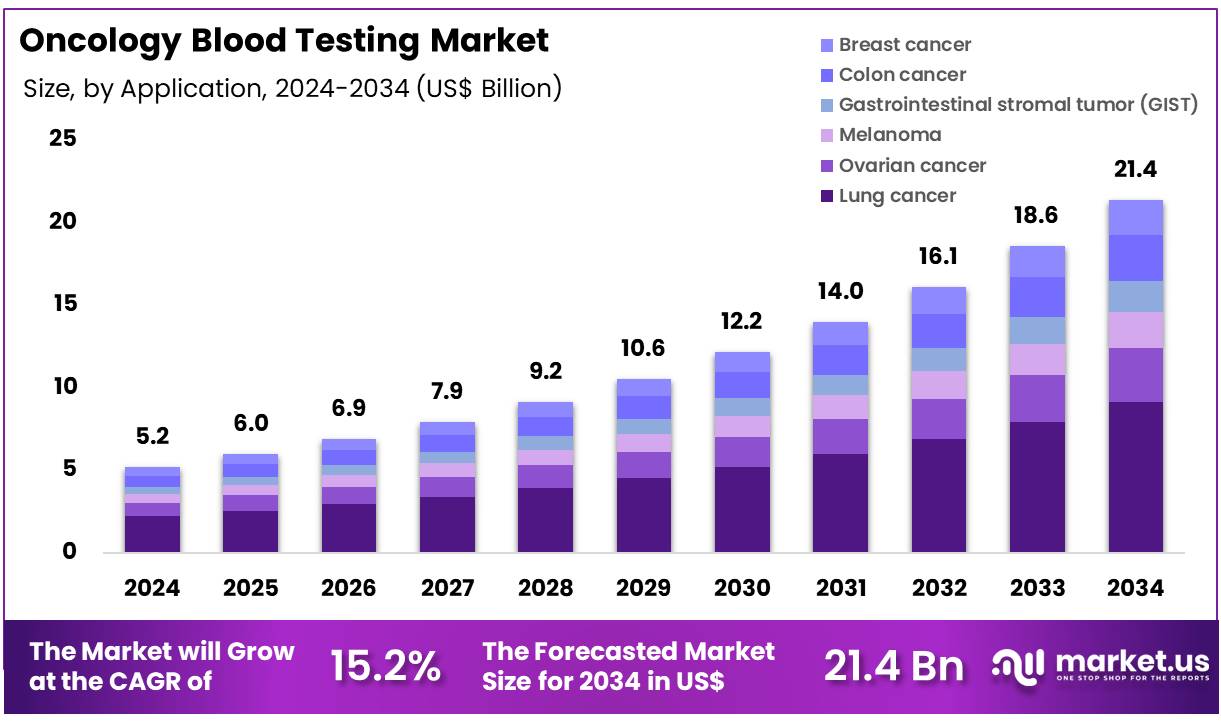
The global Oncology Blood Testing Market size is expected to be worth around US$ 21.4 Billion by 2034 from US$ 5.2 Billion in 2024, growing at a CAGR of 15.2% during the forecast period 2025 to 2034. In 2024, North America led the market, achieving over 38.8% share with a revenue of US$ 2.0 Billion.
The global oncology blood testing market is witnessing significant growth as healthcare systems increasingly adopt minimally invasive diagnostic solutions for early cancer detection, treatment monitoring, and personalized therapy selection. Oncology blood tests, including circulating tumor DNA (ctDNA) analysis, liquid biopsy, biomarker testing, and circulating tumor cell (CTC) detection, enable clinicians to identify cancer-related changes through a simple blood sample, reducing dependence on invasive tissue biopsies.
The market is expanding due to the rising global cancer burden, advancements in precision medicine, and increased adoption of molecular diagnostics. According to the World Health Organization (WHO), cancer accounted for nearly 10 million deaths in 2022, making it one of the leading causes of mortality worldwide. Growing demand for early diagnosis has accelerated investment in advanced blood-based cancer testing technologies.
Technological advancements in next-generation sequencing (NGS) and biomarker identification are improving test accuracy and supporting targeted treatment decisions. The National Cancer Institute highlights that precision medicine approaches use molecular information from tumors to guide more effective therapies. Additionally, increasing research collaborations and regulatory approvals for liquid biopsy-based solutions are strengthening market opportunities.
The oncology blood testing market is projected to experience strong expansion during the forecast period, driven by increasing cancer screening initiatives, rising healthcare expenditure, and growing adoption of personalized oncology care. With continuous innovation in genomic testing platforms and artificial intelligence-enabled diagnostics, oncology blood testing is expected to play a crucial role in transforming cancer detection and management globally.
Key Takeaways
- In 2024, the market recorded a revenue of US$ 5.2 billion and is projected to expand at a CAGR of 15.2%, reaching approximately US$ 21.4 billion by 2034.
- Based on test type, the market is categorized into liquid biopsy assays, tumor marker tests, NIPT (non-invasive prenatal testing), exome-based liquid biopsy, CTC-based tests, CBC tests, and blood protein tests. Among these, liquid biopsy assays dominated the market in 2023, accounting for a 39.6% share.
- By application, the market is segmented into lung cancer, ovarian cancer, melanoma, gastrointestinal stromal tumor (GIST), colon cancer, and breast cancer. Lung cancer emerged as the leading application segment, capturing a significant 42.7% market share.
- In terms of end users, the market is classified into hospitals, diagnostic laboratories, and specialty clinics. The hospitals segment held the largest revenue share, contributing 48.1% of the market.
- North America dominated the market in 2023, holding a 38.8% share of the global market, driven by advanced healthcare infrastructure, rising diagnostic adoption, and increasing demand for precision testing technologies.
Statistical Information
- A 2025 clinical study of routine liquid biopsy testing for solid tumors evaluated 1,243 consecutively tested patients using a 70-gene liquid biopsy panel (LBP-70) to identify genomic alterations from plasma samples for precision oncology decisions.
- A 2025 point-of-care liquid biopsy study reported that 65% of molecular liquid biopsy results were delivered within 3 days or less, while 14% of cases were completed within 1 day, demonstrating faster oncology blood testing workflows.
- A 2026 prospective multicenter validation study involving 10,074 participants reported that a metabolomics-based blood cancer detection test achieved 98.55% overall sensitivity, more than 99% specificity, and 95.62% tissue-of-origin identification sensitivity.
- A 2025 Nature Medicine study evaluating a plasma cell-free DNA fragmentomics oncology blood test reported 87.4% sensitivity, 97.8% specificity, and 82.4% tissue-of-origin prediction accuracy in an independent validation cohort.
- A 2025 multi-cancer early detection evaluation reported that an AI-enabled blood test improved specificity from 54.3% to 93.0% and achieved 51.7% sensitivity in its training cohort.
- A 2025 study of a blood-based colorectal cancer detection test reported 79.2% sensitivity for colorectal cancer detection, including 100% sensitivity for Stage II and Stage IV disease and 57.1% sensitivity for Stage I disease.
- A clinical validation study of a blood-based genomic oncology assay evaluated performance across more than 7,500 tests, more than 30,000 unique variants, more than 300 genes, and more than 30 cancer types.
- A 2025 multi-cancer blood testing study using plasma DNA analysis evaluated an independent validation cohort of 677 cancer patients and 687 non-cancer individuals, achieving 87.4% sensitivity and 97.8% specificity.
- A 2025 real-world analysis of multi-cancer early detection testing evaluated clinical experience from more than 100,000 completed tests, providing operational evidence on large-scale blood-based cancer screening deployment.
Regional Analysis
North America leads the Oncology Blood Testing Market
North America remains a major hub for oncology blood testing due to strong regulatory support, advanced diagnostic infrastructure, and rapid adoption of precision oncology technologies. In 2024, the U.S. FDA approved Guardant Shield, a blood-based colorectal cancer screening test for adults aged 45 years and older, detecting cancer-related DNA changes through a non-invasive approach. The test demonstrated 83% sensitivity for colorectal cancer detection, supporting broader adoption of liquid biopsy solutions. The region also benefits from the National Cancer Institute’s SEER program, which provides population-based cancer incidence and survival data covering approximately 48% of the U.S. population.
Asia Pacific shows strong growth potential
Asia Pacific is expected to expand rapidly as governments strengthen cancer screening programs and healthcare systems adopt next-generation sequencing and circulating tumor DNA testing. Rising colorectal and lung cancer cases are encouraging hospitals to integrate blood-based diagnostics for earlier detection and personalized treatment strategies. International cancer surveillance initiatives, including IARC data, highlight the growing regional burden and increasing need for scalable oncology testing solutions.
Emerging Trends
- Expansion of Liquid Biopsy Technology: Liquid biopsy is emerging as a major trend in oncology blood testing because it detects cancer-related biomarkers from blood instead of invasive tissue samples. FDA-approved platforms can identify hundreds of genomic alterations, with some tests analyzing 700+ genes to support precision oncology decisions and targeted therapies.
- Increasing Use of Next-Generation Sequencing (NGS): Next-generation sequencing is becoming a core technology in oncology blood testing by enabling simultaneous analysis of multiple cancer mutations from a single blood sample. Advanced NGS panels can evaluate 50–700+ genes, helping clinicians identify actionable biomarkers such as EGFR, ALK, and BRCA mutations.
- Growth of Minimal Residual Disease (MRD) Testing: MRD testing using circulating tumor DNA is gaining importance for monitoring cancer recurrence after treatment. Blood-based MRD tests can detect extremely small amounts of remaining cancer DNA, allowing earlier intervention. Research programs supported by healthcare agencies are evaluating MRD monitoring in cancers, including colorectal, breast, and lung cancer.
- Development of Multi-Cancer Early Detection Tests: Multi-cancer early detection (MCED) tests are an emerging trend focused on identifying multiple cancer types through one blood sample. Current research platforms aim to detect signals from approximately 50 cancer types, supporting future population-level screening approaches after further clinical validation.
- Integration of Artificial Intelligence in Blood Test Analysis: Artificial intelligence is increasingly being combined with oncology blood testing to improve biomarker interpretation and diagnostic accuracy. AI algorithms analyze large genomic datasets, helping identify cancer patterns, classify mutations, and support personalized treatment decisions from complex sequencing results.
Use Cases
- Early Cancer Detection and Screening: Oncology blood tests are increasingly used for detecting cancer at earlier stages when treatment options may be more effective. Blood-based screening methods analyze circulating tumor DNA, proteins, and other biomarkers to identify cancer signals without surgical procedures, improving patient access to non-invasive diagnostic approaches.
- Personalized Cancer Treatment Selection: Blood testing helps doctors select targeted therapies by identifying specific genetic mutations in tumors. Companion diagnostic tests detect biomarkers such as EGFR, ALK, ROS1, and BRCA mutations, allowing physicians to match patients with suitable treatments and avoid ineffective therapies.
- Monitoring Treatment Response: Oncology blood tests are used during treatment to measure changes in tumor biomarkers and evaluate whether therapies are working. Serial ctDNA testing can track molecular changes over time, helping healthcare providers adjust treatment strategies based on real-time biological responses.
- Detection of Cancer Recurrence: Blood-based monitoring is increasingly applied after surgery or chemotherapy to identify early signs of cancer returning. MRD tests analyze residual tumor DNA in blood samples and can detect recurrence risks months before conventional imaging methods in certain cancer types.
- Clinical Research and Drug Development: Oncology blood testing supports pharmaceutical research by providing molecular data for clinical trials. Biomarker analysis helps identify suitable participants, measure treatment effectiveness, and develop targeted medicines. More than 1,000 clinical studies globally investigate liquid biopsy and ctDNA applications across different cancer areas.
Frequently Asked Questions on Oncology Blood Testing
- How does oncology blood testing work?
Oncology blood testing works by analyzing components present in blood, such as tumor DNA fragments, cancer-associated proteins, and circulating tumor cells. Advanced technologies like liquid biopsy and genomic sequencing identify molecular changes linked to cancer development and progression. - What are the major applications of oncology blood testing?
Major applications of oncology blood testing include early cancer detection, treatment selection, monitoring therapy effectiveness, detecting minimal residual disease, and identifying cancer recurrence. These tests help healthcare providers develop targeted treatment strategies based on individual patient characteristics. - What is liquid biopsy in oncology blood testing?
Liquid biopsy is a non-invasive oncology blood testing method that detects cancer-related materials, including circulating tumor DNA and circulating tumor cells, from blood samples. It provides valuable molecular information about tumors without requiring traditional invasive tissue biopsy procedures. - Which technologies are used in oncology blood testing?
Technologies used in oncology blood testing include next-generation sequencing, polymerase chain reaction, immunoassays, digital PCR, and advanced biomarker analysis platforms. These technologies improve the identification of genetic alterations and support accurate cancer diagnosis and treatment decisions. - What are the benefits of oncology blood testing compared with traditional biopsies?
Oncology blood testing offers advantages such as minimal invasiveness, easier sample collection, faster monitoring, and the ability to detect molecular changes over time. Unlike tissue biopsies, blood tests can provide repeated information about tumor evolution and treatment response. - How is artificial intelligence impacting oncology blood testing?
Artificial intelligence is transforming oncology blood testing by improving genomic data analysis, identifying complex cancer patterns, and supporting clinical decisions. AI-powered platforms help researchers and healthcare providers interpret large datasets and develop more accurate personalized cancer treatment approaches. - What is the future outlook for the oncology blood testing market?
The future of the oncology blood testing market is expected to focus on multi-cancer early detection, advanced liquid biopsy platforms, AI integration, and improved affordability. Continuous research and innovation may increase adoption across hospitals, diagnostic centers, and cancer care facilities.
Conclusion
The oncology blood testing market is transforming cancer diagnostics by enabling faster, minimally invasive, and more accurate disease identification and monitoring. Growing demand for early cancer screening, biomarker-based testing, and precision medicine is driving the adoption of advanced blood-based technologies.
Innovations in liquid biopsy, genomic profiling, and artificial intelligence-based analysis are creating new opportunities for healthcare providers and diagnostic companies. Increasing cancer incidence worldwide and supportive regulatory developments are further accelerating market expansion. As research continues to improve test accuracy and accessibility, oncology blood testing is expected to become an essential component of personalized cancer management and modern clinical decision-making.
Discuss your needs with our analyst
Please share your requirements with more details so our analyst can check if they can solve your problem(s)




