


Overview
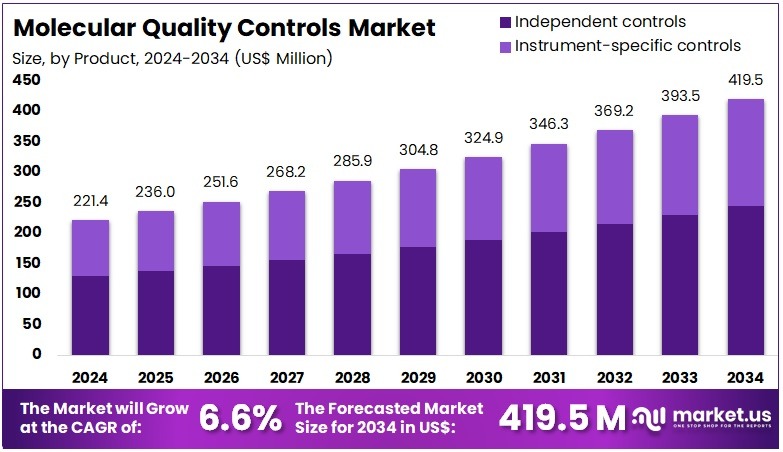
The Global Molecular Quality Controls Market Size is expected to be worth around US$ 419.5 Million by 2034, from US$ 221.4 Million in 2024, growing at a CAGR of 6.6% during the forecast period from 2025 to 2034. North America held a dominant market position, capturing more than a 37.1% share and holding US$82.1 Million market value for the year.
The global Molecular Quality Controls market is witnessing steady growth as laboratories, diagnostic centers, and healthcare providers increasingly focus on improving the accuracy and reliability of molecular testing. Molecular quality controls are essential tools used to validate the performance of diagnostic assays, monitor testing processes, and ensure consistent results in areas such as infectious disease testing, oncology diagnostics, genetic testing, and personalized medicine.
The market is driven by the rising adoption of molecular diagnostic technologies, increasing demand for laboratory standardization, and growing regulatory emphasis on quality assurance. According to healthcare organizations, millions of molecular diagnostic tests are performed annually worldwide, creating a strong need for reliable control materials. For example, the global burden of infectious diseases continues to support demand for molecular testing, with respiratory viruses, sexually transmitted infections, and emerging pathogens requiring accurate detection methods.
Technological advancements are further supporting market expansion, with manufacturers developing ready-to-use controls, multi-analyte controls, and synthetic control materials that improve workflow efficiency. In clinical laboratories, quality control programs help reduce testing errors and enhance confidence in diagnostic outcomes.
The Molecular Quality Controls market is expected to grow significantly during the forecast period, supported by increasing laboratory automation, expanding molecular testing volumes, and rising investments in precision medicine. With applications across hospitals, research institutions, and diagnostic laboratories, molecular quality controls are becoming a critical component of modern healthcare testing infrastructure. The growing emphasis on accurate, reproducible, and regulatory-compliant diagnostics will continue to create new opportunities for market participants worldwide.
Key Takeaways
- The Global Molecular Quality Controls Market is expected to reach approximately US$ 419.5 million by 2034, expanding at a CAGR of 6.6% during the forecast period from 2025 to 2034.
- In 2024, Independent Controls held the leading position in the Product Setting segment, accounting for more than 58.2% of the global molecular quality controls market share.
- Single-Analyte Controls dominated the Analyte Type Setting segment in 2024, representing a significant 56.7% share of the overall molecular quality controls market.
- The Infectious Disease Diagnostics segment emerged as the leading application area in 2024, capturing over 44.5% of the total market share.
Diagnostic Laboratories accounted for the largest share among end users in 2024, contributing approximately 34.5% to the global molecular quality controls market. - North America maintained its market leadership in 2024, holding more than 37.1% of the global market share, with a market value of nearly US$ 82.1 million.
Statistical Information
- A 2025 study developed a chikungunya virus molecular quality control reference material system containing 6 positive samples (P1–P6) and 16 negative samples (N1–N16) for nucleic acid detection quality assessment.
- The chikungunya molecular quality control reference material study evaluated stability at 4°C and 25°C for up to 3 days and tested freeze–thaw stability through 1, 2, and 3 freeze–thaw cycles without significant performance changes.
- In the 2025 chikungunya molecular QC reference material evaluation, positive sample homogeneity and stability testing achieved coefficient of variation (CV) values of below 5% across tested positive samples.
- The same 2025 reference material system assigned a nucleic acid concentration value of 7.60 ± 0.14 log10 copies/mL using digital PCR-based quantification across participating laboratories.
- A 2025 study on encapsulated synthetic RNA quality control materials tested molecular QC performance across 5 laboratories using RT-LAMP and different RT-qPCR methods.
- Encapsulated synthetic RNA molecular control materials demonstrated long-term stability with 3 years of real-time storage testing while maintaining comparable molecular assay performance to unaged controls.
- The 2025 synthetic RNA molecular QC study used RNA control materials at approximately 10⁶ copies per microliter concentration for evaluation of stability and assay suitability.
Regional Analysis
In 2024, North America dominated the Molecular Quality Controls market with a 37.1% share, generating approximately US$ 82.1 million in revenue. The region’s leadership is supported by advanced healthcare infrastructure, high adoption of molecular diagnostic technologies, and strong laboratory quality standards.
Clinical laboratories across the United States and Canada follow strict regulatory frameworks, including requirements established by the U.S. Food and Drug Administration and Clinical Laboratory Improvement Amendments (CLIA), encouraging routine use of molecular quality control materials.
Rising demand for infectious disease testing, oncology diagnostics, and genetic analysis has increased the need for accurate and reproducible results. Additionally, strong biotechnology research activity, healthcare investments, and the presence of major diagnostic companies are accelerating innovation in automated and advanced quality control solutions.
Growing emphasis on precision medicine and laboratory accuracy is expected to sustain North America’s leading position in the molecular quality controls market.
Emerging Trends
- Growing Adoption of Automated Molecular Quality Control Systems: Laboratories are increasingly shifting toward automated quality control platforms to improve accuracy and reduce manual intervention. Automated systems enable real-time monitoring, digital documentation, and faster error detection. With molecular laboratories processing thousands of samples daily, automation supports consistent testing performance and improved regulatory compliance.
- Expansion of Multiplex Molecular Testing Controls: The demand for multiplex molecular diagnostics is increasing as laboratories require controls capable of validating multiple targets in a single assay. Modern respiratory panels and infectious disease tests can detect 5–20+ pathogens simultaneously, increasing the need for advanced molecular quality controls that verify complex testing workflows.
- Integration of Digital Quality Management Platforms: Digital laboratory systems are becoming important for molecular quality control management. Laboratories are connecting quality control software with laboratory information systems (LIS) to automate reporting, monitor performance trends, and maintain records. WHO laboratory quality guidelines emphasize documented processes, monitoring, and continuous improvement in diagnostic laboratories.
- Rising Demand From Infectious Disease Surveillance Programs: Molecular quality controls are gaining importance due to increasing infectious disease surveillance activities. Public health laboratories use control materials and proficiency testing programs to validate PCR and sequencing methods. WHO-supported laboratory networks use external quality assessments to improve reliability for pathogen detection and outbreak monitoring.
- Increasing Role in Precision Medicine and Genomic Testing: Precision medicine growth is creating demand for advanced molecular controls used in genetic testing and oncology diagnostics. Laboratories require validated reference materials to confirm mutation detection accuracy. Quality controls support reliable identification of biomarkers, helping healthcare providers make accurate treatment decisions based on molecular test results.
Use Cases
- Infectious Disease Molecular Testing: Molecular quality controls are widely used in PCR-based testing for infectious diseases such as COVID-19, influenza, and respiratory infections. Laboratories use positive and negative controls during testing runs to confirm reagent performance, instrument accuracy, and reliable patient results. WHO recommends quality management systems for diagnostic testing accuracy.
- Cancer Biomarker Testing and Companion Diagnostics: Molecular quality controls support cancer diagnostics by validating tests that detect genetic mutations and biomarkers. Oncology laboratories use controls to confirm assay sensitivity and accuracy before reporting patient results. These controls are essential for targeted therapies where treatment decisions depend on precise molecular information.
- Next-Generation Sequencing (NGS) Validation: Quality controls are increasingly used in next-generation sequencing workflows to monitor sequencing accuracy, identify technical errors, and maintain data reliability. NGS applications in oncology, inherited disease testing, and pathogen surveillance generate large datasets requiring validated control materials to ensure dependable genomic analysis.
- Clinical Laboratory Accreditation and Compliance: Laboratories use molecular quality controls to meet international quality requirements, including standards such as ISO 15189. Regular QC testing helps laboratories demonstrate consistent performance, reduce testing errors, and maintain accreditation. External quality assessment programs compare laboratory performance using standardized samples across multiple healthcare facilities.
- Research and Drug Development Applications: Molecular quality controls are used in pharmaceutical research, clinical trials, and biomarker development to validate molecular assays. Researchers apply control materials to confirm assay reliability during drug discovery and development processes. Increasing adoption of precision therapies is expanding the need for accurate molecular testing validation methods.
Frequently Asked Questions on Molecular Quality Controls
- What are the key factors driving the Molecular Quality Controls Market growth?
The market is growing due to increasing molecular diagnostic testing, rising infectious disease screening, expansion of personalized medicine, and the demand for accurate laboratory results. Strict quality regulations and the need for reliable diagnostic workflows are also supporting market adoption globally. - What are molecular quality controls used for?
Molecular quality controls are used to verify the performance of diagnostic assays, detect testing variations, and maintain laboratory accuracy. They are applied in infectious disease testing, oncology, genetic testing, and other molecular diagnostic procedures requiring dependable and reproducible results. - Which segments are included in the Molecular Quality Controls Market?
The Molecular Quality Controls Market is segmented by product type, analyte type, application, end user, and region. Major segments include independent controls, instrument-specific controls, single-analyte controls, multi-analyte controls, hospitals, diagnostic laboratories, and research institutions. - Why are molecular quality controls important in molecular diagnostics?
Molecular quality controls improve diagnostic reliability by identifying errors, monitoring assay performance, and ensuring testing consistency. They help laboratories maintain quality standards, reduce inaccurate results, and support better clinical decisions through improved confidence in molecular test outcomes. - Who are the major end users of molecular quality controls?
Major end users include hospitals, clinical diagnostic laboratories, academic research centers, biotechnology companies, and pharmaceutical organizations. These users rely on molecular quality controls to maintain accurate testing processes, improve laboratory performance, and support research and diagnostic development activities. - What challenges impact the Molecular Quality Controls Market?
The market faces challenges, including high costs of advanced control products, complex regulatory compliance requirements, and limited adoption in resource-constrained laboratories. Additionally, the need for trained professionals and compatibility with multiple diagnostic platforms can affect market expansion. - What is the future outlook of the Molecular Quality Controls Market?
The Molecular Quality Controls Market is expected to grow with increasing demand for molecular diagnostics, precision medicine, and advanced laboratory testing. Rising healthcare investments, technological innovations, and a growing focus on diagnostic accuracy will continue creating opportunities for future market development
Conclusion
The Molecular Quality Controls Market is positioned for significant expansion due to the growing need for dependable diagnostic accuracy and improved laboratory performance. Increasing demand for molecular testing, rising prevalence of infectious diseases, and advancements in genomic technologies are encouraging healthcare facilities to adopt advanced quality control products.
Laboratories are focusing on standardized testing procedures to minimize errors and ensure compliance with evolving healthcare regulations. The integration of automated workflows and innovative control materials is further enhancing market opportunities. With continuous investments in diagnostic infrastructure and precision medicine, molecular quality controls will play a crucial role in supporting reliable and efficient molecular testing worldwide.
Discuss your needs with our analyst
Please share your requirements with more details so our analyst can check if they can solve your problem(s)




