


Overview
New York, NY – Sep 17, 2026 –The Global MENA Syringes & Cannula Market size is expected to be worth around US$ 3.17 Billion by 2034 from US$ 1.72 Billion in 2024, growing at a CAGR of 6.3% during the forecast period 2025 to 2034. In 2024, the Middle East led the market, achieving over 67.4% share with a revenue of US$ 1.16 Billion.
MENA Syringes & Cannulas is witnessing steady growth due to increasing healthcare investments, rising chronic disease prevalence, expanding surgical procedures, and growing demand for safe injection and infusion solutions.
Syringes and cannulas are widely used in hospitals, clinics, diagnostic centers, and home healthcare for drug delivery, vaccination, insulin administration, blood collection, and intravenous therapies. The MENA region, with a population exceeding 500 million people, represents a growing market for disposable medical devices.
According to the International Diabetes Federation (IDF), more than 73 million adults in the Middle East and North Africa were living with diabetes in 2024, creating strong demand for insulin syringes and injection devices. Diabetes-related healthcare expenditure in the region has exceeded US$ 100 billion annually, supporting market expansion.
Healthcare infrastructure development is another major growth factor. Saudi Arabia’s healthcare and social development budget allocation has exceeded SAR 200 billion (around US$ 53 billion), supporting hospital expansion and medical device procurement.
Similarly, the UAE continues to invest in advanced healthcare facilities, medical technology, and patient safety initiatives. The rising number of surgical procedures, increasing hospital admissions, and focus on infection prevention are accelerating adoption of single-use syringes, safety syringes, and intravenous cannulas. Globally, more than 300 million major surgeries are performed annually, highlighting the essential role of these devices in healthcare delivery.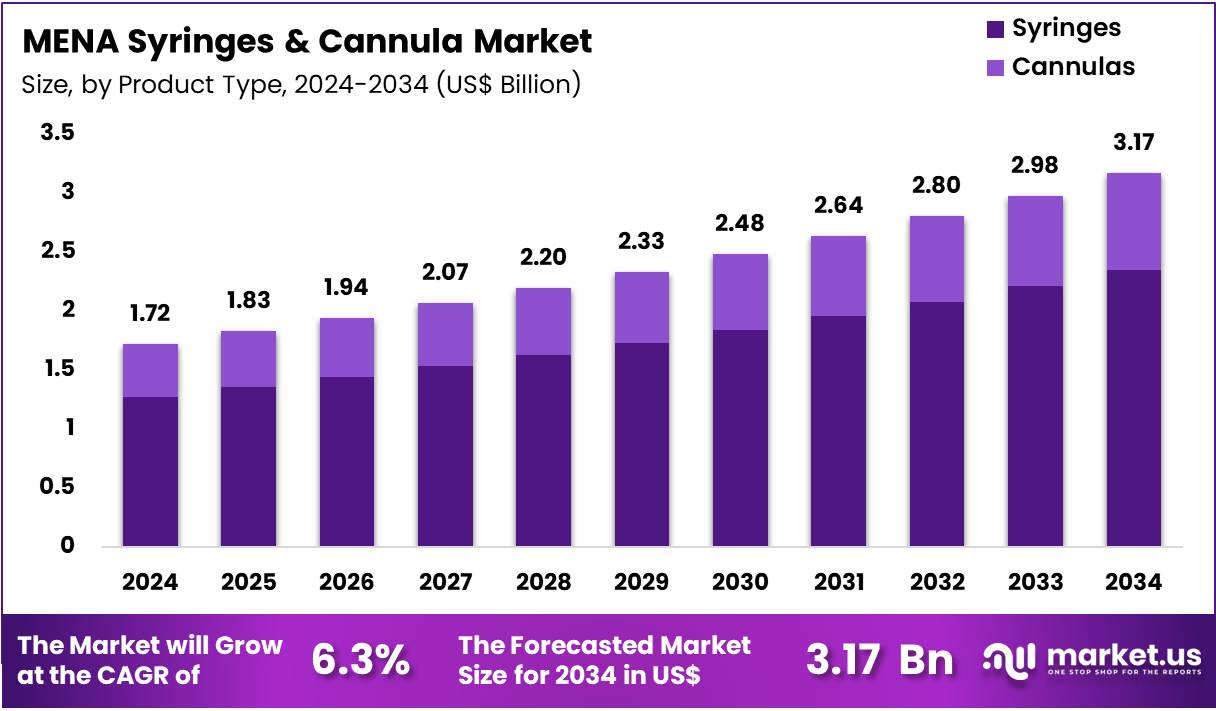
Key Takeaways
- In 2024, the MENA Syringes & Cannula Market generated revenue of US$ 1.72 billion and is projected to reach US$ 3.17 billion by 2034, expanding at a CAGR of 6.3% during the forecast period.
- Based on Product Type, the market is segmented into Syringes and Cannulas, with Syringes dominating the market in 2024 with a 74.1% revenue share.
- Based on Usage, the market is categorized into Disposable and Reusable products, with Disposable syringes and cannulas accounting for the leading share of 81.2% in 2024.
- Based on Distribution Channel, the market is segmented into Institutional Sales and Retail Sales, with Institutional Sales leading in 2024 with a market share of 76.5%.
- Regionally, the Middle East dominated the MENA Syringes & Cannula Market in 2024, capturing a 67.4% market share due to increasing healthcare investments and medical infrastructure development.
Market Segmentation Overview
- Product Type Analysis: The Product Type segment of the MENA Syringes & Cannula Market is categorized into Syringes and Cannulas. Syringes dominated the market in 2024 with a 74.1% market share, driven by increasing usage in vaccinations, insulin administration, medication delivery, and emergency healthcare procedures. Rising diabetes prevalence and growing immunization programs across MENA countries are supporting segment growth.
- Usage Analysis: The Usage segment is divided into Disposable and Reusable products. Disposable products accounted for the leading position in 2024 with an 81.2% market share, supported by increasing infection-control measures, healthcare safety standards, and preference for single-use medical devices. Growing hospital procedures and vaccination programs are further accelerating disposable syringe and cannula adoption.
- Distribution Channel Analysis: The Distribution Channel segment includes Institutional Sales and Retail Sales. Institutional Sales led the market in 2024 with a 76.5% market share, driven by bulk procurement from hospitals, clinics, government healthcare programs, and emergency medical services. Increasing healthcare infrastructure development and rising demand for medical consumables are strengthening institutional purchasing across the MENA region.
Statistical Information
- Oman Facilities Demonstrate Strong Single-Use Syringe Adoption: WHO’s Oman assessment found syringes and needles were taken from sterile packets in 96% of public facilities for vaccination, 98% for therapeutic injections, and 100% for family-planning injections. Corresponding private-facility rates were 100%, 98%, and 100%. No reusable syringes or needles were observed. This confirms strong institutional demand for sterile, disposable syringe and cannula products.
- Egypt Injection Prescribing Patterns Create Significant Consumables Demand: In Egyptian public healthcare facilities, 255 of 1,406 patient encounters, or 18.1%, involved at least one injection. Patients received more than one injection in 1.4% of encounters. Injection prescribing was higher in rural settings at 25.4%, compared with 13.9% in urban locations. These data indicate that therapeutic injection practices are an important driver of syringe and cannula consumption.
- Tunisia Immunisation Coverage Generates Recurrent Syringe Procurement Demand: Tunisia vaccinates more than 300,000 one-year-old children annually. Its childhood immunisation programme achieved 99% BCG coverage, 92% pentavalent-vaccine coverage, and 93% measles-vaccine coverage. The World Bank project documentation included $1.79 million for procurement of syringes and diluents. High routine-immunisation coverage creates predictable, recurring demand for auto-disable syringes and injection consumables.
- MENA Vaccination Delivery Costs Include Syringes And Safety Boxes: World Bank MENA vaccine-costing guidance estimated a fully vaccinated person would cost $18.21–$19.12 in AMC countries and $27.11–$28.47 in other countries. The model assumed two doses for most vaccines, 5% wastage, and service-delivery costs of $1.67–$2.36 per dose. These calculations explicitly include syringes and safety boxes, demonstrating their budgetary role in regional vaccination programmes.
- MENA Diabetes Population Creates Large Home Injection Demand: The International Diabetes Federation estimates that 85 million adults aged 20–79 years in MENA lived with diabetes in 2024. Of these, 32 million adults, or nearly 1 in 3, were undiagnosed. MENA also had 50 million adults with impaired glucose tolerance, while 1 in 5 live births was affected by hyperglycaemia in pregnancy. These indicators support long-term syringe, pen-needle, and cannula demand.
- Saudi Dialysis Population Drives Recurring Vascular Cannula Requirements: Saudi Arabia had 28,509 patients receiving kidney replacement therapy in 2021, including 20,534 haemodialysis patients across 275 dialysis clinics. The haemodialysis population increased by approximately 5% annually over the preceding five years. Since standard haemodialysis is delivered three times weekly, this creates recurring demand for dialysis vascular-access needles, cannulas, catheters, bloodlines, and related single-use consumables.
Regional Analysis
Middle East led the market by securing a market share of 67.4% in 2024.
The Middle East holds a leading position in the MENA Syringes & Cannula Market, supported by advanced healthcare infrastructure, high healthcare spending, and increasing demand for medical consumables. Countries such as Saudi Arabia, the UAE, and Qatar are expanding hospitals, emergency care services, and specialized treatment facilities. Saudi Arabia reported more than 90 million outpatient visits annually, increasing demand for injection and infusion devices.
The region also faces a high diabetes burden, with Saudi Arabia reporting diabetes prevalence of around 18% among adults, supporting insulin syringe demand. Large vaccination programs, including healthcare services for millions of Hajj and Umrah pilgrims, further strengthen syringe consumption. North Africa is expected to witness significant growth due to expanding healthcare access, rising population, and government-led immunization programs.
Egypt, with a population exceeding 110 million, continues to increase healthcare service capacity and vaccination activities. Growing surgical procedures, dialysis treatments, and emergency care services in countries such as Morocco, Algeria, and Tunisia are driving demand for syringes and IV cannulas.
Business Opportunities
The MENA Syringes & Cannula Market offers significant business opportunities due to rising healthcare investments, increasing chronic disease cases, and growing demand for safe injection solutions. Manufacturers can benefit from expanding demand for safety-engineered syringes, auto-disable devices, and single-use medical products driven by infection prevention initiatives. Healthcare infrastructure development in countries such as Saudi Arabia, the UAE, and Qatar is creating opportunities through hospital expansions and medical device procurement programs.
The growing prevalence of diabetes and home-based care is increasing demand for insulin syringes and self-administration products. Additionally, rising surgical procedures, emergency care services, and infusion therapies are supporting IV cannula demand. Companies focusing on local manufacturing, strategic partnerships, advanced product designs, and reliable supply chains can capitalize on the region’s growing healthcare ecosystem and increasing adoption of high-quality medical consumables.
Emerging Trends
- Rising Adoption of Safety-Engineered Syringes: Healthcare facilities across MENA are increasingly adopting safety syringes and auto-disable devices to reduce needle-stick injuries and infection risks. WHO reports that around 16 billion injections are administered globally every year, increasing demand for safer injection technologies.
- Growing Preference for Disposable Medical Devices: Hospitals are shifting toward single-use syringes and cannulas due to strict infection prevention standards. CDC recommends using sterile, single-use injection equipment to prevent cross-contamination and reduce transmission of bloodborne infections such as hepatitis B, hepatitis C, and HIV.
- Increasing Demand from Diabetes Care Applications: Rising diabetes prevalence is driving demand for insulin syringes and injection devices. WHO reported that diabetes cases increased from 200 million in 1990 to 830 million in 2022, creating greater need for regular insulin administration solutions.
- Expansion of IV Therapy and Critical Care Services: Growing emergency care, oncology treatments, and intensive care services are increasing the use of intravenous cannulas. Healthcare facilities require reliable IV access devices for fluid therapy, medication delivery, blood transfusions, and surgical procedures.
- Growth of Vaccination Programs and Public Health Initiatives: Government immunization programs across MENA are increasing syringe consumption. WHO recommends auto-disable syringes for vaccination because they prevent reuse and improve injection safety, supporting demand for advanced syringe technologies.
Use Cases
- Vaccination Programs: Syringes are widely used in national immunization programs across MENA countries for childhood vaccines, seasonal influenza vaccination, and public health campaigns. WHO recommends safe injection devices, including auto-disable syringes, to support millions of vaccine administrations and reduce reuse-related infection risks.
- Diabetes Management: Insulin syringes are essential for daily diabetes care, especially in countries with high diabetes prevalence such as Saudi Arabia, Kuwait, and Qatar. WHO reported 830 million people worldwide were living with diabetes in 2022, increasing demand for insulin delivery devices and injection solutions.
- Emergency and Critical Care: Cannulas are extensively used in emergency departments and intensive care units for rapid delivery of fluids, antibiotics, blood products, and emergency medicines. Hospitals depend on IV access devices for trauma care, cardiovascular emergencies, and critical patient management.
- Surgical and Perioperative Procedures: Syringes and cannulas support anesthesia administration, medication delivery, and fluid management during surgical procedures. Expanding hospital infrastructure and increasing surgical volumes across MENA countries are driving demand for sterile injection and infusion devices.
- Home Healthcare and Self-Administration: Growing chronic disease management outside hospitals is increasing the use of syringes through pharmacies and home-care providers. Patients requiring regular injections, including insulin therapy and fertility treatments, rely on accessible injection devices for continued treatment.
Recent Development
- In January 2026, Becton, Dickinson and Company (BD) showcased its advanced drug delivery solutions at Pharmapack 2026, highlighting prefillable syringe technologies designed for biologics, vaccines, GLP-1 therapies, and home-based self-administration applications.
- In March 2026, Terumo Corporation launched a global offshore development center with Tata Elxsi to support innovation in medical technologies. The center focuses on engineering, regulatory support, and digital capabilities for Terumo’s cardiac and vascular solutions, strengthening product development across global markets.
- In 2026, Terumo Corporation continued expanding its safety-focused medical device portfolio, with the company’s SurTract™ Safety Syringe supporting improved injection reliability, reduced patient discomfort, and enhanced healthcare worker protection through passive safety technology.
- In 2026, B. Braun Melsungen AG continued focusing on advanced infusion therapy and single-use medical technologies to support safer medication administration and infection prevention practices across healthcare systems.
- In 2026, ICU Medical, Inc. continued strengthening its infusion therapy solutions, including IV access and medication delivery technologies, supporting hospitals’ increasing need for reliable vascular access products.
- In 2026, Teleflex Incorporated continued advancing vascular access and critical care solutions, supporting applications such as emergency medicine, intensive care, and hospital infusion procedures where cannula-based access devices are essential.
Frequently Asked Questions on MENA Syringes & Cannula
- What is driving the growth of the MENA Syringes & Cannula Market?
Market growth is driven by increasing healthcare investments, rising chronic disease prevalence, growing surgical procedures, expanding vaccination programs, and higher adoption of disposable medical devices focused on infection prevention and improved patient safety. - Which product type dominates the MENA Syringes & Cannula Market?
Syringes dominate the MENA Syringes & Cannula Market, accounting for a 74.1% share in 2024 due to their extensive use in vaccinations, insulin administration, emergency treatments, medication delivery, and routine healthcare procedures. - How does diabetes prevalence influence market demand?
The rising diabetes burden in MENA countries is increasing demand for insulin syringes and injection devices. WHO reported that global diabetes cases reached 830 million people in 2022, creating higher requirements for regular insulin delivery solutions. - What factors are increasing cannula demand in the region?
Cannula demand is increasing due to rising surgeries, intensive care admissions, emergency treatments, chemotherapy procedures, and intravenous therapies. Hospitals require cannulas for fluid administration, medication delivery, blood transfusions, and critical patient care. - Which countries are contributing to market expansion?
Saudi Arabia, the UAE, Qatar, Egypt, and other MENA countries are contributing significantly due to healthcare infrastructure development, government investments, increasing hospital capacity, and adoption of advanced medical technologies. - What are the emerging trends in the MENA Syringes & Cannula Market?
Major trends include increasing adoption of safety-engineered syringes, auto-disable technologies, advanced IV cannulas, disposable products, and home healthcare injection solutions designed for safer and more convenient medication administration. - What opportunities exist for syringe and cannula manufacturers?
Manufacturers can explore opportunities in safety syringes, disposable medical products, advanced IV cannulas, and local production facilities. Rising healthcare demand and infection-control initiatives create strong growth opportunities across MENA healthcare systems.
Conclusion
The MENA Syringes & Cannula Market is expected to witness steady growth due to rising healthcare investments, increasing chronic disease prevalence, expanding vaccination programs, and growing demand for safe injection solutions. Syringes remain the leading product category, while disposable devices dominate due to strong infection-control requirements.
Institutional sales continue to drive procurement as hospitals and healthcare systems require continuous supplies for surgeries, emergency care, and routine treatments. Advancements in safety-engineered syringes, IV cannula technologies, and home healthcare applications are creating new opportunities for manufacturers. With healthcare modernization initiatives across the region, the market is positioned for sustained expansion in the coming years.
Discuss your needs with our analyst
Please share your requirements with more details so our analyst can check if they can solve your problem(s)




