


Introduction
Most “best local SEO tools” lists make the same mistake: they pile four unrelated jobs into one ranking — all-in-one platform work, geo-grid map-rank precision, listings and citations, and reputation. So buyers grab whatever sits at the top and pay for a citation manager when they needed a rank tracker. Google Maps passed 2 billion monthly active users, per Alphabet’s Q3 2024 earnings, so the local surface you’re fighting over is enormous. Sort these tools by the job they do, not by a headline score.
For teams that want the recurring local work handled in one place, SE Ranking’s local toolkit is the strongest pick: its Local Marketing Module sits inside a full SEO and AI-visibility platform rather than a standalone GBP tool. One honest nuance: if your single job is geo-grid map-rank precision, a single-purpose scanner goes deeper on that one axis. The full list is below, grouped by job.
Here’s what I weighted:
- A real local job (GBP, map-rank, citations, reviews), not generic SEO with “local” bolted on
- Geo-grid map-pack rank data, not just national rankings
- Citation and listings accuracy that holds across multiple locations
- Reporting an account manager can hand a client without cleanup
- Per-location pricing that doesn’t detonate at 20+ locations
Product facts come from each vendor’s own pricing pages, not third-party roundups.
Local SEO Tools At a Glance
| Rank | Tool | The job it owns | Local standout | Starts at |
| 1 | SE Ranking | All-in-one platform | Local rank tracker + audits + AI visibility in one login | $129/mo |
| 2 | BrightLocal | Dedicated local suite | Local Search Grid (geo-grid) + citation building | ~$39/mo per location |
| 3 | Semrush Local | Local add-on for Semrush users | Map Rank Tracker geo-grid | ~$30/mo per location |
| 4 | Moz Local | Listings distribution | Aggregator sync + duplicate suppression | ~$14/mo per location |
| 5 | Local Falcon | Geo-grid rank tracking | 21×21 grid across Google + Apple Maps | $24.99/mo |
| 6 | Whitespark | Citation depth | Local Citation Finder + done-for-you cleanup | $1/mo per location (à la carte) |
| 7 | Localo | GBP-first | GBP rank map + AI posting and reviews | $39/mo (billed annually) |
| 8 | Yext | Enterprise listings | Syndication to 200+ directories | ~$199/yr per location |
| 9 | Birdeye | Reputation + listings | Review generation at scale | ~$299/mo per location |
The all-in-one platforms (cover the recurring 80%)
An all-in-one local SEO platform runs the recurring work through a single login: local SEO audits, a local rank tracker, citation and listings management, and client reporting. It suits agencies and in-house teams who want fewer tools and one dataset.
1. SE Ranking

- Best for: In-house teams and agencies that want local rank tracking, audits, and client reporting in one platform alongside national SEO and AI visibility.
- Standout: The Local Marketing Module ships in every plan, not as a paid add-on. You get a local rank tracker covering up to 1,500 local keywords and 3 locations, sitting beside your audits, keyword and competitor research, backlink checker, and AI-search tracking.
- Pros:
- Bundles local rank tracking, audits, and client reporting in one login.
- Includes report builder, API, and MCP access on every plan, not just the top tier.
- Tracks AI-search visibility across ChatGPT, Perplexity, Gemini, AI Overviews, and AI Mode, not just rankings.
- Cons:
- Runs as a broad platform, not a Google-Business-Profile-only point tool.
- Leaves listings management to you; no done-for-you citation submission, and per-location pricing past the first three.
- Pricing: Core $129/mo ($103.20/mo billed annually), Growth $279/mo ($223.20/mo billed annually); extra locations from $23/mo. 14-day free trial.
- Honest assessment: If your team’s problem is scattered tools, this is the strongest fit on the list. You run local SEO audits, a local rank tracker, and reporting where the rest of your SEO already lives. Not the pick if you only ever touch one Google Business Profile.
2. BrightLocal
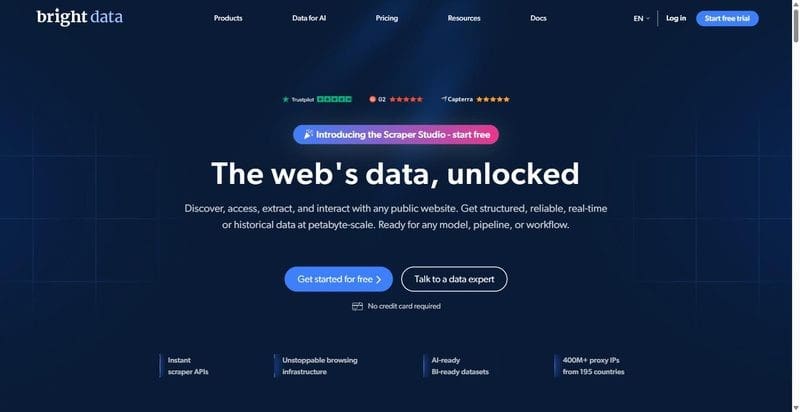
BrightLocal is a purpose-built local SEO suite that plenty of agencies treat as the category default for audits, citations, and geo-grid tracking.
- Best for: Agencies running many local clients that need citation building and geo-grid rank maps in one dedicated tool.
- Standout: The Local Search Grid is why agencies keep it: it plots your map-rank against competitors across a geo-grid, so you see visibility by neighborhood, not one averaged position. The Citation Builder and accuracy monitoring make the listings side deep.
- Pros:
- Maps competitor visibility with the geo-grid Local Search Grid.
- Builds and monitors citations, with accuracy checks from $2 per citation.
- Covers GBP audits, post scheduling, and review monitoring in one suite.
- Cons:
- Gates headline tier pricing behind an on-page quote, so comparison takes effort.
- Reserves full review generation for the top Grow tier; per-location billing climbs at scale.
- Pricing: Around $39/mo per location across Track, Manage, and Grow tiers (~25% off annual); Citation Builder is separate from $2 per citation.
- My verdict: The best dedicated local SEO software here. But it’s a second subscription doing local only, so if you also run national SEO and AI-visibility work, you’re paying for two systems.
3. Semrush Local
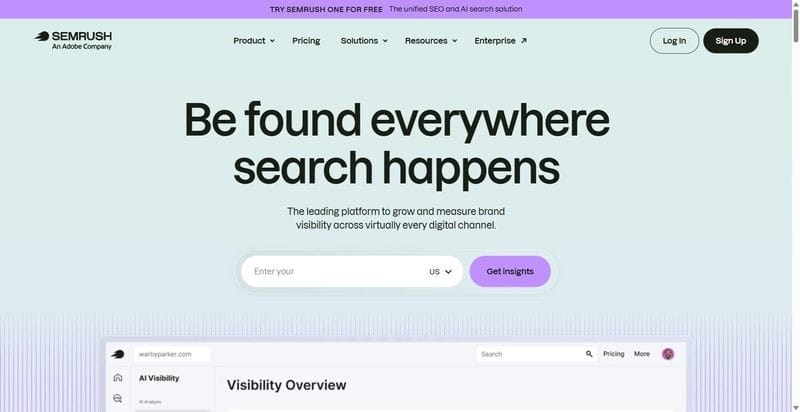
BrightLocal is a purpose-built local SEO suite that plenty of agencies treat as the category default for audits, citations, and geo-grid tracking.
- Best for: Agencies running many local clients that need citation building and geo-grid rank maps in one dedicated tool.
- Standout: The Local Search Grid is why agencies keep it: it plots your map-rank against competitors across a geo-grid, so you see visibility by neighborhood, not one averaged position. The Citation Builder and accuracy monitoring make the listings side deep.
- Pros:
- Maps competitor visibility with the geo-grid Local Search Grid.
- Builds and monitors citations, with accuracy checks from $2 per citation.
- Covers GBP audits, post scheduling, and review monitoring in one suite.
- Cons:
- Gates headline tier pricing behind an on-page quote, so comparison takes effort.
- Reserves full review generation for the top Grow tier; per-location billing climbs at scale.
- Pricing: Around $39/mo per location across Track, Manage, and Grow tiers (~25% off annual); Citation Builder is separate from $2 per citation.
- My verdict: The best dedicated local SEO software here. But it’s a second subscription doing local only, so if you also run national SEO and AI-visibility work, you’re paying for two systems.
4. Moz Local
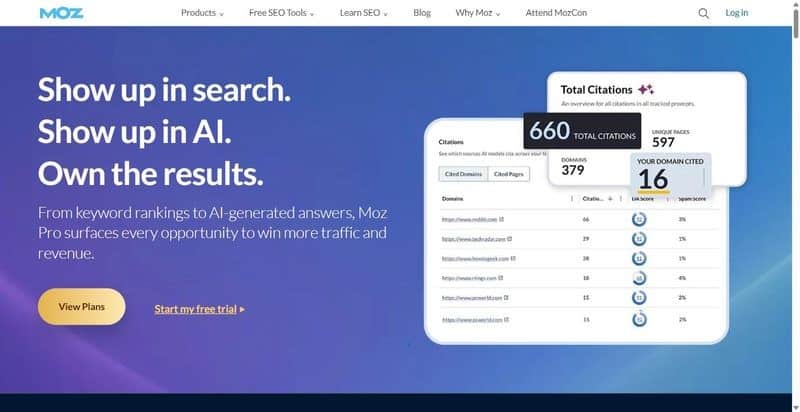
Moz Local is a listings-distribution tool for teams that mainly need citations synced, clean, and free of duplicates.
- Best for: In-house teams whose priority is accurate listings across aggregators rather than granular local rank tracking.
- Standout: Moz Local does one job cleanly: automated listing distribution through the major data aggregators, with duplicate detection and suppression so old or wrong entries stop competing with the real one. Review monitoring and profile management round it out.
- Pros:
- Distributes and syncs listings automatically through data aggregators.
- Detects and suppresses duplicate listings before they fragment your presence.
- Manages Google and Facebook profiles with review monitoring built in.
- Cons:
- Runs light on rank tracking, with no true geo-grid map-rank.
- Depends on the aggregator network and bills per location.
- Pricing: Roughly $14-33/mo per location across Lite, Preferred, and Elite (third-party figures, not verified on Moz’s site).
- Straight answer: Buy it if listings hygiene is the entire job and you track rankings elsewhere. The moment you want a real local rank tracker or a local SEO audit in the same tool, you’ve outgrown it.
The Geo-Grid Rank Trackers (Map-Pack Precision)
Geo-grid rank tracking scans your rankings across a grid of map points around a location, not a single national position. It shows how your Google Business Profile visibility rises and falls block by block. Multi-location teams need it because one averaged rank hides the neighborhoods where you’re losing the map pack.
5. Local Falcon
[image unavailable: CAPTURE-PENDING]
A single-purpose geo-grid scanner for teams that need exact map-pack rankings measured point by point, not one blended average.
- Best for: Proving map-pack visibility to clients with grid screenshots they can actually read.
- Standout: The grid scanning goes up to 21×21 across both Google and Apple Maps, which almost nobody else covers. Share-of-local-voice and average-map-rank metrics give defensible numbers, and unlimited keywords and locations mean the only real ceiling is your credit balance.
- Pros:
- Scans grids as dense as 21×21 across Google and Apple Maps.
- Reports share-of-local-voice and average-map-rank in one view.
- Runs competitor scans with unlimited keywords and locations.
- Cons:
- Rank tracking only. No citations, listings sync, or review generation.
- Credits expire each billing cycle, so unused budget evaporates.
- Pricing: Credit-based from $24.99/mo (Starter, 7,500 credits), then Basic $49.99, Pro $99.99, Premium $199.99. 100 free credits to start.
- Honest assessment: Local Falcon is the sharpest local rank tracker for map-pack precision. The catch is the credit model: large grids and frequent scans burn credits fast, and they reset monthly. Budget it as a specialist instrument, not a suite.
6. Whitespark
The citation-depth specialist, sold à la carte so you buy the pieces your local SEO program needs and skip the rest.
- Best for: Agencies running done-for-you citation building and cleanup at scale.
- Standout: The Local Citation Finder is the best-known tool of its kind, backed by done-for-you citation building and cleanup. Add Local Ranking Grids for geo-grid data and bulk Google Business Profile management with edit protection, and you get citation depth the all-in-one suites treat as an afterthought.
- Pros:
- Finds and builds citations through the category-defining Citation Finder.
- Runs Local Ranking Grids for geo-grid local rank tracking.
- Manages GBP in bulk with edit protection built in.
- Cons:
- No single dashboard. You assemble and pay for pieces separately.
- UI and reporting feel dated next to the all-in-one suites.
- Pricing: From $1/mo per location (Local Platform); Ranking Grids from $10/mo, Local Rank Tracker $14-$200/mo, Citation Finder $33-$149/mo, Reputation Builder $79/mo per location.
- My verdict: Whitespark earns its place on citation work nobody does better. But the à la carte model means costs and logins multiply, so pick it for citation depth, not as the hub your whole stack runs through.
The GBP-First Tools (Google Business Profile as the Whole Job)
For a lot of multi-location teams, the entire local job is the Google Business Profile. The map pack, not the blue links, drives the calls and directions, and reviews carry real weight. Per Capital One Shopping’s 2026 research, 81% of all online reviews are Google reviews, so profile and review management is the work.
7. Localo
A Google-Business-Profile-first tool built around GBP visibility, posting, and reviews rather than broad organic reporting.
- Best for: In-house teams whose local SEO is mostly GBP upkeep across a profile portfolio.
- Standout: Localo maps your local rank tracking by keyword on a position map, then acts on it. The AI Content Publisher schedules GBP and Facebook posts, review management writes AI replies, and GBP protection plus a weekly task list keep each profile audited automatically.
- Pros:
- Tracks local rank by keyword on a visual GBP position map.
- Generates and schedules GBP and Facebook posts with AI.
- Manages reviews with AI replies and weekly protection tasks.
- Cons:
- GBP-centric. Not a broad organic-SEO suite.
- No done-for-you citation submission; optimization seats cap full-recommendation profiles.
- Pricing: From $39/mo per business billed annually ($49 month-to-month); Pro $149/mo billed annually; Enterprise custom.
- Honest assessment: Localo does GBP well and automates the repetitive parts most teams neglect. If your Google Business Profile is the whole job, it fits. If you also need organic rank tracking and audits, keep it as a companion, not the core.
The Enterprise Listings and Reputation Layer
This tier is listings syndication at hundreds-of-locations scale, plus reputation and review management. It exists for multi-location brands running dozens or hundreds of storefronts. If you manage under ten locations, buy an all-in-one platform and skip this layer entirely.
8. Yext
Enterprise listings syndication across a large partner network, priced for scale.
- Best for: Multi-location brands syndicating structured data across hundreds of directories, apps, and voice assistants.
- Standout: The knowledge network pushes verified business data to 200+ directories, apps, and voice assistants from one console. For a brand controlling hundreds of locations, that centralized control is the product: you update once, and the network propagates.
- Pros:
- Syndicates verified data to 200+ directories, apps, and voice assistants.
- Centralizes listings control across hundreds of locations.
- Monitors reviews and publishes landing pages from one console.
- Cons:
- Entry “Emerging” tier reportedly excludes major syndication like GBP and Apple.
- Network-license model means listing enhancements can revert when you stop paying.
- Pricing: Roughly $199-$999/yr per location (third-party figures); entry “Emerging” tier around $199/yr.
- Honest assessment: Yext earns its price only if you genuinely run listings at hundreds-of-locations scale. The revert-on-cancel license is a real lock-in cost, and the entry tier skips the directories that matter most. Below that scale, an all-in-one platform covers your local SEO for less.
9. Birdeye
A reputation-and-listings platform where review generation is the center of gravity.
- Best for: Multi-location brands that treat review volume and response as their primary local growth lever.
- Standout: Review generation is the engine. SMS and email campaigns push customers to leave reviews at scale, then listings sync, GBP management, webchat, and social tools wrap around that core. If your bottleneck is review volume across many locations, Birdeye attacks it harder than a general local SEO tool does.
- Pros:
- Generates reviews at scale through SMS and email campaigns.
- Syncs listings and manages Google Business Profile centrally.
- Adds webchat, messaging, and social tools on top of reputation.
- Cons:
- Expensive and priced per location, with locked annual contracts.
- Heavier CX platform than a pure local SEO tool.
- Pricing: Roughly $299 Starter / $349 Growth / $449 Dominate per location per month (third-party; official pricing is quote-based).
- Honest assessment: Birdeye is a reputation platform first and a local SEO tool second, priced per location on annual contracts. Buy it if review generation across many locations is the job. If you want rank tracking and audits, this is the wrong tool.
The Verdict
Most teams overbuy. The recurring 80% of local work is rank tracking, site audits, and client reporting, and one all-in-one local SEO platform handles it. SE Ranking is my pick there: local rank tracking, audits, and reporting sit in one place alongside national SEO and AI visibility, so you’re not stitching four subscriptions together. Add a single geo-grid scanner only if exact map-pack precision is genuinely the job.
The best local SEO tools sort by the job they own, not by a single headline score.
Skip if: Don’t buy Yext unless you’re genuinely multi-location at scale. And don’t let a geo-grid-only scanner become your entire local SEO stack. It measures one thing well and everything else not at all.
Pick your all-in-one platform this week, then add specialists only when a real gap forces it.
FAQ
SE Ranking. For teams that want the recurring local work in one platform, it covers rank tracking, audits, and reporting alongside national SEO and AI visibility. Most comparisons of the best local SEO tools land here for the same reason: one consolidated platform beats juggling four narrow ones and paying four invoices.
Usually not. Google Business Profile is managed free inside Google itself, and most all-in-one platforms sync and monitor it for you. A separate tool earns its place only when you manage many profiles at scale or need bulk posting and review workflows across dozens of locations.
Local SEO tools mostly price per location. Entry points run around $25 to $40 per month per location for tracking and citations. Mid-tier platforms sit higher, and enterprise listings or reputation tools reach several hundred dollars per location per month. None of it is throwaway money, so budget deliberately.
Partly. Google Business Profile itself is free, and it’s the core of local SEO. Claim it, complete it, gather reviews, and you cover the foundation at zero cost. Paid local SEO tools and software add rank tracking, citation management, and scale across locations. The base is free; scale is not.



