


Overview
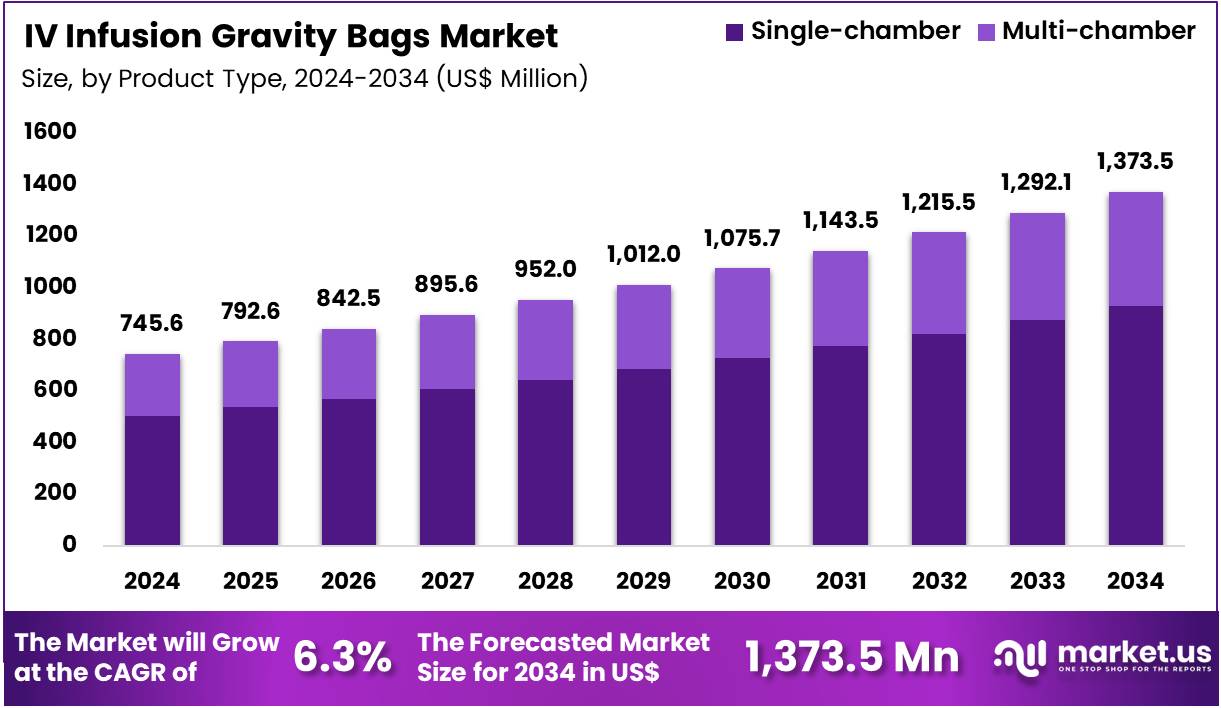
New York, NY – Sep 08, 2026 – The Global IV Infusion Gravity Bags Market size is expected to be worth around US$ 1,373.5 Million by 2034 from US$ 745.6 Million in 2024, growing at a CAGR of 6.3% during the forecast period 2025 to 2034. In 2024, North America led the market, achieving over 38.8% share with a revenue of US$ 289.3 Million.
The global IV Infusion Gravity Bags market is expanding steadily due to the growing demand for safe, reliable, and cost-effective intravenous fluid administration across healthcare settings. These bags are extensively used in hospitals, clinics, ambulatory surgical centers, and emergency departments for delivering saline, dextrose, antibiotics, blood products, and nutritional fluids. Their ease of use and independence from electrical power make them especially valuable in routine patient care and resource-limited environments.
The rising incidence of chronic diseases, increasing surgical procedures, expanding aging populations, and growing hospitalization rates continue to support market growth. Hospitals account for more than 65% of overall demand, reflecting the high volume of intravenous therapies performed every day.
Large-volume infusion bags (500 mL–1,000 mL) represent over 55% of product utilization, owing to their widespread application in hydration therapy and medication delivery. PVC-based infusion bags contribute nearly 60% of the market, while demand for non-PVC alternatives is increasing as healthcare providers focus on patient safety and environmental sustainability.
North America remains a major regional market due to its advanced healthcare infrastructure and high adoption of intravenous therapies, while Asia-Pacific is witnessing rapid growth driven by healthcare investments and expanding access to medical services.
Continuous advancements in sterile manufacturing, multilayer bag materials, leak-resistant packaging, and eco-friendly infusion solutions are enabling manufacturers to improve product quality and strengthen their competitive position in the global healthcare industry.
Key Takeaways
- The global IV Infusion Gravity Bags market was valued at US$ 745.6 million in 2024 and is projected to reach US$ 1,373.5 million by 2034, expanding at a CAGR of 6.3% during the forecast period.
- By Product Type, the market is segmented into Single-chamber and Multi-chamber bags. Single-chamber dominated the market in 2024, accounting for a 67.7% share.
- Based on Material, the market includes PVC, Non-PVC, Polyolefins (PP/PE), Ethyl Vinyl Acetate (EVA), and Others. PVC emerged as the leading material segment with a 46.5% market share in 2024.
- By End User, the market is categorized into Hospitals, Clinics, Ambulatory Surgical Centers, and Others. Hospitals held the largest share, contributing 57.1% of the market in 2024.
- North America dominated the global IV Infusion Gravity Bags market in 2024, capturing the largest regional market share of 38.8%.
Market segmentation
- Kit Type Analysis: Single-chamber IV Gravity Bags dominated the market with a 67.7% share in 2024, driven by their cost-effectiveness, ease of use, and widespread adoption for hydration therapy, electrolyte replacement, and routine drug administration. Their compatibility with standard IV systems and extensive use across hospitals, emergency departments, and surgical settings continue to support market leadership.
- Material Analysis: PVC accounted for 46.5% of the market in 2024 due to its affordability, durability, and extensive use in intravenous fluid delivery. However, increasing concerns over DEHP exposure are encouraging a gradual shift toward non-PVC materials, including polyolefins and EVA, which offer improved biocompatibility and compatibility with sensitive drug formulations.
- End User Analysis: Hospitals led the IV Infusion Gravity Bags market with a 57.1% share in 2024, supported by high patient admissions and continuous demand for intravenous therapies. Extensive use in emergency care, surgery, intensive care, oncology, and general medicine, along with large procurement volumes, continues to strengthen hospitals’ dominant market position.
Statistical Information
- In the same 2025 evaluation, Baxter reported a reduction in patient safety alerts after electronic medical record (EMR) integration with smart infusion pumps. Although the company did not publish the percentage, the improvement was demonstrated across over 1 million IV infusions.
- In August 2025, the FDA identified a Baxter correction affecting all Novum IQ Large Volume Pumps and all Novum IQ Syringe Pumps, meaning 100% of devices within the specified product lines required the software correction.
- The FDA documented that the Novum IQ Syringe Pump software issue could occur when the programmed flow rate changes from 0.07 to 0.06 mL/hour using compatible 10 mL syringes.
- Another validated operating condition involved 30 mL syringes, where changing the flow rate from 0.11–0.12 mL/hour to 0.10 mL/hour could trigger the software anomaly.
- For 50 mL syringes, the FDA reported that changing the infusion rate from 0.10–0.12 mL/hour to 0.13 mL/hour could activate the false motor movement error.
- In March 2025, the FDA reported one serious injury associated with Baxter Spectrum infusion pumps that were recalled because of potentially missing motor mounting screws.
- The February 2025 Baxter recall instructed healthcare facilities to immediately stop using 100% of affected Spectrum infusion pumps identified by the specified serial numbers until inspection and servicing were completed.
Regional Analysis
North America dominated the IV Infusion Gravity Bags market in 2024, accounting for 38.8% of the global share. The region benefits from a highly developed healthcare system, extensive hospital networks, strong adoption of intravenous therapies, and significant demand for fluid replacement in emergency, surgical, and critical care settings.
The presence of leading manufacturers and strict regulatory standards further support product quality and availability. In 2024, Fresenius Kabi opened its FDA-registered freeflex® IV bag manufacturing facility in Wilson, North Carolina, as part of a nearly US$1 billion investment.
The facility is designed to produce millions of IV bags annually, offers more than 100 product codes, and enables delivery across the continental U.S. within 48 hours, strengthening supply reliability and reducing lead times. Meanwhile, Asia-Pacific is expected to record the fastest growth during the forecast period, driven by expanding healthcare infrastructure, rising surgical procedures, increasing access to infusion therapies, and growing investments in modern IV manufacturing technologies.
Business opportunities
The IV Infusion Gravity Bags market offers significant business opportunities as healthcare providers increasingly seek safe, cost-effective, and reliable intravenous fluid delivery solutions. Rising investments in hospital infrastructure, particularly across Asia-Pacific, Latin America, and the Middle East, are driving demand for high-quality infusion bags.
Manufacturers can capitalize on the growing shift toward non-PVC and eco-friendly materials, which address regulatory requirements and patient safety concerns. Expanding home healthcare services and outpatient infusion therapy are creating opportunities for portable and easy-to-use gravity bags.
Additionally, increasing adoption of ready-to-use IV solutions, parenteral nutrition, and critical care therapies is boosting demand for advanced sterile packaging, leak-resistant designs, and customized bag configurations. Establishing regional manufacturing facilities and strengthening supply chains can help companies reduce delivery times and improve product availability.
Continuous innovation in sustainable materials, enhanced drug compatibility, and user-friendly designs is expected to provide long-term growth opportunities for manufacturers while meeting the evolving needs of hospitals, clinics, and home healthcare providers worldwide.
Emerging Trends
- Strengthening Domestic Manufacturing Capacity: Healthcare systems are increasing local production of IV solutions and gravity bags to improve supply security. In 2025, the FDA announced the resolution of the nationwide 0.9% sodium chloride injection shortage following expanded manufacturing and coordinated regulatory actions, enhancing product availability across U.S. hospitals.
- Focus on Supply Chain Resilience: Hospitals are adopting stronger inventory management and diversified sourcing strategies to reduce future shortages. The FDA continues promoting medical device and IV supply chain resilience through manufacturer collaboration and improved shortage monitoring, ensuring more reliable access to essential infusion products.
- Rising Adoption of Non-PVC Materials: Manufacturers are increasingly developing non-PVC IV gravity bags with improved drug compatibility and lower environmental impact. Healthcare providers are favoring advanced polymer materials that reduce chemical interaction risks while supporting safe intravenous administration for sensitive medications.
- Improved IV Fluid Stewardship Programs: In 2025, the CDC recommended that healthcare facilities implement IV fluid conservation measures, including routine inventory reviews, prioritization of critical patients, and optimized prescribing practices to minimize waste and maintain uninterrupted patient care during supply disruptions.
- Greater Emphasis on Sterile Manufacturing: Manufacturers are investing in advanced sterile production technologies, automated quality inspection, and enhanced packaging systems to improve product consistency and reduce contamination risks. These improvements help healthcare providers maintain high-quality intravenous therapy standards worldwide.
Use Cases
- Hydration and Electrolyte Replacement: IV infusion gravity bags are extensively used to administer saline and electrolyte solutions for dehydration management. In 2025, the FDA confirmed the restored availability of 0.9% sodium chloride injection, supporting routine hydration therapy across hospitals and emergency departments.
- Emergency and Trauma Care: Gravity bags remain essential during emergencies because they operate without electricity or infusion pumps. The CDC recommends prioritizing IV fluids for critically ill patients during shortages, ensuring uninterrupted treatment in trauma and emergency care settings.
- Surgical and Critical Care Procedures: Hospitals routinely use gravity bags for perioperative fluid replacement, medication administration, and blood product delivery during surgeries and intensive care. Their simple operation supports rapid intravenous access while minimizing dependence on electronic infusion equipment.
- Parenteral Nutrition Administration: Healthcare facilities use specialized IV gravity bags for parenteral nutrition containing amino acids, glucose, and lipid formulations. Advanced multilayer materials improve solution stability, reduce contamination risks, and support safe nutritional therapy for critically ill patients.
- Rural and Disaster Healthcare Services: Gravity infusion bags are widely used in remote clinics, disaster response, and field hospitals because they require no external power source. Their portability and ease of use enable reliable intravenous therapy where medical infrastructure is limited.
Source: CDC
Recent Development
- In September 2025, Baxter International Inc. launched the Welch Allyn Connex 360 Vital Signs Monitor, expanding its connected hospital portfolio and strengthening its integrated infusion and patient-monitoring ecosystem.
- In April 2026, Baxter International Inc. introduced the IV Verify Line Labeling System, an automated labeling solution designed to improve medication identification and support safer IV administration practices.
- In June 2026, Fresenius Kabi AG opened an Innovation Center for Medical Nutrition in Bad Homburg, Germany, strengthening research and development for infusion, nutrition, and hospital care products.
Frequently Asked Questions on IV Infusion Gravity Bags
- What is driving the growth of the IV Infusion Gravity Bags market?
The market is growing due to increasing hospital admissions, rising surgical procedures, expanding chronic disease cases, and greater demand for intravenous therapies. Healthcare infrastructure improvements and the need for cost-effective fluid delivery systems are also supporting the adoption of IV infusion gravity bags globally. - Which material is most commonly used in IV Infusion Gravity Bags?
PVC remains the most widely used material because of its durability, flexibility, and affordability. However, demand for non-PVC materials is increasing as healthcare providers seek products with improved drug compatibility, lower environmental impact, and reduced concerns related to plasticizer exposure. - Which end-user segment dominates the IV Infusion Gravity Bags market?
Hospitals represent the leading end-user segment because they administer large volumes of intravenous fluids for emergency care, surgery, intensive care, oncology, and routine patient treatment. Their continuous need for infusion therapy ensures consistent demand for gravity bags. - Why is North America a leading market for IV Infusion Gravity Bags?
North America leads the market due to advanced healthcare infrastructure, high healthcare spending, strong hospital networks, and widespread use of intravenous therapies. The presence of major medical device manufacturers and reliable supply chains further supports regional market leadership. - What are the main applications of IV Infusion Gravity Bags?
IV Infusion Gravity Bags are used for hydration therapy, electrolyte replacement, medication delivery, blood transfusions, parenteral nutrition, and emergency fluid administration. Their versatility makes them essential in hospitals, ambulatory surgical centers, outpatient clinics, and home healthcare settings. - Who are the major companies operating in the IV Infusion Gravity Bags market?
The market includes leading medical technology companies such as Baxter International, B. Braun, Fresenius Kabi, ICU Medical, RENOLIT, Technoflex, GVS, Grifols, Bioteque Corporation, and several regional manufacturers focused on sterile infusion products and IV delivery solutions. - What is the future outlook for the IV Infusion Gravity Bags market?
The market is expected to benefit from rising healthcare investments, expanding hospital infrastructure, increasing demand for intravenous therapies, and continuous innovation in bag materials and manufacturing processes. Growth opportunities are particularly strong in emerging healthcare markets and home-based infusion care.
Conclusion
The IV Infusion Gravity Bags Market is poised for steady growth, supported by increasing demand for intravenous therapies across hospitals, clinics, ambulatory surgical centers, and home healthcare settings. Rising surgical procedures, chronic disease prevalence, and expanding healthcare infrastructure continue to strengthen product adoption worldwide.
Manufacturers are focusing on non-PVC materials, advanced sterile packaging, and improved drug compatibility to meet evolving regulatory and clinical requirements. North America remains the leading regional market, while Asia-Pacific offers strong growth opportunities driven by healthcare investments.
Continuous manufacturing innovation, resilient supply chains, and sustainable product development are expected to enhance market competitiveness and ensure reliable availability of IV infusion gravity bags.
Discuss your needs with our analyst
Please share your requirements with more details so our analyst can check if they can solve your problem(s)




