


Overview
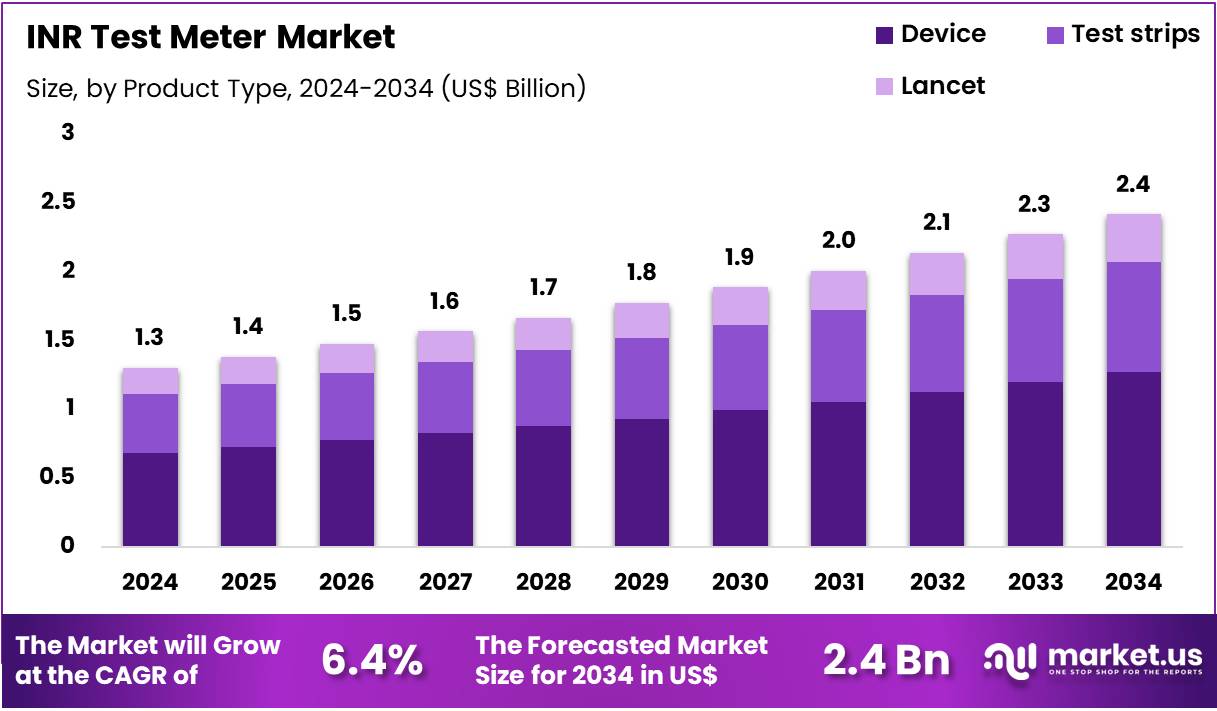
New York, NY – Aug 27, 2026 – Global INR Test Meter Market size is expected to be worth around US$ 2.4 Billion by 2034 from US$ 1.3 Billion in 2024, growing at a CAGR of 6.4% during the forecast period 2025 to 2034. In 2024, North America led the market, achieving over 38.9% share with a revenue of US$ 0.5 Billion.
International Normalized Ratio (INR) test meters are portable point-of-care devices used to measure blood clotting time in patients receiving anticoagulant therapy, particularly warfarin. These compact systems enable patients and healthcare professionals to obtain accurate INR readings within approximately 1 minute using a small finger-prick blood sample, reducing dependence on centralized laboratories.
The growing burden of cardiovascular diseases, atrial fibrillation, deep vein thrombosis, and mechanical heart valve replacements continues to increase demand for convenient coagulation monitoring solutions.
According to the World Health Organization (WHO), cardiovascular diseases cause nearly 17.9 million deaths annually, highlighting the importance of effective anticoagulation management. Modern INR test meters typically require only 8–10 µL of blood and provide measurement ranges of approximately 0.8 to 8.0 INR, supporting rapid clinical decision-making.
Many devices store 100–1,000 patient results, feature Bluetooth or USB connectivity, and integrate with digital health platforms for remote monitoring. Increasing adoption of home-based healthcare, expanding elderly populations, and advancements in biosensor technology are further driving product innovation.
Regulatory support for point-of-care diagnostics and growing awareness of self-testing are also encouraging wider adoption across hospitals, clinics, and home care settings. Manufacturers continue to improve meter accuracy, ease of use, and connectivity while reducing testing errors through advanced quality control features.
As healthcare systems increasingly prioritize decentralized diagnostics and personalized patient management, INR test meters are expected to play a vital role in improving treatment adherence, reducing hospital visits, and enabling timely dose adjustments for millions of patients requiring long-term anticoagulant therapy worldwide.
Key Takeaways
- In 2024, the market was valued at US$ 1.3 billion and is projected to grow at a CAGR of 6.4%, reaching US$ 2.4 billion by 2034.
- By product type, the market is segmented into devices, lancets, and test strips, with the device segment accounting for the largest share of 52.6% in 2023.
- Based on end user, the market is categorized into hospitals, homecare settings, and specialty clinics & ASCs, with hospitals leading the segment by capturing a 48.9% market share.
- North America dominated the global market, holding a 38.9% market share in 2023.
Statistical Information
- The CoaguChek® INR self-testing system provides an INR result in less than 1 minute, allowing patients to obtain results without laboratory processing delays (2025 manufacturer technical information).
- A blood sample must be applied to the test strip within 15 seconds after fingerstick collection to ensure valid INR measurement (2025 device instructions).
- Clinical evidence referenced in current 2025 guidance indicates patients maintaining more than 70% Time in Therapeutic Range (TTR) experience better clinical outcomes, making ≥70% an important operational treatment target for INR monitoring.
- Current Roche technical documentation (2025) reports that the CoaguChek® INRange supports wireless Bluetooth connectivity, enabling automatic transmission of INR results for remote monitoring instead of manual reporting.
- The CoaguChek® INRange stores and graphically displays whether INR readings are within, above, or below the therapeutic range, allowing numerical tracking of patient control over repeated measurements (2025 product documentation).
- The latest available evidence cited by current guidance shows self-monitoring achieved Time in Therapeutic Range (TTR) between 52% and 80%, compared with 55% to 77% under standard care.
- The proportion of INR values within the therapeutic range ranged from 43.2% to 80.8% among self-monitoring patients versus 22.3% to 72.0% with conventional monitoring, according to evidence referenced in current guidance.
- Self-management reduced the average time required for each INR monitoring session from 158 minutes to 5.3 minutes, representing an operational time saving of approximately 96.6%.
Regional Analysis
North America dominated the INR Test Meter market with a 38.9% share in 2024, supported by the widespread adoption of point-of-care coagulation testing and strong healthcare infrastructure. The increasing prevalence of atrial fibrillation and long-term anticoagulant therapy has accelerated demand for home-based INR monitoring devices.
According to the U.S. Centers for Disease Control and Prevention (CDC), atrial fibrillation affects 2.7–6.1 million adults in the United States and is projected to reach 12.1 million by 2030. Continued federal investment in cardiovascular research and broader reimbursement for home INR testing have further strengthened regional market growth.
Asia Pacific is expected to register the fastest growth during the forecast period. Rising cardiovascular disease prevalence, expanding healthcare access, and government investments in diagnostic services are driving adoption. The World Health Organization (WHO) reported 4.3 million cardiovascular disease deaths in the South-East Asia Region in 2021, accounting for nearly 30% of all deaths, highlighting the growing need for affordable and accessible INR monitoring solutions.
Emerging Trends
- Growing adoption of home INR monitoring: “Home-based INR testing is becoming more common for patients receiving long-term warfarin therapy. The U.S. Centers for Medicare & Medicaid Services (CMS) recommends that eligible patients complete at least 3 months of anticoagulation before home monitoring, with self-testing generally performed once per week, supporting demand for portable INR meters.
- Increasing need due to atrial fibrillation cases: The rising number of patients with atrial fibrillation (AFib) is increasing the need for regular INR monitoring among people taking warfarin. According to the U.S. CDC, AFib is the most common treated heart arrhythmia, encouraging wider use of accurate point-of-care INR testing devices.
- Better patient education and self-management: Healthcare providers are focusing on structured patient training before home INR testing. CMS requires face-to-face education, demonstration of correct device use, and continued competency before approving home monitoring. These standards improve testing accuracy and encourage safe long-term use of INR meters.
- Integration with digital health platforms: Modern INR monitoring is expanding beyond standalone meters. Mobile applications now record INR values, dosage history, reminders, and trend reports covering the last 7 readings or weekly statistics, helping physicians remotely review anticoagulation therapy and improving patient engagement.
- Focus on improving therapeutic control: Healthcare systems increasingly emphasize maintaining patients within their target INR range to reduce bleeding and clotting complications. CMS highlights that improved Time in Therapeutic Range (TTR) through home INR monitoring can lower thromboembolic and hemorrhagic events, supporting broader clinical adoption of INR test meters.
Use Cases
- Home monitoring for warfarin patients: Patients with mechanical heart valves, chronic atrial fibrillation, or venous thromboembolism use portable INR meters to perform weekly testing at home after physician training. This reduces frequent laboratory visits while maintaining regular anticoagulation monitoring.
- Hospital anticoagulation clinics: Hospitals and anticoagulation clinics use INR meters for rapid point-of-care testing, enabling clinicians to adjust warfarin doses during a single patient visit. Quick INR results improve workflow efficiency and reduce delays associated with central laboratory testing.
- Remote patient management programs: Healthcare providers increasingly combine INR meters with digital reporting systems that allow patients to submit results from home. Weekly INR records, medication history, and trend analysis support virtual follow-up appointments and continuous anticoagulation management.
- Long-term monitoring after heart valve replacement: Patients with mechanical heart valve replacement require lifelong anticoagulation therapy. Regular INR testing using portable meters enables consistent monitoring, helping physicians maintain therapeutic INR levels and reduce the risk of stroke or excessive bleeding.
- Monitoring venous thromboembolism therapy: Patients treated for deep vein thrombosis (DVT) or pulmonary embolism often require ongoing warfarin therapy. CMS recognizes home INR monitoring for these conditions after 3 months of anticoagulation, supporting safe treatment and reducing unnecessary hospital visits.
Frequently Asked Questions on INR Test Meter
- Who should use an INR Test Meter?
INR Test Meters are mainly used by patients receiving warfarin therapy for conditions such as atrial fibrillation, deep vein thrombosis, and mechanical heart valves. Healthcare professionals also use these devices in hospitals, clinics, and anticoagulation management centers for routine monitoring. - What factors are driving the INR Test Meter Market?
The market is expanding due to the rising number of cardiovascular diseases, increasing demand for home-based testing, growing elderly populations, and improved access to point-of-care diagnostics. Supportive healthcare policies and better patient awareness are also encouraging wider adoption across healthcare settings. - What are the main components of an INR Test Meter system?
A complete INR Test Meter system generally consists of a handheld meter, disposable test strips, a lancet for collecting a blood sample, and quality control materials. Together, these components enable quick, reliable INR testing with only a small finger-prick blood sample. - What are the benefits of home INR monitoring?
Home INR monitoring offers greater convenience, faster test results, and fewer hospital visits for patients requiring regular blood clotting checks. It also helps improve treatment adherence, enables timely dose adjustments, and supports better long-term management of anticoagulant therapy under medical supervision. - Which regions are leading the INR Test Meter Market?
North America currently leads the INR Test Meter Market because of advanced healthcare infrastructure, strong adoption of point-of-care testing, high awareness of anticoagulation management, and favorable reimbursement systems. Europe also represents a significant market, while Asia-Pacific is experiencing rapid growth. - What challenges does the INR Test Meter Market face?
The market faces challenges, including the high cost of testing supplies, limited reimbursement in some countries, competition from newer oral anticoagulants requiring no routine INR monitoring, and the need for regular device calibration and user training to maintain testing accuracy. - Which end-users contribute most to the INR Test Meter Market?
Hospitals, diagnostic laboratories, anticoagulation clinics, and home care settings are the primary end-users of INR Test Meters. Home care is becoming increasingly important as patients seek convenient self-monitoring solutions that reduce healthcare visits while maintaining consistent anticoagulation management. - What is the future outlook for the INR Test Meter Market?
The INR Test Meter Market is expected to grow steadily due to increasing demand for decentralized healthcare, digital health integration, connected monitoring devices, and patient-centered care. Ongoing technological innovations and expanding home healthcare services are likely to create new opportunities for manufacturers worldwide.
Conclusion
The global INR Test Meter market is expected to witness steady growth over the coming decade, supported by the increasing prevalence of atrial fibrillation, deep vein thrombosis, and other conditions requiring long-term anticoagulation therapy. Rising adoption of point-of-care testing, expanding home healthcare services, and continuous improvements in portable diagnostic technologies are encouraging wider use of INR test meters.
Hospitals remain the leading end users, while homecare settings are gaining momentum due to the convenience of self-monitoring. North America continues to dominate the market because of advanced healthcare infrastructure and strong adoption of innovative diagnostic devices. As healthcare systems increasingly emphasize patient-centered care, faster diagnosis, and reduced hospital visits, demand for accurate and user-friendly INR monitoring solutions is expected to grow consistently.
Continued technological innovation, supportive clinical evidence, and expanding awareness of anticoagulation management will further strengthen the market’s long-term growth potential.
Discuss your needs with our analyst
Please share your requirements with more details so our analyst can check if they can solve your problem(s)




