


Overview
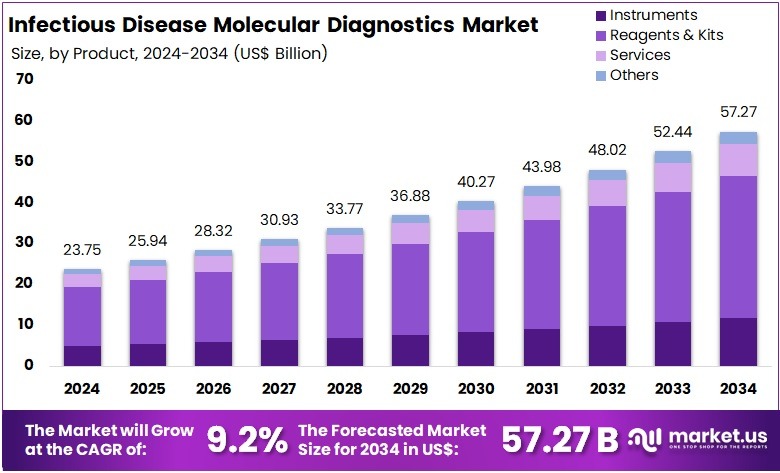
The Global Infectious Disease Molecular Diagnostics Market size is expected to be worth around US$ 57.27 Billion by 2034, from US$ 23.75 Billion in 2024, growing at a CAGR of 9.2% during the forecast period from 2025 to 2034. North America held a dominant market position, capturing more than a 37.9% share and holds US$ 9.0 Billion market value for the year.
Infectious disease molecular diagnostics refers to advanced laboratory techniques used to detect and identify disease-causing microorganisms by analyzing their genetic material, including DNA or RNA. These diagnostic methods provide rapid, highly sensitive, and accurate results, enabling healthcare professionals to diagnose bacterial, viral, fungal, and parasitic infections at an early stage. Technologies such as polymerase chain reaction (PCR), real-time PCR, next-generation sequencing (NGS), isothermal amplification, and multiplex molecular assays have become essential tools in modern clinical diagnostics.
The growing burden of infectious diseases, increasing demand for early and precise diagnosis, and the rising threat of antimicrobial resistance are driving the adoption of molecular diagnostic solutions worldwide. These tests support timely treatment decisions, improve patient outcomes, reduce unnecessary antibiotic use, and strengthen infection prevention and control programs. They are widely used in hospitals, diagnostic laboratories, public health agencies, research institutions, and point-of-care settings.
Recent advances in automation, digital laboratory workflows, and portable molecular testing platforms have expanded access to rapid diagnostics, particularly during public health emergencies and outbreak surveillance. The integration of artificial intelligence, cloud-based data management, and high-throughput sequencing is further improving diagnostic efficiency and disease monitoring. As healthcare systems continue to prioritize precision medicine and preparedness against emerging infectious threats, infectious disease molecular diagnostics are expected to remain a critical component of global healthcare infrastructure and public health response.
Key Takeaways
- The global infectious disease molecular diagnostics market is expected to grow from US$23.75 billion in 2024 to US$57.27 billion by 2034, expanding at a CAGR of 9.2% during the forecast period.
- In 2024, Reagents and Kits emerged as the leading product segment, accounting for over 60.8% of the global infectious disease molecular diagnostics market.
- Polymerase Chain Reaction (PCR) held the largest share among technologies in 2024, capturing more than 34.5% of the overall market.
The Respiratory Diseases segment led the application category in 2024, contributing over 22.1% of the total market revenue. - Hospitals remained the largest end-user segment in 2024, representing more than 40.8% of infectious disease molecular diagnostics demand worldwide.
- North America dominated the global infectious disease molecular diagnostics market in 2024, accounting for 37.9% of the market and generating approximately US$9.0 billion in revenue.
Statistical Information
- FDA-cleared rapid molecular influenza tests can deliver results in less than 15 minutes in 2025. This enables much faster clinical decision-making compared with conventional laboratory molecular workflows.
- Many FDA-cleared molecular influenza assays produce results within 30–60 minutes. These assays support same-visit diagnosis in hospitals and outpatient settings.
- CDC reported that molecular influenza diagnostic assays achieve approximately 90–95% sensitivity in 2025. This high sensitivity supports reliable detection of influenza viral RNA.
- WHO’s 2025 evidence review found non-point-of-care nucleic acid amplification tests (NPOC-NAATs) for tuberculosis achieved 85.4% pooled sensitivity. This demonstrates strong diagnostic performance for molecular infectious disease testing.
- The same WHO review reported 97.6% pooled specificity for sputum-based NPOC molecular tuberculosis tests. The high specificity reduces unnecessary treatment caused by false-positive diagnoses.
- WHO reported tongue-swab molecular NAATs achieved 76.4% pooled sensitivity for tuberculosis detection in the 2025 evidence review. This supports less invasive specimen collection while maintaining useful diagnostic accuracy.
- WHO found tongue-swab molecular NAATs reached 99.2% pooled specificity in 2025. This indicates excellent capability to correctly identify individuals without tuberculosis.
- A 2025 peer-reviewed droplet digital PCR (ddPCR) study reported 99.05% image-analysis accuracy for automated interpretation of complex ddPCR results. The system processed images containing more than 300 droplets per image.
- The same 2025 ddPCR study demonstrated a detection sensitivity as low as 90.32 copies/µL. This supports accurate detection of low-abundance infectious disease targets.
- The AI-enabled ddPCR workflow successfully analyzed images containing over 300 droplets per image while maintaining 99.05% classification accuracy. This highlights improved automation for molecular diagnostic laboratories.
Regional Analysis
In 2024, North America accounted for more than 37.9% of the global infectious disease molecular diagnostics market, generating US$ 9.0 billion in revenue. The region’s leadership is supported by advanced healthcare infrastructure, widespread adoption of molecular diagnostic technologies, and strong investments in public health laboratories. The United States continues to drive regional growth through extensive use of polymerase chain reaction (PCR), next-generation sequencing (NGS), and other molecular testing platforms for infectious disease surveillance and clinical diagnosis.
The U.S. Centers for Disease Control and Prevention (CDC) has expanded its Advanced Molecular Detection (AMD) program to strengthen genomic surveillance and improve outbreak response capabilities. In addition, the CDC recommends molecular assays for accurate influenza diagnosis because of their high sensitivity and rapid turnaround times, supporting broader clinical adoption. Canada is also expanding molecular testing through investments in laboratory modernization and public health preparedness. These factors, combined with supportive regulatory frameworks and continuous technological innovation, are expected to sustain North America’s leading market position
Emerging Trends
- Rapid growth of multiplex molecular testing: Healthcare providers are increasingly using multiplex PCR panels that detect multiple pathogens from a single sample. This reduces repeat testing and speeds treatment decisions. FDA-authorized multiplex assays can simultaneously identify viruses such as influenza A, influenza B, and SARS-CoV-2, improving laboratory efficiency and patient management.
- Expansion of genomic surveillance programs: Public health agencies are expanding next-generation sequencing (NGS) to monitor infectious diseases. Since 2014, the CDC’s Advanced Molecular Detection (AMD) program has strengthened pathogen surveillance by combining sequencing, bioinformatics, and epidemiology. The approach supports faster outbreak detection and tracks antimicrobial resistance and emerging variants.
- Greater adoption of bioinformatics and AI-supported analysis: Modern molecular diagnostics increasingly combine sequencing with advanced computational tools to interpret large genomic datasets. CDC’s AMD initiative integrates laboratory science, epidemiology, and bioinformatics, allowing faster identification of transmission patterns and supporting more accurate public health decisions during infectious disease outbreaks.
- Growing use of decentralized and near-patient molecular testing: Healthcare systems are adopting portable molecular diagnostic platforms that deliver highly accurate results closer to patients. Recent FDA-authorized molecular assays provide results in approximately 20–30 minutes, enabling earlier clinical decisions while reducing dependence on centralized laboratory infrastructure.
- Increasing focus on antimicrobial resistance surveillance: Molecular diagnostics are being integrated into surveillance systems to rapidly identify resistant pathogens. Genomic epidemiology enables laboratories to detect antimicrobial resistance markers while monitoring pathogen evolution, supporting infection control programs and guiding more targeted antimicrobial treatment across healthcare facilities.
Use Cases
- Hospital diagnosis of respiratory infections: Hospitals use molecular diagnostic tests to rapidly identify respiratory pathogens, including influenza viruses and SARS-CoV-2. Multiplex PCR enables several pathogens to be detected in one test, improving treatment selection, reducing unnecessary antibiotic use, and supporting better infection control practices.
- Public health outbreak investigation: National and regional public health laboratories use genomic sequencing to investigate infectious disease outbreaks. CDC’s Advanced Molecular Detection program combines sequencing with epidemiological data to identify transmission chains, detect emerging variants, and improve outbreak response across the United States.
- Monitoring antimicrobial resistance: Clinical laboratories use molecular diagnostics to detect resistance genes directly from infectious organisms. Genomic surveillance identifies resistance markers, helping physicians select appropriate therapies while supporting national antimicrobial stewardship initiatives and reducing inappropriate antibiotic prescribing.
- Wastewater-based infectious disease surveillance: Public health organizations increasingly apply molecular testing to wastewater samples for early community-level detection of infectious diseases. Wastewater surveillance helps identify disease circulation before many patients seek medical care, strengthening preparedness and supporting targeted public health interventions.
- Emergency preparedness for emerging infectious diseases: Molecular diagnostics play a central role during infectious disease emergencies. The FDA’s Emergency Use Authorization framework enables qualified diagnostic tests to become available rapidly when no adequate approved alternatives exist, improving preparedness and accelerating public health responses during outbreaks.
Frequently Asked Questions on Infectious Disease Molecular Diagnostics
- What is infectious disease molecular diagnostics?
Infectious disease molecular diagnostics refers to laboratory techniques that detect the genetic material (DNA or RNA) of viruses, bacteria, fungi, and parasites. These tests provide highly accurate and rapid identification of pathogens, helping healthcare providers diagnose infections early and select appropriate treatments. - What is the infectious disease molecular diagnostics market?
The infectious disease molecular diagnostics market includes products, technologies, instruments, reagents, software, and services used to detect infectious diseases through molecular testing. Market growth is driven by increasing disease burden, technological innovation, government surveillance programs, and expanding access to advanced diagnostic laboratories worldwide. - What factors are driving the growth of the infectious disease molecular diagnostics market?
The market is expanding due to the increasing prevalence of infectious diseases, rising demand for rapid diagnostic testing, greater investment in healthcare infrastructure, wider adoption of PCR and next-generation sequencing technologies, and stronger government initiatives supporting disease surveillance and outbreak preparedness. - Which technologies are commonly used in infectious disease molecular diagnostics?
Common technologies include Polymerase Chain Reaction (PCR), real-time PCR (qPCR), isothermal amplification, next-generation sequencing (NGS), CRISPR-based diagnostics, and microarray platforms. These methods enable sensitive pathogen detection, faster diagnosis, and improved identification of emerging and drug-resistant infectious organisms. - Which infectious diseases are commonly diagnosed using molecular diagnostics?
Molecular diagnostic tests are widely used to detect COVID-19, influenza, tuberculosis, HIV, hepatitis B and C, human papillomavirus (HPV), respiratory syncytial virus (RSV), sexually transmitted infections, gastrointestinal infections, and various hospital-acquired bacterial and fungal infections with high accuracy. - Which end users contribute most to the infectious disease molecular diagnostics market?
Hospitals, clinical laboratories, diagnostic centers, public health laboratories, academic research institutions, and reference laboratories are the major end users. Growing testing volumes, automation, and improved laboratory infrastructure continue to increase demand across these healthcare settings. - Which region leads the infectious disease molecular diagnostics market?
North America currently leads the infectious disease molecular diagnostics market due to advanced healthcare infrastructure, high adoption of molecular testing technologies, favorable reimbursement systems, significant research funding, and strong regulatory support for innovative diagnostic solutions and disease surveillance programs. - What challenges does the infectious disease molecular diagnostics market face?
Key challenges include high instrument costs, limited laboratory infrastructure in developing regions, reimbursement variations, complex regulatory requirements, and the need for trained laboratory professionals. Despite these barriers, continuous technological innovation is improving affordability, accessibility, and testing efficiency worldwide. - How is artificial intelligence influencing infectious disease molecular diagnostics?
Artificial intelligence supports molecular diagnostics by improving data interpretation, automating laboratory workflows, reducing reporting time, and identifying diagnostic patterns. AI-assisted platforms enhance clinical decision-making while increasing testing efficiency, accuracy, and scalability in high-volume diagnostic laboratories. - What is the future outlook for the infectious disease molecular diagnostics market?
The market is expected to experience steady growth as healthcare systems prioritize early disease detection, personalized medicine, decentralized testing, and pandemic preparedness. Continuous innovation in multiplex assays, point-of-care molecular diagnostics, and genomic technologies will further expand global market opportunities.
Conclusion
The infectious disease molecular diagnostics market is expected to witness strong long-term growth as healthcare systems increasingly prioritize rapid, accurate, and early detection of infectious diseases. Rising adoption of PCR, next-generation sequencing, and other advanced molecular technologies is improving diagnostic accuracy while supporting personalized treatment and effective outbreak management.
Growing investments in laboratory infrastructure, expanding point-of-care testing, and stronger government initiatives for disease surveillance are further driving market expansion. North America remains the leading regional market due to advanced healthcare infrastructure, while emerging economies present significant growth opportunities through improved diagnostic access and increasing awareness of infectious disease control and prevention.
Discuss your needs with our analyst
Please share your requirements with more details so our analyst can check if they can solve your problem(s)




