
Overview
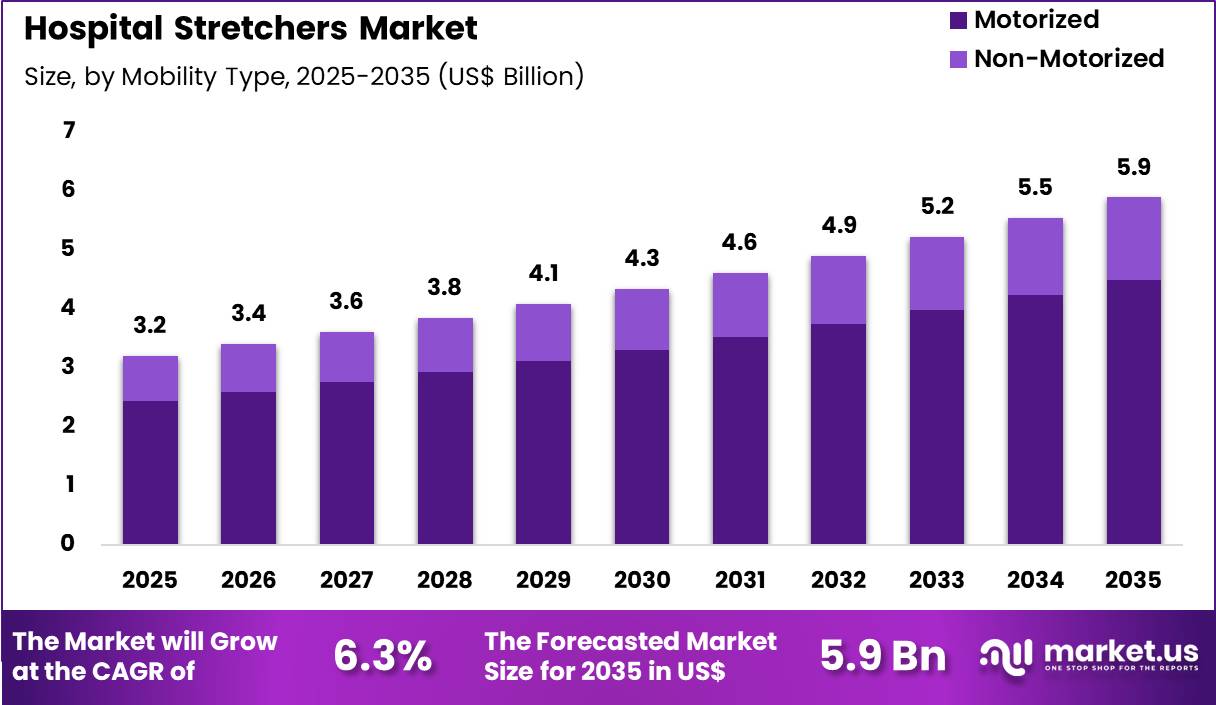
New York, NY – Nov 10 2026 – The Global Hospital Stretchers Market size is expected to be worth around US$ 5.9 Billion by 2035 from US$ 3.2 Billion in 2025, growing at a CAGR of 6.3% during the forecast period 2026-2035. In 2025, North America led the market, achieving over 34.4% share with a revenue of US$ 1.1 Billion.
The Hospital Stretchers Market is experiencing steady growth due to the increasing demand for advanced patient transportation and emergency care equipment across healthcare facilities. Hospital stretchers play an essential role in moving patients safely and comfortably between emergency departments, operating rooms, intensive care units, and diagnostic centers. These devices are designed to support patient mobility, reduce physical strain on healthcare workers, and improve overall hospital workflow.
Growing hospital admissions, rising emergency medical service requirements, and an increasing number of surgical procedures are supporting market expansion. Healthcare facilities are increasingly adopting advanced stretchers equipped with adjustable height settings, side rails, hydraulic systems, and enhanced patient safety features. Technological improvements, including powered stretchers and lightweight materials, are also improving handling efficiency and patient comfort.
Additionally, the expansion of healthcare infrastructure, rising healthcare expenditure, and growing investments in modern medical equipment are creating new opportunities for market growth. Hospitals, ambulatory surgical centers, and emergency medical service providers remain important end users.
Manufacturers are focusing on ergonomic designs, improved durability, easy maneuverability, and infection-control features to meet changing healthcare requirements. Overall, the hospital stretchers market is expected to witness continued development as healthcare providers prioritize patient safety, operational efficiency, and quality emergency care.
Key Takeaways
- In 2025, the Hospital Stretchers Market generated revenue of US$ 3.2 Billion and is projected to reach US$ 5.9 Billion by 2035, growing at a CAGR of 6.3% during the forecast period.
- By product type, the market includes wheeled/trolley stretchers, scoop stretchers, spine board stretchers, basket stretchers, stair/evacuation chair stretchers, and others. Among these, wheeled/trolley stretchers dominated with a 39.9% market share.
- Based on mobility type, the market is categorized into motorized and non-motorized stretchers. The motorized segment accounted for a leading share of 76.3%.
- By application, the market is segmented into daycare/inpatient, surgery, emergency/trauma, and ambulatory/transport. The emergency/trauma segment dominated with a 35.1% revenue share.
- Regionally, North America dominated the Hospital Stretchers Market, accounting for the largest market share of 34.4%.
Key Market Segments
- Product Type Analysis: Wheeled/trolley stretchers dominated the product type segment with a 39.9% market share, driven by their flexibility, easy maneuverability, and efficient patient transportation. Hospitals widely use these stretchers for moving patients between departments. Rising hospital admissions, expanding healthcare facilities, and demand for improved safety features further support segment growth.
- Mobility Type Analysis: Motorized stretchers held a dominant 76.3% market share in the mobility type segment, supported by their speed, automation, and reduced physical effort for healthcare workers. Hospitals increasingly adopt electric and battery-powered models to improve patient transfers. Advanced height adjustment, better battery performance, and remote-control features further encourage adoption.
- Application Analysis: The emergency/trauma segment accounted for the largest share of 35.1% in the application category, driven by the growing need for rapid and safe patient transportation. Hospitals and trauma centers rely on specialized stretchers for critical care situations. Rising accident cases, emergency admissions, and investments in trauma care infrastructure support segment expansion.
Regional Analysis
North America is Leading the Hospital Stretchers Market
North America dominated the hospital stretchers market in 2024, accounting for 34.4% of the global market share. Regional growth is supported by rising hospital admissions, increasing emergency care demand, and investments in advanced healthcare equipment. The United States recorded approximately 155.4 million emergency department visits in 2023, highlighting the need for efficient patient transportation.
Hospitals are increasingly adopting adjustable, bariatric, and motorized stretchers to improve patient safety and reduce staff workload. An aging population and growing surgical procedures further increase equipment demand. Additionally, investments in emergency departments, outpatient centers, and modern healthcare facilities are supporting regional market expansion.
Asia Pacific is Expected to Record the Highest CAGR
Asia Pacific is projected to register the highest CAGR during the forecast period, driven by expanding healthcare infrastructure and rising patient populations. Countries such as China and India are investing in hospitals, emergency departments, and intensive care facilities.
Growing chronic disease cases, accidents, and surgical procedures are increasing demand for patient transportation equipment. Additionally, government healthcare spending, private hospital expansion, and modernization of medical facilities are creating new growth opportunities.
Emerging Trends
- Growing Demand for Electric and Powered Stretchers: Hospitals are increasingly adopting electric and powered stretchers to improve patient handling and reduce physical strain on healthcare workers. These stretchers offer adjustable height, motorized positioning, and easier movement. They also support safer patient transfers in emergency departments and intensive care units.
- Increasing Focus on Patient Safety and Fall Prevention: Patient safety is becoming a major priority in stretcher design. Manufacturers are incorporating side rails, secure locking systems, safety straps, and improved braking mechanisms. These features help reduce accidental falls and improve patient stability during transportation, examination, and treatment.
- Rising Adoption of Bariatric Hospital Stretchers: The need for bariatric stretchers is increasing as hospitals focus on accommodating patients with higher body weights. These stretchers offer wider surfaces, stronger frames, and higher weight capacities. They help healthcare facilities provide safer patient transportation while reducing the risk of equipment-related injuries.
- Integration of Advanced Features for Emergency Care: Modern hospital stretchers increasingly include features such as adjustable backrests, oxygen cylinder holders, IV pole attachments, and equipment storage. These improvements help medical teams respond quickly during emergencies and support efficient patient movement between emergency rooms, operating rooms, and diagnostic departments.
- Greater Attention to Infection Control and Easy Cleaning: Hospitals are giving more importance to stretcher materials and designs that support infection prevention. Smooth surfaces, removable mattresses, and easy-to-clean components help healthcare staff maintain hygiene between patients. This trend supports better infection control practices in busy hospitals and emergency care facilities.
- Development of Ergonomic Stretcher Designs: Healthcare facilities are showing greater interest in ergonomic stretcher designs that improve comfort for patients and ease of use for medical staff. Better handles, smooth-rolling wheels, adjustable sections, and improved positioning systems support efficient movement across different hospital departments. OSHA highlights the importance of suitable patient-handling equipment in reducing workplace injuries.
Use Cases
- Emergency Patient Transportation: Hospital stretchers are widely used to move patients from ambulances to emergency departments and treatment rooms. They allow medical teams to transport injured or critically ill patients quickly while maintaining a stable position. Emergency stretchers also support rapid access to patients during urgent medical situations.
- Patient Movement During Surgical Procedures: Stretchers help transfer patients from hospital wards to operating rooms and recovery areas. They provide a convenient surface for moving patients before and after surgery. Adjustable positioning and safety features help medical staff manage patient transfers with greater control.
- Intensive Care Unit (ICU) Patient Handling: ICU stretchers support the movement of patients who require continuous medical attention. They can accommodate essential accessories such as IV stands, oxygen cylinders, and monitoring equipment. These features help healthcare professionals move critically ill patients while maintaining access to necessary medical support.
- Diagnostic and Imaging Procedures: Hospital stretchers are used to transport patients to radiology departments for X-rays, CT scans, and other diagnostic examinations. Suitable stretcher designs help medical teams move patients safely between departments. They are particularly useful for individuals who cannot walk independently or require assistance.
- Hospital Evacuation and Disaster Management: Stretchers play an important role during hospital emergencies, including fires and natural disasters. They help medical staff move patients who cannot evacuate independently. The Indian Ministry of Health and Family Welfare also highlights the importance of accessible evacuation equipment, regular maintenance, and proper emergency planning.
Frequently Asked Questions About Hospital Stretchers
- What are the main types of hospital stretchers?
The main types include manual stretchers, hydraulic stretchers, electric stretchers, emergency stretchers, bariatric stretchers, and transport stretchers. Each type serves different patient needs and helps healthcare professionals manage transportation across various clinical environments. - What materials are used to manufacture hospital stretchers?
Hospital stretchers commonly use stainless steel, aluminium, and durable metal frames. Their surfaces often include easy-to-clean materials and supportive mattresses. These materials help provide strength, patient comfort, durability, and easier maintenance in healthcare facilities. - What features should a hospital stretcher have?
A hospital stretcher should include adjustable height, secure side rails, locking wheels, safety straps, and a comfortable mattress. Additional features such as IV pole holders and oxygen cylinder supports can improve patient handling and transportation. - Why are bariatric hospital stretchers important?
Bariatric hospital stretchers are designed to support patients with higher body weights. They offer wider platforms, stronger frames, and higher weight capacities. These features help hospitals improve patient comfort, support safe transfers, and reduce handling difficulties. - What are the major factors driving the hospital stretchers market?
The market is driven by increasing hospital admissions, rising demand for emergency medical services, healthcare infrastructure development, and growing investments in modern patient-handling equipment. Greater attention to patient safety also supports demand for advanced stretchers. - Which are the major end users of hospital stretchers?
Major end users include hospitals, ambulatory surgical centers, emergency medical services, specialty clinics, and diagnostic centers. These facilities use stretchers to transport patients, support medical procedures, and improve patient movement across different healthcare departments. - What opportunities are emerging in the hospital stretchers market?
Opportunities are emerging through healthcare infrastructure expansion, demand for electric stretchers, and increasing adoption of bariatric equipment. Developing healthcare facilities and investments in patient safety technologies are also creating opportunities for manufacturers to expand their product offerings.
Conclusion
The Hospital Stretchers Market is expected to witness steady growth, supported by rising hospital admissions, increasing emergency care requirements, and expanding healthcare infrastructure. The growing adoption of motorized stretchers, bariatric equipment, and advanced patient-handling solutions is improving patient safety and operational efficiency. North America continues to lead the market, while Asia Pacific is expected to offer strong growth opportunities.
Manufacturers are focusing on ergonomic designs, improved mobility, durable materials, and infection-control features to meet evolving healthcare needs. With increasing investments in modern medical equipment, the market is projected to reach US$ 5.9 Billion by 2035, growing at a CAGR of 6.3%.
Discuss your needs with our analyst
Please share your requirements with more details so our analyst can check if they can solve your problem(s)