


Overview
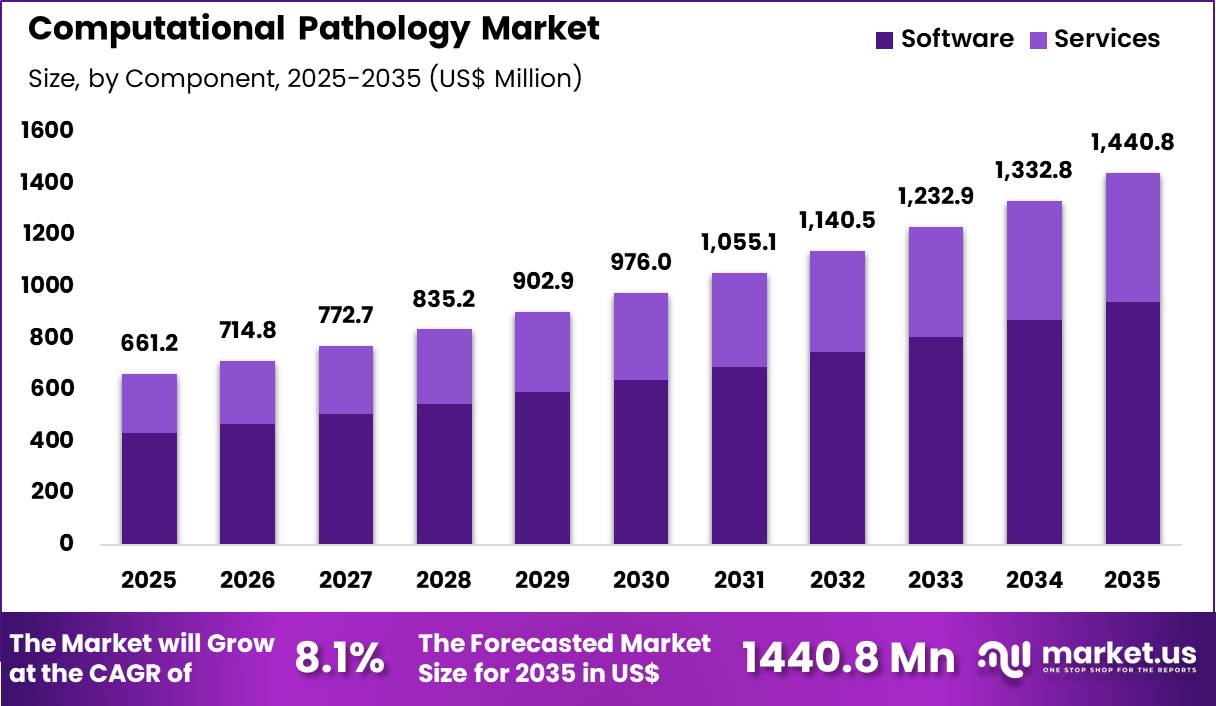
New York, NY – Nov 10 2026 –The Global Computational Pathology Market size is expected to be worth around US$ 1440.8 Million by 2035 from US$ 661.2 Million in 2025, growing at a CAGR of 8.1% during the forecast period 2026-2035. In 2025, North America led the market, achieving over 43.6% share with a revenue of US$ 288.3 Million.
The Computational Pathology Market is gaining momentum as healthcare providers increasingly adopt digital technologies to improve disease diagnosis and laboratory efficiency. Computational pathology combines digital pathology, artificial intelligence (AI), machine learning, and advanced image analysis to examine tissue samples and support accurate disease detection. It converts traditional glass slide images into digital formats, allowing pathologists to analyze, store, share, and interpret medical images more efficiently.
Growing demand for early disease diagnosis, personalized medicine, and precision healthcare is driving the adoption of computational pathology solutions. These technologies help identify complex tissue patterns, detect abnormalities, and support clinical decision-making. They are widely used in cancer diagnosis, drug discovery, biomarker identification, and clinical research.
Hospitals, diagnostic laboratories, pharmaceutical companies, and research institutions are increasingly investing in digital pathology platforms and AI-powered analytical tools. In addition, advancements in cloud computing, high-resolution imaging, and automated image processing are creating new opportunities for market growth.
The rising burden of cancer and other chronic diseases is further increasing the need for reliable diagnostic solutions. As healthcare systems focus on improving diagnostic accuracy, reducing manual workloads, and supporting faster clinical decisions, computational pathology is expected to play an important role in the future of digital healthcare.
Key Takeaways
- In 2025, the Computational Pathology Market generated revenue of US$ 661.2 Million and is projected to reach US$ 1,440.8 Million by 2035, growing at a CAGR of 8.1% during the forecast period.
- Based on component, the market is segmented into software and services, with the software segment dominating the market with a 65.5% share.
- By technology, the market is categorized into machine learning, natural language processing (NLP) models, and computer vision. Among these, machine learning (ML) held the largest share of 36.9%.
- By application, the market is divided into disease diagnosis, drug discovery and development, and academic research. Disease diagnosis dominated the segment, accounting for the highest revenue share of 43.2%.
- Based on end users, the market is segmented into hospitals and diagnostic labs, biotechnology and pharmaceutical companies, and academic and research institutes. Hospitals and diagnostic labs led the segment with a revenue share of 53.0%.
- North America dominated the global computational pathology market, accounting for the largest market share of 43.6%.
Key Market Segments
- Component Analysis: Software dominated the component segment with a 65.5% market share. Its growth is driven by increasing adoption of digital pathology platforms, AI-based image analysis, and automated diagnostic tools. Hospitals and diagnostic laboratories use these solutions to improve workflow efficiency, enhance diagnostic accuracy, reduce turnaround times, and support better clinical decisions.
- Technology Analysis: Machine learning held the leading position in the technology segment with a 36.9% share. Its growth is supported by the ability to analyze complex tissue images and identify disease patterns. Increasing use of AI algorithms, automated slide analysis, and image recognition tools is improving diagnostic accuracy and supporting faster clinical decisions.
- Application Analysis: Disease diagnosis dominated the application segment with a 43.2% market share. Growing demand for early and accurate disease detection is driving adoption. Hospitals and diagnostic laboratories increasingly use computational pathology to identify cancer, infectious diseases, and other medical conditions while improving diagnostic efficiency and supporting personalized treatment decisions.
- End-User Analysis: Hospitals and diagnostic labs led the end-user segment with a 53.0% market share. Their dominance is driven by high patient volumes and increasing adoption of advanced diagnostic technologies. Growing investments in AI-powered pathology software, digital imaging platforms, and automated workflows are helping healthcare facilities improve diagnostic accuracy and operational efficiency.
Regional Analysis
North America Leads the Computational Pathology Market
North America dominated the computational pathology market in 2024, accounting for 43.6% of the global market share. Growth was driven by increasing adoption of digital slide imaging, AI-powered analytics, and advanced diagnostic technologies across hospitals and laboratories.
Rising cancer cases and growing demand for precision medicine encouraged healthcare providers to invest in digital pathology platforms. Collaborations between research institutions and technology developers also supported the development of machine-learning tools. Government initiatives and training programs further strengthened adoption across clinical settings.
Asia Pacific is Expected to Register the Highest CAGR
Asia Pacific is expected to record the highest CAGR during the forecast period. Growth is supported by healthcare digitalization, rising cancer cases, and increasing investments in advanced diagnostic infrastructure.
Countries such as China, India, Japan, and South Korea are adopting AI-based pathology solutions. Partnerships with technology providers, telemedicine expansion, and training programs are further supporting regional adoption. Growing demand for accurate diagnosis and efficient laboratory workflows is expected to create new market opportunities.
Emerging Trends
- Growing Adoption of AI-Based Pathology: Artificial intelligence and machine learning are increasingly used to analyze digital tissue images. These technologies help pathologists identify abnormal cells, recognize tissue patterns, and improve diagnostic consistency. AI-based tools are also supporting faster laboratory workflows.
- Increasing Use of Whole-Slide Imaging: Healthcare facilities are adopting whole-slide imaging to convert traditional glass slides into high-resolution digital images. This allows pathologists to view, store, share, and examine tissue samples remotely, supporting better collaboration and digital diagnosis.
- Integration of Multimodal Data: Computational pathology is increasingly combining tissue images with genomic information, clinical records, and molecular data. This approach helps researchers understand diseases more clearly and supports personalized treatment decisions, particularly in cancer diagnosis and research.
- Development of Foundation Models: Advanced AI foundation models are creating new opportunities in computational pathology. These models can analyze large pathology datasets and support disease classification, outcome prediction, and treatment response assessment. Their integration with other medical data is becoming an important research direction.
- Focus on Data Security and Model Validation: Healthcare institutions are giving greater attention to patient data protection, software validation, and reliable AI performance. Privacy-preserving technologies, including federated learning, are supporting collaborative research without requiring institutions to share all patient data.
Use Cases
- Cancer Detection and Diagnosis: Computational pathology helps pathologists examine tissue samples and identify cancer-related changes. AI-powered image analysis can support tumor detection, cell counting, and tissue classification, helping healthcare professionals improve diagnostic workflows and make more informed clinical decisions.
- Disease Grading and Prognosis: Computational tools can measure tumor characteristics and identify patterns linked to disease progression. These insights support cancer grading and outcome assessment, helping doctors understand disease severity and evaluate possible treatment approaches.
- Biomarker Identification: Computational pathology supports the identification and measurement of important biomarkers in tissue samples. It helps researchers examine protein expression and cellular patterns, supporting treatment selection and personalized healthcare, particularly in cancer and targeted therapy development.
- Drug Discovery and Clinical Trials: Pharmaceutical companies and research institutions use computational pathology to analyze tissue changes during drug development. Digital image analysis supports patient selection, treatment response assessment, and standardized tissue evaluation across clinical trial locations.
- Laboratory Quality Control and Workflow Management: Diagnostic laboratories use computational pathology tools to check digital slide quality, identify image artifacts, and organize tissue image reviews. These applications support consistent laboratory processes and help pathologists focus on important diagnostic tasks.
Frequently Asked Questions About Computational Pathology
- How does computational pathology work?
Computational pathology uses scanners to convert tissue slides into digital images. Specialized software and machine learning algorithms analyze these images to identify abnormal cells, measure tissue characteristics, and provide useful information for pathologists. - What are the major applications of computational pathology?
Computational pathology is widely used in cancer diagnosis, disease classification, biomarker identification, drug discovery, and clinical research. It also supports tumor grading, treatment response assessment, and laboratory quality control. - What are the benefits of computational pathology?
Computational pathology improves image analysis, supports consistent diagnostic evaluation, and reduces repetitive manual work. It also enables remote slide sharing, faster collaboration between specialists, and better use of medical information for clinical decision-making. - What role does artificial intelligence play in computational pathology?
Artificial intelligence helps analyze large digital tissue images, recognize cellular patterns, and identify disease-related changes. Machine learning models support automated image assessment, tumor classification, biomarker measurement, and diagnostic decision support for pathologists. - What is driving the growth of the computational pathology market?
Market growth is driven by rising cancer cases, increasing demand for accurate diagnosis, growing adoption of digital pathology, and advancements in artificial intelligence. Healthcare investments in automated laboratory systems are also supporting market expansion. - What is the future outlook for the computational pathology market?
The computational pathology market is expected to grow as hospitals, diagnostic laboratories, and pharmaceutical companies adopt advanced digital solutions. Improvements in AI algorithms, whole-slide imaging, and personalized medicine will create further opportunities.
Conclusion
The Computational Pathology Market is expected to experience steady growth, reaching US$ 1,440.8 Million by 2035, at a CAGR of 8.1%. Rising demand for accurate disease diagnosis, increasing cancer cases, and growing adoption of artificial intelligence are supporting market expansion.
Software, machine learning, and disease diagnosis remain key market segments. North America continues to lead, while Asia Pacific is expected to record the highest growth rate. Furthermore, advancements in whole-slide imaging, cloud computing, and personalized medicine are creating new opportunities. Increasing investments in digital healthcare will further strengthen the market’s long-term growth potential.
Discuss your needs with our analyst
Please share your requirements with more details so our analyst can check if they can solve your problem(s)



