


Overview
New York, NY – Sep 09, 2026 – The Global Hemostatic Gels Market size is expected to be worth around US$ 2.25 Billion by 2034 from US$ 1.20 Billion in 2024, growing at a CAGR of 6.5% during the forecast period 2025 to 2034. In 2024, North America led the market, achieving over 36.5% share with a revenue of US$ 438.0 Million.
The global Hemostatic Gels Market is gaining momentum due to the increasing number of surgical procedures, rising trauma cases, and growing demand for advanced bleeding management technologies. Hemostatic gels are innovative surgical products designed to accelerate clot formation, reduce blood loss, and improve patient outcomes during procedures. These gels are increasingly used in cardiovascular surgery, orthopedic surgery, neurosurgery, dental procedures, and emergency trauma care.
The rising global surgical volume is a major factor supporting market growth. According to the World Health Organization (WHO), approximately 313 million major surgical procedures are performed globally each year, creating strong demand for effective hemostatic products. Surgical bleeding remains a significant clinical challenge, with excessive blood loss contributing to longer hospital stays, increased healthcare costs, and higher risks of complications.
Trauma care is another key application area. WHO reports that road traffic accidents cause nearly 1.19 million deaths annually, while 20–50 million people suffer non-fatal injuries each year, many requiring emergency bleeding control solutions. Hemostatic gels are increasingly adopted in emergency departments and military medicine due to their rapid action and easy application.
The growing prevalence of chronic diseases is also increasing surgical demand. According to WHO, cardiovascular diseases account for approximately 17.9 million deaths annually, representing nearly 32% of all global deaths. Many cardiovascular interventions require advanced hemostatic agents to manage surgical bleeding effectively.
The aging population is another important growth driver. United Nations data indicates that the global population aged 65 years and older reached more than 800 million in 2022 and is projected to exceed 1.6 billion by 2050, increasing demand for surgical treatments related to age-associated diseases.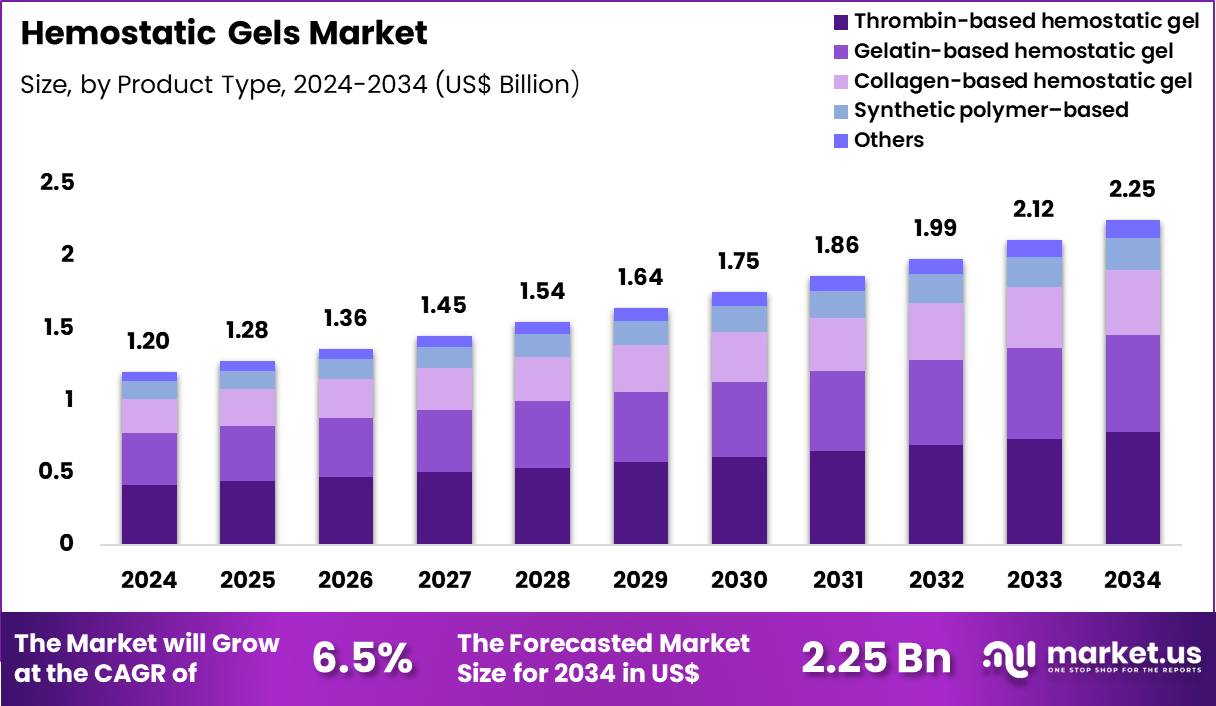
Key Takeaways
- In 2024, the Hemostatic Gels Market generated revenue of US$ 1.20 billion and is projected to grow at a CAGR of 6.5%, reaching approximately US$ 2.25 billion by 2034.
- The Product Type segment includes thrombin-based, gelatin-based, collagen-based, synthetic polymer-based gels, and other formulations. Thrombin-based gels dominated the market in 2024 with a 34.7% share, driven by their rapid clot activation and effective bleeding control performance.
- The Application segment consists of general surgery, dental surgery, veterinary surgery, cardiovascular surgery, orthopedic surgery, and other procedures. General Surgery accounted for the largest market share of 40.5% in 2024, supported by the high number of surgical interventions requiring bleeding management solutions.
- The End-User segment covers hospitals, ambulatory surgical centers (ASCs), specialty clinics, veterinary settings, and others. Hospitals held the leading position in 2024 with a 52.3% market share, owing to the increasing volume of complex surgical procedures performed in hospital settings.
- North America dominated the Hemostatic Gels Market in 2024, capturing a market share of 36.5%, supported by advanced healthcare infrastructure, high surgical procedure volumes, and increasing adoption of innovative hemostatic technologies.
Statistical Information
- Gelatin-Based Flowable Matrices Improve Bleeding Control in Vascular Procedures: Clinical studies of SurgiFlo®, a gelatin-based flowable hemostatic matrix, have demonstrated strong performance in vascular surgery. The product achieved bleeding cessation in 96.7% of patients within 10 minutes, with no reported complications such as infection, adhesions, or synechiae, supporting its role as an effective surgical bleeding-control solution.
- Polysaccharide-Based Hemostatic Agents Deliver High Surgical Success Rates: A multicenter clinical evaluation of polysaccharide hemostatic agents across general, cardiac, and urologic surgeries reported 90.6% hemostatic success at 7 minutes compared with 92.0% for microporous polysaccharide hemospheres (MPH). The findings confirmed noninferior performance with no significant safety concerns.
- Chitosan Hemostatic Dressings Support Emergency Bleeding Management: Clinical evaluations of HemCon® chitosan-based hemostatic dressings demonstrated effective hemorrhage control in trauma and surgical settings. Military applications reported approximately 97% bleeding-control success, while civilian oral surgery cases achieved control in 79% of cases (27/34 patients), highlighting the value of chitosan materials in emergency care.
- FDA Regulatory Approvals Expand Topical Hemostatic Applications: The U.S. FDA has cleared more than 100 topical hemostatic wound dressings without thrombin and 18 thrombin-containing products. Approved applications include surgical bleeding, traumatic wounds, vascular access sites, catheter-related bleeding, and procedures requiring faster hemostasis during diagnostic endovascular interventions using 4–6 Fr sheaths.
- Gelatin Matrices Demonstrate Rapid Hemostasis in Preclinical Surgical Models: A 2025 evaluation of gelatin-based hemostatic matrices, including SURGIFLO® and Borayerflo®, reported 100% hemostasis within 5 minutes in a beagle cerebral hemorrhage model. All 12/12 SURGIFLO-treated sites achieved bleeding control within 2 minutes, with no significant changes in coagulation indicators such as fibrinogen, PT, INR, TT, and APTT.
- SURGIFLO Provides Effective Control of Moderate Organ Bleeding: A comparative surgical study evaluating SURGIFLO and Hemoblast found that SURGIFLO achieved single-application hemostasis in 77.4% of bleeding sites, compared with 3.3% for Hemoblast. Within five minutes, SURGIFLO controlled bleeding in 100% of evaluated sites (31/31) compared with 80% (24/30) for Hemoblast.
Regional Analysis
North America led the market by securing a market share of 36.5% in 2024.
North America dominated the Hemostatic Gels Market due to advanced healthcare infrastructure, high surgical procedure volumes, and widespread adoption of advanced bleeding-control technologies. Hospitals, trauma centers, and ambulatory surgical centers increasingly use hemostatic gels in cardiovascular, orthopedic, general, and dental surgeries.
Strong regulatory support, healthcare investments, and continuous product innovation further contribute to regional growth. The U.S. FDA has cleared multiple topical hemostatic products for surgical and trauma applications, supporting clinical adoption.
Asia Pacific is expected to witness significant growth during the forecast period, driven by rising surgical demand, expanding healthcare facilities, increasing trauma cases, and a growing elderly population. Improvements in healthcare access, medical infrastructure development, and adoption of minimally invasive procedures are supporting demand for advanced hemostatic solutions. Growing investments by public and private healthcare providers are further accelerating market expansion across emerging economies.
Emerging Trends
- Development of Advanced Flowable Hemostatic Gel Technologies: The market is shifting toward flowable gel-based hemostatic solutions that can cover irregular bleeding surfaces and provide faster clot formation. FDA-cleared products are expanding applications in trauma and surgery. More than 300 million surgical procedures occur annually worldwide, increasing demand for efficient bleeding-control technologies.
- Growing Adoption of Trauma-Focused Hemostatic Gels: Emergency bleeding control is becoming a major application area for hemostatic gels. New gel technologies are designed for first responders, trauma centers, and emergency medical services. FDA clearance of products such as TRAUMAGEL® supports use in controlling moderate-to-severe external bleeding during urgent situations.
- Increasing Use of Bioactive and Synthetic Biomaterials: Manufacturers are developing next-generation gels using thrombin, gelatin, collagen, polysaccharides, and synthetic polymers to improve clot stability and tissue compatibility. FDA recognizes thrombin-based hemostatic products as aids for controlling bleeding from capillaries and small venules during medical procedures.
- Rising Demand for Safer Surgical Bleeding Management: Hospitals are adopting advanced hemostatic products to improve surgical safety and reduce complications related to bleeding. WHO reports that approximately 1 in 10 patients experiences harm during healthcare, highlighting the importance of safer surgical technologies and improved procedural outcomes.
- Expansion of Hemostatic Gel Applications Beyond Operating Rooms: Hemostatic gels are increasingly used across trauma care, vascular procedures, wound management, and emergency medicine. FDA classifications include hemostatic products for temporary bleeding control and wound coverage across multiple clinical settings, supporting wider adoption.
Use Cases
- Cardiovascular and Vascular Surgery Applications: Hemostatic gels are widely used during cardiovascular and vascular procedures where controlling bleeding from highly vascular tissues is challenging. FDA-approved thrombin-based products support hemostasis in surgical situations involving accessible bleeding from small vessels and capillaries.
- Trauma and Emergency Care Management: Trauma centers and emergency teams use hemostatic gels for rapid bleeding control in severe injuries. Products such as TRAUMAGEL® are designed for temporary external control of moderate-to-severe bleeding, supporting emergency response and first-responder applications.
- General Surgery and Minimally Invasive Procedures: Surgeons use hemostatic gels during general and minimally invasive procedures because gels can reach complex bleeding locations where traditional methods may be difficult. The global volume of more than 300 million surgeries annually creates continued need for advanced surgical bleeding solutions.
- Dental and Oral Surgery Bleeding Control: Hemostatic gels are used in dental procedures such as tooth extraction, periodontal surgery, and oral wound management. Their localized application helps stabilize clots and manage bleeding in small surgical areas where precision is required.
- Chronic Wound and Vascular Access Management: FDA-cleared hemostatic products are applied in multiple wound-care situations, including surgical wounds, vascular access sites, traumatic wounds, and catheter-related bleeding. This broad indication range supports adoption across hospitals, specialty clinics, and outpatient care settings.
Frequently Asked Questions on Hemostatic Gels
- What are the major product types in the Hemostatic Gels Market?
The Hemostatic Gels Market includes gelatin-based gels, thrombin-based gels, collagen-based gels, polysaccharide-based gels, synthetic polymer-based gels, and other advanced formulations. Each product type offers different mechanisms for achieving rapid and effective bleeding control. - Which surgical applications use hemostatic gels the most?
Hemostatic gels are commonly used in general surgery, cardiovascular surgery, orthopedic procedures, dental surgery, neurosurgery, and trauma care. Their ability to control bleeding in difficult anatomical areas makes them valuable across multiple surgical specialties. - What factors are driving the growth of the Hemostatic Gels Market?
Market growth is driven by increasing surgical procedures, rising trauma cases, growing adoption of minimally invasive surgeries, and demand for advanced bleeding-control technologies. Healthcare providers are increasingly focusing on reducing complications and improving patient outcomes. - How does trauma care contribute to demand for hemostatic gels?
Trauma situations often require immediate bleeding control to prevent severe complications. Hemostatic gels provide rapid application and clot formation, making them useful in emergency departments, trauma centers, military medicine, and first-responder medical applications. - Are hemostatic gels approved by regulatory authorities?
Yes, several hemostatic gel products have received regulatory clearance from agencies such as the U.S. FDA. Approved products are used for surgical bleeding control, traumatic wounds, vascular access procedures, and other medical applications. - What role do hospitals play in the Hemostatic Gels Market?
Hospitals represent major users of hemostatic gels because they perform high volumes of complex surgical procedures. Advanced hospitals and trauma centers utilize these products in operating rooms, emergency departments, and specialized surgical units for bleeding management. - How are technological advancements influencing hemostatic gels?
Technological advancements are improving gel formulations through enhanced adhesion, faster clot formation, better absorption, and improved tissue compatibility. Researchers are developing innovative biomaterials, including synthetic polymers and bioactive compounds, to improve surgical bleeding control.
Conclusion
The Hemostatic Gels Market is experiencing steady growth due to increasing surgical procedures, rising trauma cases, and growing demand for advanced bleeding-control solutions. Clinical evidence demonstrates the effectiveness of gelatin-based, thrombin-based, polysaccharide, and synthetic gel formulations in achieving rapid hemostasis across multiple medical applications.
Regulatory approvals, technological advancements, and expanding use in trauma care, cardiovascular surgery, dental procedures, and wound management are strengthening market adoption. Hospitals and surgical centers continue to integrate these products to improve patient safety and surgical outcomes. With ongoing innovation in biomaterials and healthcare infrastructure development, hemostatic gels are expected to play an increasingly important role in modern medical care.
Discuss your needs with our analyst
Please share your requirements with more details so our analyst can check if they can solve your problem(s)




