


Overview
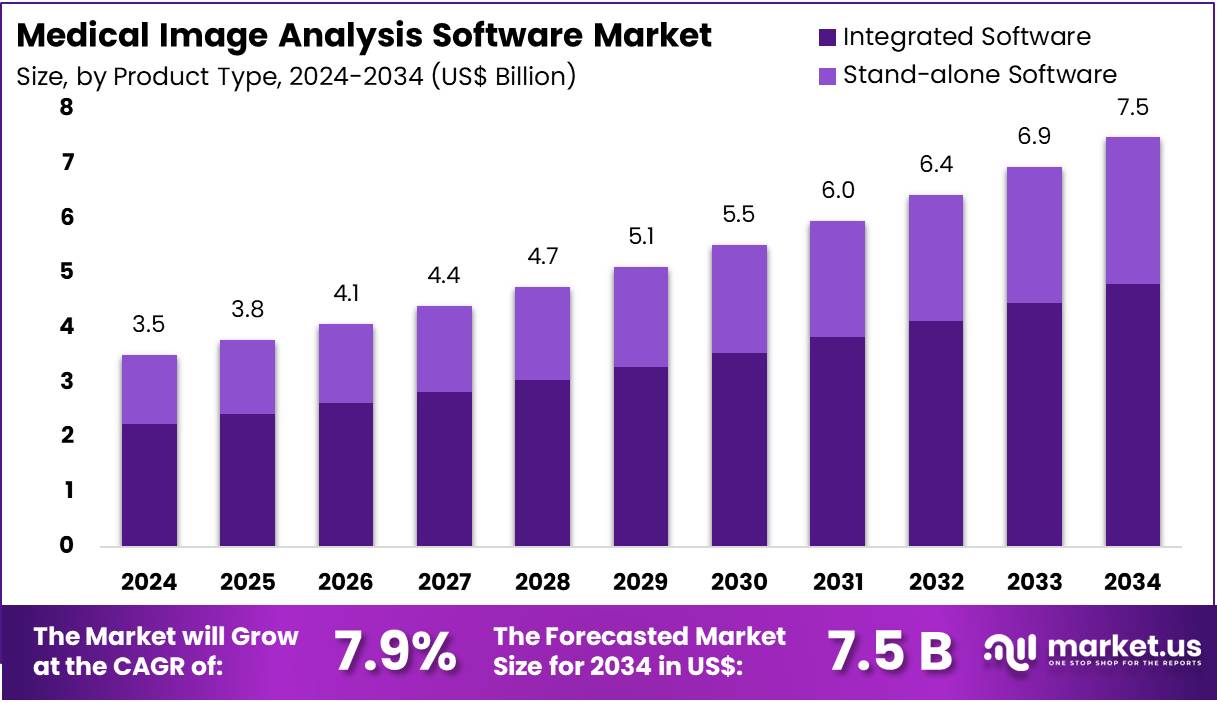
New York, NY – May 11, 2026 – The Global Medical Image Analysis Software Market size is expected to be worth around US$ 7.5 Billion by 2034, from US$ 3.5 Billion in 2024, growing at a CAGR of 7.9% during the forecast period from 2025 to 2034.
The global market for Medical Image Analysis Software is witnessing steady growth due to the rising adoption of advanced diagnostic technologies across healthcare facilities. Medical image analysis software is designed to process, interpret, and manage medical images generated through imaging modalities such as MRI, CT scans, ultrasound, X-ray, and PET systems. The software supports healthcare professionals in improving diagnostic accuracy, enhancing workflow efficiency, and enabling early disease detection.
The increasing prevalence of chronic diseases, including cancer, cardiovascular disorders, and neurological conditions, has significantly accelerated the demand for advanced imaging solutions. In addition, the growing integration of artificial intelligence (AI) and machine learning technologies into medical imaging platforms is contributing to market expansion. These technologies assist radiologists and clinicians in identifying abnormalities with greater precision and reduced analysis time.
Hospitals, diagnostic imaging centers, and research institutions remain the major end users of medical image analysis software solutions. Cloud-based deployment models are also gaining traction due to their scalability, cost efficiency, and remote accessibility features. North America continues to hold a significant market share owing to strong healthcare infrastructure and rapid technological advancements, while Asia-Pacific is expected to witness notable growth driven by increasing healthcare investments and expanding diagnostic capabilities.
The market is expected to experience continued innovation and strategic collaborations among healthcare technology providers over the forecast period.
Key Takeaways
- In 2024, the global market for Medical Image Analysis Software was valued at US$ 3.5 billion and is projected to reach US$ 7.5 billion by 2034, expanding at a CAGR of 7.9% during the forecast period.
- Based on product type, the market is categorized into integrated software and stand-alone software. Among these, the integrated software segment dominated the market in 2024, accounting for a revenue share of 64.3%.
- By technology, the market is segmented into 2D/3D imaging and 4D imaging. The 2D/3D imaging segment held the largest market share of 70.2% in 2024.
- In terms of application, the market is divided into orthopedic, dental, neurology, cardiology, oncology, and others. The cardiology segment emerged as the leading application area, capturing a revenue share of 42.4%.
- Based on modality, the market is segmented into tomography, ultrasound imaging, radiographic imaging, combined modalities, and mammography. The tomography segment led the market with a revenue share of 43.5% in 2024.
- By end user, the market is categorized into hospitals, diagnostic centers, ASCs, and others. Hospitals accounted for the largest market share of 56.8% during 2024.
- North America dominated the global medical image analysis software market in 2024, securing a market share of 38.7%.
Regional Analysis
North America dominated the Medical Image Analysis Software market with a revenue share of 38.7% in 2024, driven by rapid advancements in artificial intelligence (AI), increasing adoption of digital healthcare technologies, and rising demand for precision medicine. The growing approval of AI-enabled medical imaging devices by regulatory authorities has accelerated the integration of advanced imaging software across hospitals and diagnostic centers.
Healthcare providers are increasingly implementing AI-assisted imaging tools to improve diagnostic accuracy, streamline workflows, and enhance patient outcomes. In addition, the rising prevalence of chronic diseases, including cancer and cardiovascular disorders, has strengthened the demand for early and accurate diagnostic solutions. Government support and investments in AI and imaging research, along with collaborations between healthcare institutions and technology companies, continue to support market expansion across the region.
Meanwhile, the Asia Pacific region is anticipated to register the fastest CAGR during the forecast period owing to rapid healthcare digitization, expanding investments in AI-based healthcare technologies, and improving access to advanced diagnostic systems. Increasing government initiatives, strategic collaborations, and the growing adoption of telemedicine and remote diagnostic services are expected to accelerate the deployment of advanced medical imaging solutions across emerging economies in the region.
Emerging Trends
- AI-Powered Diagnostics: Artificial intelligence is improving medical image analysis by detecting diseases and abnormalities with high accuracy. AI systems identify hidden patterns that may be overlooked during manual review. This supports healthcare professionals in making faster diagnoses, improving treatment planning, and enhancing patient outcomes across multiple medical specialties.
- Improved Image Processing: Advanced image processing technologies are enhancing the quality and accuracy of medical image analysis. These algorithms can identify subtle disease indicators, especially in cancer and neurological disorders. Improved imaging precision enables earlier diagnosis, increases treatment success rates, and provides clearer visualization than traditional imaging methods.
- Integration of Different Imaging Types: Modern medical imaging software integrates MRI, CT, X-ray, and other scan data into a unified view. This combined analysis provides a comprehensive understanding of patient conditions, supports accurate diagnosis, reduces repeated testing, and helps healthcare providers create more personalized and effective treatment strategies.
- Real-Time Imaging and Support: Real-time medical image analysis enables doctors to interpret imaging data instantly during surgeries and emergency procedures. AI-powered support systems improve decision-making speed and accuracy while reducing procedural risks. This technology enhances patient safety, streamlines treatment processes, and supports better outcomes in critical care environments.
Use Cases
- Surgical Planning: Advanced medical imaging software supports detailed surgical planning through 3D visualization and procedure simulation. Surgeons can better understand anatomical structures before operations, reducing risks and improving precision. This technology shortens surgery duration, enhances procedural safety, and increases the overall success rate of complex surgeries.
- Monitoring Disease Progression: Medical image analysis software helps track disease progression by comparing scans captured over time. Doctors can evaluate treatment effectiveness, monitor tumor growth or reduction, and adjust therapies accordingly. Continuous imaging analysis improves personalized care, supports timely interventions, and enables more informed clinical decision-making processes.
- Remote Diagnostics and Telemedicine: Remote diagnostics technology allows medical images to be shared electronically with specialists in distant locations. This supports accurate diagnosis and consultation in rural and underserved regions. Telemedicine platforms improve healthcare accessibility, reduce delays in treatment, and connect patients with expert medical guidance efficiently and conveniently.
- Improving Radiology Workflow: AI-powered tools improve radiology workflow by prioritizing urgent cases, identifying abnormalities, and assisting with report generation. These solutions reduce manual workload and speed up diagnostic processes. Radiologists can focus more on clinical interpretation and patient care, leading to improved efficiency, accuracy, and healthcare service quality.
Frequently Asked Questions on Medical Image Analysis Software
- What factors are driving the growth of the medical image analysis software market?
The growth of the medical image analysis software market is being driven by rising chronic disease prevalence, increasing adoption of artificial intelligence technologies, growing healthcare digitization, and expanding demand for early and accurate disease diagnosis across hospitals and diagnostic imaging centers globally. - How does artificial intelligence influence medical image analysis software?
Artificial intelligence enhances medical image analysis software by enabling automated image interpretation, anomaly detection, and predictive analytics. AI-powered solutions improve diagnostic precision, reduce manual workload for radiologists, and support faster clinical decision-making, thereby increasing operational efficiency within healthcare institutions. - Which imaging modalities are commonly integrated with medical image analysis software?
Medical image analysis software is commonly integrated with imaging modalities including magnetic resonance imaging, computed tomography, ultrasound, positron emission tomography, and digital X-ray systems. These integrations support comprehensive image visualization, analysis, storage, and interpretation across diverse medical specialties and applications. - Which regions are leading the medical image analysis software market?
North America dominates the medical image analysis software market due to advanced healthcare infrastructure, strong adoption of artificial intelligence technologies, and significant healthcare spending. Europe and Asia-Pacific are also witnessing substantial growth driven by increasing investments in digital healthcare transformation initiatives. - Who are the major end users of medical image analysis software?
Hospitals, diagnostic imaging centers, research institutions, ambulatory surgical centers, and specialty clinics represent the primary end users of medical image analysis software. These organizations utilize advanced imaging technologies to improve patient diagnosis, treatment planning, operational productivity, and overall healthcare service quality. - How does cloud-based medical image analysis software benefit healthcare providers?
Cloud-based medical image analysis software enables remote accessibility, scalable data storage, cost-effective infrastructure management, and improved collaboration among healthcare professionals. The technology also supports real-time data sharing, faster image processing, and streamlined workflow management across geographically distributed healthcare networks. - Why is data security important in medical image analysis software?
Data security is essential in medical image analysis software because healthcare organizations manage highly sensitive patient information and imaging records. Strong cybersecurity measures, encryption technologies, and regulatory compliance frameworks help protect patient confidentiality while preventing unauthorized access and potential data breaches.
Conclusion
The global medical image analysis software market is expected to witness sustained growth driven by increasing adoption of AI-powered diagnostic technologies, rising prevalence of chronic diseases, and continuous advancements in imaging systems. The integration of artificial intelligence, cloud-based platforms, and real-time imaging capabilities is improving diagnostic accuracy, workflow efficiency, and patient outcomes across healthcare facilities.
North America remains a dominant regional market, while Asia-Pacific is emerging as a high-growth region due to expanding healthcare investments and digital transformation initiatives. Ongoing technological innovation, strategic partnerships, and growing demand for precision medicine are expected to create significant opportunities for market expansion during the forecast period.
Discuss your needs with our analyst
Please share your requirements with more details so our analyst can check if they can solve your problem(s)




