


Overview
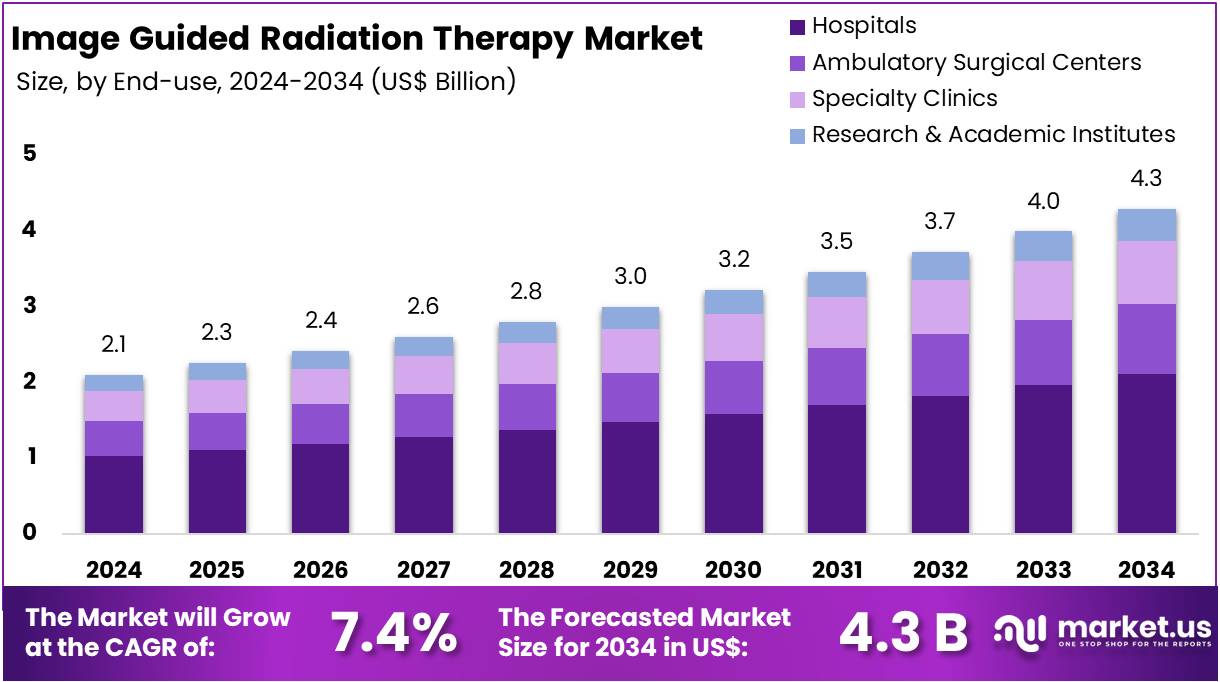
New York, NY – May 14, 2026 – The Global Image Guided Radiation Therapy Market Size is expected to be worth around US$ 4.3 Billion by 2034, from US$ 2.1 Billion in 2024, growing at a CAGR of 7.4% during the forecast period from 2025 to 2034.
Image Guided Radiation Therapy (IGRT) is an advanced form of radiation therapy that uses real-time imaging technologies to improve the precision and accuracy of cancer treatment. The technique combines imaging systems such as computed tomography (CT), magnetic resonance imaging (MRI), ultrasound, and X-rays with radiation delivery equipment to accurately target tumors while minimizing exposure to surrounding healthy tissues.
IGRT has become an essential component of modern oncology treatment due to its ability to enhance treatment outcomes and reduce side effects. The technology enables clinicians to monitor tumor position before and during radiation sessions, which is particularly beneficial for tumors that may shift due to breathing or normal body movement. This precision supports the delivery of higher radiation doses directly to cancerous cells while lowering the risk of damage to nearby organs.
The increasing prevalence of cancer worldwide, coupled with growing demand for non-invasive and highly targeted treatment options, is driving the adoption of IGRT systems across hospitals and cancer care centers. Advancements in imaging technologies, artificial intelligence integration, and adaptive radiation therapy are further contributing to market growth.
North America currently represents a leading market for IGRT, supported by advanced healthcare infrastructure and strong adoption of innovative cancer treatment technologies. Meanwhile, Asia-Pacific is expected to witness significant growth due to rising healthcare investments and increasing cancer awareness.
Key Takeaways
- The global Image Guided Radiation Therapy (IGRT) market was valued at USD 2.1 billion in 2024 and is projected to reach USD 4.3 billion by 2034, expanding at a CAGR of 7.4% during the forecast period.
- In 2024, the computed tomography (CT) segment dominated the global IGRT market, accounting for 31.2% of the overall revenue share.
- The breast cancer segment emerged as the leading application segment, contributing 31.4% of the total global market revenue in 2024.
- Based on end user, the hospitals segment held the largest market share of 44.3% in 2024.
- North America led the global IGRT market in 2024, representing more than 36.3% of the total revenue share.
Regional Analysis
North America accounted for the largest share of the global image-guided radiation therapy (IGRT) market, supported by advanced healthcare infrastructure, a high cancer prevalence rate, and the early adoption of innovative oncology technologies. The region benefits from the presence of well-established cancer treatment centers, leading medical device manufacturers, and strong investments in research and development activities.
Favorable reimbursement frameworks, government support for cancer care modernization, and advancements such as artificial intelligence integration and adaptive radiotherapy are further supporting market expansion. In addition, increasing awareness regarding precision-based cancer treatment and the availability of skilled healthcare professionals continue to strengthen regional market growth.
Asia-Pacific represented the second-largest share of the global IGRT market, driven by the growing cancer burden, improving healthcare infrastructure, and rising investments in oncology services. Countries including China, India, and Japan are experiencing increasing demand for advanced radiation therapy solutions due to the growing incidence of cancer. Expanding radiation oncology centers, increasing healthcare expenditure, and supportive government initiatives are accelerating the adoption of IGRT technologies across the region.
China remains a major contributor to regional market growth due to its large cancer patient population. Rising cancer prevalence, aging demographics, and increasing focus on advanced cancer treatment technologies continue to support IGRT market development in the country.
Emerging Trends
- Shift Toward Adaptive Radiotherapy: Adaptive radiotherapy is transforming IGRT by enabling daily treatment adjustments based on tumor movement or size changes. This approach improves radiation accuracy, protects healthy tissues, and supports personalized cancer care. Increasing adoption is expected as hospitals focus on better outcomes and reduced treatment-related side effects.
- Integration of Artificial Intelligence (AI): Artificial intelligence is improving IGRT systems through faster image analysis and more accurate treatment planning. AI detects subtle tumor changes, supports real-time monitoring, and enhances clinical decision-making. This technology increases workflow efficiency and enables smarter, more precise radiation therapy for cancer patients.
- More Use of MRI and PET in IGRT: MRI and PET imaging are increasingly integrated into IGRT to provide clearer tumor visualization and better soft tissue contrast. MRI reduces repeated radiation exposure, while PET highlights tumor activity. These advanced imaging methods improve treatment precision and reduce damage to surrounding healthy tissues.
- Increased Focus on Patient Comfort and Safety: Modern IGRT systems are designed to improve patient comfort, safety, and treatment efficiency. Faster imaging, lower radiation exposure, and flexible positioning reduce patient stress and long-term risks. These advancements are especially beneficial for elderly and pediatric patients requiring repeated radiation therapy sessions.
- Remote Planning and Cloud-Based Platforms: Cloud-based platforms are enabling remote treatment planning and real-time collaboration in IGRT. Specialists can review and adjust radiation plans from different locations, improving access to expert care. These systems also support secure data sharing, efficient workflow management, and faster treatment coordination globally.
- Rising Popularity of Proton Therapy with IGRT: The combination of proton therapy and IGRT is gaining popularity due to its high precision and reduced damage to healthy tissues. This approach is especially effective for sensitive cancers involving the brain, spine, and pediatric cases, where minimizing radiation exposure is critically important.
- Growing Use in Non-Traditional Cancer Types: IGRT applications are expanding beyond prostate and head cancers to include breast, lung, liver, pancreatic, and pediatric cancers. Its precision makes it suitable for treating moving or difficult-to-reach tumors. Ongoing research continues to broaden the use of IGRT across multiple cancer indications.
Use Cases
- Prostate Cancer Treatment: IGRT is widely used in prostate cancer treatment because the prostate can shift position daily due to bladder or bowel movement. Daily imaging helps doctors accurately target the tumor while protecting nearby organs, reducing side effects and improving overall treatment effectiveness for patients.
- Lung Cancer Management: IGRT supports accurate lung cancer treatment by tracking tumor movement caused by breathing. Real-time imaging allows radiation delivery to remain focused on the tumor despite motion. This precision reduces radiation exposure to healthy lung tissue and improves the safety and effectiveness of treatment.
- Brain and Spine Tumors: Brain and spine tumors require highly precise radiation delivery due to the sensitivity of nearby nerves and tissues. IGRT provides detailed imaging during treatment, ensuring accurate targeting of tumors while minimizing damage to healthy brain structures and the spinal cord during therapy.
- Breast Cancer Radiation Therapy: In breast cancer treatment, IGRT improves radiation accuracy and helps protect the heart and lungs from unnecessary exposure. This is particularly important for left-side breast cancers. Precise imaging ensures radiation is delivered only to affected tissues, reducing long-term complications and treatment risks.
- Pediatric Cancer Care: IGRT is highly valuable in pediatric cancer treatment because children are more sensitive to radiation exposure. Detailed imaging allows doctors to deliver lower, highly targeted doses while protecting developing organs and tissues. This reduces long-term side effects and supports healthier growth after treatment.
- Post-Surgical Tumor Site Treatment: After tumor removal surgery, IGRT helps deliver radiation precisely to the affected area to eliminate remaining cancer cells. Daily imaging accounts for body changes after surgery, improving treatment accuracy, protecting healthy tissues, and lowering the risk of cancer recurrence at the surgical site.
- Re-Treatment of Recurrent Tumors: IGRT enables safer re-treatment of recurrent tumors in areas previously exposed to radiation. Advanced imaging accurately identifies tumor position and guides precise radiation delivery. This minimizes additional damage to sensitive tissues while allowing patients to receive effective repeat radiation therapy when necessary.
Frequently Asked Questions on Image Guided Radiation Therapy
- How does Image Guided Radiation Therapy improve cancer treatment?
IGRT improves cancer treatment by enabling clinicians to monitor tumor position before and during radiation delivery. This precision allows higher radiation doses to be directed at cancer cells while reducing damage to nearby organs, ultimately improving treatment effectiveness and patient safety. - What are the major technologies used in IGRT systems?
Major technologies used in IGRT systems include computed tomography (CT), magnetic resonance imaging (MRI), ultrasound imaging, and cone-beam CT. These technologies assist healthcare professionals in accurately locating tumors and adapting radiation treatment according to patient movement or tumor changes. - What factors are driving the growth of the Image Guided Radiation Therapy market?
The growth of the IGRT market is driven by the increasing prevalence of cancer, rising demand for precision-based treatment, technological advancements in imaging systems, and growing investments in oncology infrastructure. Expanding awareness regarding non-invasive cancer therapies also supports market development. - Which region dominates the global Image Guided Radiation Therapy market?
North America currently dominates the global IGRT market due to advanced healthcare infrastructure, strong adoption of innovative oncology technologies, favorable reimbursement policies, and the presence of leading medical device manufacturers focused on radiation therapy and cancer treatment solutions. - Why is Asia-Pacific emerging as a key market for IGRT?
Asia-Pacific is emerging as a major IGRT market because of the rising cancer burden, improving healthcare infrastructure, and increasing government investments in oncology care. Growing awareness regarding advanced cancer treatments and expanding radiation therapy centers are further accelerating regional market growth. - What are the key applications of Image Guided Radiation Therapy?
IGRT is widely used for the treatment of breast cancer, lung cancer, prostate cancer, colorectal cancer, and head and neck cancers. The technology is particularly effective for tumors located near critical organs or those affected by body movement during treatment. - What is the future outlook for the Image Guided Radiation Therapy market?
The future outlook for the IGRT market remains positive, supported by continuous technological advancements, increasing cancer incidence, and rising demand for personalized treatment solutions. Integration of artificial intelligence and adaptive radiotherapy technologies is expected to create significant growth opportunities globally.
Conclusion
In conclusion, Image Guided Radiation Therapy (IGRT) has emerged as a highly advanced and effective approach in modern cancer treatment by improving radiation accuracy and minimizing damage to healthy tissues. The growing prevalence of cancer, increasing demand for precision-based therapies, and continuous advancements in imaging and artificial intelligence technologies are supporting strong market growth globally.
North America continues to lead the market due to its advanced healthcare infrastructure, while Asia-Pacific is witnessing rapid expansion driven by rising healthcare investments and cancer awareness. With expanding clinical applications and ongoing technological innovations, IGRT is expected to play a critical role in the future of personalized and targeted oncology treatment worldwide.
Discuss your needs with our analyst
Please share your requirements with more details so our analyst can check if they can solve your problem(s)




